A collector's guide to Central Mine, USA: its geology, mining history and notable minerals, illustrated with the 62 specimens documented from this locality on EarthWonders.
Key facts
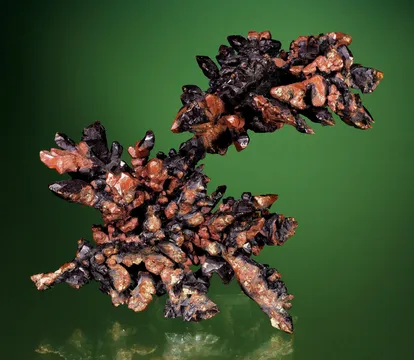
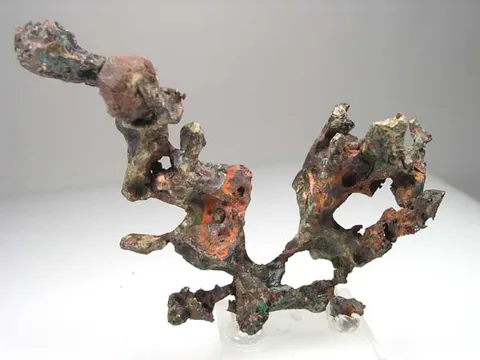
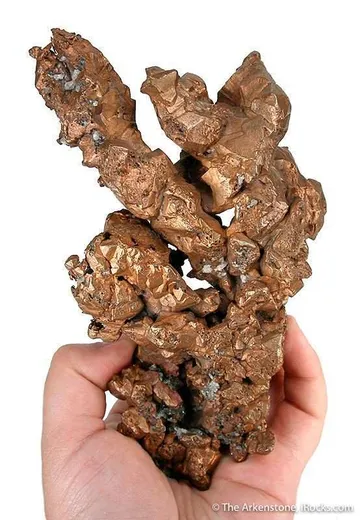
Central Mine is one of the classic names of the Lake Superior native-copper district: an early, profitable fissure-vein mine on the Keweenaw Peninsula of Michigan, set against the Greenstone bluff above the East Branch of the Eagle River. For collectors, its importance is not simply that it produced copper; it produced copper in the uncompromising old-Michigan style—blocky and arborescent native copper crystals, dodecahedral groups, hoppered cubic forms, bright to dark brown patinas, copper-included calcite, native silver with copper, and occasional cabinet pieces that have the mass and authority of ore but the aesthetics of a crystallized specimen.
Geologically, Central belongs to the Keweenaw’s Mesoproterozoic Midcontinent Rift copper system, where native copper was deposited in and around the Portage Lake Volcanics. Unlike the great stratiform amygdaloid and conglomerate lodes farther south in the district, Central was a fissure mine: its richest ground followed a steep vein cutting across the volcanic beds. That distinction matters to collectors. Fissure mines such as Central, Cliff, and Phoenix are the sources of many of the district’s most sculptural copper specimens—pieces that grew in open fractures and vugs rather than merely replacing vesicular flow tops.
Regional View
Country View
Historically, Central stands with the pioneer mines of the Keweenaw. The Central Mining Company began work in the 1850s on ground sold from the Northwestern Mining Company, and the discovery of mass copper in and around ancient workings gave the mine an unusually strong start. It became the first Keweenaw mine to make a profit in its first year of operation, later producing more than 51 million pounds of refined copper and paying substantial dividends before closing in 1898. The town that grew around it—Cornish, company-built, and perched on the hillside below the workings—became one of the best-remembered mining settlements in the Copper Country.
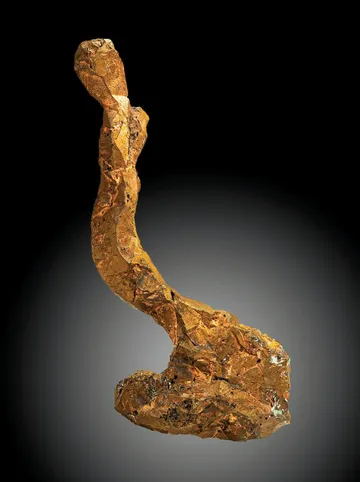
The best Central specimens have a look collectors recognize instantly: native copper crystals with a dry, old patina; sculptural branching groups with sharp terminations; compact nests of rare cubic crystals; and rosy calcite crystals translucent enough to reveal metallic copper glowing inside them. The finest pieces are not bright, scrubbed novelties. They are old survivors—specimens that escaped the smelter, stayed out of acid baths, and retained the copper-brown surface that makes Keweenaw classics feel as much historical artifact as mineral specimen.

Photo: Eric Polk, Wikimedia Commons
Search for specimens: View all specimens from Central Mine, USA
Central Mine is at Central, Houghton Township, Keweenaw County, Michigan, north of U.S. Highway 41 and west of the East Branch of the Eagle River. The historic mine and townsite lie on the eastern side of the prominent Greenstone bluff, a basaltic ridge that forms one of the defining landforms of the northern Keweenaw. The locality is part of the Portage Lake Volcanics, the volcanic package that hosts the Keweenaw native-copper district. The broader mineralizing event was hydrothermal and late Mesoproterozoic in age, depositing native copper, silver, calcite, quartz, prehnite, datolite, zeolites, and related secondary minerals in fractures, amygdules, and permeable beds.
The Central ore body was a fissure vein rather than a blanketlike amygdaloid lode. U.S. Geological Survey descriptions compiled from mine maps and L. L. Hubbard’s work record the vein as striking nearly at right angles to the beds and dipping steeply eastward in the upper workings. Near the surface, the productive portion lay close beneath the Greenstone flow; with depth it moved progressively farther from the Greenstone. The ore shoot reached its greatest extent along the fissure near the 100-fathom level, narrowed toward the 200-fathom level, expanded again, and continued downward to the Kearsarge conglomerate, where a strike fault displaced the fissure. Below that fault, the continuation of the vein was found to be wide but comparatively poor in copper. This structural history explains the mine’s strong early returns and its eventual decline: the richest fissure ground was real and spectacular, but it was not endless.
The workings were opened where outcrops and ancient pits exposed the fissure roughly 600 feet south of the Greenstone bluff. In the summer of 1855, men working under John Robinson deepened the ancient pit and found mass copper. A second shaft was started about 200 feet uphill to the north, and the first year’s production—83,836 pounds of copper—was hauled by wagon to Eagle Harbor for shipment down the Great Lakes. By 1859 the mine had four shafts stepping up the hill. By the mid-1860s it employed hundreds of men, many of them Cornish miners known in the district as “Cousin Jacks.”
The Central Mining Company worked the mine from its opening in 1854 until closure in 1898. Contemporary and later geological summaries give total production as 51,875,527 pounds of copper, with about $2,130,000 in dividends. The mine’s strongest years came while large masses and rich fissure ground were still being found. In 1882 Central produced a record 2,512,886 pounds of copper, yet costs were already eroding profits; only $40,000 was paid in dividends that year. Mechanical improvements followed, including power drills, a Rand compressor, and a second man engine at the No. 2 shaft, but the deepening fissure yielded fewer of the great masses that had made the mine profitable. Work was suspended on August 1, 1894, reduced exploration continued for several years, and the mine closed on July 20, 1898. The stamp mill finished the rock on hand on August 6, 1898. Calumet & Hecla acquired the property in 1905 but did not reopen it.
For mineral collectors, Central remained productive after mining ended because its poor-rock piles were large, copper-rich enough to reward patient searching, and periodically refreshed by weathering or disturbance. Modern finds from the dumps include crystallized copper, shot copper, copper in calcite, prehnite with copper, and rare silver-copper pieces. Serious collecting today is governed by access and safety. Public tourism sources currently identify Central and Cliff as the only mine tailing piles in the Keweenaw generally accessible and legal to pick, with the important limitation that visitors at Central are welcome only when the gates are closed and no work is being done on site. During Keweenaw Mineral Days, selected piles may be rotated or “flipped” for surface collecting, including Central in some years. Most other mine sites in the region are private property, and old dumps and mine openings pose real hazards: unstable rock, buried metal, hidden voids, and steep loose slopes.

Central Mine copper ranges from small dump pieces and “shot copper” to historically mined masses, but the locality’s collecting prestige rests on crystallized native copper. Fine specimens occur as vug-grown groups with dodecahedral to complex modified forms, arborescent and herringbone branches, plates, and rare sharp cubic or hoppered cubic crystals. Color is critical: the best Central pieces retain a stable reddish-brown to chocolate-brown natural patina, sometimes with small areas of brighter copper on protected edges, while overcleaned examples lose much of their historical character. Associated minerals include calcite, quartz, prehnite, datolite, tenorite, and native silver; the copper-in-calcite pieces, when transparent and rosy, form a distinct Central sub-class. Thumbnail to miniature crystals from the dumps are still possible, but matrix-supported, undamaged, old-patina cabinet specimens from the 19th-century workings are scarce, and large museum-scale pieces with documented provenance rank among the major American copper classics.
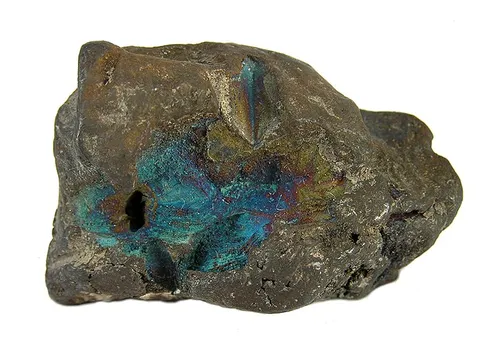
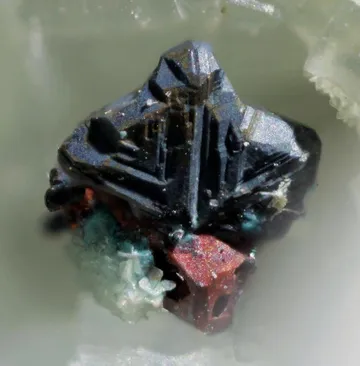
Other documented Central minerals include native silver, cuprite, tenorite, hematite, ilmenite, quartz, manganite, calcite, possible rhodochrosite, azurite, malachite, datolite, prehnite, albite, and related Keweenaw gangue minerals. Native silver is the most important accessory native element and occurs with copper in silver-copper “halfbreed” style masses and specimens. Calcite is especially collectible where it encloses copper as metallic orange to pinkish internal color, and Central examples can be unusually transparent and aesthetic. Datolite and prehnite are less abundant as market specimens than copper, but they are meaningful locality minerals; green botryoidal prehnite and rare prehnite-copper-calcite combinations are documented, and Central datolite belongs to the same boron-bearing hydrothermal assemblage that makes the Keweenaw famous among Midwest collectors. Manganite is a notable micromineral rarity from Central, with recent symposium abstracts singling out attractive crystals from the mine.
Central Mine pieces should be judged first on locality confidence. The northern Keweenaw fissure mines—Central, Cliff, Phoenix, Copper Falls, Northwestern, and nearby prospects—produced broadly similar copper, calcite, prehnite, and silver-copper specimens, and old labels are sometimes generalized to “Lake Superior,” “Keweenaw,” or simply “Michigan copper.” A Central label is strongest when supported by an old collection tag, museum accession history, documented dealer provenance, or a specimen style consistent with known Central material. Be especially cautious with unprovenanced “Central” labels on generic float copper, polished copper-in-matrix slices, or attractive copper crystals that could just as easily have come from another Keweenaw fissure locality.
The most common condition issue is cleaning. Native copper is soft, and its patina is part of both its aesthetics and its evidence of age. Acid-brightened pieces, wire-brushed surfaces, lacquered ore slices, and artificially polished faces are common in the broader Michigan copper trade. Such treatments are not always deceptive—many tourist pieces are openly sold that way—but they are not equivalent to an old undamaged crystallized specimen. On fine Central copper, look under magnification for rounded crystal edges, scratchy brush marks, unnatural orange brightness in recesses, glue repairs, and modern trimming that exposes raw copper where an old surface should continue.
Copper-in-calcite requires different handling. Calcite is softer than copper, cleaves readily, and is vulnerable to acid. The best examples have transparent to translucent calcite with visible internal copper, but they often show cleavage bruises, contacted backs, or small chips on terminations. Avoid soaking these pieces in acidic cleaners, and keep them away from environments that encourage copper salts to bloom. Any green or blue secondary coatings should be assessed carefully: some malachite or azurite is natural, but loose powdery alteration on copper can indicate unstable surface corrosion or past chemical treatment.
No widely documented class of fabricated Central Mine fakes dominates the literature, but mislabeling and enhancement are persistent risks. The market contains a wide spectrum: inexpensive dump copper, attractive miniatures still found by detectorists, old-time cabinet pieces, and rare museum-level specimens with six-figure presence. True crystallized Central copper with old patina, sharp form, and secure provenance is much less available than the number of “Michigan copper” specimens on the market might suggest. Native silver from Central is rarer still, especially in attractive association rather than as a small metallic bleb.
Central began, like several great Keweenaw mines, with older evidence underfoot. In 1854 the Northwestern Mining Company sold 320 acres to the newly organized Central Mining Company, and the ground already contained an ancient pit. In the Keweenaw, that mattered: prehistoric copper workings were more than archaeological traces; to 19th-century prospectors they were practical clues. The first Central miners reopened the pit, exposed copper-bearing trap rock, and found the kind of nearly pure mass copper that could make a fissure mine profitable. In its first year, the mine shipped 83,836 pounds of copper by wagon to Eagle Harbor, where the metal went “below”—down the Great Lakes toward the industrial world that would smelt and use it.
The town rose with the mine. In 1855, Central had not yet built houses of its own, so its 26 miners and 20 surface workers lived at the neighboring Winthrop and Northwestern locations. By 1864, the mine employed 240 men: 146 miners, 28 mechanics and engineers, and 64 laborers. By 1870, the village population was about 950; later accounts place the peak above 1,200 people in 130 homes. Cornish speech was so common that a visitor from elsewhere in America might have wished for an interpreter. The 1883 county history describes a three-story schoolhouse, forty by seventy feet, standing high on the Greenstone bluff; it had four lower-floor classrooms and an upper hall, with three teachers paid a total of $191.61 per month. The company store carried an average stock valued at $30,000, and the livery could shelter more than 100 horses.
The most vivid domestic picture comes from Alfred Nicholls, a Central miner injured in an accident who later became a teacher and principal at the Central school. He remembered the settlement not as a romantic ruin but as a self-contained human place, “a little world of its own.” His description of a miner’s home is exact enough to smell the stove polish: bare scrubbed kitchen floor, whitewashed walls, homemade furniture, a black shining cook stove, cane-seated chairs in the “front room,” and a wood rocking chair with a chicken-feather cushion. That chair, Nicholls recalled, was for company and convalescence, not daily idleness; if a wife used it too freely, the neighbors read it as a sign that the household work was being neglected.
Winter gave the place its hard edge. Houses at Central were not insulated. Bedrooms could be so cold that residents poured sawdust over windows and boarded them up against the season. Supplies came by boat, and when Lake Superior froze the community had to live on what had already arrived. In November 1860, the Eagle Harbor wharf used by the company burned, destroying winter food and materials. Replacement supplies were shipped in, only for the vessel to be caught in a storm and forced to throw much of its cargo overboard to avoid sinking. The alternative road to the larger settlement at Calumet was not a quick errand but an overnight stagecoach trip over rough country.
Then came April 22, 1872. Thirteen men were riding the skip car down the No. 2 shaft when the wire rope failed. Ten died. Most were Cornish, and the news traveled back across the Atlantic into Cornish newspapers and verse. The poem “Sad News From Central Mine” opened with the blunt refrain:
Sad news from across the ocean we hear,
Sad news from the Central Mine,
The loss pierced the fiction that Central was simply a temporary workplace. Many Cornish miners still thought of home as Cornwall, with Michigan a “foreign land” where they might earn money and eventually leave. The poem named the dead and their home places, pulling the disaster back across the ocean to the wives, children, parents, and chapels that had sent men into the Keweenaw copper rush.
Central’s last act as a living mine was quieter. The great masses became fewer. Production declined. New drills and compressors could make labor more efficient, but they could not create a new ore shoot. In 1892, Michigan’s Commissioner of Mineral Statistics, James P. Edwards, called Central “The Last of the Mohicans,” meaning the last remaining fissure mine in the state. Work was suspended in 1894, the mine closed in 1898, the pumps stopped, and water rose through workings that had once yielded fortunes in native copper.
Yet Central did not vanish. In 1907, former residents returned for a reunion at the Methodist church, built in 1868 for the Cornish mining community. The reunion became annual, centered on a Sunday service, and the church has been brought back to life one day a year ever since. The building had been more than a chapel: it held Sunday school, a lending library, school programs, Fourth of July events, and Christmas parties with presents for children. Long after the mine closed, descendants kept returning because the church remained the most tangible connection to the people who had lived, worked, married, mourned, and scattered from the hillside town.