






A collector's guide to Copper Falls Mine, USA: its geology, mining history and notable minerals, illustrated with the 106 specimens documented from this locality on EarthWonders.
Key facts
Copper Falls is one of the classic names of the Keweenaw fissure-vein country: a mine group south of Eagle Harbor, Michigan, where native copper was won from steep crosscutting veins and from the Ashbed amygdaloid, an oxidized fragmental basalt flow top of the Portage Lake volcanic pile. To collectors, its importance is not measured only in tons. Copper Falls belongs with Cliff, Central, and Phoenix in the small fraternity of Keweenaw County fissure mines that produced sharply crystallized native copper and native silver before the great bedded lode mines farther south came to dominate the district.
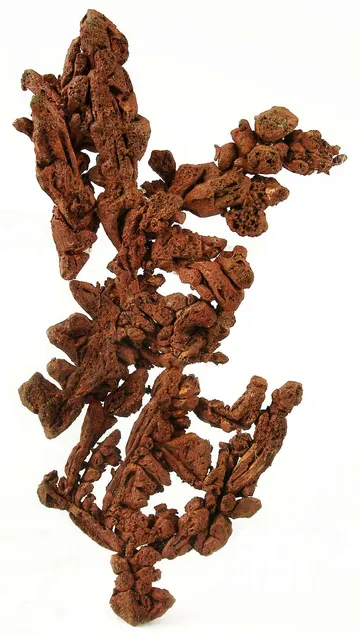
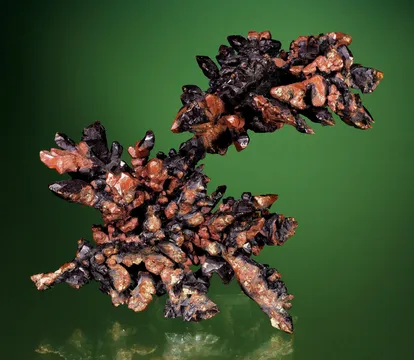
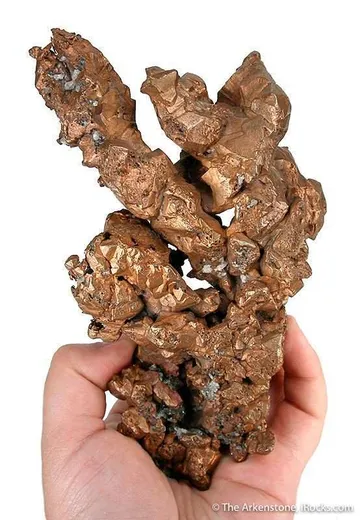
The best Copper Falls specimens have the look serious Copper Country collectors prize: old reddish to warm brown copper, often with cuprite or darker oxide patina, forming sculptural crystal groups rather than mere hackly mass copper. Dodecahedral copper groups are the classic habit, with octahedral and less common cubic expressions, and historic accounts singled the mine out for crystals from a few millimeters to about 2.5 cm. The associated suite is equally Keweenawan but distinctly fissure-vein in flavor: silver, calcite, prehnite, analcime, datolite, natrolite, quartz, epidote, pumpellyite, and apophyllite-group minerals, with several notable specimen horizons tied to the Owl Creek fissure, Gribble vein, Petherick workings, and the small “Silver Pit” surface find north of the Petherick vein.
Regional View
Country View
The locality lies in rugged ground near Owl Creek, about 4 km southwest of Eagle Harbor, where ridges rise more than 200 meters above Lake Superior and old dumps now stand in for vanished surface plant. The name itself is literal: copper showings were found in a waterfall on Owl Creek, and that small, mineralized fall gave the mine its enduring identity.

Photo: Rob Lavinsky, iRocks.com / Wikimedia Commons

Photo: Rob Lavinsky, iRocks.com / Wikimedia Commons
Search for specimens: View all specimens from Copper Falls Mine, USA
Copper Falls is best understood as a mine group rather than a single simple shaft. The historically important ground includes the Copper Falls fissure workings, the Owl Creek fissure, the Gribble vein, the Ashbed amygdaloid, nearby Petherick workings, and associated prospect pits that collectors have long grouped under the Copper Falls name. The main locality is in Eagle Harbor Township, Keweenaw County, in the northern part of Michigan’s Lake Superior native copper district.
The deposit belongs to the Keweenaw native copper system, where low-temperature hydrothermal fluids moved through fractured and permeable volcanic rocks of the Midcontinent Rift. In the Copper Falls area those fluids deposited native copper in fissure veins and in the porous upper zones of basalt flows. The Ashbed lode was a fragmental to scoriaceous amygdaloid, locally sandy and well oxidized, and USGS descriptions note that at Copper Falls the upper part of the lode carried more copper than deeper portions, with some copper also present in the basal amygdaloid of the overlying flow. The more abundant gangue and alteration minerals recorded from the mine include calcite, quartz, epidote, and pumpellyite, while datolite is especially associated with fissure-adjacent zones.
Ore shoots were not evenly distributed. The mine’s richest early production came from fissure veins, above all the Owl Creek fissure, and late nineteenth-century descriptions recalled stretches where the vein was almost solid copper through several levels. The Ashbed was developed to about 1,500 feet in depth by 1891, with workings extending roughly 1,000 feet east and 1,400 feet west from the Owl Creek fissure; stoped widths varied but averaged about 6 to 8 feet, and historical estimates placed the lode at roughly 10 to 12 feet thick with about 1 percent copper in some reports. The Gribble vein is known to collectors largely through underground specimen finds; Mindat notes that it does not crop out at the surface and was accessible only through the Owl Creek Fissure Mine workings.
Mining began in the great first wave of Keweenaw copper development. The property was originally leased by David Henshaw in 1843, with the first copper-bearing discovery in the waterfall on Owl Creek in 1843 or 1844. Copper Falls opened in 1845 and became one of the district’s earliest industrial copper mines. It was never the most profitable of the Keweenaw mines, but its stubborn, intermittent life was long: the old Copper Falls mine was worked into the 1890s, the Arnold-associated operations continued around the turn of the century, and historical summaries place the broader operation from 1845 to 1901. Arnold Mining Company records state that Arnold was incorporated in 1864, that the old Copper Falls and Arnold properties were consolidated in January 1898, and that the company controlled about 3,323 acres.
Production was respectable even if profit was elusive. Contemporary state reports credit the Copper Falls property with 12,843 tons and 429 pounds of copper product, equivalent to more than 25 million pounds, and only $100,000 in dividends. Silver production is much harder to track because native silver was inconsistently reported and, historically, not always delivered to company accounts. Mineralogical summaries credit Copper Falls with about 30,000 ounces of silver, mostly from the fissure veins, with the Owl Creek fissure the leading producer.
Collectors should separate three kinds of Copper Falls material. First are the old mine specimens recovered by miners during the operating years: crystallized copper, silver, calcite, analcime, apophyllite, and associated minerals that entered major public and private collections. Second are underground collector finds from accessible upper workings before the modern sealing of old shafts and adits, including the Gribble vein specimens recovered in the late twentieth century. Third are surface and dump finds from the mine area and adjacent prospects, including the 1980 “Silver Pit” find north of the Petherick vein that produced a small number of excellent silver-on-prehnite specimens.
Access today is limited by ownership, safety, and closure of underground workings. No serious collector should attempt to enter old Copper Falls workings; the abandoned shafts and adits have been sealed, and even historically “dry” levels are still old mine workings with all the usual collapse, oxygen, and vertical-opening hazards. Dump collecting in the Copper Falls area has been popular, but legal access depends on current land status and permission. For modern field work, the safest collecting goal is modest dump material—small copper, datolite, analcime, natrolite, quartz, and prehnite—rather than the old underground pockets that made the mine famous.
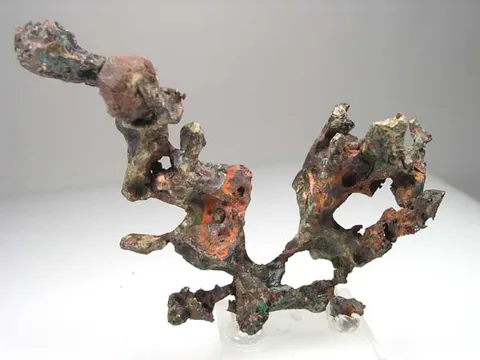
Copper is the signature species from Copper Falls and the reason the mine’s name carries weight among advanced Keweenaw collectors. The classic crystals are native copper in dodecahedral groups, with octahedral forms also recorded and scarce cubic habits prized when the label is secure; sizes range from tiny sharp crystals to groups with individual crystals around 2.5 cm, while display specimens may reach large miniature to cabinet size. Historic examples show warm brown, brick-red, or blackish patina from cuprite and tenorite, sometimes with quartz, calcite, malachite, prehnite, pumpellyite, or basaltic matrix. Especially desirable pieces are sharp, three-dimensional crystal groups from the fissure veins—particularly old-time Owl Creek or Gribble vein material—where form, patina, and documented provenance distinguish a true Copper Falls specimen from ordinary massive or cleaned Keweenaw copper.
Silver from Copper Falls is scarcer than copper and has special status because the mine yielded both historic fissure-vein silver and the small modern “Silver Pit” surface find north of the Petherick vein. The most distinctive specimens from that 1980 find are bright to lightly tarnished cubic and skeletal cubic silver crystals, commonly only millimeters across but visually crisp, perched on pale to greenish vuggy prehnite with minor analcime and chalky white datolite. Copper Falls silver can also occur with copper in classic Keweenaw intergrowths and as delicate crystal groups from fissure material recovered around 1982 by Don Pearce of Calumet. The best pieces here are not large by world silver standards; they are judged by sharp cubic habit, lack of abrasion, clean contrast on prehnite, and an old or find-specific label separating them from more common district-wide native silver.
Calcite from Copper Falls ranges from gangue and cleavable masses to genuine museum-quality crystals, and the Gribble vein is the essential name for the best documented crystal habit. The 4th level of the Gribble vein produced opaque white, sometimes twinned pseudocubic calcite crystals, and other Copper Falls calcites are known with copper inclusions or dark inclusions giving gray to black tones. Foster and Whitney noted copper-included calcite from the mine as early as 1850, placing Copper Falls within the broader Keweenaw tradition of copper-bearing calcite, though it is more selective and less abundant than the most celebrated district calcite localities. Strong specimens show complete pseudocubic or twinned forms, clean faces, good contrast against carbonate or copper-bearing matrix, and a secure Gribble or Copper Falls label.
Prehnite at Copper Falls is most important as a matrix and pocket mineral in the fissure and flow-top environment rather than as large isolated display crystals. It occurs as amygdule filling in the bed of Owl Creek below the Owl Creek fissure and, most famously for collectors, in the “Silver Pit” north of the Petherick vein, where vuggy prehnite hosted analcime, datolite, copper, and small superb silver crystals. Colour is generally pale green to whitish or gray-green, with botryoidal, fibrous, compact, or vug-lining textures typical of Keweenaw prehnite. Fine Copper Falls prehnite specimens are those that provide an attractive, undamaged, vuggy matrix for silver or copper, or that show crisp open cavities with associated analcime and datolite rather than nondescript massive green filling.
Analcime from Copper Falls is a serious locality species, known as colorless to white trapezohedrons, fine reddish crystals associated with natrolite, etched crystals from Petherick vein outcrops and trenches, and red granular to radially fibrous material from the old Copper Falls vein. Mineralogical summaries note crystals as large as about 2.5 cm in the Copper Falls–Northwestern occurrence, rare pseudomorphs after feldspar to about 1 cm, and Copper Falls veins where analcime is later replaced by prehnite and calcite. In the 2023 Mineralogical Record treatment, a 10 cm specimen of hematite-red analcime from Copper Falls in the A. E. Seaman Mineral Museum collection is illustrated, and analcime with native copper inclusions is noted from early reports. The best pieces show sharp trapezohedral form, red hematite coloration or clean white lustre, association with natrolite, copper, or prehnite, and enough label detail to distinguish Copper Falls from visually similar Arnold, Phoenix, and other Ashbed lode material.
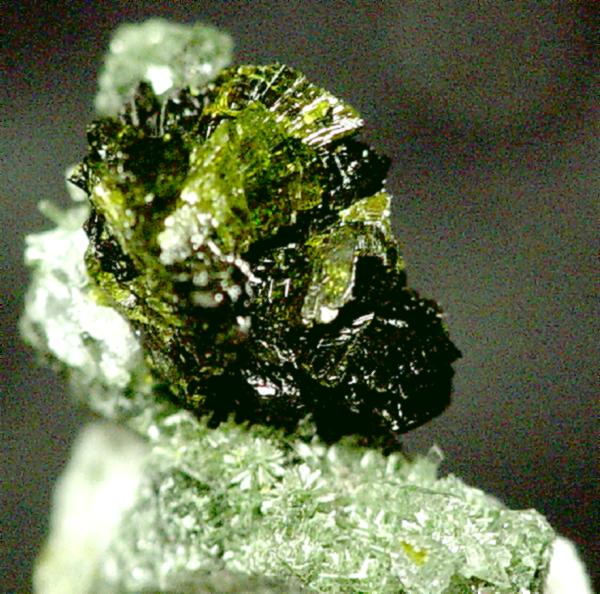
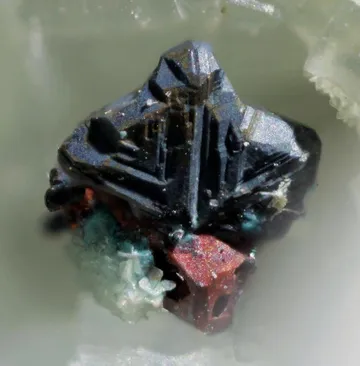
Other documented Copper Falls minerals include datolite, natrolite, quartz, epidote, pumpellyite-(Mg), apophyllite-group minerals, adularia, saponite, chlorite-group minerals, and minor oxidation products on copper. Datolite is especially characteristic near the fissures and in the Silver Pit association; natrolite is a useful associate for reddish analcime; and apophyllite from Copper Falls is represented by old museum specimens, including material formerly in the Clarence Bement collection. Pumpellyite is historically important in the Keweenaw: Copper Falls produced classic green pumpellyite-(Mg) with quartz, and Charles Palache’s early twentieth-century Keweenaw work helped popularize the name “pumpellyite,” though the mineral had already been described elsewhere under the name “lotrite.”
For Copper Falls, provenance is the first authenticity issue. The mine belongs to a crowded belt of visually similar Keweenaw fissure and Ashbed localities—Copper Falls, Arnold, Petherick, Owl Creek, Gribble, Phoenix, Central, Northwestern—and old labels are often shortened, recopied, or lost. A specimen labeled simply “Copper Falls” may be perfectly legitimate, but a premium Gribble vein, Silver Pit, Petherick, or Owl Creek attribution should be backed by an old label, collection history, or a credible find record. The problem is not merely academic: a cubic copper from the Gribble vein, a 1980 silver-on-prehnite from the Silver Pit, or a red analcime from the old Copper Falls vein carries more collector meaning than an undifferentiated Keweenaw copper.
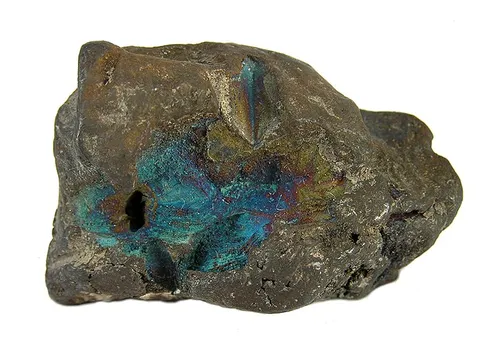
Cleaning and surface presentation matter. Old Copper Falls copper may show natural cuprite-red, brown, or black patina with minor green malachite or chrysocolla in protected areas. Aggressive acid cleaning, polishing, lacquering, or wire-brushing can make a specimen brighter but often removes the very surface evidence that gives Keweenaw copper its age and character. Be cautious of unusually shiny pieces sold as old-time Copper Falls unless the form and label are compelling. Conversely, dark or red patina is not automatically damage; on Copper Falls material it can be part of the classic appearance.
Condition varies by species. Native copper is tough but easily bent, clipped, or bruised along protruding arms and crystal edges; many specimens were extracted from hard basalt and may show saw cuts, chisel marks, or repaired joins. Silver crystals, especially the delicate cubic and skeletal forms on prehnite, are far less forgiving: tiny crystals can be rubbed off by careless wrapping, and silver may darken with normal sulfide tarnish. Calcite, prehnite, analcime, and natrolite should be kept away from vibration and hard cleaning; calcite is acid sensitive, and zeolite-rich matrices can shed small crystals if scrubbed.
Market availability is uneven. Massive or hackly Keweenaw copper with a Copper Falls label appears occasionally, but fine crystallized Copper Falls copper, credible silver-on-prehnite from the 1980 Silver Pit find, sharp Gribble vein calcite, and good red analcime are all much less common. The strongest specimens tend to be old collection pieces: ex-museum, ex-Seaman-associated, ex-Bement, ex-Hubbard, ex-Roebling, ex-Hauck, or with documented modern collector provenance. For advanced buyers, the best value is often in label quality and mineralogical specificity rather than sheer size.
Copper Falls began, as many Keweenaw mines did, with a convergence of ancient work and nineteenth-century ambition. Explorers in the 1840s found Native American hammerstones and mining implements in the vicinity, signs that copper had drawn people to the ground long before company charters and Boston investors. Then came the small creek, the waterfall, and the metallic showings that made the name inevitable. A copper-bearing discovery in the falls on Owl Creek in 1843 or 1844 led to the Copper Falls enterprise, and by 1845 the mine had joined the first industrial rush into the Lake Superior native copper country.
The old accounts are full of the peculiar psychology of Copper Falls: always promising, rarely profitable, impossible to abandon. Later writers noted that it produced more than 25 million pounds of copper but never repaid its initial investment. That imbalance—spectacular mineral, disappointing balance sheet—helped create the collector legacy. A mine that runs for decades despite poor profits gives miners, captains, and later collectors many chances to see open cavities, rich streaks, and crystal-lined pockets that a shorter-lived operation would have left behind.
One nineteenth-century mining report preserves the sense of wonder the old mine inspired underground. Reliable miners who had worked across the Lake Superior district said they had seen more copper at one time in the Copper Falls mine than in any other mine they knew. Through several levels, the vein was remembered as “almost solid copper.” The same account states that Copper Falls yielded a good deal of native silver in its best days, including occasional large masses, and that some of the most beautiful crystallized copper and crystallized silver seen by the writer had come from this mine.
Silver added a human complication. The official story of any copper mine is measured in production, dividends, and hoisted tons; the underground story is often measured in pockets quietly emptied. The 1891 report says that, especially in the early days, silver discovered in mines was often appropriated by the miners. When a “vug” or silver deposit was found, men might conceal it until they could remove the metal and sell it to dealers who were ready buyers. The report gives a Cliff mine example—four men securing $800 worth of silver at one time—but the passage is framed by Copper Falls’ own silver richness, and it helps explain why the mine’s recorded silver totals can never tell the full mineralogical story.
The twentieth century added a different kind of collecting chapter. The high elevation of Copper Falls left upper workings comparatively dry, and before recent sealing of shafts and adits, determined collectors could enter parts of the old mine. That access produced important modern specimens from underground zones such as the Gribble vein. One 9 cm copper crystal specimen from the Gribble vein, 4th level, was collected in 1982 by Ross Lillie and Bob Barron. Another Copper Falls cubic copper, collected in 1994 from the 3rd level of the Gribble vein, has been described as perhaps the finest cubic copper crystal recovered in the Copper Country in modern times.
The most focused modern silver story is the 1980 surface discovery north of the Petherick vein. A prospector using a metal detector located what was first thought of as a small silver vein. Mineralogically, it proved to be a mineralized basalt flow top: vuggy prehnite with minor analcime and chalky white datolite. It did not produce quantities, but what it did produce was memorable—small, superb groups of cubic silver crystals, some skeletal, perched on prehnite. For collectors of Keweenaw silver, those pieces occupy a special niche: not imposing by size, but sharply crystallized, find-specific, and instantly recognizable when the label is right.


-Quartz-21371.jpg)