Lake Superior Mine, USA locality guide: native copper and silver from Keweenaw fissure veins, famed arborescent copper forms and rare minerals.
Key facts
Lake Superior Mine is the early name attached to one of the most storied native-metal occurrences in the northern Keweenaw: the old Phoenix fissure system near Phoenix, Houghton Township, Keweenaw County, Michigan. In collector terms it sits at the intersection of two reputations. Historically, it belongs to the first wave of Lake Superior copper mining, when companies rushed into the wild basalt ridge country south of Lake Superior in the 1840s. Mineralogically, it belongs to the fissure-vein tradition of the Keweenaw, where copper and silver were not disseminated sulphide ores in the ordinary Western-mining sense, but native metals deposited in open spaces, fractures, and altered basalt by low-temperature hydrothermal fluids.
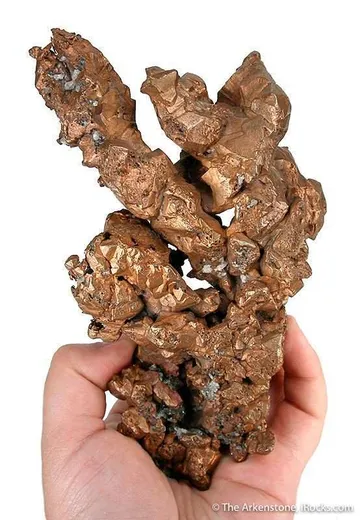
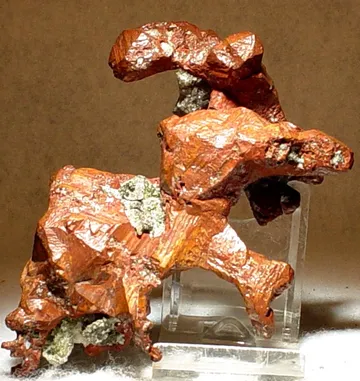
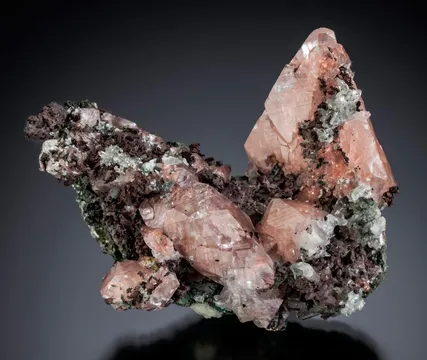
The mine matters because it is part of the Phoenix story before “Phoenix” became the better-known name. The Lake Superior workings were taken over and renamed Phoenix in 1849, and the larger Phoenix mine became one of the great specimen localities of the Michigan Copper Country: native copper in arborescent, crystallized, spinel-twinned, branching, flattened, and sculptural forms; native silver in rare copper-associated groups; and a supporting cast of prehnite, calcite, quartz, datolite, analcime, laumontite, K-feldspar, malachite, and other Keweenaw secondary and gangue minerals. The best specimens have the dense visual language collectors want from a fissure mine: reddish copper against pale green prehnite or white calcite, silver-white native silver set into or over copper, and rugged dark basaltic matrix that makes the metallic growth stand forward rather than disappear.
Regional View
Country View
Geologically, Lake Superior Mine belongs to the Mesoproterozoic Midcontinent Rift copper province, the same immense volcanic-sedimentary system that made the Keweenaw famous. The mine worked fissure mineralization near the base of the greenstone bluff, the long basalt escarpment that forms the backbone of the northern Keweenaw. Unlike the huge later amygdaloid and conglomerate lodes farther south, these early fissure mines were narrow, structurally controlled, locally rich, and disproportionately important for specimens. They did not dominate the district’s production totals, but they produced the kind of crystallized copper and copper-silver pieces that still define old Michigan native-metal collecting.

Photo: Fabre Minerals
Search for specimens: View all specimens from Lake Superior Mine, USA
Lake Superior Mine is the early Lake Superior/Phoenix fissure locality near Phoenix, in northern Keweenaw County, Michigan, close to the junction of US 41 and M-26 and a few kilometers southwest of Eagle River. The district lies in the Lake Superior native copper belt, where 1.1-billion-year-old rift-related basalts, interflow conglomerates, and related sedimentary rocks were fractured, altered, and mineralized by copper-bearing fluids. In the northern Keweenaw, fissure veins were especially important: steep or irregular copper-bearing openings cutting the volcanic pile, commonly associated with epidote-prehnite alteration, calcite, quartz, zeolites, and native copper.
The original Lake Superior workings were opened in 1844 by the Bay State Mining Company, which sank shallow shafts on an outcropping fissure vein. In 1849 the operation was reorganized under the Phoenix name, and the Phoenix mine worked with few interruptions until June 1905. The broader Phoenix mine was not a single simple hole in the ground but a group of veins and workings, including the Robbins or West vein, Phoenix vein, St. Clair vein, and Babbitt vein, along with related prospects in the Phoenix area. Production credited to the Phoenix operation totaled more than 16.6 million pounds of copper and about 25,000 ounces of silver, modest beside the great amygdaloid and conglomerate producers but immense in specimen significance.
The ore bodies were not large porphyry-style systems or massive sulphide lenses. They were copper-bearing fissures and associated mineralized openings in basalt, where native copper occurred as masses, sheets, branches, wires, flattened crystals, crystal groups, and fracture fillings. Silver was present in far smaller quantity but achieved outsized collector importance when it appeared as visible native silver intergrown with copper or perched on copper. The visual distinction between the Lake Superior/Phoenix fissure material and later mass-production lode material is important: good pieces tend to be more sculptural, more open, and more specimen-like than ordinary copper-bearing rock.
The historical Lake Superior period belongs to the feverish first decade of Michigan copper mining. In the mid-1840s the Lake Superior Company’s Eagle River works were already being described as substantial: about 120 men, hundreds of tons of ore ready for stamping, and a water-powered crushing machine capable of treating about ten tons of rock per day. A contemporary description noted a principal shaft 70 feet deep in an approximately 11-foot vein or dyke, with one side carrying enough native silver to be economically interesting even without the copper. That sentence explains why early Lake Superior/Phoenix specimens can carry a special aura: for a brief moment, the young copper district seemed also to promise a native-silver bonanza.
The mine’s later identity as Phoenix is inseparable from its specimen record. The Phoenix mine became famous for native copper and associated minerals, particularly crystallized copper, silver, analcime, calcite, and prehnite-bearing material. Analcime from Phoenix is especially well known in the literature; some Phoenix analcime crystals show distinctive epitaxial overgrowths, and amber-colored pseudocubic calcite crystals from the West vein have been regarded as a distinctive find. While those features are normally discussed under the Phoenix name, the old Lake Superior fissure is part of the same early mine history and collector geography.
Collecting access today must be approached conservatively. The Keweenaw is full of old mine lands, abandoned shafts, unstable dumps, private parcels, historical resources, and places where casual collecting has become inappropriate or illegal. The Lake Superior/Phoenix area should be treated as private or restricted unless the collector has current, explicit permission from the landowner and understands exactly where legal collecting is allowed. No old shaft, adit, caved stope, ruin, or underground opening is a collecting opportunity. Specimens now circulating most often come from old collections, historic dealer inventories, past dump collecting, or material absorbed into the broader Phoenix/Lake Superior specimen stream.
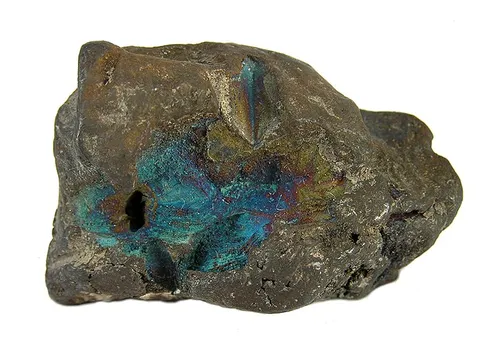
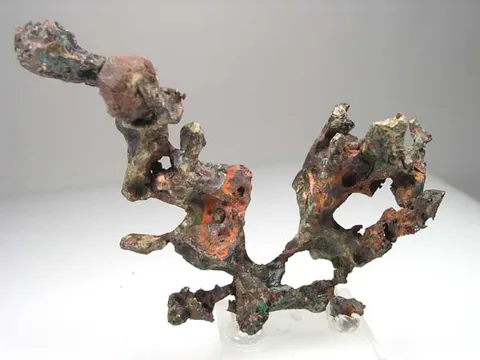
Copper from Lake Superior Mine is classic Keweenaw fissure-vein native copper: reddish to brownish metallic Cu, commonly oxidized to darker tenorite or locally green malachite on exposed surfaces, and prized when it shows open branching, arborescent growth, distorted crystals, spinel twinning, sheets, or sculptural masses rather than shapeless copper-bearing rock. The best Lake Superior/Phoenix pieces are small-cabinet to miniature specimens with visible crystal architecture, clean separation from basalt or prehnite-rich matrix, and enough natural patina to read as old Michigan copper without looking polished or chemically stripped. Ordinary pieces may simply show massive copper in dark matrix; better pieces show three-dimensional copper, contrasting gangue, and the rugged fissure-vein character that links them to the early Phoenix system rather than to a generic “Lake Superior copper” label.
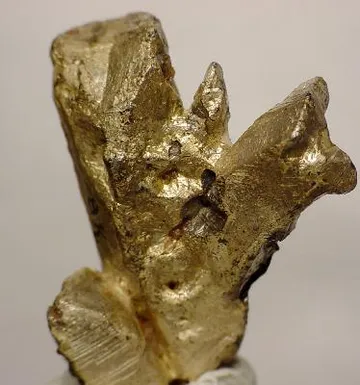
Silver from Lake Superior Mine is much scarcer than copper and is most desirable when it remains visibly intergrown with or perched on native copper. Documented collector material includes small silver-copper “halfbreed” specimens with polycrystalline silver, discernible crystal faces, and arborescent copper, typically in miniature sizes rather than large cabinet pieces. The color contrast is central to the appeal: pale silver-white to gray Ag against red-brown Cu, sometimes with dark matrix or pale gangue. Fine pieces are judged by natural metal relationships, visible crystallization, and believable old provenance; rounded, smeared, polished, or nugget-like masses are less desirable unless clearly understood as historical mill or float material rather than natural crystal growth.
Other minerals documented from the Lake Superior/Phoenix mine environment include calcite, prehnite, quartz, datolite, analcime, laumontite, K-feldspar including adularia, and malachite; the broader Phoenix mine also has records of ankerite, atacamite, babingtonite, baryte, chrysocolla, cuprite, dolomite, domeykite, epidote, fluorapophyllite-(K), hematite, microcline, natrolite, pumpellyite-(Mg), chlorastrolite, stilbite subgroup minerals, and tenorite. No accepted type-locality mineral is tied specifically to Lake Superior Mine, but the Phoenix-area analcime suite is a serious collector note: colorless to pink trapezohedra, copper-included examples, and epitaxial analcime overgrowths have made the Phoenix name important beyond native copper alone.
The most important authenticity issue is locality precision. “Lake Superior Mine” can be confused with the broader Lake Superior copper district, the Phoenix mine as a successor name, the separate Superior mine in Houghton County, Ontonagon County localities, and the unrelated Lake Superior and Arizona Mine in Pinal County, Arizona. A good label should say Lake Superior Mine, Old Phoenix Fissure, Phoenix, Houghton Township, Keweenaw County, Michigan, or give a clearly equivalent historical wording. If a specimen is simply labeled “Lake Superior,” it may refer only to the district or the lake region, not this mine.
Copper-silver “halfbreed” specimens need special care. Natural copper-silver intergrowths exist in the Michigan native copper district, but many rounded halfbreeds in commerce are products of stamp-mill processing, where copper and silver were mechanically crushed, flattened, and pressed together. Such pieces can be historic and attractive, but they are not the same as natural crystallized silver on copper. For Lake Superior Mine, the most convincing specimens show natural crystal texture, undisturbed contacts, compatible patina, and an old label. Suspiciously bright silver patches, solder-like joins, plated surfaces, or unnaturally polished metal should be examined carefully.
Condition problems are typical of native-metal specimens. Copper and silver are both soft and malleable; branches bend, silver plates tear, crystal edges flatten, and old cleaning can burnish surfaces. Harsh acids and aggressive mechanical cleaning are especially damaging because they remove patina, alter copper oxides, attack calcite, and can leave a specimen looking newly manufactured. Tarnish on silver and brown to black oxidation on copper are not automatic defects; on an old Keweenaw piece they may be part of the specimen’s credibility.
Fluorescence is not a major buying point for Lake Superior Mine native-metal specimens. Handling and storage matter more. Keep silver away from sulfur-bearing materials, rubber, acidic paper, and damp storage if you want to slow tarnish. Avoid repeated bare-hand handling of bright metal surfaces; skin oils accelerate uneven tarnish and can brighten high points in an artificial-looking way over time.
Market availability is limited. Copper specimens attributed to Lake Superior Mine appear occasionally, but many comparable early-fissure specimens are labeled Phoenix, Keweenaw County, or simply Michigan. Silver-copper pieces from the mine are much scarcer and command attention when they have visible silver crystallization, good copper association, and credible provenance. Small, sharp, old-labeled specimens can be more desirable than larger undiagnostic masses.
In 1846, the Lake Superior Company’s works at Eagle River were already being described with the urgency of a frontier operation that had found something real. The company had about 120 workmen on site and nearly 800 tons of ore ready for treatment. Its crushing machine, powered by water, could stamp about ten tons of rock per day—a remarkable industrial presence in a forested, storm-battered corner of the Upper Peninsula where transport, food, shelter, and winter survival were all part of the mining calculation.
The most arresting early description is the 70-foot shaft. It was sunk in an 11-foot vein or dyke, and the report stated that one half of the structure carried native silver in such quantity that the silver alone mattered, even without counting the copper. That is the kind of sentence that fueled the Lake Superior copper rush: not a laboratory observation, not a cautious assay table, but a report from the edge of a new mining district saying that silver was visible enough to change the economics of the ground.
The wider setting was unforgiving. One contemporary account of Lake Superior exploration describes a sudden gale, an open boat driven toward shore, men jumping into the water to hold the craft by the head, waves combing over the sides and stern, luggage thrown out before the boat filled, and a desperate search for dry birch bark to start a fire. The same storm took Dr. Douglass Houghton and two men near Eagle River. That loss was not merely local tragedy; Houghton’s geological work had helped draw national attention to Michigan’s copper country, and his death became part of the region’s founding mythology.
The later Phoenix mine left its own specimen folklore. One copper “chisel chip fan” from Phoenix, about 17 cm across, was described as an artifact made by miners for important visitors to show their skill with hammer and chisel. It was displayed for many years in the Calumet & Hecla Company offices. For a collector, that object sits in a fascinating category: not a natural copper crystal group, but an authentic mine-made copper artifact from the same native-metal culture that produced the great specimens. It reminds us that Keweenaw copper was not just ore and not just mineralogy—it was a material miners handled intimately, cut, shaped, saved, traded, and transformed into memory.