






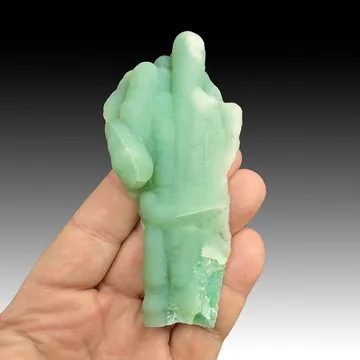
Lavrion Mining District, Greece - renowned for blue-green smithsonite botryoids, adamite, azurite, fluorite, and rich paragenesis that attracts serious collect…
Key facts
Lavrion is one of those rare districts where a mineral label carries three kinds of weight at once: cabinet beauty, scientific importance, and historical gravity. On the southern tip of Attica, between Thorikos, Kamariza, Plaka, Legrena, Sounion, and the Aegean coast, the district exploited a complex Pb-Zn-Ag-Cu system developed in marbles and schists of the Attic-Cycladic domain, cut and overprinted by Miocene intrusions, skarns, carbonate-replacement bodies, veins, breccias, and an unusually deep, chemically restless supergene zone. For collectors, that long geological story condenses into a distinctive Lavrion look: blue-green smithsonite botryoids, glowing adamite and zincolivenite on brown gossan, azurite sprays and spheres in marble cavities, fluorite and calcite from the vein systems, nickel-green annabergite, and an endless suite of arsenates, sulfates, carbonates, chlorides, and slag minerals that make the district one of Europe’s great micro-mineral laboratories.
Lavrion’s fame is not only a matter of species count, though that count is extraordinary. It is the style of preservation and association that makes the district addictive. A small vug may carry smithsonite, adamite, calcite, conichalcite, malachite, and iron oxides in a few square centimeters; another pocket may offer a textbook sequence from sulfide ore to carbonate crusts to arsenate sprays. The best specimens are rarely about single large crystals. They are about color, paragenesis, and texture: botryoidal zinc carbonate with a satin glow; turquoise to sea-green arsenates sparkling over limonite; glassy fluorite in old vein pockets; bright malachite tufts interrupting azurite blue; snow-white aragonite “iron flowers” from old workings. Lavrion rewards the collector who looks closely.
Regional View
Country View
The district’s historical role is just as commanding. Ancient Lavreotiki was the great silver-mining landscape of Athens, worked intensively in antiquity and reopened on an industrial scale in the nineteenth century. Its ore financed ships, coinage, metallurgy, settlements, washeries, railways, smelters, and finally museums and heritage parks. It is now as much a cultural landscape as a collecting locality: mine shafts, ore washeries, cisterns, metallurgical ruins, and modern industrial buildings stand above the same oxidized ore systems that supplied collectors with classic Lavrion specimens.

Photo: Wikimedia Commons

Photo: Wikimedia Commons
Search for specimens: View all specimens from Lavrion Mining District, Greece
The Lavrion district occupies the Lavreotiki peninsula of southeastern Attica, about 50 kilometers southeast of Athens, and includes many named subdistricts and mines rather than a single mine. Labels may read Lavrion, Laurion, Laurium, Kamariza, Kamareza, Agios Konstantinos, Plaka, Megala Pefka, Sounion, Thorikos, Avlaki, Esperanza, Christiana, Hilarion, Jean Baptiste, Clemence, Serpieri, Adami, or a numbered mine. For serious collectors, those distinctions matter because the district is not mineralogically uniform: the Kamariza mines are particularly important for smithsonite, adamite, zincolivenite, azurite, conichalcite, arsenates, sulfates, and many rarities; Plaka is essential for skarn, porphyry-related, vein, breccia, and replacement mineralization; Megala Pefka is a classic source for fluorite-calcite associations; and the coastal slag localities represent a separate anthropogenic mineral world that should not be confused with the natural mine assemblages.
Geologically, Lavrion belongs to the Attic-Cycladic Massif and exposes a stacked metamorphic architecture cut by the Western Cycladic detachment system. The lower Kamariza unit includes marbles and schists, including the Lower and Upper Kamariza marbles and the Kamariza schists; structurally above are rocks of the Lavrion blueschist unit, with marbles, schists, and metabasic lenses; a limited upper unit includes non-metamorphic limestone, chert, and serpentinite. Miocene granodioritic intrusions and related dikes at Plaka and Kamariza helped drive hydrothermal activity. The result is a cluster of deposit styles in a compact district: porphyry-style Mo ± W mineralization, Fe-Cu skarn, carbonate-replacement Pb-Zn-Ag mineralization, Pb-Zn-Ag-Au veins and breccias, and broad supergene oxidation.
The economically important ore bodies were chiefly carbonate-replacement bodies and vein-breccia systems. In Kamariza, the Hilarion, Clemence, Jean Baptiste, Serpieri, and Christiana mines worked stratabound lenses, mantos, chimneys, and irregular replacement masses in marble. Primary ore minerals included galena, sphalerite, pyrite, chalcopyrite, arsenopyrite, pyrrhotite, gersdorffite, bismuthinite, and a suite of sulfosalts, with quartz, fluorite, calcite, dolomite, siderite, ankerite, and other carbonates as gangue and alteration minerals. At Plaka, the granodiorite and its aureole produced skarn and porphyry-style features as well as the famous Vein 80, a large subhorizontal vein system with Pb-As-Sb-Cu-Ag character and fluorite-carbonate gangue. Oxidation of these ores generated the mineral wealth for which collectors know Lavrion: cerussite and smithsonite after lead and zinc ores; copper carbonates and sulfates; zinc, copper, iron, nickel, lead, cadmium, and aluminum arsenates and sulfates; and delicate chloride and sulfate species in old workings and slag environments.
Mining history here runs unusually deep. Archaeological and historical summaries place the beginning of exploitation in the late Neolithic to Early Bronze Age, with major systematic development in antiquity and exceptional intensity during the Classical period. The ancient Athenians exploited galena-rich silver-lead ores, crushed and washed ore in carefully engineered washeries, conserved scarce water in cisterns, smelted ore, and cupelled lead-silver metal. The famous “owl” coinage of Athens and the naval power associated with the Classical city are inseparable from the Lavrion mines. The mining landscape still preserves shafts, adits, washeries, cisterns, kilns, workshops, and metallurgical remains across the Lavreotiki peninsula.
Modern exploitation began in the 1860s after Andreas Kordellas drew attention to the value of the ancient slags and wastes. Giovanni Battista Serpieri and Hilarion Roux became central names in the nineteenth-century revival, and the French and Greek mining companies transformed Lavrio into a major industrial town. The French Compagnie Française des Mines du Laurium became especially important, with mines, beneficiation works, furnaces, railways, port facilities, housing, schools, churches, and industrial infrastructure. Modern production shifted with economics and technology: ancient slags and “ekvolades” were reworked; fresh lead, zinc, and mixed sulfide ores were mined; flotation was introduced in the twentieth century; zinc and lead prices, ore depletion, and industrial crisis eventually forced closure. Mining ceased in the late twentieth century, while ore processing and metallurgical activity continued longer at some facilities. The former French company complex later became the Lavrion Technological and Cultural Park under the National Technical University of Athens.
Collecting today requires caution, restraint, and current local knowledge. Much of Lavreotiki is archaeologically and environmentally protected, and many old workings are unsafe. Shafts can be deep, galleries are unstable, ironwork is corroded, floors may be undercut or flooded, and old mining and metallurgical wastes can be contaminated with lead, arsenic, cadmium, and other heavy metals. Legitimate collecting has historically centered on dumps, already disturbed material, old dealer stocks, and specimens recovered by local collectors with access and permission. Underground collecting should never be treated as casual recreation. For the marketplace, the most desirable pieces are usually older well-provenanced specimens or modern specimens with exact mine attribution, because “Lavrion” alone can hide a great deal of mineralogical ambiguity.
The notable specimen-producing areas include Kamariza’s Hilarion and Jean Baptiste mines for smithsonite and adamite-rich gossan cavities; Christiana for azurite, conichalcite, and complex arsenate assemblages; Clemence and the Km 3 area for Ni-Bi-Au-Ag-bearing vein and breccia assemblages including annabergite; Megala Pefka for fluorite with calcite and related secondary minerals; Plaka and Adami for fluorite, wulfenite, mimetite, skarn-related minerals, and vein assemblages; Sounion workings for aragonite “flos ferri” and chloride-bearing associations; and the beach and harbor slag localities for an entirely different suite of anthropogenic secondary minerals. The best pockets were small, chemically specialized, and often more important for diversity than for large crystal size, which is why fine Lavrion pieces so often deserve a microscope as much as a display case.
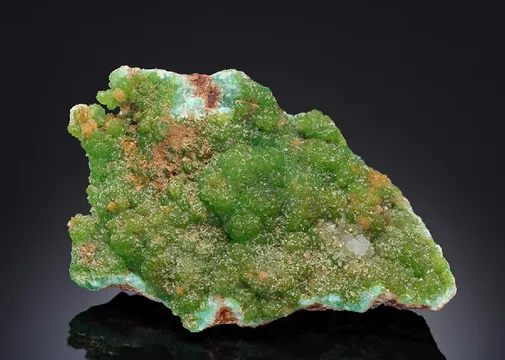
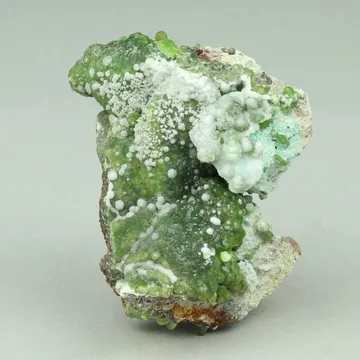
Smithsonite is Lavrion’s most recognizable cabinet mineral, especially from Kamariza mines such as Hilarion and Jean Baptiste, where oxidized zinc-lead ore in marble produced botryoidal, stalactitic, crustiform, and locally sparkling crystalline aggregates in pale blue, blue-green, green, white, grey, cream, yellowish, and brownish tones. The best pieces show tight, lustrous botryoids or rounded crusts with depth of color and contrast against limonite, gossan, calcite, aragonite, hemimorphite, or adamite; ordinary pieces tend to be chalky, bruised, or visually flat. Hilarion material is especially prized when smithsonite is paired with blue-green adamite or zincolivenite-group crystals, while Jean Baptiste labels are valued for classic pale smithsonite on oxidized carbonate matrix. Sizes range from thumbnail micro-vugs to small-cabinet plates, but quality is judged less by mass than by undamaged botryoidal surfaces, pleasing color zoning, and a clear Lavrion association.
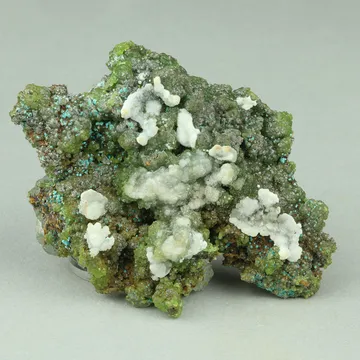
Adamite from Lavrion is chiefly a Kamariza supergene mineral, especially familiar from Hilarion, Christiana, Jean Baptiste, and related Agios Konstantinos workings, where it forms fine radiating crusts, fan-shaped rosettes, bow-tie aggregates, prismatic crystals, and pseudo-octahedral crystals on limonitic gossan, smithsonite, calcite, aragonite, hemimorphite, and other zinc-copper arsenates. Colors range from colorless and pale yellow through green, blue-green, turquoise, and rarer violet to pinkish hues, but the blue to sea-green material is the collector favorite; many green pieces historically called “cuprian adamite” overlap compositionally with zincolivenite or olivenite-series material, so analyzed labels carry extra value. Good Lavrion adamite shows sharp individual crystals or sparkling continuous druse, saturated color, fresh luster, and minimal abrasion; common material is attractive but granular, dull, or visually indistinct without magnification.
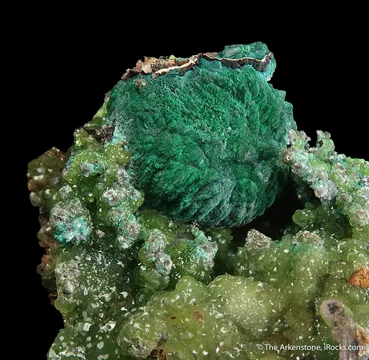
Azurite is one of the signature copper minerals of Lavrion’s oxidized zones, recorded from Kamariza localities including Christiana, Hilarion, Serpieri, and other mines, where it occurs as tiny blades, sprays, microcrystalline crusts, spherical aggregates, and rich blue coatings in cavities of oxidized marble and gossan. The Christiana area is especially associated with bright azurite in complex vugs with malachite, calcite, zincolivenite/adamite-series minerals, conichalcite, olivenite-group minerals, and iron oxides. Lavrion azurite is usually a thumbnail-to-miniature or micro-aesthetic species rather than a large-crystal cabinet mineral; superior specimens have vivid royal to electric blue color, sparkling crystal definition, and a clean contrast with green malachite or pale calcite, while ordinary pieces are dark, dusty, crusty, or partly altered.
Fluorite at Lavrion belongs to both the primary hydrothermal gangue and later collectable vein-cavity assemblages, with notable material from Megala Pefka, Kamariza, Plaka, and vein systems such as those around the Plaka area. It occurs as cubes, cuboctahedral crystals, druses, and massive to cleavable vein material, commonly associated with calcite, quartz, galena, sphalerite, cerussite, malachite, azurite, brochantite, beudantite, and limonite. Colors include pale violet, purple, colorless, greenish, and bluish tones; the most desirable pieces show sharp, glassy cubes or well-separated crystals on contrasting calcite or oxidized matrix, whereas common material is cleaved, etched, iron-stained, or massive. Classic Megala Pefka fluorite-calcite associations have a distinct European old-mine character and are much scarcer on the market than the district’s smithsonite and adamite.
Annabergite is one of Lavrion’s most evocative alteration minerals because it points directly to nickel-bearing primary assemblages in the Kamariza and Km 3/Clemence-style vein and breccia systems, where gersdorffite and related Ni-Bi-Au-Ag mineralization weathered in carbonate host rocks. It occurs as apple-green to pale green coatings, earthy crusts, small crystalline aggregates, and locally more attractive botryoidal or sparkling patches on brecciated marble, gossan, and sulfide-bearing matrix, often with galena, gersdorffite, calcite, fluorite, and iron oxides. The best specimens are not large showpieces but well-colored, richly covered, and accurately localized examples from nickel-rich pockets; ordinary pieces are powdery, sparse, or visually difficult to distinguish from other green secondary minerals without analytical support.
Calcite is omnipresent at Lavrion as marble host rock, hydrothermal gangue, vein fill, skarn-retrograde mineral, and supergene cavity mineral, but collectible pieces are most appealing when calcite provides bright, sharply formed crystals in association with the district’s more colorful secondary suite. Kamariza, Hilarion, Megala Pefka, Plaka, and other sublocalities have produced calcite as rhombs, scalenohedra, dogtooth crystals, drusy crusts, and pale to colorless coatings with smithsonite, adamite, azurite, fluorite, gypsum, aragonite, galena, and iron oxides. Good pieces are valued for contrast and paragenesis rather than rarity: clean white or transparent calcite can set off blue-green smithsonite, turquoise adamite, violet fluorite, or deep azurite beautifully. Less desirable examples are bruised, stained, or merely massive carbonate without a strong associated species.
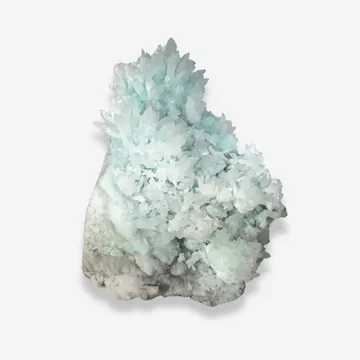
Aragonite from Lavrion is best known in the “flos ferri” style: branching, coral-like, acicular to fibrous growths formed in old mine cavities, with notable records from Megala Pefka, Sounion Mine No. 19, Agrileza-area workings, Kamariza, Hilarion, and other parts of the district. Specimens may be white, cream, brownish, pale blue, or greenish, and some larger groups reach hand-size to small-cabinet scale, though many of the most elegant examples are delicate vug linings or branching sprays only a few centimeters across. Associations include calcite, fluorite, smithsonite, brochantite, and oxidized carbonate matrix. The best pieces have clean, undamaged branching form, silky luster, and sculptural openness; ordinary examples are broken, dusty, compact, or too fragile to display well.
Malachite is widespread in Lavrion’s copper-bearing oxidized ore zones but is most collectable as a visual accent in azurite-rich and arsenate-rich assemblages from Kamariza, Christiana, Hilarion, Serpieri, Megala Pefka, and related workings. It occurs as velvety tufts, fine sprays, botryoidal crusts, thin coatings, pseudomorphic patches after azurite, and bright green seams in limonitic or carbonate matrix, commonly with azurite, conichalcite, adamite/zincolivenite-series minerals, calcite, brochantite, and other copper secondary species. Lavrion malachite is rarely about large standalone crystals; the desirable pieces have fresh emerald-green color, crisp fibrous texture, and strong contrast with azurite blue or pale carbonate. Ordinary material is massive, smeared, dull, or visually lost among other green copper minerals.
Conichalcite is a classic Lavrion micro and small-specimen species, particularly from the Christiana and Hilarion mines in the Kamariza area, where copper-arsenate chemistry produced grass-green globules, spheroidal aggregates, botryoidal crusts, and tiny crystal groups on goethite, limonite, and oxidized carbonate matrix. Christiana’s second-level material is notable for spheroidal conichalcite, while Hilarion pieces may place green conichalcite balls among blue-green adamite or zincolivenite-series crystals, creating the kind of multi-species miniature that makes Lavrion famous. Excellent pieces have saturated green color, discrete rounded aggregates, and a clean visual relationship to associated adamite, azurite, malachite, calcite, or iron oxides; ordinary pieces are dull green crusts requiring magnification and analysis to separate confidently from other copper arsenates.
Gypsum is a documented but less glamorous Lavrion species, occurring in the oxidation and sulfate-rich environments of the mining district, including Kamariza and Hilarion material, where it may appear as colorless to white selenite, small tabular crystals, crusts, and delicate transparent blades in cavities or on oxidized matrix. It is best appreciated in association specimens, especially with smithsonite, spangolite, devilline, cyanotrichite, calcite, and other sulfate-carbonate assemblages from the supergene zone. Fine Lavrion gypsum is valued when crystals are sharp, transparent, and undamaged or when it helps document a rare paragenesis; ordinary examples are soft, scratched, dehydrated-looking, or too inconspicuous beside the district’s more colorful arsenates and carbonates.
Beyond these familiar species, Lavrion is one of the world’s great type-locality districts. Natural mine species first described from the area include laurionite, glaucocerinite, ktenasite, serpierite, zincaluminite, natroglaucocerinite, mereiterite, niedermayrite, zincowoodwardite, kapellasite, attikaite, zincolivenite, drobecite, kamarizaite, agardite-(Nd), hilarionite, nickeltsumcorite, katerinopoulosite, prachařite, voudourisite, lazaridisite, stergiouite, katsarosite, fabritzite, and tzeferisite, with additional type species tied to the slag localities. For collectors, these rarities range from visually modest microcrystals to intensely colored crusts and balls, but their importance lies in chemistry and provenance: Lavrion is a place where zinc, copper, lead, iron, nickel, cadmium, arsenic, sulfate, carbonate, chloride, and organic or near-surface processes repeatedly found narrow windows in which new minerals could crystallize.
Lavrion specimens should be bought with locality precision in mind. “Lavrion” alone is historically common on older labels, but it can blur very different origins: natural mine specimens from Kamariza, Plaka, Megala Pefka, Sounion, or Thorikos; anthropogenic slag minerals from coastal slag sites; and dealer material whose exact mine attribution was never recorded. Exact labels such as Hilarion Mine, Jean Baptiste Mine, Christiana Mine, Serpieri Mine, Clemence Mine, Megala Pefka Mine No. 28, Adami Mine, or Sounion Mine No. 19 add value, especially for species whose paragenesis is locality-sensitive.
The biggest identification issue is the adamite–zincolivenite–olivenite problem. Much older Lavrion material sold as “cuprian adamite” may be adamite, zincolivenite, olivenite-series material, or zoned compositions, and color alone is not enough. Blue adamite from Lavrion may be closer to adamite composition, while many greener specimens occupy intermediate or copper-richer fields, but confirmation requires analytical work and, in strict cases, crystallographic information about Cu-Zn ordering. For valuable pieces, especially strong green pseudo-octahedral crystals from Kamariza, labels such as “adamite group,” “adamite/zincolivenite series,” or “formerly labeled cuprian adamite” may be more honest than a definitive species name without analysis.
Mislabelling has a documented history beyond Lavrion itself. The Kingsbury frauds in British mineralogy included specimens claimed from British localities that were later shown to be Lavrion material, including adamite attributed to Sandbed mine. That episode matters to collectors because Lavrion’s look is distinctive but portable: a sharp green arsenate on limonitic gossan can acquire a false locality if the label is weak. Conversely, old “Greece” or “Laurium” labels may conceal excellent Lavrion specimens that deserve more careful attribution.
Condition is often the main value divider. Smithsonite botryoids are easily bruised at high points; adamite and zincolivenite druses lose impact when crystal tips are rubbed; azurite can be dusted, rubbed, or partly altered to malachite; aragonite flos ferri breaks with the slightest pressure; gypsum scratches and cleaves readily; and many Lavrion micro-specimens carry soft, powdery secondary minerals that should not be washed aggressively. Avoid soaking mixed supergene pieces unless you know every component. A soft brush, air puffer, and careful dry handling are usually safer than water, acids, or ultrasonic cleaning.
Handling should also reflect the district’s chemistry. Lavrion specimens may contain lead, arsenic, cadmium, nickel, copper, and soluble sulfates, especially in gossan, slag, and brightly colored microcrystalline crusts. This is normal for the locality, not a reason to avoid collecting it, but it is a reason to wash hands after handling, avoid inhaling dust, keep friable pieces in boxes, and keep specimens away from children and food-preparation areas. Soluble sulfate efflorescences and slag minerals can be unstable in changing humidity, so sensitive micro-specimens deserve stable storage.
In the market, Lavrion remains available but uneven. Common smithsonite, aragonite, calcite, malachite, and mixed gossan pieces appear regularly, while top smithsonite with color and luster, fine Kamariza adamite/zincolivenite, vivid azurite combinations, classic fluorite-calcite pieces, and well-documented type-locality rarities are much harder to obtain. The best Lavrion specimens are increasingly provenance-driven: a clean old collection label, an exact mine name, analytical confirmation for difficult arsenates, and undamaged micro-crystal surfaces can matter as much as size.
In antiquity, Lavrion was not merely a mine. It was one of the engines of Athens. The ore lay not in a single romantic cavern but across a wide working landscape of shafts, galleries, washeries, cisterns, kilns, and workshops spread through the dry hills of Lavreotiki. Ancient miners learned to follow red iron oxides, heavy galena fragments, and contacts in the marble, then drove narrow galleries deep enough that later descriptions emphasize a brutal economy of space: no wasted rock, no extra room, only enough passage for a worker to pursue the ore.
The turning point in the Classical story was the exploitation of richer “third contact” ores around the Kamariza-Maronia area. The revenue became a political instrument. Around 483 BC, Themistocles persuaded Athens not to distribute the windfall but to build a fleet. That decision helped produce the triremes that fought at Salamis in 480 BC. For a collector holding a smithsonite or adamite from Kamariza, the connection is startlingly physical: the same marble-hosted ore system that later oxidized into blue-green cabinet minerals once supplied the silver that moved through the Mediterranean as Athenian owls.
The surface installations were as ingenious as the underground workings. Lavrion is a semi-arid district, and water was too precious to waste. Ancient ore washeries were cut into rock and coated with waterproof plaster; water ran over slightly inclined tables, through channels and settling basins, and back for reuse. Ore was crushed and ground before washing, and some reconstructions describe the useful mineral being concentrated while three quarters of the extracted rock could be discarded before smelting. In a district famous today for color, the ancient miners were practicing a different kind of visual mineralogy: weight, sheen, red oxide stains, and the behavior of crushed grains under flowing water.
A second Lavrion story begins in the nineteenth century with old waste. The ancient miners had left slag and low-grade material that still contained recoverable metal. Andreas Kordellas, sent by the young Greek state in 1860, recognized the potential of the old residues. Giovanni Battista Serpieri and Hilarion Roux then helped launch the modern industrial revival, and by the 1860s the port of Lavrio was no longer a sleepy relic of antiquity but the nucleus of a mining town. Furnaces, washing installations, rail systems, port works, and company housing followed. The modern town grew around ore just as the ancient mining villages had done.
The so-called Lavreotiki Affair gave that revival a dramatic political edge. The dispute over the right to exploit ancient slags and off-grade ores became more than a technical matter; it became a national and international controversy involving investors, diplomats, the Greek state, and foreign capital. The compromise of the 1870s led to the formation of Greek and French companies, but it also generated speculative fever. Lavrion entered modern Greek industrial history not only as a mine but as a symbol of technological promise, foreign investment, political conflict, and economic risk.
The twentieth-century ending was slower and more melancholy. As ore bodies depleted and metal prices shifted, mining and metallurgy contracted. The French company’s mining activity ceased in the 1970s, and the industrial complex finally closed near the end of the 1980s. Then the site changed identity again. Instead of being erased, the old French company plant was taken into a new life as the Lavrion Technological and Cultural Park, preserving furnaces, workshops, industrial buildings, and memory. The same district that once produced silver for Athens and lead for industry now produces research, education, heritage tourism, and mineralogical study.
Modern field accounts from Lavrion still convey the pull of the underground maze. One University of Texas geology writer described entering with old pants, rain boots, helmet, hammers, and flashlights; the first meters brought a sudden temperature drop, then dim light, branching passages, knee-deep water, rusty iron bars, and floor holes waiting in the dark. The guide, Konstantinos Kapelas, knew the labyrinth from childhood. The writer’s excitement peaked not at machinery or history but in “chambers full of minerals,” where malachite, fluorite, and azurite could still be seen and collected in small amounts. That combination—danger, beauty, science, and memory—is precisely why Lavrion has to be approached with respect.
.jpg)
.jpg)