A collector's guide to Kakanda deposit, DR Congo: its geology, mining history and notable minerals, illustrated with the 45 specimens documented from this locality on EarthWonders.
Key facts
Kakanda is one of the classic copper-cobalt deposits of the central Congolese Copperbelt, in the Kakanda-Kambove part of the Katanga Copper Crescent, near Kambove and Likasi in today’s Lualaba Province. For ore geologists it belongs to the great family of sediment-hosted, stratabound Cu-Co deposits developed in Roan Group rocks; for collectors it is a name associated above all with vivid cobalt-bearing carbonates, malachite, and the remarkable dark green kolwezite pseudomorphs after cuprite that came out of Kakanda South in the 2020 period.
The best Kakanda cabinet pieces have a distinctive palette: hot-pink to raspberry cobalt-bearing calcite or cobalt-bearing dolomite, bright velvety or stalactitic malachite, black to brown cobalt oxides, and, on a small number of important specimens, sharp olive-green to nearly black pseudomorphs preserving the cuboctahedral form of cuprite. Those pseudomorphs made Kakanda stand apart from the better-known Kolwezi-area kolwezite localities because they are not merely crusts or balls of a rare carbonate; they preserve crisp crystal geometry on a cobalt-rich carbonate matrix, giving the specimens both mineralogical and sculptural force.
Regional View
Country View
Historically, Kakanda also matters because it is not a short-lived collector occurrence but a long-known industrial mining district. The deposit was discovered in the early twentieth century and produced copper ore from 1930, first by underground chambered methods associated with shafts at the margins of later open pits. In later decades Kakanda became part of the Gécamines central mining group and then, in the modern period, part of the Boss Mining complex. Its specimen production is therefore inseparable from large-scale ore extraction: the fine pieces are byproducts of active or formerly active pits, processing campaigns, and near-surface oxidation zones rather than the output of a locality worked primarily for collectors.
Search for specimens: View all specimens from Kakanda deposit, DR Congo
Kakanda is an active copper-cobalt deposit in the Lubudi Territory of Lualaba Province, DR Congo, placed by Mindat at about 10° 43' 41'' south and 26° 22' 52'' east. The nearest large mining towns are Kambove to the southeast and Likasi farther east-southeast, and the deposit lies within the broader Kakanda-Kambove belt of the Katanga Copper Crescent. In collector labels, older political geography is common: “Katanga,” “Shaba,” “Zaïre,” “Kambove District,” and “Kakanda Mine” may all refer to material from the same mining area or from one of its sublocalities, especially Kakanda South and Kakanda North.
Geologically, Kakanda is a sediment-hosted, stratabound copper-cobalt deposit of the Roan succession, hosted in dolomitic and locally carbonaceous, pyritic sedimentary rocks. Published deposit compilations place Kakanda among the reduced-facies copper occurrences of the Neoproterozoic Roan Group, and the Kakanda East-Kakanda North-Kakanda South grouping is treated as a significant deposit in USGS assessments of the Central African Copperbelt. In practical specimen terms, the most important environment is the oxidized and supergene-altered part of the ore system, where copper and cobalt were remobilized into carbonates, hydroxides, phosphates, silicates, and oxides.
The ore body described in collector-oriented geological accounts is tubular and held in dolomitic host rock, with covellite, chalcocite, and chalcopyrite as principal copper sulfides in the primary to mixed ore. Approximate published dimensions for the ore body are 800 meters long, 300 meters wide, and 30 meters thick. The oxidized near-surface zones produced the collector minerals: malachite in stalactitic and crustiform habits, cobalt-bearing calcite and dolomite lining cavities, heterogenite and manganese oxides as dark coatings, and rare kolwezite replacing cuprite.
Kakanda was discovered in 1910 and entered production in 1930. Early working used chambered underground mining from shafts reported to have reached depths of up to 350 meters at the margins of the open pits. Under Union Minière du Haut-Katanga, and later Gécamines, Kakanda became part of the central copper-cobalt mining infrastructure of the Congolese Copperbelt. The Kakanda concentrator was reportedly started in 1961 by Union Minière/Gécamines using equipment from the closed Shinkolobwe uranium processing plant; it treated copper ore with cobalt as a secondary metal and had a stated capacity of about 2,000 dry tonnes per day in a 2014 training report. That same account says the concentrator was fed historically by ores from Kakanda North, Kakanda South, and Gisele, later shifted toward cobalt treatment, and was used by Boss Mining from 2007 onward.
Modern operations are associated with Boss Mining, a joint venture involving ERG Africa and Gécamines. Boss Mining’s Kakanda operations have included mining, concentration, and links to the Luita processing complex. The industrial status of the site has changed several times: Boss Mining was placed on care and maintenance in 2019, ERG celebrated a restart ceremony at Kakanda on 23 November 2022, and the Ministry of Mines suspended Boss Mining in May 2023 after a flooding-related environmental incident in the Kakanda area. ERG’s 2024 reporting states that the suspension was lifted in May 2024 after corrective measures, including water-management improvements.
Collector access should be regarded as closed and controlled. Kakanda is an industrial mining concession, not a public collecting locality. Modern pieces reach the market through commercial channels associated with mining, sorting, dealer access, or secondary trading. Recent company statements also describe unauthorized artisanal and semi-mechanized mining activity in parts of the concession, including a fatal landslide at the SAAFI site on 11 March 2026. For collectors, that is a sober reminder that attractive Kakanda specimens come from a working mining landscape with serious safety, legal, and social complications; field collecting without permission is not appropriate.
The most famous specimen-producing event of recent years came from Kakanda South. Around 2020, decimeter-scale geodes were found containing pinkish-red cobalt-bearing dolomite, locally with distorted cuprite cuboctahedra altered completely to dark olive-green kolwezite and sometimes coated by pale green malachite. Fine examples from this find show sharp pseudomorphs to roughly 1 cm, though at least one documented specimen records replaced cuprite groupings reaching 2.7 cm. Larger plates from the find are scarce, and condition varies because the carbonate matrices can be sparkling but fragile and the protruding pseudomorphs are vulnerable to edge bruising.
Earlier and broader Kakanda material includes cobalt-bearing calcite clusters, cobalt-bearing dolomite druses, malachite crusts and stalactites, spherocobaltite from Kakanda South and possibly Kakanda North, and cobalt oxide assemblages. A frequently repeated mining note records “caves” of stalactitic malachite encountered near the surface in the northern part of the ore body, though most market specimens are smaller display pieces rather than intact large cavern formations.
Calcite from Kakanda is best known in its cobalt-bearing variety: sparkling, vivid pink to deep raspberry druses and crusts, commonly forming small rhombohedral to scalenohedral crystals on pale carbonate or dark ore matrix. Documented market specimens from Kakanda show crystals to about 7 mm on pieces in the miniature range, while larger plates occur but are less common in fine condition. The strongest pieces have saturated color, bright luster, and complete crystal coverage on an undamaged matrix; ordinary examples are paler, chalkier, or so intergrown with cobalt-bearing dolomite that the label is more visual than analytical. Good Kakanda calcite is often associated with malachite, heterogenite, manganese oxides, dolomite, or, in the finest recent combinations, kolwezite after cuprite.
Dolomite from Kakanda is important both as a host carbonate and as an aesthetic mineral in its cobalt-bearing form, where it may appear as bright fuchsia to rose-pink, sparkling, finely crystallized druses lining cavities in dolomitic ore. The celebrated Kakanda South find yielded decimeter-scale geodes of pinkish-red cobalt-bearing dolomite, and those cavities provided the stage for the locality’s best kolwezite-after-cuprite pseudomorphs. Fine dolomite specimens are judged by the intensity and evenness of the cobalt color, the freshness and transparency of the crystal faces, the density of coverage on both sides of a plate, and the contrast with dark green kolwezite or pale green malachite; weaker pieces are merely pink carbonate crusts without luster, contrast, or defined crystals.
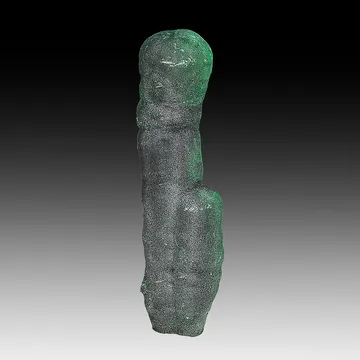
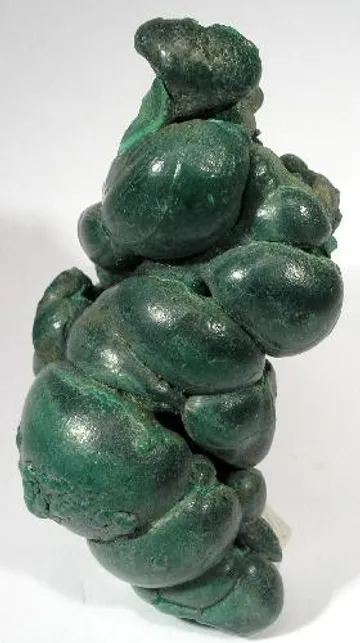
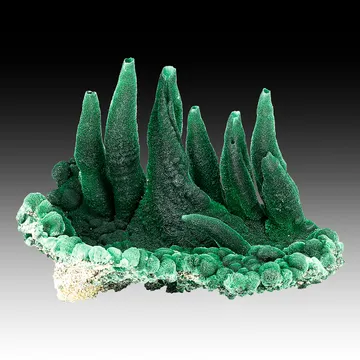
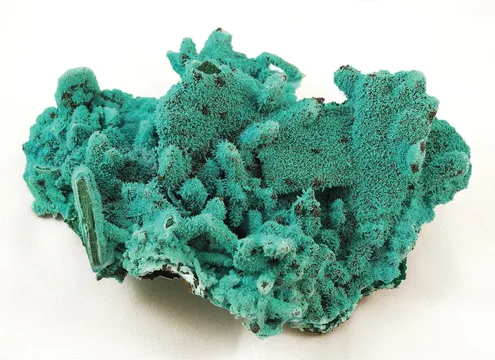
Malachite is a major secondary copper mineral at Kakanda and one of the visual signatures of the oxidized ore zone. The most evocative report from the mine describes near-surface “caves” of stalactitic malachite in the northern part of the ore body, while collector specimens more often show velvety crusts, botryoidal coatings, green skins on cobalt-bearing carbonates, or minor crusts over kolwezite-after-cuprite pseudomorphs. The best Kakanda malachite has a saturated emerald to deep green color, velvety texture or well-developed stalactitic form, and strong contrast against pink calcite or dolomite; ordinary material is thin, dull, incomplete, or simply a green wash on ore matrix.
Kolwezite is the mineral that gives modern Kakanda its specialist cachet. Although Musonoi near Kolwezi is the type locality for the species, Kakanda South produced a distinctive occurrence in which cuprite crystals were replaced by dark olive-green to green-black kolwezite while retaining sharp cuboctahedral forms. These pseudomorphs sit on hot-pink cobalt-bearing dolomite or calcite and may carry a pale malachite crust; published and market-documented examples report pseudomorphs around 1 cm, with a larger documented specimen showing replaced cuprite groupings to 2.7 cm. The best Kakanda kolwezites are not just rare by species name: they have crisp form, unmistakable replacement texture, strong color contrast, undamaged edges, and analytical or very reliable provenance support.
Cuprite at Kakanda is collector-significant less for surviving bright red crystals than for the crystal forms it left behind. In the Kakanda South geodes, distorted cuprite cuboctahedra developed in cobalt-bearing carbonate cavities and were later completely replaced by kolwezite, preserving the original cuprite geometry in dark green pseudomorphs. Some labels therefore read “cuprite” or “cuprite after” in a structural sense, and serious collectors should distinguish true Cu2O from kolwezite pseudomorphs after cuprite. The most desirable Kakanda cuprite-related specimens show isolated, sharp, complete cuboctahedral forms on vivid pink cobalt-bearing dolomite or calcite; broken, ambiguous, or merely green-black lumps do not carry the same mineralogical weight.
Other minerals documented from the Kakanda deposit and its sublocalities include brochantite, chrysocolla, cornetite, heterogenite, libethenite, pseudomalachite, quartz including chalcedony, manganese oxides including dendritic forms, possible plancheite, and spherocobaltite. Spherocobaltite is especially worth noting because Kakanda South is a documented occurrence, with crystals described as small discoidal to pseudo-hexagonal forms; however, the old collector habit of calling any bright pink cobalt-bearing carbonate “spherocobaltite” is a known problem throughout Katanga, and many attractive pink specimens are calcite or dolomite rather than CoCO3. Mindat currently treats erythrite from Kakanda as an erroneous or highly doubtful entry, noting the lack of arsenic for the locality, so old labels pairing Kakanda cobalt carbonates with erythrite deserve caution.
Kakanda specimens present three main authenticity issues: species confusion, locality ambiguity, and pseudomorph terminology. The species confusion is most common among the pink carbonates. “Cobaltocalcite,” “cobaltoan calcite,” “cobalt-bearing calcite,” “cobaltoan dolomite,” and “spherocobaltite” have all circulated in the Katanga market, but they are not interchangeable names. True spherocobaltite is CoCO3 and is much less common than cobalt-bearing calcite or dolomite. Fine pink Kakanda material should not be upgraded to spherocobaltite without evidence, and high-value labels should ideally be backed by analysis or by a chain of provenance from a specialist dealer.
Kolwezite-after-cuprite pieces require equally careful wording. The classic Kakanda South specimens are pseudomorphs: the visible dark green crystals are kolwezite preserving the earlier cuprite form. A label that says “cuprite” alone may be misleading if no Cu2O remains. Conversely, a label that says “kolwezite ps. cuprite” is a desirable and specific description when the morphology is sharp and the association matches the Kakanda South find.
Locality precision matters. “Kakanda,” “Kakanda deposit,” “Kakanda Mine,” “Kakanda South,” and “Kakanda North” are not always used consistently in commerce. Older labels may use Katanga, Shaba, or Zaïre; those are historically understandable, but the modern geographic reference is Kakanda deposit, Lubudi, Lualaba, DR Congo. A specimen attributed specifically to Kakanda South should fit the known assemblage of cobalt-bearing carbonate with malachite and, for the celebrated 2020 material, kolwezite-after-cuprite pseudomorphs.
Condition is often the difference between a routine Kakanda specimen and a serious collector piece. Pink carbonate druses can bruise, abrade, or lose their sparkle on exposed edges. Malachite velvet can rub or flatten. Kolwezite pseudomorphs are protruding dark crystals on a comparatively delicate carbonate matrix, so edge damage, broken tips, and glued repairs should be checked under magnification. The strongest examples show intact pseudomorph edges, a clean and natural contact with the carbonate matrix, and no suspicious green paint-like coating.
Fluorescence should not be treated as a primary identifying feature for Kakanda material. Some calcites fluoresce, but cobalt and manganese impurities can strongly affect luminescence, and many cobalt-bearing carbonates are more valued for daylight color than ultraviolet response. Handling is straightforward for normal cabinet care: keep specimens dry, avoid acids, avoid ultrasonic cleaning, and do not scrub velvety malachite or soft carbonate druses. As with cobalt-bearing and copper-bearing minerals generally, avoid generating dust and wash hands after handling friable ore pieces.
On the market, Kakanda cobalt-bearing calcite and dolomite are available in small to cabinet sizes, often at accessible prices when they are simple pink druses. Malachite combinations are less common in fine aesthetic form. The kolwezite-after-cuprite pseudomorphs are the premium modern Kakanda material: small miniatures and thumbnails appear sporadically, while large, sharp, undamaged plates with strong contrast are genuinely scarce and can command strong prices, especially when tied to the 2020 find and backed by reputable documentation.
The modern collector story of Kakanda turns on a mineralogical surprise in pink cavities. From March to September 2020, new Congolese finds reported by Christophe Gobin of Dubai Gems brought attention back to the Kakanda South Pit. The mine was not a romantic hand-dug pocket locality; it was an immense industrial open pit, about 1.5 kilometers long and 700 meters wide. Yet within that scale, the specimen story was intimate: decimeter-sized geodes lined with pinkish-red cobalt-bearing dolomite. In some of those cavities, distorted cuprite cuboctahedra had been transformed, crystal for crystal, into dark olive-green kolwezite. The result was a paradox collectors love: a rare copper-cobalt carbonate preserving the hard geometry of a copper oxide that was no longer there.
One cabinet specimen from that find became a public benchmark. The Lapis report illustrated a 19 cm wide Kakanda piece from the Christophe Gobin/Dubai Gems circle, photographed by Federico Picciani, showing kolwezite pseudomorphs after cuprite on cobalt-bearing dolomite. That was not just a big pink Congo carbonate; it was a specimen that made Kakanda a serious kolwezite locality in its own right. In the Kambove district, kolwezite had previously been a rarity, and the sharp pseudomorphs from Kakanda were described as a “premiere” because they preserved freely formed cuprite crystals rather than appearing only as the more familiar coatings or aggregates.
The find quickly entered the high-end specimen conversation. In 2022, a cabinet specimen measuring 13.2 x 9.3 x 3.2 cm was offered in a Mineral Auctions benefit sale connected with The Mineralogical Record. The description emphasized the unusual contrast: a velvety field of pink cobaltoan dolomite supporting sharp dark green-black crystals determined by analysis as kolwezite replacing cuprite. The pseudomorphs reached about 1 cm. It was one of the larger plates in good condition, donated by Christophe Gobin, valued at $6,000–$7,500, and it closed at $1,555 after a long series of bids. For collectors, the result was instructive: Kakanda’s best pseudomorphs were valuable not because of size alone, but because they combined rarity, form, contrast, and a very specific discovery context.
Kakanda’s industrial life has had its own ceremonial moments. On 23 November 2022, ERG held an official restart ceremony at Kakanda for Boss Mining after the operation had been on care and maintenance since 2019. The company account records speeches, music from community choirs, and traditional blessings led by local chiefs. ERG described the first phase as processing historically mined Kiwana fines at the Luita concession, with more than 750 jobs for DRC nationals expected in that phase. In a mining district where collector minerals are inseparable from ore production, that restart was more than a corporate event: it marked the reactivation of the industrial system through which any future specimens would most likely pass.