Haut-Katanga, DR Congo — Katangan locality famed for malachite and chrysocolla, notable baryte associations, and Kipushi minerals with germanium and gallium.
Key facts
Haut-Katanga is the eastern, Lubumbashi–Kambove–Kipushi portion of the great Katanga Copperbelt, a mineral province whose name carries unusual weight with collectors. This is not a single mine locality in the ordinary sense, but a collector’s region of world-class deposits: L’Etoile du Congo and Ruashi on the outskirts of Lubumbashi; the Kambove district with Shangulowé, Mindingi, Shinkolobwe, Kamoya and related workings; Luiswishi north of Lubumbashi; and the deep, geochemically singular Kipushi mine near the Zambian border. Together they expose the oxidized and primary mineral stories of the Central African Copperbelt: sediment-hosted copper-cobalt ores in Katangan Supergroup rocks, supergene copper minerals formed in the weathered caps, and locally extraordinary uranium, zinc, lead, germanium and gallium mineralization.
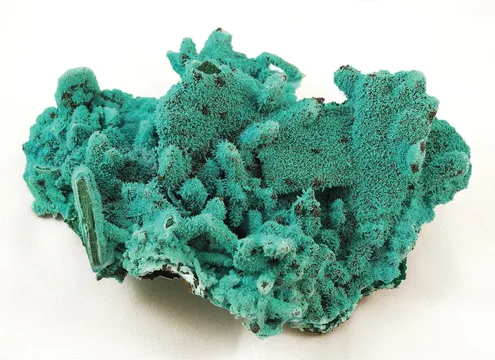
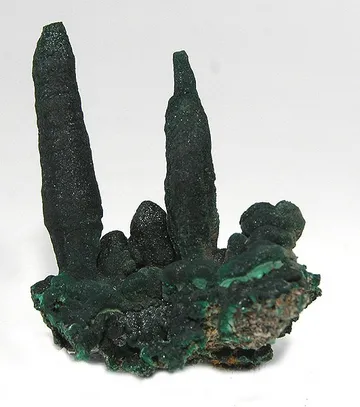
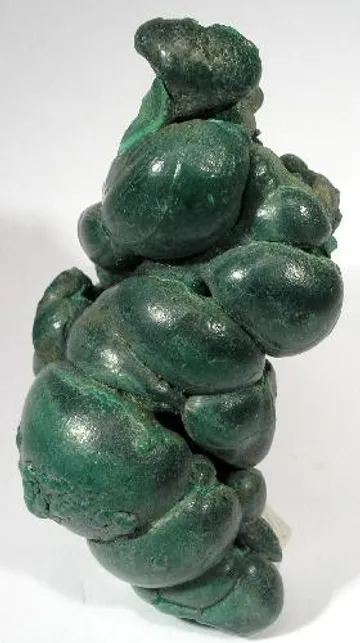
For the specimen collector, Haut-Katanga is first and foremost one of the classic sources of Congolese malachite. The best pieces have the unmistakable Katanga look: velvet-green botryoids, glassy-to-silky fibrous sprays, stalactitic masses with concentric banding, and vivid associations with sky-blue chrysocolla, teal cornetite, black heterogenite and, at Shangulowé, pale gemmy baryte perched on or included by malachite. L’Etoile du Congo has long been a reference locality for malachite and chrysocolla combinations; Mindingi has supplied distinctive fibrous and globular malachites; and the Kambove–Shangulowé area has produced some of the most surprising baryte–malachite combinations known from the DRC.
Regional View
Country View
Haut-Katanga’s importance is deeper than display malachite. Kipushi is a textbook Cu-Zn-Pb-Ag-Ge deposit and the type locality for germanium- and gallium-bearing species including briartite, gallite, kipushite and zincobriartite, while Luiswishi is the type locality for sengierite. Shinkolobwe, although better known historically as a uranium mine than as a casual collecting locality, is one of the most mineralogically consequential uranium localities in the world, with a roster of type-locality uranyl minerals that includes becquerelite, billietite, curite, fourmarierite and many others. Cornetite, one of the signature copper phosphates of the district, was first described from L’Etoile du Congo.

Photo: Wikimedia Commons

Photo: Wikimedia Commons
The historic labels add another layer of fascination. Older specimens may read “Katanga,” “Shaba,” “Zaire,” “Elizabethville,” “Jadotville,” “Kambove District,” “Star of the Congo,” “Kalukuluku,” or “Prince Léopold Mine.” Some are precise and valuable as provenance; others are only regional shorthand. Since the former Katanga Province was split administratively in 2015, collector labels that simply say “Katanga, Congo” may refer either to modern Haut-Katanga or to Lualaba. For Haut-Katanga material, the strongest labels name the mine: L’Etoile du Congo, Ruashi, Mindingi, Shangulowé, Luiswishi, Kipushi or Shinkolobwe.
Search for specimens: View all specimens from Haut-Katanga, DR Congo
Haut-Katanga occupies the southeastern DRC portion of the Central African Copperbelt, where the economically dominant copper-cobalt deposits are largely sediment-hosted and stratiform to stratabound. The ore-bearing units belong chiefly to the Katanga Supergroup, particularly the Roan Group and, in classic Congolese terminology, the Mines Subgroup or “Serie des Mines.” These rocks include dolomitic shales, dolostones, silty dolomites, carbonaceous shale, siltstone and sandstone, with mineralized horizons repeated, folded, faulted and locally brecciated during Lufilian deformation. In the collector’s hand, that geology is expressed as malachite and chrysocolla coating weathered dolomitic and siliceous matrices, cornetite and pseudomalachite on oxidized copper-rich substrates, cobalt oxides such as heterogenite as black botryoidal crusts, and, at Kipushi, dense sulfide assemblages whose germanium minerals are best appreciated in polished ore or micro mounts rather than as showy cabinet crystals.
The familiar oxidized copper suite is the upper story. In the near-surface and weathered parts of many deposits, primary copper-cobalt sulfides were altered and redistributed into malachite, azurite, chrysocolla, cuprite, heterogenite, pseudomalachite, spherocobaltite, cornetite, libethenite, conichalcite and related species. The oxidation zone is where most display specimens originated. Malachite formed as botryoidal crusts, mammillary masses, velvet coatings, fibrous aggregates and stalactites in cavities, fractures and leached open spaces. Chrysocolla supplied the pale to intense blue contrast, either as botryoidal masses and coatings or as a siliceous skin on malachite. Heterogenite supplied black, lustrous cobalt-oxide surfaces. Cornetite and pseudomalachite added copper phosphate color, especially at L’Etoile du Congo.
L’Etoile du Congo, also known historically as Star of the Congo and Kalukuluku, lies at the edge of Lubumbashi. It is one of the classic specimen names of Haut-Katanga and is especially associated with malachite, chrysocolla, cornetite, pseudomalachite and heterogenite. The mine’s best malachites include polished stalactitic sections with tight concentric banding, velvety botryoidal specimens, and blue-green malachite–chrysocolla combinations with strong color contrast. Mindat’s occurrence data for malachite at L’Etoile characterize it as world-class, with botryoidal, mammillary and stalactitic habits, and the photo record is particularly rich in chrysocolla, cornetite and heterogenite associations. For collectors, L’Etoile is also important because cornetite was first described from this mine, making it a foundational locality for copper phosphate mineralogy.
Ruashi, a few kilometers from L’Etoile in the Lubumbashi mining area, is geologically allied and economically important as a Cu-Co deposit. Historical accounts record Union Minière du Haut-Katanga identifying the Etoile orebody in 1911 and the Ruashi orebody in 1919. Ruashi’s oxidized zone is noted for malachite, chrysocolla, heterogenite, cuprite, azurite, cornetite and spherocobaltite, while deeper or less oxidized zones contain sulfides such as chalcopyrite, bornite, carrollite and chalcocite. Industrial work at Ruashi has been primarily ore-focused; fine specimens exist, but the mine is less famous in the cabinet-specimen market than L’Etoile, Mindingi or Shangulowé.
The Kambove district is a major collector name within Haut-Katanga. Kambove itself, Mindingi, Shangulowé, Shinkolobwe, Kamoya South II and nearby workings all sit within a mineral belt where copper, cobalt and, locally, uranium mineralization occur in repeated and structurally complicated Roan-hosted units. Mindingi is an open-cast locality known to collectors for malachite in botryoidal masses, needles, blocky curved crystals and diamond-shaped crystal forms, with associations including heterogenite, quartz, chrysocolla, cryptomelane and hollandite. A notable 2023 appearance of dark, goethite-infused globular malachite on sparkling microcrystalline quartz gave Mindingi a fresh round of attention among collectors of unusual malachite habits.
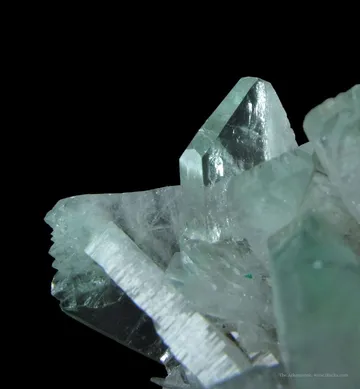
Shangulowé is the Kambove-district locality that tends to stop collectors mid-sentence. Its classic output is baryte with malachite: translucent to colorless or gray-white bladed to chisel-shaped baryte crystals, commonly containing green malachite inclusions, set on botryoidal malachite and sometimes chrysocolla. The best late-1990s to early-2000s specimens show sharp baryte crystals to several centimeters, cleanly placed on green matrix; some later-discussed examples and older collection pieces also show malachite pseudomorphs after baryte. The combination is so counterintuitive—pale, glassy baryte blades growing out of saturated green malachite—that even experienced collectors often want reassurance that the pieces are natural. The best examples show convincing intergrowth, malachite inclusions within baryte, and coherent pocket relationships rather than inserted crystals.
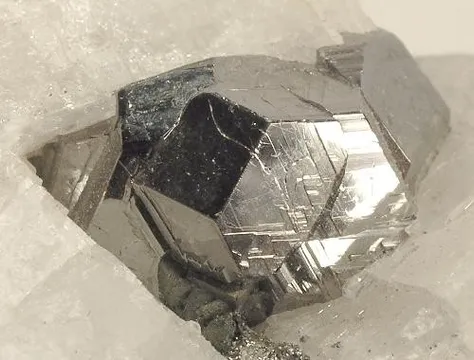
Kipushi is a different kind of Haut-Katanga classic. Located near the town of Kipushi, southwest of Lubumbashi and close to the Zambian border, the former Prince Léopold Mine is an underground Cu-Zn-Pb-Ag-Ge system rather than a typical open-pit copper-cobalt oxide specimen mine. It began modern production in the 1920s, operated for decades, and became famous scientifically for its high-grade sulfide ores and germanium-bearing minerals. The primary ore assemblages include sphalerite, galena, pyrite, arsenopyrite, chalcopyrite, bornite, chalcocite, tennantite-group minerals, germanite, renierite, briartite and gallite. To the specimen collector, Kipushi is less about large green display malachite and more about rare-species provenance: metallic sulfide intergrowths, microscopic type minerals, and old labels tied to one of Africa’s most important base-metal deposits.
Luiswishi, north of Lubumbashi, is another significant Cu-Co locality and the type locality for sengierite, a copper uranyl vanadate. Collector specimens of sengierite from Luiswishi are typically small green platy crystals or microcrystalline aggregates, valued more for rarity and type-locality significance than for size. Luiswishi is also known commercially as an open-cut copper-cobalt mine and has supplied typical Katanga oxidized copper minerals, but its strongest identity among systematic collectors is the uranium-vanadium species story.
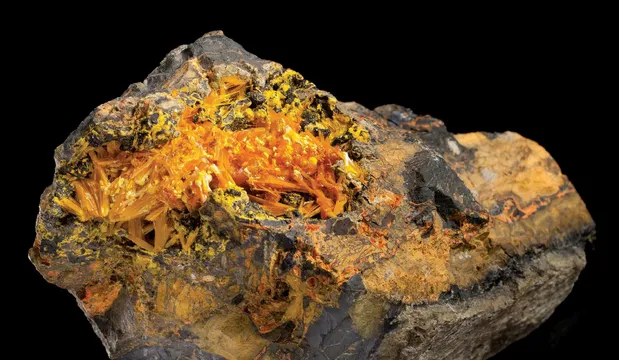
Shinkolobwe is the most historically charged locality in Haut-Katanga. Situated in the Kambove territory, it was mined for radium and uranium and later became globally famous because high-grade uranium ore from the mine supplied the Manhattan Project. Mineralogically, Shinkolobwe is a classic uranium locality of the first rank. Its oxidation products include colorful uranyl species—yellow, orange, red and green minerals that are prized by specialists but require serious radioactive-mineral handling protocols. Shinkolobwe material is not casual shelf stock. Old specimens should be stored, labeled, monitored and handled with informed respect, especially if friable, dusty or rich in uraninite and secondary uranium minerals.
Access today is effectively industrial, legal and security-controlled rather than recreational. Many named deposits are active mines, closed mines, concession ground or areas with safety and radiation concerns. Direct field collecting by visiting mineral collectors is not a realistic expectation at major operations such as Ruashi, L’Etoile, Kipushi or Shinkolobwe. Specimens reach the market through older collections, mine-related channels, artisanal recovery, local specimen dealers and international dealer networks, with varying degrees of label precision. For serious collectors, provenance discipline matters: “Haut-Katanga” is a useful regional label, but mine-level locality is much stronger, and a credible old label can be as important as the mineral itself.
Malachite from Haut-Katanga ranges from ordinary ore-grade green crusts to some of the most sculptural malachite specimens in the world: L’Etoile du Congo is especially known for botryoidal, mammillary and stalactitic malachite, often with chrysocolla, cornetite, pseudomalachite and black heterogenite; Mindingi adds fibrous fans, needles, blocky curved crystals and dark globular aggregates on sparkling quartz; Shangulowé contributes the rare and highly prized baryte–malachite association, including malachite-included baryte and malachite pseudomorphs after baryte. Fine Haut-Katanga pieces are separated from common Congo malachite by crisp undamaged velvet, lively chatoyance, natural undulating botryoidal surfaces, clean blue chrysocolla contrast, attractive stalactitic architecture, or sharp baryte/cornetite associations; common pieces are abundant, but superb, undamaged cabinet specimens with convincing mine-level provenance are much scarcer than the broad “Katanga malachite” market suggests.
Other minerals documented from Haut-Katanga make the province a systematic collector’s paradise. L’Etoile du Congo is the type locality for cornetite, Cu3(PO4)(OH)3, and is also important for chrysocolla, heterogenite, pseudomalachite and libethenite. Kipushi is a type-locality heavyweight for germanium and gallium mineralogy, including briartite, Cu2FeGeS4, gallite, CuGaS2, kipushite, zincobriartite and related rare sulfides with renierite and germanite. Luiswishi is the type locality for sengierite, Cu2(UO2)2(VO4)2 · 6H2O. Shinkolobwe anchors the uranium suite, with type-locality minerals including becquerelite, billietite, curite, fourmarierite, cattierite, comblainite, cousinite, dewindtite, dumontite, ianthinite, kasolite, masuyite, parsonsite, schoepite, sklodowskite, soddyite, studtite and others reported from the mine’s remarkable uranyl oxidation environment.
The first collector caution is locality precision. “Katanga, Congo” is a common commercial label, but modern Katanga has been split, and many famous “Katanga” malachites on the market are actually from Lualaba localities such as Mashamba West, Musonoi or Kolwezi-area mines rather than Haut-Katanga. That does not make them bad specimens, but it does matter for a locality collection. Haut-Katanga material should ideally be labeled to a named mine—L’Etoile du Congo, Mindingi, Shangulowé, Kipushi, Luiswishi, Ruashi or Shinkolobwe. Older labels reading Shaba or Zaire may be perfectly legitimate; vague modern labels deserve closer scrutiny.
Authenticity is a real concern for Congolese malachite and chrysocolla. Genuine Haut-Katanga malachite stalactites and botryoids are abundant enough that unusual form alone is not proof of fakery, but the market has seen assembled, repaired and treated Congo material. Warning signs include repeated identical “fingers,” resinous or granular coatings on broken surfaces, visible glue at attachment points, concealed wires or rods, unnatural glittering skins, suspiciously perfect stalactite bundles with no coherent growth relationships, and chrysocolla or malachite contrasts that appear painted, selectively etched or chemically altered. Some documented suspect Congo malachite–chrysocolla material was examined by experienced dealers and laboratory specialists, with conclusions that at least some examples had undergone chemical treatment affecting color. A specimen can also be partly genuine and partly manipulated: real malachite fragments may be repaired, assembled, coated with crushed malachite and resin, or mounted onto another base.
Shangulowé baryte on malachite deserves special judgment rather than automatic suspicion. The finest examples look improbable, with clear to pale baryte blades rising from velvety green malachite, and public collector discussions often circle around whether the association can be natural. Verified older examples, museum specimens and reputable dealer records support the locality as a genuine source of baryte–malachite combinations and malachite pseudomorphs after baryte. On better pieces, look for malachite included inside baryte, baryte bases naturally seated in the malachite layer, consistent matrix, and old provenance. Be wary of crystals that appear simply planted into soft green material or of baryte tips capped in mechanically uniform malachite without intergrowth.
Condition problems are common. Fibrous malachite can bruise, flatten or shed; velvet surfaces can be polished by poor packing; chrysocolla can be softer and more porous than it looks; cornetite and pseudomalachite crystals are small and easily rubbed; baryte cleaves and chips readily; and old malachite stalactites may have repaired breaks. Polished malachite slices from L’Etoile can be attractive and legitimate, but they should be bought as lapidary/display objects rather than judged by the same criteria as natural-surface specimens. On unpolished malachite, avoid oily-looking coatings unless disclosed as stabilization or cleaning residue.
Fluorescence is not a major feature for malachite here; malachite itself is generally not fluorescent. The handling issue that does matter is radioactivity in Shinkolobwe and, to a lesser degree, uranium-bearing material from Luiswishi and other uranium-enriched occurrences. Uraninite, becquerelite, billietite, curite, kasolite, sengierite, torbernite-like minerals and other uranyl species should be treated as radioactive mineral specimens: store them in closed, labeled boxes; minimize dust; avoid prolonged close display near living spaces; wash hands after handling; keep away from children; and use a radiation meter if building a serious suite. Do not grind, trim or ultrasonically clean radioactive secondary uranium minerals.
Market availability is uneven. General Haut-Katanga or “Katanga” malachite remains common, especially small polished pieces, botryoidal chunks and malachite–chrysocolla combinations. Good L’Etoile specimens with mine-level labels are available but increasingly sorted by quality, with vivid undamaged blue-green pieces commanding premiums. Mindingi malachite appears periodically, including modern finds of unusual habit. Shangulowé baryte–malachite is much scarcer, especially undamaged old pieces with glassy baryte over green malachite; these are now specialty specimens rather than bulk material. Kipushi rare species, Luiswishi sengierite and Shinkolobwe uranium minerals are primarily systematic-collector material, often appearing through old collections, specialist dealers and micromount circles rather than mainstream decorative mineral channels.
The strangest thing about some Haut-Katanga specimens is that they look too theatrical to be real. Shangulowé baryte on malachite is the perfect example: clear, pale, chisel-shaped baryte crystals standing on a deep-green carpet, with malachite included inside the baryte itself. Old specimens from the late 1990s and early 2000s circulated through specialist dealers and then largely disappeared into collections. When similar material resurfaced in online collector circles, the reaction was immediate disbelief. Collectors accustomed to ordinary malachite botryoids saw optically clean baryte crystals perched on malachite stalactitic growth and asked the obvious question: how could such different-looking minerals have grown together without human help? The best answers are in the specimens themselves—green phantoms and inclusions inside the baryte, coherent seating of crystals on the malachite layer, and older examples in collections before the social-media era made the association famous.
Mindingi’s 2023 malachite episode was quieter but just as collector-specific. In late spring and early summer of that year, unusual dark malachites appeared from the mine: globular aggregates made of tightly packed acicular crystals, darkened by goethite, resting on plates of sparkling microcrystalline quartz. They were not the standard Congo malachite stalactites that fill souvenir tables and decorator shops. They were odd, textural, almost lunar in miniature, and their appeal was mineralogical rather than merely colorful. For collectors who already owned L’Etoile botryoids and polished stalactites, the Mindingi material offered something harder to find: a recognizable Haut-Katanga malachite with a distinct pocket identity.
The most consequential Haut-Katanga story, however, is not a malachite story at all. It is Shinkolobwe. In 1940, Edgar Sengier of Union Minière du Haut-Katanga had high-grade Congolese uranium ore moved out of Africa and placed in a warehouse on Staten Island, near the Bayonne Bridge. The shipment amounted to roughly 1,200 tons of ore, packed in 2,007 steel drums, material far richer than the uranium sources then available in North America. When the Manhattan Project needed uranium urgently, the essential feed material was already on American soil. Shinkolobwe was not just another uranium locality; its ore sat at the junction of mineralogy, colonial extraction, wartime secrecy and nuclear history. For the collector, an old Shinkolobwe specimen is therefore never just a yellow uranyl crust or a black uraninite mass. It is a fragment of one of the most powerful and troubling mineral stories of the twentieth century.
Kipushi’s story has a different rhythm: industrial, deep, metallic and persistent. Opened in the 1920s as the Prince Léopold Mine, it became one of the great underground mines of the Central African Copperbelt and produced copper, zinc, lead, cadmium, silver and germanium-bearing ores over decades. Unlike the bright oxidized copper pockets of L’Etoile or Shangulowé, Kipushi’s collector importance lies in ore polished under a microscope: tiny grains of briartite in germanium-rich sulfides, gallite lamellae, renierite, germanite and dense intergrowths that require labels, analysis and patience. After roughly three decades of inactivity, the modern Kipushi redevelopment became a major mining story again in the 2020s, with Ivanhoe Mines and Gécamines restarting the zinc-copper-germanium-silver operation. For systematic collectors, that restart is a reminder that classic localities are not frozen in old catalogues; they remain working geologic systems embedded in modern critical-mineral economics.