North Kivu, DR Congo — Rubaya gem elbaite crystals: pink to apple-green, sharp prisms; Lueshe offers rare niobate species; prized for beauty and locality diver…
Key facts
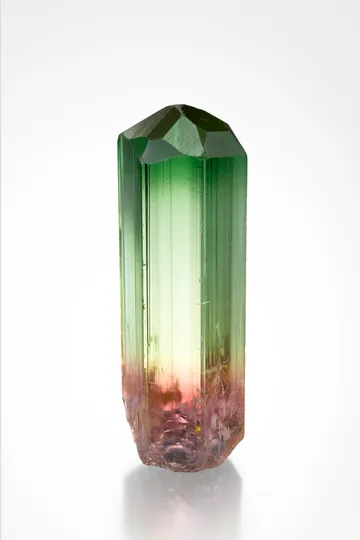
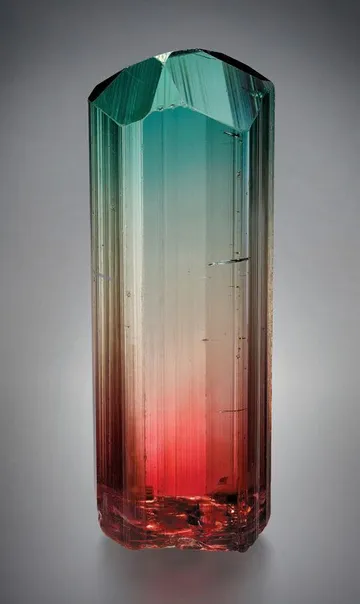
North Kivu’s collector significance rests on an unusual pairing: young, market-shaking gem tourmaline from rare-element pegmatites in Masisi Territory, and classic niobium minerals from the Lueshe carbonatite in Rutshuru Territory. For specimen collectors, the headline locality is Rubaya, in the Bahunde area of Masisi, where highly fractionated, weathered LCT pegmatites long mined for coltan and cassiterite began yielding superb elbaite crystals in the 2010s. The best pieces have the look collectors hope for but rarely receive from a rough-gem mining district: transparent, lustrous, sharply terminated prisms in pink, red-pink, apple to mint green, blue-green, peach-brown, and bicolored or tricolored zoning, often with a bright internal glow along the c-axis.
Geologically, the province sits in the eastern DRC segment of the Central African tin-tantalum province, where Mesoproterozoic to early Neoproterozoic granite-related systems of the Kivu/Karagwe-Ankole realm generated cassiterite, columbite-tantalite, wolframite, tourmaline, lithium mica, quartz, feldspar, and related rare-element minerals. In Masisi, many workings are not romantic hard-rock adits but lateritic hillsides, pits, trenches, short tunnels, eluvial concentrations, and weathered pegmatite dykes. That is exactly why so many crystals reached the gem trade as broken rough, while only a minority survived as undamaged mineral specimens.
Regional View
Country View
The older mineralogical classic of North Kivu is Lueshe, a carbonatite-syenite complex north of Goma. Lueshe is not the source of the gem tourmalines that made Rubaya famous; it belongs to a different geological world, one of niobium-bearing carbonatite, pyrochlore-supergroup alteration, fenitization, apatite, REE minerals, and the type-locality species lueshite and hydropyrochlore. For the advanced collector, this gives North Kivu a double identity: modern gem elbaite for aesthetics, and rare niobate species for systematic depth.

Photo: Wikimedia Commons
Search for specimens: View all specimens from North Kivu, DR Congo
North Kivu is a province-level collecting locality, so good labels should name the actual sublocality whenever possible. For gem tourmaline, the crucial names are Rubaya, Rukaza-Rubaya, Bahunde, and Masisi Territory; older and trade labels may simply say “Goma,” because Goma is the export and trading city on the Rwanda border rather than the true pegmatite source. For niobium-systematic minerals, the key locality is Lueshe Mine, Bwito, Rutshuru Territory, historically also written Lweshe.
The Rubaya-Masisi tourmaline district is tied to rare-element pegmatites and their eluvial to lateritic breakdown products. The ore minerals that drive mining are columbite-tantalite and cassiterite, with tourmaline recovered as both by-product and, during periods of strong gemstone demand, as a target in its own right. Mindat’s Rubaya locality notes numerous artisanal pits, trenches, and short tunnels dug through laterite, in places reaching unaltered pegmatite dyke material. The documented mineral suite includes albite, cleavelandite, quartz, cassiterite, columbite-tantalite, elbaite, lepidolite, microlite-group minerals, pegmatite, laterite, and tourmaline.
The broader geological framework is the tin-granite and pegmatite province of eastern Congo. Reviews of the Kivu Belt describe economically important mineralization associated with late Kibaran to early Neoproterozoic G4 granites, which are linked with cassiterite, columbite-group minerals, wolframite, tourmaline, and associated minerals such as beryl and spodumene in parts of the belt. In North Kivu specifically, the Masisi district lies northwest of Lake Kivu, with host rocks assigned to K3 and K4 units and mineralization dominated by cassiterite, columbite-group minerals, wolframite, and tourmaline. Columbite-group minerals from Mutiko in the Masisi district have been dated at about 950 Ma, a useful anchor for the late rare-metal mineralization of the district.
The Rubaya mines, also known as the Bibatama Mining Concession, include named sites such as Bibatama D2, Luwowo or Lowowo, Gakombe D4, Koyi, Mataba D2, Bundjali, and Bibatama D3. The official concession history is complex. The Société Minière de Bisunzu, or SMB, formerly Mwangachuchu Hizi International, has been the principal company name attached to the concession, while artisanal production has been associated with COOPERAMMA and other local mining structures. The area has alternated between semi-industrial and artisanal working, with mechanical mining reported at D2 Bibatama and hand mining, washing, sorting, crushing, bagging, tagging, and transport to Goma forming the practical chain for much of the coltan economy.
Gem tourmaline entered the literature before most collectors understood the locality. IPIS fieldwork in 2015 treated Masisi in North Kivu and Kalehe in South Kivu as the two principal tourmaline-producing localities in the Kivus. Rwangara/Shakubangwa, south-southeast of Ngungu, became important during a 2014 artisanal rush known locally as “the Boom.” By September 2015, worker numbers had fallen sharply, but the site still had a support village, hillside workings, washing activity below the workings, and trader traffic linking it with Goma, Numbi, and Lumbishi. The Journal of Gemmology later recorded that gem tourmaline had been mined in the Rwangara area since about 2004, with several tonnes of mostly bead- and cabochon-grade greenish blue material reportedly recovered, while Rubaya produced better-quality facetable and specimen-grade material in 2017.
The 2017 Rubaya production is one of the key episodes in the modern collector story. Initial output in June consisted of several kilograms of crystals, commonly tricolored green, pale yellow, and brownish pink, or bicolored light and dark green. From late June to August, additional tricolored crystals and some blue-green tourmaline were produced. Some tens of kilograms reportedly came out, and many crystals had excellent transparency, with the largest clean pieces around 100 grams. September and October production shifted toward peachy to brownish pink and pale brownish green, and although those colors were less desirable as cutting material, some fine crystal specimens emerged.
Collecting access today should be understood as commercial rather than recreational. These are active or recently active mining zones in a conflict-affected province, not field-collecting destinations for foreign mineral collectors. Access, security, legality, mine ownership, traceability, and export documentation are all serious matters. Since April 2024, Rubaya has repeatedly appeared in international reporting and UN expert material because of armed-group control, mineral smuggling risk, and disrupted traceability. In 2026, lethal landslides and collapses at Rubaya reinforced the danger of unregulated work in steep, saturated, hand-dug coltan workings. Collectors should therefore treat ethical provenance, chain of custody, and honest sublocality labelling as part of the specimen itself, not as afterthoughts.
Lueshe, by contrast, is a niobium carbonatite locality. The complex is described as an oval intrusion about 2 by 3 km, emplaced in Precambrian quartzites and garnet-, biotite-, and kyanite-bearing schists, with syenites, carbonatites, minor pyroxenites, and a fenite aureole. Lateritic niobium ore formed above the carbonatite, and pyrochlore concentrates were mined for niobium. The locality produced lueshite, NaNbO3, the sodium niobate named for Lueshe, as well as hydropyrochlore, pyrochlore-supergroup minerals, fersmite, monazite-(Ce), parisite-(Ce), phlogopite, apatite-rich material, and other carbonatite assemblage minerals. Unlike Rubaya elbaite, Lueshe specimens are usually small, dark, rare-mineral pieces for the systematic cabinet.
North Kivu elbaite specimens known to collectors overwhelmingly mean the Rubaya-Masisi production, especially crystals once sold under the vague trade label “Goma” but now better placed at Rukaza-Rubaya, Bahunde, Masisi Territory. The best examples are single prisms or small clusters rather than matrix pieces: transparent to gemmy, strongly lustrous, and sharply terminated, with pink to red-pink, green, blue-green, peach-brown, and bicolored to tricolored zoning; reported sizes range from thumbnail and miniature crystals through small-cabinet pieces, with gem rough documented up to roughly 100 g clean pieces during the 2017 Rubaya output. Associations are those of weathered LCT pegmatite and eluvial ore—quartz, albite/cleavelandite, lepidolite, cassiterite, columbite-tantalite, and microlite-group minerals—but fine matrix specimens are much less common than loose crystals because mining was directed at coltan and gem rough. The difference between an ordinary Rubaya elbaite and a serious one is not just color: it is complete termination, uninterrupted prism faces, high transparency, crisp zoning that remains visible in transmitted light, and minimal basal bruising from extraction.
“Tourmaline” on a North Kivu specimen label should be read critically, because some specimens are species-confirmed elbaite while others remain group-level or trade-labelled material from Masisi. The district has produced greenish blue, pale green, near-colourless to pale brownish pink, brownish red, peachy, brownish pink, and multicolored crystals from Rwangara and Rubaya, with Rwangara known earlier for large quantities of mostly cabochon- and bead-grade material and Rubaya celebrated for clearer, sharper, more specimen-worthy crystals from 2017 onward. The Journal of Gemmology reported chemical work on Rubaya blue-green samples showing likely calcium-bearing elbaite with iron as the main chromophore and no detected copper, while Rwangara samples were elbaite with some liddicoatite component. Good North Kivu tourmaline group specimens are therefore valued for gem clarity, saturated but open color, clean longitudinal zoning, and natural crystal completeness, while darker, fractured, bead-grade, contact-broken, or nondescript green crystals are far more ordinary.
Other documented North Kivu minerals greatly broaden the province beyond gem tourmaline. At Rubaya, the important associated minerals are cassiterite, columbite-tantalite, microlite-group minerals, lepidolite, albite, cleavelandite, quartz, pegmatite, and laterite. At Lueshe, the systematic collector encounters an entirely different suite: lueshite and hydropyrochlore are both type-locality minerals there; pyrochlore-supergroup minerals, fersmite, goethite, hematite, jarosite, kaolinite, kyanite, magnesite, magnetite, microcline, monazite-(Ce), montmorillonite, nacrite, parisite-(Ce), phlogopite, pyrrhotite, and related carbonatite and fenite minerals are recorded from the mine. Lueshite crystals are small but important, typically black to metallic-looking pseudocubic crystals, while hydropyrochlore from the type locality is known as greenish octahedra in residual soils above the carbonatite.
The most common locality problem is mislabelling. Many fine crystals that circulated as “Goma tourmaline” are more accurately Rubaya or Rukaza-Rubaya, Bahunde, Masisi Territory, North Kivu. “Goma” should usually be regarded as a trading/export label unless the specimen has older documentation that explains the usage. Likewise, “Congo tourmaline” is too broad for a serious label; North Kivu Rubaya material should not be confused with South Kivu/Numbi material, Tanganyika/Manono-region material, or unrelated African tourmalines that enter the same cutting centers.
Species naming deserves care. Fine colored tourmaline from Rubaya is commonly elbaite, but not every “tourmaline” label is an analytical determination. Where price is high, ask whether the specimen has been tested, especially if it is being sold with varietal claims such as rubellite, indicolite, liddicoatite, or Paraíba-type. Published testing of limited Rubaya blue-green material did not detect copper, so a claim of copper-bearing “Paraíba” North Kivu tourmaline should be treated as a laboratory question, not a sales adjective.
Condition is the decisive value factor. These crystals were produced in mining environments aimed at coltan and gem rough, not at careful specimen extraction. Expect broken bases, bruised terminations, nicked prism edges, contact marks, internal stress cracks, and crystals trimmed from larger rough pieces. Repairs are plausible on multicolored crystals and clusters, especially where side crystals or terminations create obvious value jumps. Use magnification and strong oblique light to check glue lines, polished-away chips, resin-filled fractures, rebuilt terminations, and colorless adhesive at the base of side crystals.
Treatment concerns are mostly gem-market concerns, but they matter when faceted stones accompany specimen lots or when crystals are unusually light-colored. Rwangara material was reportedly tested for irradiation, with light stones turning unattractive brownish yellow rather than improving. That does not establish routine treatment of North Kivu crystals, but it does show that treatment experimentation occurred in the trade. For mineral specimens, the larger risks are repair, polishing, trimming, and incomplete locality information rather than routine color enhancement.
Matrix pieces from Rubaya are scarce enough to merit extra scrutiny. A loose crystal on quartz or feldspar is not automatically suspicious, but Rubaya’s specimen habit in commerce is overwhelmingly loose crystal or cluster. Examine matrix attachments for glue, matching contact surfaces, unnatural clay packing, and inconsistent weathering. Conversely, a verified natural matrix specimen with clean crystal attachment can be much more significant than a comparable loose crystal.
Lueshe material presents different handling issues. Lueshite, hydropyrochlore, pyrochlore-supergroup minerals, and related carbonatite specimens are commonly small, sometimes friable, and often embedded in altered carbonatite or lateritic material. Some niobium and REE carbonatite specimens may contain uranium- or thorium-bearing phases, so prudent collectors store them labelled, avoid grinding or creating dust, wash hands after handling, and keep small radioactive-systematic specimens away from sleeping areas and children. The aesthetic market for Lueshe is narrow, but the systematic market is strong because of the type-locality status and the relative scarcity of sharp crystals.
Market availability is uneven. Rubaya elbaite is visible on the modern market, including high-end single crystals, but top pieces are far less common than cuttable fragments and lower-grade tourmaline. The finest examples—gemmy, undamaged, well terminated, strongly colored, and accurately labelled—are already recognized as modern classics. Lueshe lueshite and hydropyrochlore appear sporadically and usually in small sizes; fine, sharp, well-provenanced crystals should be bought on quality and documentation rather than size alone.
The Rwangara/Shakubangwa tourmaline story reads like a sudden mineral rush compressed into a few highland paths. In September 2015, field researchers travelling from Goma drove about 60 km by 4x4 into the Masisi highlands to Ngungu, passed state-service roadblocks at Mubambiro, Sake, and Karuba, then continued by motorbike and on foot. The mine itself had no road access. From Ngungu, one route required a 6 km motorbike ride to Luzirantaka village, followed by a one-hour walk along the Luzirantaka River to a hilltop elevation of 2,719 meters. Below the workings, the river area doubled as a trading and washing point, with bags of sand carried down from the hill and washed by women.
The “Boom” at Rwangara/Shakubangwa peaked around September 2014. At its height, the site was said to support roughly 3,000 to 4,000 dependants, including about 400 to 700 artisanal workers and hundreds of people trading stones locally. By the time researchers visited in September 2015, the scene had contracted dramatically: around 50 to 60 diggers were seen working during the mid-week visit, while the broader digger count was said to have dropped from around 700 to around 100. Local traders described the 2014 trade as numbering in the hundreds, with petty traders, small traders, intermediate traders, and buyers from Goma and Numbi all coming into the orbit of the hill.
The same boom carried darker details. Mining was described as chaotic, and reports included children on site, local FARDC involvement, and night exploitation. In 2014, some Mining Police were said to have pushed miners to work after dark so that the most productive pits could be accessed and the best stones collected. Tensions between pit captains and police reportedly escalated, and a miner was killed. By December 2014, after talks involving the local cooperative TUUNGANE, a new POLIMINES contingent was deployed, and stakeholders said the night exploitation problem ended.
Even the measures meant to keep children out were strikingly physical. At Rwangara/Shakubangwa, the team was told women were generally forbidden from entering because children tended to follow them. When the legal distinction was explained—that mining law barred pregnant women from mining rather than all women—the team was told that efforts were underway to create a moat children could not jump. The researchers saw this moat work near the bottom of the site, close to the trading point where women were mainly located.
The 2017 Rubaya production brought the specimen world’s attention sharply back to Masisi. Rough dealer Farooq Hashmi reported that in June 2017, Rubaya began producing several kilograms of crystals, many of them tricolored green, pale yellow, and brownish pink or bicolored light and dark green. From late June to August, additional tricolored crystals appeared, along with blue-green material. The total production was described in tens of kilograms, with many crystals of excellent transparency and the largest clean pieces around 100 grams. By September, the color shifted toward peachy and brownish pink, then darker material in October. For faceters, the later colors were less desirable; for mineral collectors, some of those same crystals had the form, luster, and completeness to become specimens rather than disappear into parcels of rough.
Rubaya’s more recent history is inseparable from the larger conflict-minerals story. International reporting and UN expert material describe Rubaya as one of the world’s most important coltan sources, under M23/AFC control from 2024 onward, with traceability systems disrupted and smuggling risks rising. In 2026, landslides and mine collapses at Rubaya were reported to have killed more than 200 people in at least one major incident, with heavy rain, hand-dug workings, and rebel control all part of the grim context. For collectors, those events are not background noise. They are part of the locality record, and they make responsible sourcing, documentation, and refusal of dubious supply chains part of the ethics of owning North Kivu material.
Lueshe’s story is older and more mineralogical, centered on a carbonatite rather than a pegmatite rush. Alexandre Safiannikoff named lueshite from the Lueshe locality in 1959, fixing North Kivu permanently in the literature of rare niobates. Subsequent work on Lueshe pyrochlore and weathered carbonatite showed a complex alteration history in which primary carbonatite minerals were modified by hydrothermal and supergene processes. To the collector holding a 5 mm black lueshite crystal, the locality may seem modest; to a mineralogist, it is a named point in the evolution of pyrochlore-supergroup nomenclature, niobium ore geology, and carbonatite weathering.