A collector's guide to Lupoto Mine, DR Congo: its geology, mining history and notable minerals, illustrated with the 39 specimens documented from this locality on EarthWonders.
Key facts
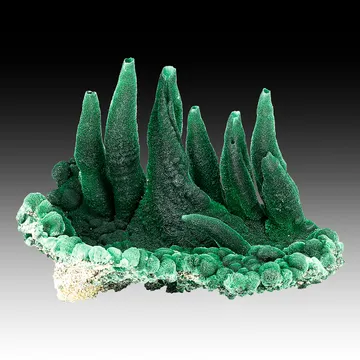
Lupoto is one of those modern Katanga localities whose reputation among collectors rests less on sheer output than on a single, instantly recognizable specimen style: turquoise-blue chrysocolla preserving earlier crystal architecture in sculptural sprays, jackstraw clusters, hollow blades, and little finger-like groups on dark gossan. The mine belongs to the great Central African Copperbelt, in the Haut-Katanga copper-cobalt province, and its collector minerals are the supergene expression of a much larger industrial ore system. In specimen terms, Lupoto matters because it produced some of the most memorable recent chrysocolla pseudomorphs from the Democratic Republic of the Congo—pieces in which azurite-like or barite/gypsum-like forms were replaced or coated through malachite and finally chrysocolla, sometimes finished with sparkling drusy quartz.
Regional View
Country View
Geologically, Lupoto sits within the Katangan copper-cobalt belt, where Neoproterozoic Roan Group / Mines Subgroup rocks have been folded, dismembered, and locally preserved as mineralized blocks and rafts in a structurally complex belt. The Kalumines ground around Lupoto was described by TEAL as a wide, kite-shaped anticline cored by Roches Argilo-Talcqueuse and containing numerous rafts of Mine Series rocks. For collectors, that industrial language translates into a familiar Katanga story: sulfide copper-cobalt mineralization near the primary zone, oxidized and transition-zone assemblages nearer surface, and open spaces in gossanized ore where copper was remobilized into malachite, chrysocolla, and related secondary species.
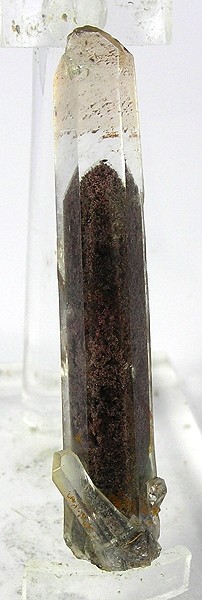
Photo: Wikimedia Commons
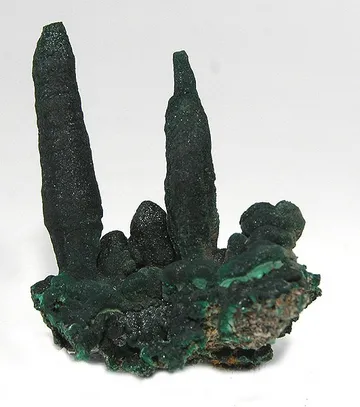
The best Lupoto specimens are not the massive, botryoidal chrysocolla that collectors know from many copper deposits. They are delicate pseudomorphic objects: free-standing blue-green blades, hollow casts, and velvety acicular coatings that retain the memory of earlier crystals. Good pieces are judged by the clarity of the pseudomorph, the saturation of the blue, the amount of intact three-dimensional form, the presence of contrasting malachite or quartz, and—most critically—the absence of broken tips in a material that is inherently fragile.
Search for specimens: View all specimens from Lupoto Mine, DR Congo
The specimen locality is the Lupoto Mine at Kakumba, Kipushi Territory, Haut-Katanga, in the Katanga Copper Crescent. Published locality records place it near 11° 36' S, 27° 15' E, in the broader Lubumbashi–Kipushi copper-cobalt district. In company and mining literature it is most often discussed as part of the Kalumines or Kasonta-Lupoto property, not to be confused with every later corporate use of the name “Lupoto” for nearby exploration ground.
The deposit is an industrial copper-cobalt orebody hosted in the Katangan succession. TEAL’s 2007 drilling update described the Kalumines area as a 77 km2 licence about 25 km northwest of Lubumbashi, containing near-surface copper occurrences at Lupoto, Kasonta, Niamumenda, and Karavia. The same report described the prospect area as a broad anticline cored by RAT rocks and carrying more than 26 km of Mine Series-rock strike in rafts. ARM’s 2008 resource statement described the copper-cobalt mineralization at Lupoto as transgressive across several Series des Mines units, averaging about 25 m thick and dipping steeply, between roughly 90 and 65 degrees.
The old exploration history is unusually well documented for a specimen-producing locality. UMHK and Gécamines drilled Lupoto between 1923 and 1967, with further drilling reported up to 1977. TEAL later twinned and infilled parts of that older work, including reverse-circulation and diamond drilling during 2007. Historic Gécamines figures gave Lupoto an inferred resource of 6.70 million tonnes at 3.13% total copper; later TEAL/ARM reporting gave a larger resource model, including indicated and inferred categories at lower average grades, and described a first open-pit phase with hand sorting and screening.
Mining started in the modern phase in May 2007 under TEAL and Gécamines. The initial operation was small open-pit mining, ramping toward about 110,000 m3 per month, with copper ore concentrated by hand sorting and a mechanized screening plant before toll treatment in Lubumbashi furnaces. A TEAL release described a planned electric arc furnace intended to make “black copper” ingots grading up to 95% copper. USGS reporting for 2008 recorded the Luputo/Lupoto operation as having begun in May 2007, with expected 2008 production of copper in concentrate and a feasibility study then underway for a larger operation.
Ownership and operating control changed after the first TEAL period. Kalumines began as a Gécamines joint venture with TEAL, later involving ARM and Vale interests, before Gécamines moved back toward control. By 2014, Congolese reporting described Luna Mining as having entered a partnership with Gécamines for exploitation of the Lupoto quarry. Later technical and transparency reporting refers to treatment of Kalumines material and tailings through arrangements involving Luna Mining, Trafigura, and Gécamines. For collectors, the practical result is simple: this is not a casual collecting locality. Access is industrial, rights-controlled, and politically and logistically complex; specimens reaching the market have come through mine-related production, local recovery, dealers, and older collection dispersals rather than ordinary visitor collecting.
The specimen-producing pockets appear to have been in oxidized gossanous material associated with near-surface copper mineralization. Dealer records and Mindat photo descriptions repeatedly describe dark crumbly gossan matrix, malachite pseudomorphs, chrysocolla coatings, hollow casts, and in some cases drusy quartz. The most famous finds are generally described by the trade as a limited, one-time or short-lived discovery around the early-to-mid 2010s, with some records specifically citing 2010, 2013, or 2015 depending on which lot or wave of material is being discussed. The strongest pieces from those finds show free-standing azurite-like blades or barite/gypsum-like forms in crisp relief, rather than nondescript blue crusts.
Chrysocolla is the signature collector mineral of Lupoto, especially as brilliant turquoise to blue-green pseudomorphs and coatings on malachite after earlier bladed or prismatic crystals. The finest examples are not smooth massive chrysocolla but tiny acicular to velvety crystalline coatings that preserve sharp crystal outlines, hollow casts, and three-dimensional sprays on gossan; dealer and collection records document thumbnails through cabinet specimens, with notable examples around 3–11 cm and individual blades reported to several centimeters long. Associations include malachite, residual or interpreted azurite forms, heterogenite in some specimen records, drusy quartz, and dark iron-rich matrix. The most desirable Lupoto chrysocolla pieces have saturated blue color, intact free-standing forms, visible multistage pseudomorphism, and no distracting broken blades; ordinary pieces tend to be flatter, crustier, greener, or visibly chipped.
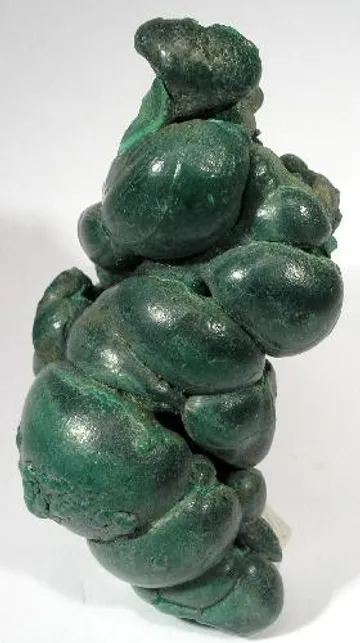
Malachite from Lupoto is important both as a visible mineral and as the crucial middle act in the locality’s famous pseudomorph sequence. It occurs as green coatings, cores, remnants inside broken casts, fibrous masses, and malachite pseudomorphs after earlier azurite-like blades; some specimens show chrysocolla over malachite so thoroughly that only a green interior or edge betrays the intermediate generation. Small cabinet examples around 5–6 cm are common in trade records, while larger clusters are scarcer and usually valued for the crispness of their preserved former crystal form. Better Lupoto malachites show strong emerald-green contrast against sky-blue chrysocolla or white quartz and retain recognizable bladed or stalactitic structure; lesser pieces are massive, rubbed, or poorly distinguished from generic Katanga malachite.
Azurite at Lupoto is best understood through absence and memory: the celebrated specimens rarely present as fresh, lustrous azurite crystals, but many preserve what collectors and dealers interpret as original azurite crystal geometry after later replacement by malachite and chrysocolla. The locality’s azurite interest is therefore pseudomorphic, expressed in bladed, prismatic, jackstraw, or free-standing forms that resemble former azurite, with occasional reports of residual material or azurite associations in photo data. Size ranges in the market run from miniatures to cabinet specimens, with individual former crystal forms reported around 2.5–6.2 cm in exceptional pieces. The best “azurite” examples from Lupoto are those where the former azurite shape is unmistakable, sharply retained, and aesthetically arranged; buyers should be cautious with labels implying abundant unreplaced azurite unless the specimen shows clear evidence or has analytical support.
Gypsum is recorded in the Lupoto specimen world chiefly as a proposed precursor in pseudomorph labels—“chrysocolla after gypsum” or “chrysocolla/malachite after gypsum”—rather than as a major suite of collectible transparent gypsum crystals. Some Lupoto pieces show bright blue, fuzzy chrysocolla preserving forms described as gypsum-like on dark crumbly matrix, and EarthWonders records include drusy milky quartz on chrysocolla, malachite, and ajoite-labelled material as pseudomorphs after gypsum. Trade descriptions commonly place these specimens in the 5–10 cm range, with associations of chrysocolla, malachite, quartz, and sometimes heterogenite or ajoite-labelled material. The best pieces are those whose former gypsum-like habit is coherent and fully terminated, with vivid blue color and minimal chipping; ordinary examples are hard to separate from the broader, and sometimes debated, Lupoto population labelled after azurite, barite, heterogenite, or gypsum.
Other documented or reported Lupoto minerals require careful wording. Mindat’s principal locality list confirms chrysocolla, malachite, quartz, and a chlorite-group mineral, the latter noted as green inclusions forming phantoms in quartz. Hematite appears in specimen-photo descriptions with quartz and chlorite phantoms, while heterogenite appears in some collector specimen records associated with chrysocolla and malachite. Baryte is repeatedly invoked by dealers and museum displays as a likely or possible precursor for some pseudomorphs, and one museum page specifically titles a Lupoto specimen as chrysocolla pseudomorph after baryte. Ajoite is the most delicate name here: some individual specimen records and older labels use it, including a reported analysis cited in a Mindat photo description, but Mindat’s own ajoite locality discussion has warned that material labelled ajoite from Luputo/Lupoto was later considered chrysocolla and that no ajoite had been confirmed there. No type-locality mineral is established for Lupoto in the sources consulted.
Lupoto specimens demand sharper label scrutiny than most Congo copper secondaries. The principal issue is not whether the piece is from a copper deposit—its look is distinctive—but what, exactly, the pseudomorph is after and what the blue mineral should be called. The same visual family has been sold as chrysocolla after azurite, chrysocolla after malachite after azurite, chrysocolla after barite, chrysocolla after gypsum, chrysocolla/malachite after an unknown mineral, and occasionally as ajoite. For most collectors, “chrysocolla on or after malachite, probably after azurite/barite/gypsum” is safer than an overconfident label unless the specimen comes with analysis or a strong old provenance.
The most persistent authenticity concern is misidentification, especially ajoite. True ajoite carries a premium because collectors associate it with Ajo, Arizona, and Messina/Musina, South Africa. Lupoto material labelled ajoite should be treated as provisional unless analytical paperwork accompanies the specimen. Chrysocolla and malachite can also be confused visually when coatings are velvety, matte, or pale; malachite will react with acid, chrysocolla generally will not, but destructive testing is inappropriate for good specimens and should never be done on display faces.
Condition is the second major issue. The best Lupoto pieces are airy, light, and often hollow. Broken blades, bruised terminations, rubbed blue coatings, and losses along the display edge are common. Some pieces show dark or brown gossan contact points where the specimen grew against pocket wall; these should not automatically be treated as damage. Conversely, freshly exposed green interiors on blade tips may reveal actual breaks through chrysocolla into malachite. Because many examples were mounted on acrylic bases by dealers, inspect for glue, repaired contact points, and whether the base hides damage or instability.
Treatment issues are not widely documented for Lupoto specifically, but the material is porous and can be visually improved by wetting, oiling, or overly saturated photography. Ask for daylight or neutral-light images if the color looks impossibly electric. Avoid soaking, ultrasonic cleaning, acid testing, and aggressive brushing. Chrysocolla is softer and more brittle than azurite or malachite in many specimen contexts, and gossan matrix may shed grains. Store specimens away from repeated handling, and support free-standing sprays with a custom base rather than letting them rattle loose in a box.
Market availability is intermittent. Common small Lupoto pseudomorphs appear regularly enough through dealer inventories, auctions, and collection resales, but sharp, three-dimensional examples from the early find are much scarcer than generic “Congo chrysocolla.” Documented auction and dealer records show miniatures and small cabinets selling from under a few hundred dollars into higher ranges when form, color, and condition are strong. The very best examples—large, intact, sculptural, vividly blue, with quartz sparkle or exceptional hollow crystal architecture—are now collection pieces rather than routine stock.
The collector story of Lupoto begins with industry, not show cabinets. UMHK and Gécamines drilled the ground for decades, from the 1920s through the late 1960s, and the modern TEAL program returned to that old data with a classic verification campaign: twin the old holes, tighten the drill spacing, model the ore, and start a rapid-entry open pit where surface mineralization was strongest. In 2007 the operation was still raw and physical—ore selected by hand, a screening plant being installed, concentrates sent to Lubumbashi furnaces while TEAL prepared its own furnace for black copper ingots. Somewhere in that near-surface oxidized material, the pockets that would interest collectors most were forming a very different kind of value: fragile blue casts and pseudomorphs that industrial mining would regard only as bits of copper ore.
Then came the specimen find that made Lupoto famous. Dealers describe the best material as an isolated discovery around the early-to-mid 2010s. One auction record says the pieces were discovered in mid-2010 and quickly disappeared; another says they began showing up around 2013; several trade listings tie especially fine azurite-form pieces to a 2015 wave. The differences probably reflect how material filtered from mine to dealer to Tucson table, but the collector memory is consistent: the pieces landed with impact. They were not just blue; they preserved a sequence. First there had been blades—perhaps azurite, perhaps baryte or gypsum in some cases. Then malachite took the form. Then chrysocolla arrived as the final blue skin, sometimes as minute acicular crystals visible under magnification. In the best examples, the malachite dissolved partly away, leaving hollow chrysocolla casts like mineral architecture emptied from within.
A few descriptions from old dealer records read like field notes from the specimen market. One cabinet piece measured 10.8 x 6.7 x 6.3 cm, with free-standing casts up to 2.5 cm. Another, 9.1 x 8.1 x 5.9 cm, preserved sharp crystal forms with broken sections revealing malachite cores and hollow interiors. A particularly strong specimen was described with crystal forms up to 6.2 cm, an exceptional size for the find. Collectors remember these not as ordinary secondary copper pieces but as pseudomorph specimens where each stage of alteration is legible: form from azurite or another bladed mineral, green carbonate preservation by malachite, blue silicate finish by chrysocolla.
The mine’s human story is more difficult. In April 2014, Congolese news reported that more than twenty thousand artisanal miners had been ordered to leave the Lupoto quarry so Luna Mining, working with Gécamines, could begin exploitation. In August of the same year, Radio Okapi reported claims by artisanal miners that colleagues had been trapped in underground workings while road-tracing and hole-filling work was underway. A village chief said Luna Mining had warned of operations to close holes in the hills, but the number of people underground was not confirmed in that report. For collectors, this is not background color to romanticize; it is part of the reality behind many modern copperbelt specimens. Lupoto pieces sit at the intersection of industrial concessions, artisanal recovery, shifting corporate control, and a mineral trade that often receives the beauty but not the full story of extraction.