






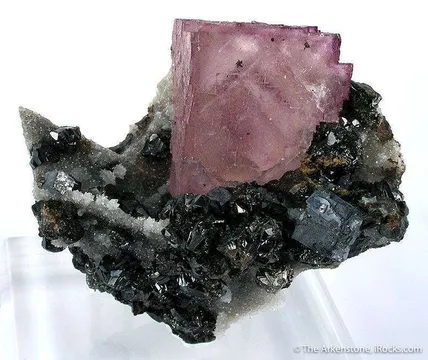
Illinois, USA: a diverse locality producing fluorite, calcite, galena, sphalerite, and pyrite, famed for Cave-in-Rock specimens and historic fluorspar mining.
Key facts
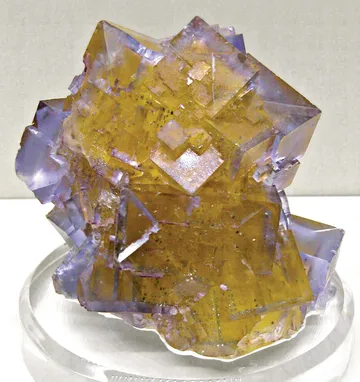
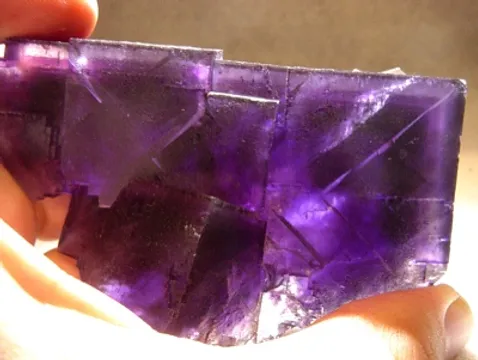
Illinois occupies an unusually large place in American mineral collecting because its best specimens come from three very different geological worlds. In the far south, the Illinois portion of the Illinois-Kentucky Fluorspar District made Hardin and Pope Counties synonymous with fluorite: sharply zoned yellow, blue, purple, and colorless cubes, commonly accompanied by calcite, sphalerite, galena, barite, witherite, and bitumen. In the northwest, Jo Daviess County and the Galena area belong to the Upper Mississippi Valley Lead-Zinc District, a classic Mississippi Valley-type province of galena, sphalerite, marcasite, pyrite, barite, dolomite, and calcite in Ordovician carbonate rocks. In the coal country around Sparta and Conant, flattened pyrite disks — historically sold as “marcasite suns,” “miners’ dollars,” or “pyrite dollars” — formed in thin organic-rich shale above Pennsylvanian coal seams and became one of the most recognizable mineral habits in the United States.
The collector’s image of Illinois is therefore not one specimen but a suite: gemmy Cave-in-Rock fluorite cubes with purple rims and golden cores; honey to white calcite perched on fluorite or lining carbonate cavities; heavy metallic galena cubes from old lead-zinc ground; dark reddish-brown sphalerite serving as matrix for fluorite; and brassy, radially striated pyrite suns from black Anna Shale. Illinois also matters historically. Fluorite became the official state mineral in 1965, and for much of the twentieth century southern Illinois was the principal domestic source of fluorspar. The last Illinois fluorspar mine closed in 1995, leaving the market dependent on old stocks, old collections, and occasional legally recovered material from private ground.
Regional View
Country View
The geological setting behind the southern Illinois classics is a heavily faulted margin of the Illinois Basin, where mineralizing fluids moved through Mississippian limestone and dolostone. The ore bodies were developed both as fissure veins along faults and as bedding-replacement or “blanket” deposits, especially in the Cave-in-Rock, Rosiclare, Harris Creek, Goose Creek, and related subdistricts. Collectors often speak casually of “Cave-in-Rock fluorite,” but many of the finest pieces came from named mines north and northwest of the village, including Minerva No. 1, Denton, Annabel Lee, Crystal, Victory, Deardorff, Green, Hill-Ledford, and others. Good old labels matter here because the district produced enough variation in color zoning, matrix, associated minerals, and crystal style that mine-level provenance can significantly affect both scientific and market interest.


Search for specimens: View all specimens from Illinois, USA
For collectors, “Illinois” is best understood as a state-level locality containing several specimen-producing provinces rather than a single mine or district. The dominant specimen province is southern Illinois, where the Illinois-Kentucky Fluorspar District occupies parts of Hardin, Pope, and adjacent counties and continues across the Ohio River into western Kentucky. The host rocks are Paleozoic sedimentary units of the Illinois Basin, with the most important southern Illinois ore deposits in Mississippian limestones and dolostones. Mineralization was concentrated in a complexly faulted area around the Rock Creek Graben, Hicks Dome, and associated fracture systems. The deposits are commonly described as a fluorite-rich subclass of Mississippi Valley-type mineralization, but the district is unusual because fluorite is not merely an accessory gangue mineral; it was the principal mined commodity.
The ore bodies occurred in two main forms. Fissure veins followed faults and fractures and were especially rich in calcite and fluorite, with quartz, galena, sphalerite, ferroan dolomite, pyrite, marcasite, barite, chalcopyrite, oil, and bitumen as recurring associates. Bedding-replacement deposits formed where mineralizing fluids selectively replaced favorable limestone horizons, creating pod-like or blanket-like ore bodies that could run along structural trends. In bedded ores, fluorite was the principal ore mineral; galena and sphalerite were locally abundant, and banded fluorite included the dark fine-grained layers known by miners as “coontail” spar. The best specimen pockets were open cavities, brecciated zones, and vugs where crystal faces could develop rather than massive ore replacing carbonate rock.
The timing and source of the southern Illinois mineralizing fluids have been debated for decades. Older models emphasized deep magmatic or hydrothermal sources; modern work gives a larger role to basinal brines expelled through the Illinois Basin, with fluorine and metals focused along faults and carbonate traps. Recent geochronology and petrologic studies at Hicks Dome and the surrounding district have strengthened the case for multiple mineralizing events, including an early Permian event around 270–277 million years ago and later overprinting in parts of the system. For specimen collectors, the practical expression of that complex history is the repeated opening, sealing, brecciation, and re-opening of cavities: fluorite on calcite, calcite on fluorite, sulfides included in or perched upon fluorite, hydrocarbons trapped in crystals, and late barite or witherite occupying spaces left by earlier stages.
Mining began in the district as lead prospecting and later shifted decisively toward fluorspar. Fluorite was reportedly found in Illinois in the 1830s and mined by the 1840s, but at first it was often discarded because the market for fluorspar was limited. Industrial demand changed that: fluorspar became important as a flux in steelmaking and as feedstock for hydrofluoric acid and fluorine chemistry. Rosiclare and Cave-in-Rock became the names known to miners, geologists, and collectors. Operators changed over time, but important names include Rosiclare Lead and Fluorspar Mining Company, Minerva Oil Company, Ozark-Mahoning Company, Aluminum Company of America, Penwalt, and Atochem North America. By the late twentieth century the industry was fighting cheaper foreign supply and the high cost of deep underground mining. The last major Illinois fluorspar operations ceased in the 1990s, and no production has occurred from the Minerva mine since 1995.
The Minerva No. 1 mine is central to collector history. It operated from the late 1940s into the 1990s, first under Minerva Oil Company and later under Ozark-Mahoning. It worked several levels, including the Rosiclare Level in the Aux Vases interval and the Bethel Level. The mine’s hoisting shaft was reported at 645 feet, and it became famous not only for fluorite but for sphalerite, barite, witherite, alstonite, and benstonite. The Denton mine opened the Harris Creek subdistrict and produced bedding-replacement ore in the Rosiclare and sub-Rosiclare levels; it is one of the great names on labels for purple fluorite, fluorite with sphalerite, and calcite-bearing combinations. The Annabel Lee mine, northeast of Denton, operated from the early 1980s until 1995 and mined narrow ore pods, commonly less than 100 feet wide, mainly in the Rosiclare Level with some Bethel Level ore. Its specimens include fluorite, barite, celestine, calcite, gypsum, and sphalerite; some calcite from the north orebody is described as more needle-like than material from the south orebody.
The Cave-in-Rock subdistrict produced some of the richest and most storied ore in the region. At the W.L. Davis-Deardorff mine, mine-run ore was reported to average 50 to 60 percent fluorite, 12 to 14 percent zinc, and 3 to 5 percent lead, and quartz was unusually abundant compared with many other Cave-in-Rock mines. The Green mines, Hill-Ledford mine, Oxford area, Crystal mine, Victory mine, and Goose Creek workings each added their own combinations of fluorite, calcite, sulfides, and barite. Many old specimens are labeled only “Cave-in-Rock District” or “Rosiclare,” and this is not necessarily wrong: miners, dealers, and early collectors often used district labels rather than mine names, especially when specimens passed through local rock shops, company employees, or dealers before modern locality standards became common.
Northwestern Illinois tells a different but equally important story. Around Galena in Jo Daviess County, the Illinois portion of the Upper Mississippi Valley Lead-Zinc District produced galena and sphalerite from Ordovician limestone, dolomite, and shale. Galena gave the town its name and fueled one of the earliest major mineral rushes in the United States during the 1820s. In this district, sphalerite formed fracture fillings, bedding-plane veins, disseminations, and replacement bodies; galena occurred as vug-lining crystals, intergrowths with sphalerite, disseminated crystals, embedded crystals in marcasite, calcite, and barite, and thin to several-inch veins. Cubic galena is the classic habit, but octahedral faces and octahedra occur. Near-surface weathering produced secondary carbonates and oxides, including cerussite on galena and smithsonite after sphalerite, the latter historically known to miners as “dry bone.”
The third great Illinois specimen style is the pyrite sun from the coal mines around Sparta, Randolph County, and Conant in Perry County. These formed in Pennsylvanian-age rocks, especially the black, organic-rich Anna Shale just above the Herrin coal. In the Sparta area they were found roughly 200 to 250 feet below ground in coal mines, a few inches above the coal seam. The suns range from small disks to showy multi-inch specimens, with well-formed examples reaching 5 inches or more. Although long marketed as marcasite suns, analytical work and modern summaries emphasize that the classic disks are pyrite with minor marcasite rather than true marcasite-dominant specimens. Their restricted vertical growth between compacting shale layers gave them their flattened, radial form.
Collecting access today is limited and must be approached conservatively. The old fluorspar mines are underground industrial sites, commonly flooded, collapsed, reclaimed, or on private property. Mine dumps, quarry faces, creek exposures, and old roads in the district may contain fluorite or associated minerals, but land ownership, mineral rights, safety, and permission are decisive. Serious collectors should treat southern Illinois as an old-stock and permission-only locality, not an open collecting field. The same is true for Jo Daviess lead-zinc sites and active or former coal mines that produced pyrite suns. Legally obtained specimens usually come from old collections, estate material, former miners’ collections, reputable dealers, museum deaccession or exchange material, and occasional documented finds from private land with permission.
Illinois calcite ranges from common gangue to first-rate collector material, especially in the southern fluorspar district where it is one of the principal vein minerals and an essential associate of fluorite. In Cave-in-Rock and Harris Creek specimens it appears as white, cream, honey-brown, and colorless crystals; rhombohedral, scalenohedral, acicular, botryoidal, and drusy habits are all documented, with especially admired pieces from Denton, Annabel Lee, and the Bethel Level of Minerva No. 1. The most desirable specimens are not merely calcite from Illinois but calcite that records the district’s paragenesis: honey scalenohedra or white druses sharply perched on purple or yellow fluorite, botryoidal growths from open cavities, needle-like Annabel Lee material, or calcite crystals carrying petroleum or gas inclusions. Ordinary pieces are massive, bruised, iron-stained, or visually subordinate; good pieces have distinct crystal habit, clean luster, undamaged terminations, and a convincing fluorspar-district association.
Marcasite in Illinois has two collector meanings, and the distinction is important. In the southern fluorspar district it is a documented minor primary sulfide in veins and replacements with fluorite, calcite, galena, sphalerite, barite, pyrite, chalcopyrite, and bitumen, generally as small metallic coatings, aggregates, or cavity linings rather than the dominant display mineral. In coal-measure material from the Sparta area, older labels often say “marcasite sun,” but the classic flattened disks have been shown to be principally pyrite with minor marcasite; true marcasite content is nevertheless relevant because it can influence stability. The best Illinois marcasite-labeled specimens are therefore either analytically credible marcasite from sulfide-rich carbonate or shale settings, or historically labeled pyrite-sun pieces whose label is understood as old collector terminology. Fresh metallic luster, clear association, dry stability, and honest labeling separate desirable examples from unstable, powdering, or misidentified material.
Galena is historically foundational in Illinois: it named the city of Galena and anchored the early lead mining of Jo Daviess County, while also occurring as an important accessory and byproduct in the southern fluorspar district. Northwestern Illinois galena commonly forms cubes, cubes modified by octahedral faces, octahedral crystals, intergrowths with sphalerite, and crystals embedded in marcasite, calcite, or barite within the Upper Mississippi Valley Lead-Zinc District. Southern Illinois galena appears with fluorite, calcite, sphalerite, barite, quartz, pyrite, and chalcopyrite in both vein and bedding-replacement ore, but it is usually less visually dominant than the fluorite. Strong collector pieces show sharp metallic cubes or modified crystals with bright luster and clear association, especially on calcite, dolomite, fluorite, or sphalerite; ordinary ore fragments are heavy and historic but may be massive, dull, bruised, or coated by alteration products.
Illinois sphalerite is widespread in both the northwest lead-zinc district and the southern fluorspar district, but the finest collector associations are often from Cave-in-Rock-area mines where dark reddish-brown to nearly black sphalerite forms sparkling crystal aggregates and matrix for fluorite, calcite, galena, barite, and quartz. In the Upper Mississippi Valley district, sphalerite occurs as fracture fillings, bedding-plane veins, replacements, disseminations, and fibrous layers with crystals elongate perpendicular to the vein surface; colors include dark reddish brown, lighter brown, yellow, and purple. At Minerva No. 1 and related southern Illinois mines, sphalerite can be both ore and aesthetic matrix, and old specimens with lustrous sphalerite supporting blue, purple, or yellow fluorite have become much harder to replace since mining ceased. Good pieces show bright resinous to adamantine faces, visible crystal form, attractive contrast with fluorite or calcite, and minimal bruising; massive dark sphalerite without sparkle or association is more common.
Illinois pyrite is famous above all for Sparta-area pyrite suns: thin, flattened, radially crystallized disks from the Anna Shale above the Herrin coal in Pennsylvanian coal mines, commonly called pyrite dollars, miners’ dollars, or sun dollars. These specimens formed under severe vertical confinement in organic-rich shale, producing a habit utterly unlike ordinary pyrite cubes; showy examples are typically several inches across, with especially fine disks reaching 5 inches or more. Pyrite is also documented in the southern fluorspar district as a primary vein mineral, often with calcite, fluorite, quartz, galena, sphalerite, marcasite, barite, chalcopyrite, and bitumen, and in the Upper Mississippi Valley district with sphalerite, galena, marcasite, calcite, and barite. Collector-grade pyrite suns are complete, thin, lustrous, radially sharp, stable, and either clean floaters or naturally seated in shale; chipped rims, dull surfaces, shale smear, repairs, and decay lower desirability.
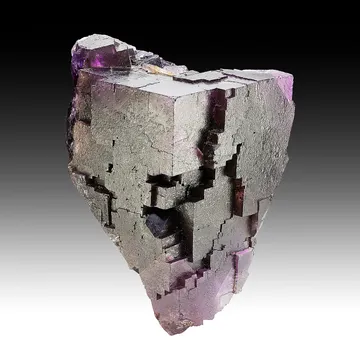
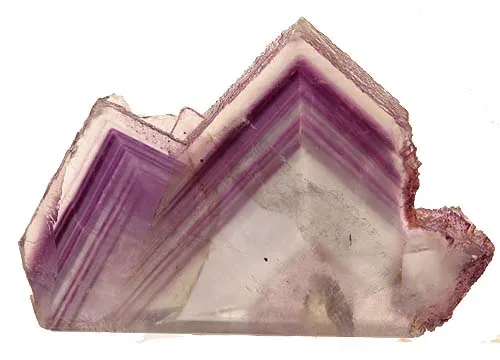
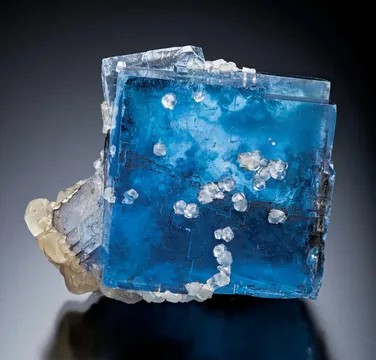
Other documented Illinois minerals deepen the state’s appeal far beyond the five species above. Fluorite is the emblematic Illinois mineral and the centerpiece of the southern district, with blue, purple, yellow, colorless, zoned, phantom, petroleum-included, and sulfide-associated specimens from Minerva No. 1, Denton, Annabel Lee, Crystal, Victory, Green, Deardorff, Hill-Ledford, and other mines. Barite, witherite, strontianite, celestine, quartz, dolomite, ankerite, chalcopyrite, gypsum, aragonite, malachite, cuprite, smithsonite, cerussite, pyromorphite, sulfur, stibnite, and hydrocarbon bitumen are all part of the southern fluorspar assemblage. The Minerva and Annabel Lee mines are particularly important for uncommon barium-carbonate species such as witherite, alstonite, benstonite, and paralstonite. Hicks Dome adds a more exotic layer of REE-Th-F-Ba-Nb-Be mineralization, with monazite, xenotime, florencite-group material, bastnäsite, synchysite, bertrandite, apatite, fluorite, barite, calcite, quartz, and sulfides recorded in breccias and related intrusions.
Illinois specimens reward careful labels. A piece marked only “Cave-in-Rock” may be entirely legitimate, but the phrase can refer broadly to the Cave-in-Rock mining subdistrict, the village area, or old dealer shorthand for the southern Illinois fluorspar district. Mine-level labels — Minerva No. 1, Denton, Annabel Lee, Deardorff, Crystal, Victory, Green, Hill-Ledford, Gaskins, Rosiclare, or Harris Creek — add value only when they are credible. Because many specimens were recovered by miners, sold through local rock shops, traded at shows, or dispersed from old collections, labels can be vague or later “upgraded” by guesswork. Treat precise mine attributions with interest but also with discipline: matrix, color zoning, associations, and crystal style should be compatible with the named mine, and old labels or collection history are worth preserving.
The most common mislabeling problem is not species but locality precision. Southern Illinois fluorite with sphalerite and calcite can resemble material from Tennessee or Kentucky to non-specialists, and old “Rosiclare” or “Cave-in-Rock” labels may conceal a more specific mine. Conversely, modern sellers sometimes over-specify mine names for district-labeled pieces because Minerva, Denton, and Annabel Lee command attention. Galena and sphalerite from Jo Daviess County can be confused with Wisconsin or Iowa Upper Mississippi Valley material if labels are lost. Pyrite suns are often mislabeled as marcasite suns; historically that wording is common, but mineralogically the classic Sparta disks should be treated as pyrite-dominant unless analysis proves otherwise.
Condition issues vary by assemblage. Fluorite from southern Illinois is relatively soft and cleaves perfectly, so bruised cube edges, cleaved corners, contacted backs, and repaired plates are common. Calcite is softer still and is easily bruised or etched; some oil- or gas-included Annabel Lee calcite has a history of internal stress and cleavage failure after removal from depth. Galena can lose brilliance through oxidation or handling and should be kept away from acids. Sphalerite is brittle and can chip along crystal edges. Pyrite suns and marcasite-bearing pieces demand dry, stable storage; any sulfur odor, powdering, white or greenish efflorescence, cracking shale, or staining of boxes and labels is a warning sign of sulfide decay.
Treatments and cleaning deserve scrutiny. Pyrite suns have often been mechanically trimmed, stabilized, acid-cleaned, or brightened; an unnaturally vivid iridescent surface should prompt questions about whether it is natural oxidation color or the result of chemical cleaning. Shale matrix on pyrite suns can be fragile and may not tolerate soaking, solvents, or humidity changes. Fluorite and calcite plates from the fluorspar district may have been acid-cleaned to remove carbonate, iron staining, or clay; careful cleaning can be acceptable, but over-cleaning can dull calcite, expose cleavages, or leave unnatural surfaces. Repaired fluorite corners and reattached crystals are not unusual on older cabinet pieces, especially large plates, and black-light examination plus close inspection of suspicious seams is prudent.
Fluorescence is a useful but uneven clue. Illinois fluorite may fluoresce blue to violet, and hydrocarbon inclusions can show a white response under ultraviolet light. Calcite from some district specimens can fluoresce, but response is not consistent enough to authenticate a locality by itself. Avoid using fluorescence as the sole basis for mine attribution. Instead, combine UV response with label history, mineral association, crystal habit, matrix, and provenance.
In the market, Illinois remains available but increasingly stratified. Small or imperfect fluorite, common calcite, massive galena, and modest pyrite suns are still encountered, but top-quality old-stock fluorite from the major southern Illinois mines is no longer easy to replace. Fine Denton or Minerva fluorite with strong color zoning, blue or purple phantoms, undamaged luster, and attractive calcite or sphalerite associations can command strong prices. Large, complete pyrite suns with crisp radial structure and stable shale matrix are also sought after. For serious collectors, the best Illinois purchases are pieces with both aesthetics and documentation: an old label, a named mine, a recognized collection, or a specimen history that predates the wave of modern locality guessing.
In May 1987, Alan Goldstein went underground at the Annabel Lee mine with photographer Chris Anderson and spent an entire eight-hour shift documenting the mine. Mine geologist Eric Livingston later suggested that it may have been the only time a full shift in any Illinois-Kentucky fluorspar mine had been recorded photographically. The descent itself gives the story its weight: the top of the mine was 868 feet above the working level, “almost 90 stories of rock” overhead, and the men rode the cage attached to the skip, the ore bucket that connected the underground world to daylight.
The photographs and notes from that shift read like a walk through the anatomy of a late twentieth-century fluorspar mine. The headframe, ore bins, compressor room, hoist operator, cage, jumbo drill, pole-mounted drill, front-end loader, ore hauler, grizzly, chute, roof bolts, and air ducts all appear as a working system built around narrow mineralized bodies far below Hardin County. One machine had been hauled underground in pieces and assembled in the workshop. The drill station was described simply as “the noisiest place on the planet,” a place where ear protection was not optional but critical. At one point the crew was 1,300 feet underground in the north orebody; elsewhere they worked the 900-foot level in the south orebody, inspecting pockets, drilling, scaling roof slabs, mucking ore, and watching fluorite disappear into the haulage stream.
The Annabel Lee was not a single cavernous treasure chamber. It mined two separate deposits hundreds of feet apart, and the shift moved between north and south orebodies with different textures and minerals. In the north, Goldstein inspected mine faces and pockets; in the south, he examined a large pocket of mostly broken fluorite crystals with a small amount of flowing water behind him. The white minerals in some faces were barite and calcite, with purple fluorite present but not always as clean crystals. On the roof of the south orebody, oil- and gas-filled calcite crystals were visible. Calcite in brecciated limestone and calcite on the roof recorded the same fractured, sealed, and reopened plumbing that made the district so productive.
One of the most memorable Annabel Lee episodes happened after the specimen reached the surface. Goldstein described a doubly terminated calcite crystal with a visible gas bubble. A day or two after collection, the crystal “exploded” along a cleavage plane, apparently as pressure changed from the 900-foot level to the surface. The townhouse smelled like an oil well until the doors were opened. That detail is easy to smile at, but it is also an unusually direct collector-scale reminder that some Illinois specimens are not inert decorations: they are pieces of a petroleum-bearing hydrothermal system, opened from depth and suddenly placed in a living room.
The pyrite suns of Sparta have their own folklore, born not in fluorite mines but in coal mines. They occur in black Anna Shale a few inches above the Herrin coal, where thin roof sheets could fall naturally or be pulled down for safety. The disks were once miners’ curiosities, saved from a material stream that otherwise treated them as waste. Their round, radial form makes them look biological, and many have been mistaken for fossils; Illinois State Museum material puts the correction bluntly — call them pyrite suns, pyrite dollars, miner’s dollars, or sun dollars, but do not call them fossils. The real story is mineralogical: iron and sulfur crystallized in a narrow, compacting layer, with growth forced outward into a flattened disk rather than upward into ordinary cubes.

_3_(42590140555).jpg)