






A collector's guide to Hill-Ledford Mine, USA: its geology, mining history and notable minerals, illustrated with the 44 specimens documented from this locality on EarthWonders.
Key facts
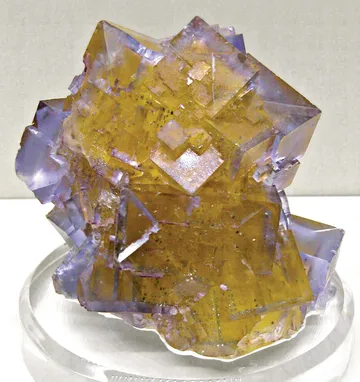
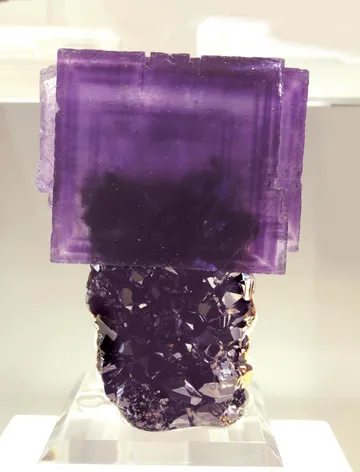
Hill-Ledford is one of the classic old-stock fluorite localities of the Cave-in-Rock subdistrict in Hardin County, southern Illinois, and its best specimens have the unmistakable mid-century Illinois look: deep grape-purple cubes, lustrous stepped faces, occasional blue tones, and a heavy sulfide association of galena and sphalerite, commonly with calcite or quartz. The mine belongs to the Illinois-Kentucky Fluorspar District, a fluorite-rich Mississippi Valley-type system in which mineralizing brines moved through Mississippian sedimentary rocks and localized ore along faults, collapse structures, bedding-replacement horizons, and solution features. At Hill-Ledford, the distinctive geological control was an oval brecciated collapse feature in and around the Aux Vases “Rosiclare” interval, interpreted as a feeder-pipe-related structure through which ore fluids rose before moving updip into receptive horizons.
For collectors, Hill-Ledford matters because it bridges two worlds: the industrial fluorspar mines that made southern Illinois famous, and the cabinet-specimen market that still prizes “Cave-in-Rock” fluorite decades after the major mines closed. Compared with the later Harris Creek mines, Hill-Ledford material is older, less frequently accompanied by precise pocket notes, and commonly labeled only as “Cave-in-Rock,” “Hardin County,” “Ozark-Mahoning,” or “Rosiclare/Sub-Rosiclare Level.” Well-documented Hill-Ledford pieces are therefore more valuable than their abundance in old collections might suggest.
Regional View
Country View
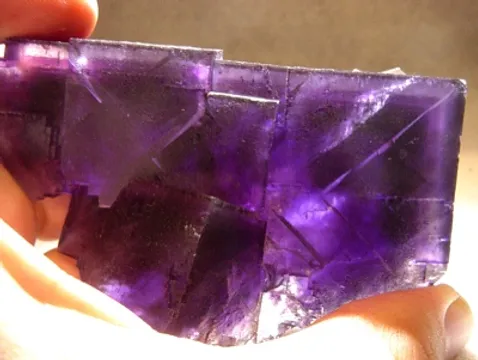
The finest Hill-Ledford fluorites are not delicate miniature curiosities; they are substantial, architectural Illinois specimens. Cubes can be large, blocky, and dark, with beveled, stepped, or etched faces that show the repeated dissolution and renewed deposition so characteristic of the district. The most desirable examples preserve sharp purple fluorite on contrasting metallic galena or resinous sphalerite, or show the unusual hollow and cast-like fluorite forms for which the mine has particular cachet.

Photo: Wikimedia Commons
Search for specimens: View all specimens from Hill-Ledford Mine, USA
Hill-Ledford Mine is in the Cave-in-Rock mining subdistrict of Hardin County, Illinois, north of the Ohio River and north of the town of Cave-in-Rock. It was an Ozark-Mahoning operation and appears in Illinois State Geological Survey mine-location records as the Ozark-Mahoning Company Hill-Ledford Lead & Fluorspar Mine, with a shaft in Section 23, Township 11 South, Range 9 East. The mine is part of the Illinois-Kentucky Fluorspar District, historically the great American source of fluorite and associated lead-zinc minerals.
The deposit is a bedding-replacement and collapse-controlled fluorspar orebody. Illinois State Geological Survey mapping places the mine north of the Oxford Mine and west of the Minerva Mine, along the west side of Illinois Route 1. Brecke’s structural work on the Cave-in-Rock district recognized an oval collapse structure at Hill-Ledford, expressed as an approximately 75-foot vertical offset in the Aux Vases Sandstone/Rosiclare interval. Later ISGS descriptions treat this collapse feature as a localized feeder-pipe-style conduit, similar in concept to the pipelike solution structure at the nearby North Green Mine.
Ore was present in more than one stratigraphic level. The main productive horizons included the upper Downeys Bluff Limestone, known in the mining literature as the Bethel Level, and horizons in the Ste. Genevieve Limestone, including Rosiclare and Sub-Rosiclare positions. Two parallel orebodies trended northeast-southwest, fitting the broader structural grain of the Cave-in-Rock subdistrict. Drilling beneath the mine floor showed sphalerite-fluorite mineralization extending more than 170 feet down into the collapse feature, a useful reminder that the attractive specimens collectors see today were only the showy edges of a much larger mineralizing system.
The C.N. Hill Shaft was started in July 1953, reached bottom in November 1956, and was followed by development work into March 1957. The shaft was concrete-lined to 110 feet and timbered below that to its 724-foot bottom. The mine operated from the late 1950s into the 1970s, a period when Ozark-Mahoning was one of the dominant operators in the district. Published Ozark-Mahoning records give Hill-Ledford production as 792,848 raw tons at 23% CaF2 and 1.6% Zn, placing it among the significant postwar mines of the Cave-in-Rock area, though not as specimen-famous as Minerva No. 1.
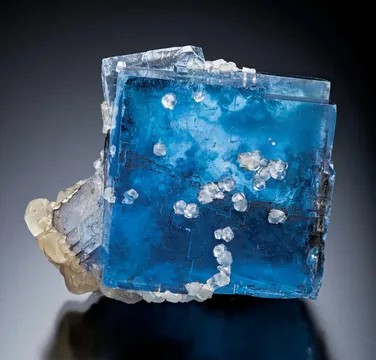
The specimen-producing levels most often attached to Hill-Ledford labels are the Rosiclare and Sub-Rosiclare levels, although experienced Illinois collectors warn that the two horizons can be nearly impossible to separate visually once a specimen is out of the mine. Most Hill-Ledford fluorite is purple; blue fluorite is reported but much less common. Quartz is an important locality clue because, while not unique to Hill-Ledford, it is notably associated with the Hill-Ledford and Davis-Deardorff part of the Cave-in-Rock subdistrict and is relatively uncommon from much of the wider district.
Hill-Ledford is a closed historical underground mine. Modern collecting should be regarded as dependent on private ownership, permission, safety, and reclamation status; old mine openings, subsidence features, and dumps in this district are not casual public collecting sites. Much of the specimen material now circulating is old stock from miners, local collectors, Ozark-Mahoning-era collections, and later dispersed collections such as those of Ross Lillie, Wayne Fowler, Ron Roberts, and other Illinois fluorite specialists.
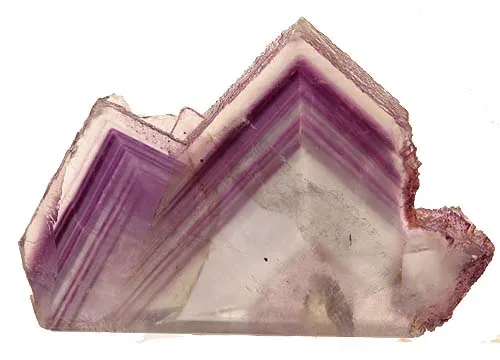
Hill-Ledford fluorite is overwhelmingly known as purple cubic material, from small cabinet pieces to large cabinet specimens, with documented crystals reaching exceptional sizes for the district and published Mindat data recording fluorite crystals to 0.5 m on edge. The typical collector piece shows dark grape-purple to reddish-purple cubes, commonly stepped or complexly grown, on sphalerite, galena, calcite, or quartz; a small amount of blue fluorite is reported but is far scarcer than the purple. Rosiclare and Sub-Rosiclare labels appear frequently, but the two horizons produced very similar specimens, so a precise level assignment is strongest when it comes from an old mine or collector label rather than appearance alone. The best pieces have sharp luster, undamaged cubic architecture, strong color without becoming dead-black, and contrasting sulfide or calcite matrix; ordinary pieces tend to be massive purple fluorite, cleaved chunks, or cubes with rubbed edges and little association.
Galena from Hill-Ledford occurs as the lead sulfide member of the mine’s fluorite-galena-sphalerite assemblage and is most desirable when it provides bright metallic cubic or cuboctahedral contrast against purple fluorite. Compared with fluorite, galena is less often the visual centerpiece, but it is a critical locality and quality marker because well-placed, lustrous galena crystals make Hill-Ledford specimens read unmistakably as Cave-in-Rock lead-fluorspar ore rather than simple purple fluorite. Notable documented pieces include large cabinet fluorite-galena specimens from the Rosiclare or Sub-Rosiclare levels, and the strongest examples show crisp galena perched or embedded with sharp fluorite rather than dull, corroded sulfide masses hidden in broken matrix.
Sphalerite at Hill-Ledford is the dark zinc sulfide companion to the purple fluorite, usually appearing as black to very dark brown resinous or submetallic masses and crystals in the matrix, and less often as isolated display crystals. Geologically it is more than a decorative accessory: ISGS summaries describe sphalerite-fluorite mineralization extending down into the collapse feature below the mine floor, and the mine’s recorded ore grade includes measurable zinc. Collector-quality pieces are those in which sphalerite gives texture and contrast without overwhelming or staining the fluorite; the most attractive combinations show lustrous purple cubes rising from dark sphalerite, sometimes with calcite or quartz adding a pale counterpoint.
Other minerals documented from Hill-Ledford include calcite, quartz, petroleum, and bitumen. Calcite is the familiar pale carbonate accent on many Illinois fluorite pieces, while quartz is a particularly useful association because it is comparatively restricted within the district and is cited by collectors as common from Hill-Ledford and Davis-Deardorff but rare from many other Cave-in-Rock mines. Petroleum and bitumen are locality-appropriate reminders that the district’s ore fluids were part of a broader basinal-brine and hydrocarbon system; petroleum-related inclusions and films are also invoked in discussions of fluorescence in some southern Illinois fluorite. No type-locality mineral is credibly tied to Hill-Ledford itself in the verified locality records consulted.
The principal authenticity issue for Hill-Ledford is not faking but over-precision. A large amount of old Cave-in-Rock fluorite entered the market before collectors and dealers routinely preserved exact mine and level data. Labels reading “Hardin County,” “Cave-in-Rock,” “Rosiclare,” “Mahoning,” or “Ozark-Mahoning” may be honest period labels without being sufficient proof of Hill-Ledford origin. Conversely, a later “Hill-Ledford” attribution can be plausible but should be treated as an attribution unless supported by an old label, collection history, or highly characteristic associations.
For attribution, look for the full combination of features rather than one color clue. Deep purple cubic fluorite alone is too generic for southern Illinois. Hill-Ledford becomes more credible when the piece has large purple cubes, Rosiclare/Sub-Rosiclare-era old-stock provenance, quartz association, sphalerite and galena matrix, or the distinctive hollow/cast-like fluorite forms noted from the mine. A dated acquisition can be very useful: material obtained in the 1950s, 1960s, or early 1970s fits Hill-Ledford’s productive period far better than labels invoking later Harris Creek mines that were not yet operating.
Condition problems are typical of fluorite and especially typical of old mine-run Illinois material: cleaved edges, bruised cube corners, rubbed high points, and contact areas are common. Because Hill-Ledford cubes can be dark, small chips may show as pale flashes on edges. Highly lustrous, undamaged faces and complete crystal architecture command a premium. Matrix pieces with galena should be kept dry and stable; while galena itself is robust, associated sulfides and old carbonate matrix can collect dust and grime in stepped fluorite surfaces. Avoid acids on combination pieces, and be conservative with cleaning because calcite, sulfides, bituminous films, and possible petroleum-related residues may be part of the specimen’s character and provenance.
Fluorescence should not be assumed to be strong. Some Illinois fluorite fluoresces, and district literature connects oil or petroleum associated with fluorite mineralization to observed fluorescence in certain crystals, but individual Hill-Ledford specimens vary. Test gently under longwave and shortwave ultraviolet if fluorescence matters to you, and do not let fluorescence override locality evidence.
Market availability is moderate but uneven. Small to medium old-stock Hill-Ledford fluorites appear periodically from older collections, often at accessible prices if they are simple purple cubic pieces. Fine, precisely labeled combinations with galena, sphalerite, calcite, or quartz are much scarcer. Museum-scale or highly unusual hollow fluorite pieces, especially those with Ross Lillie or American Mineral Treasures provenance, are a different market altogether and should be evaluated as major Illinois classics rather than ordinary regional fluorite.
The story of Hill-Ledford begins with a shaft that took years to become a mine. In July 1953 the C.N. Hill Shaft was started; only in November 1956 did the sinking reach bottom, and development still continued into March 1957. The engineering details read like the anatomy of a serious postwar Ozark-Mahoning operation: concrete lining down to 110 feet, timber below that, and a final shaft depth of 724 feet. By the time specimens began reaching collectors, they had come from a mine built not as a weekend dig but as a deep industrial fluorspar machine.
One of the most memorable Hill-Ledford specimens later acquired a name: “The Helmet.” It was not a conventional plate of purple cubes but a fluorite cast after dissolved baryte, mined in the late 1950s or early 1960s. Its growth history is almost cinematic. First came globular baryte groups overgrown by fluorite. Then the chemistry changed, the baryte dissolved away, and fluorite continued growing inward on the walls of the vacant spaces. The result was a series of interconnected, crystal-lined hollows, a specimen measuring 22 x 14.5 x 13 cm and looking enough like a helmet to earn the nickname. Ex Ross Lillie Collection #RCL1790, it was displayed in the 2008 Tucson Gem & Mineral Show’s American Mineral Treasures exhibit and illustrated in the accompanying book.
Hill-Ledford also lives in the detective work of labels. One collector recalled buying a large Cave-in-Rock fluorite in 1965 for $4.00, with only that broad district name attached. Decades later, the very facts that seemed unimportant at the time—the year of purchase, the size of the crystals, the deep color, the few calcite remnants, and the absence of a modern Harris Creek-style label—became evidence. Experienced collectors weighing such clues have pointed to Hill-Ledford’s Sub-Rosiclare material as a plausible source for some of these older, generically labeled Cave-in-Rock specimens. That is the quiet drama of this locality today: not only finding the crystals, but recovering their names.
_1.jpg)