






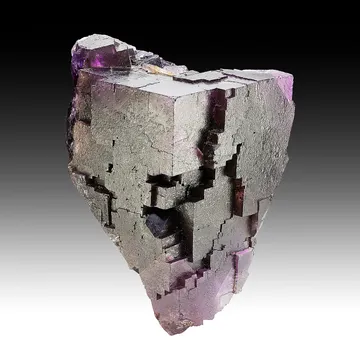
Hardin County, USA - a premier fluorite locality with lustrous yellow-to-honey cubes showing purple zoning, etched plates, and rich collector appeal.
Key facts
Hardin County, Illinois, is one of the great American fluorite names: not a single mine, but a dense landscape of former fluorspar, lead, zinc, and barium workings along the Illinois side of the Illinois-Kentucky Fluorspar District. For collectors, “Hardin County” usually means the Cave-in-Rock, Rosiclare, Harris Creek, Goose Creek, Hamp, and related subdistricts, where low-temperature hydrothermal fluids moved through Mississippian limestones and sandstones, climbed faults, and spread laterally into receptive carbonate beds. The result was a suite of vein, bedding-replacement, and residual fluorspar deposits that supplied industry for generations and, almost incidentally, produced some of the most recognizable fluorite specimens in the world.
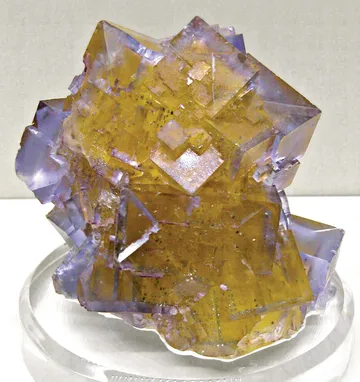
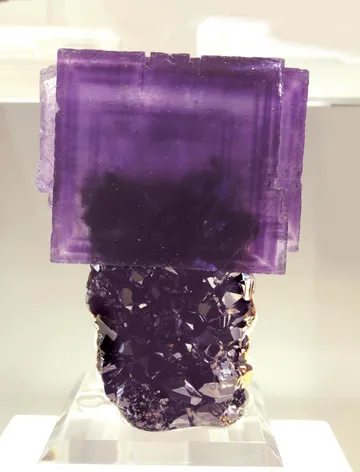
The county’s collector identity rests on fluorite first: lustrous cubes and modified cubes, often yellow to honey internally with purple, blue, lavender, or smoky violet zoning on the edges; large plates of etched, stepped, or phantomed crystals; and dramatic associations with calcite, baryte, sphalerite, galena, witherite, strontianite, alstonite, benstonite, and paralstonite. Minerva No. 1, Denton, Annabel Lee, Hill-Ledford, W.L. Davis-Deardorff, Victory, Crystal, and the Rosiclare mines each contributed their own accents. The best Hardin County fluorites are not merely purple cubes: they are geological cross-sections in color, showing repeated growth, corrosion, hydrocarbon entrapment, and late overgrowths that turn a simple CaF2 crystal into a small history of moving brines.
The district’s geology is inseparable from Hicks Dome and the Fluorspar Area Fault Complex. Hicks Dome, a deeply uplifted, structurally complex feature in western Hardin County, is associated with Permian igneous activity, brecciation, and rare-earth/thorium mineralization. Around it, northeast-trending high-angle faults and grabens provided the plumbing for acidic, saline, fluorine-bearing fluids. Where those fluids encountered carbonate units such as the upper Ste. Genevieve, Renault, and Downeys Bluff limestones, they deposited fluorite and sulfides; where open cavities developed, collectors received the prize: crystals.
Regional View
Country View
Hardin County also carries a rare mineralogical distinction beyond fluorite. The Minerva No. 1 mine is the type locality for paralstonite, and it is one of the classic world localities for well-crystallized alstonite, benstonite, witherite, strontianite, and baryte combinations. Collectors of American systematic minerals value these carbonate assemblages almost as much as the district’s gemmy fluorites. In the late mining years, particularly from the 1980s through the mid-1990s, Denton, Annabel Lee, and Minerva produced enough fine material that many serious collections still contain a Hardin County piece—but the finest, undamaged, well-localized specimens have become steadily more selective and expensive.

Photo: Wikimedia Commons

Photo: Wikimedia Commons
Search for specimens: View all specimens from Hardin County, USA
Hardin County occupies the Illinois side of the Illinois-Kentucky Fluorspar District, where the principal collector localities fall into several historic subdistricts. Rosiclare, on and near the Ohio River, represents the older vein-mining heart of the Illinois district, with the famous Rosiclare, Blue Diggings, Argo, Daisy, Hillside, and related veins. Northeastward around Cave-in-Rock and Spar Mountain, the ore style changes markedly: bedding-replacement fluorspar bodies became dominant, especially in the great Cave-in-Rock subdistrict. Farther north and west, Harris Creek and Goose Creek include late-producing mines such as Denton and Annabel Lee, whose specimens anchor many modern collections.
The deposits are best understood as a connected system rather than isolated shows of fluorite. Fluids moved upward along faults and fractures, then spread into favorable carbonate beds where permeability, chemistry, and roof conditions allowed replacement and cavity formation. Three ore styles were worked in the county: steep vein deposits along faults, stratabound bedding-replacement bodies in limestone, and residual “gravel spar” deposits formed by weathering of fluorite-rich veins and beds near the surface. In the Cave-in-Rock district, miners followed bedding-replacement ore into hillsides and underground, using modified room-and-pillar methods; rooms could be broad, and pillars were left irregularly to hold unstable roofs while extracting as much fluorspar as possible.
The stratigraphic names on old labels matter. “Rosiclare Level” specimens are tied to mineralization near the top of the Ste. Genevieve Limestone beneath the Aux Vases Sandstone, historically called the Rosiclare Sandstone. “Bethel Level” specimens relate to ore in the Downeys Bluff Limestone below the Bethel Sandstone. A “Sub-Rosiclare Level” was also worked in parts of the Ste. Genevieve section, including the Spar Mountain Sandstone interval. These level names are not romantic marketing language; they are clues to the horizon in which a specimen formed and, in some cases, to its paragenesis and appearance.
Rosiclare was historically a giant. The Rosiclare Mine operated for more than a century and was at one time described as the largest fluorspar mine in the United States, and perhaps the world. The Rosiclare subdistrict’s north-trending normal faults carried veins whose widths and richness varied with host rock; the widest and best mineralized parts commonly occurred where limestone or calcareous beds formed one or both fault walls. Fluorite, calcite, quartz, galena, sphalerite, pyrite, and lesser secondary minerals define the classic Rosiclare assemblage, while baryte is less prominent there than in parts of the Cave-in-Rock and Minerva systems. Flooding was a chronic mining problem, particularly near the Ohio River.
The Cave-in-Rock subdistrict became the dominant collector name of the late twentieth century. Mines at Lead Hill and Spar Mountain began as hillside adits and open pits, initially chasing lead ore and leaving fluorite as low-value material before the fluorspar market matured. As steelmaking and later chemical uses created demand for fluorite, the same region became a major industrial field. The Spar Mountain and Austin mines yielded high-purity fluorite, with galena and sphalerite locally present; the Victory and Crystal mines developed around complex bedding-replacement bodies and structural controls; and the W.L. Davis-Deardorff mine became known for rich fluorite-zinc-lead ore and, among collectors, for delicate fluorite on quartz-rich matrix.
Minerva No. 1 is the county’s most famous late producer. Discovered in the 1940s and later operated by Ozark-Mahoning, it worked the largest bedding-replacement orebody in the United States and produced fluorite, zinc ore, and an extraordinary suite of barium and strontium carbonates. The mine worked multiple levels, including Rosiclare and Bethel horizons, and its shaft and mill were central fixtures of the Cave-in-Rock mining landscape until the operation closed in the mid-1990s. Collectors know Minerva for zoned yellow-purple fluorite, blue-capped and hydrocarbon-rich fluorite from late ore zones, white to yellow witherite, baryte, strontianite sprays, benstonite, alstonite, and paralstonite.
Denton and Annabel Lee, in the Harris Creek area north of Cave-in-Rock, were among the last great specimen sources. Denton was the first mine opened in the Harris Creek subdistrict and worked bedding-replacement ore similar to that at Cave-in-Rock, largely in the Rosiclare and Sub-Rosiclare levels. Annabel Lee operated from the early 1980s until 1995 and worked two separated orebodies. Its headframe became a familiar landmark visible from Illinois Highway 1. Both mines yielded important late-production fluorite and calcite specimens: Denton is particularly prized for purple fluorite plates with golden calcite, chalcopyrite, and bright galena; Annabel Lee for fluorite, lustrous calcite, baryte, celestine, and distinctive petroleum-bearing calcites.
The best documented pocket story from Hardin County is the Minerva Cross-Cut ore body, mined from about 1990 to 1994. The zone was reportedly found by following a small exposure left in an old drift; rather than pinching out, it ran into unmapped, undrilled ground and carried enough ore to extend the life and specimen output of the mine. Its abundant hydrocarbons affected both mineral growth and milling. Early fluorite there was commonly brown or pale yellow, etched and distorted, but in places it received a late transparent, vividly zoned overgrowth. The most coveted material came from the September 1990 “Blue Cap Pocket,” a small, one-time find remembered for a distinctive combination and color that produced only a limited number of flats.
Collecting access today is not comparable to the mining years. The principal underground mines are closed, flooded, sealed, demolished, reclaimed, or on private and industrial land. The former Minerva property has been reported as patrolled and not advisable for casual collecting; Annabel Lee and Denton are not public underground collecting sites. Some older accounts mention tailings or gravel fields in the district, but serious collectors should treat every mine, dump, quarry, shaft site, and reclaimed area as private unless current permission is obtained from the landowner and any mineral-rights holder. Abandoned fluorspar workings also pose real hazards: unstable highwalls, concealed shafts, bad ground, deep water, and industrial equipment sites are not compatible with casual trespass collecting.
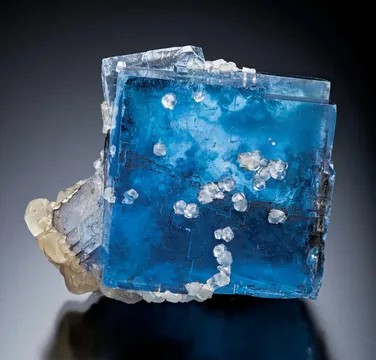
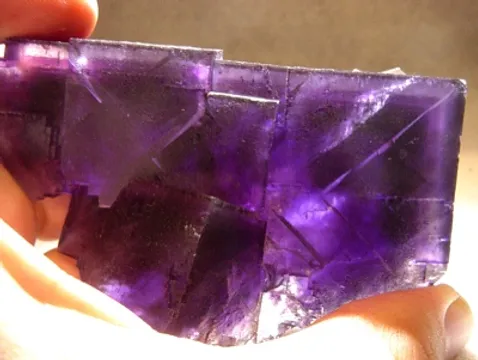
Hardin County fluorite is most famous as cubic crystals and plates from Cave-in-Rock, Minerva No. 1, Denton, Annabel Lee, Hill-Ledford, W.L. Davis-Deardorff, Victory, Crystal, and Rosiclare-area mines, with color zoning that can run from honey-yellow cores to violet, purple, blue, lavender, smoky, gray, or rarely greenish edges; the finest crystals are glassy, sharp, visibly phantomed, and undamaged, while ordinary pieces tend to be cleaved mine-run chunks, dull etched fragments, or poorly localized “Cave-in-Rock” material. Minerva is especially associated with zoned yellow-purple and hydrocarbon-included fluorite, including Cross-Cut and Blue Cap material; Denton is valued for rich purple fluorite plates with golden calcite, chalcopyrite, and galena; Annabel Lee yielded lustrous blue to purple fluorite with calcite, baryte, celestine, and sulfides; W.L. Davis-Deardorff material may carry fluorite on quartz-rich matrix; and Hill-Ledford is remembered for some of the district’s largest crystals, reportedly reaching remarkable cabinet-scale dimensions. Strong pieces show intact cube edges, clean luster, balanced color contrast, meaningful associations, and a mine-specific provenance rather than a vague county label.
Calcite from Hardin County is a major companion mineral rather than a mere gangue afterthought, ranging from white, cream, amber, golden, and honey-colored scalenohedra, rhombs, twinned crystals, blades, and vein fillings to petroleum- or gas-included crystals in late cavities. Denton and Annabel Lee produced especially showy calcite-on-fluorite specimens in the 1980s and 1990s, with golden calcite standing on dark purple or color-zoned fluorite; Minerva specimens can show calcite with fluorite, baryte, benstonite, hydrozincite coatings, alstonite, or witherite; and Annabel Lee calcite is notable for differences between orebodies, including needle-like north-orebody material and larger south-orebody specimens. The best collector pieces have bright, transparent to translucent calcite crystals that are compositionally well placed on fluorite rather than massive white vein calcite; because calcite is softer and more cleavable than fluorite, bruised terminations, cleaved tips, and pressure-fractured petroleum-bearing crystals are common condition concerns.
Other documented minerals from Hardin County make the locality unusually important for systematic collectors. Minerva No. 1 is the type locality for paralstonite, BaCa(CO3)2, described from the mine in 1979. Alstonite occurs there as small pseudohexagonal dipyramids in cavities with waxy benstonite, fine-grained calcite, and witherite; benstonite, though not first described from Illinois, is a signature Minerva species in cream to tan coatings and rhombohedral aggregates on calcite, fluorite, and sphalerite; witherite forms white to pale yellow barrel-shaped crystals, sometimes highly aesthetic on fluorite or baryte; and strontianite appears as tufts, sprays, bowties, and acicular aggregates, locally white, brownish, yellowish, or rarely pinkish. Baryte, galena, sphalerite, chalcopyrite, pyrite, quartz, celestine, cerussite, smithsonite, greenockite, gypsum, malachite, azurite, pyromorphite, anglesite, hydrozincite, and bitumen or petroleum inclusions round out the district suite, while Hicks Dome adds a separate rare-earth/thorium dimension with minerals reported from breccias and prospect material, including monazite-group minerals, florencite-group material, brockite, bertrandite, baryte, calcite, quartz, fluorite, galena, and sphalerite.
The most common authenticity problem with Hardin County specimens is not outright faking but over-broad or incorrect locality labeling. “Cave-in-Rock” is often used loosely for material from several mines north and west of the village, and “Rosiclare” may appear on labels for specimens from the broader Illinois-Kentucky district rather than the Rosiclare mine or subdistrict. Older labels may say Minerva No. 1, Mahoning No. 1, Ozark-Mahoning No. 1, Cave-in-Rock, or simply Southern Illinois; these names may reflect both the operator and the period of recovery. For premium pieces, especially Blue Cap Pocket, Cross-Cut, Denton, Annabel Lee, or rare-carbonate specimens, provenance matters nearly as much as species identification.
Condition must be judged carefully. Fluorite has perfect cleavage and Hardin County material was mined in an industrial fluorspar operation, not specimen-mined in the modern boutique sense. Edge chipping, contacted faces, internal bruises, re-cleaved corners, and repaired plates are all encountered. Some old material was intentionally cleaved into octahedrons or trimmed aggressively from massive ore, and attractive isolated cubes may have one or more damaged backs or contacted sides hidden by display orientation. On fluorite-calcite specimens, examine calcite terminations under magnification; calcite tips are commonly bruised or cleaved, particularly on large golden scalenohedra and twinned crystals.
Color and luster should be read in context. The finest Cave-in-Rock and Minerva fluorites can be intensely zoned, with yellow interiors and purple to blue margins, but Hardin County also produced dull, etched, brownish, gray, and heavily included crystals. Etching is not automatically damage: in Cross-Cut and other hydrocarbon-rich zones, corrosion textures and late overgrowths can be part of the specimen’s character. What separates a desirable etched Hardin County fluorite from ordinary mine-run material is compositional balance, transparency in the later growth, sharp surviving edges, and a documented mine or pocket.
Fluorescence adds an important dimension. Fluorite from Denton, Minerva, and related Hardin County mines can show blue to purple responses under longwave, midwave, or shortwave ultraviolet light, and hydrocarbon inclusions may fluoresce as bright white or blue-white dots, wisps, streaks, and clouds inside the fluorite. Calcite may fluoresce orange, yellow, pink, magenta, red, or white depending on activators and wavelength, while post-mining hydrozincite coatings on Minerva material can glow bright blue under shortwave UV. UV response is attractive, but it should not be used alone to authenticate mine origin; many fluorites fluoresce, and hydrocarbon-bearing material occurs across parts of the district.
Treatments are less commonly advertised for Hardin County than for some modern fluorite localities, but cleaning, trimming, stabilization, and repairs are routine realities. Watch for acid-cleaned calcite associations, glued cube corners, reassembled plates, oiling or wetting used to enhance luster in photographs, and specimens mounted to disguise cleaved backs. Rare carbonates such as alstonite, benstonite, witherite, strontianite, and paralstonite deserve gentle handling: some are brittle, some occur as delicate sprays or coatings, and witherite contains barium and should be handled with normal mineral hygiene rather than abraded, powdered, or cleaned carelessly.
Market availability remains good in the broad sense because the district produced vast numbers of specimens, but truly fine Hardin County pieces are no longer casual commodities. Small fluorites, cleaved octahedrons, massive purple chunks, and modest calcite-fluorite plates appear regularly. Fine Denton plates, undamaged Annabel Lee combinations, Minerva fluorites with strong zoning and hydrocarbon character, Blue Cap Pocket pieces, and well-crystallized rare-carbonate associations are much scarcer and increasingly provenance-sensitive. Serious buyers should favor old labels, mine-level attribution, collection history, and honest condition descriptions over dramatic but unsupported “Cave-in-Rock” claims.
In May 1987, Alan Goldstein and Chris Anderson went underground at the Annabel Lee mine for an eight-hour shift that Goldstein later described as a photographic documentation of the mine’s operations and geology. Mine geologist Eric Livingston told him it may have been the only time a full shift was photographed in any fluorite mine in the Illinois-Kentucky fluorspar district. The images read like a day-long descent into the working anatomy of a late fluorspar mine: headframe, compressor room, hoist operator, cage, skip, drill jumbo, ore faces, haulage, grizzly, roof bolts, and the return to daylight at shift change.
The numbers give the episode its force. Goldstein recorded the cage entrance as 868 feet below the surface—“almost 90 stories of rock”—and photographed work as deep as 1,300 feet underground in the north orebody. A pole-mounted drill worked the face; a machine called the “Jumbo” bored horizontal holes; equipment had to be hauled down in pieces and assembled in the underground workshop. In one caption, the compressor room became “the noisiest place on the planet,” and at the hoist the operator’s importance was reduced to one plain sentence: “Our life was in his hands.”
The Annabel Lee did not present itself as a tidy specimen mine. Goldstein described air full of water vapor and a little diesel exhaust, tunnels where miners moved under air ducts, and active faces where he inspected pockets while the production cycle continued around him. In the south orebody, 900 feet down, he photographed fluorite, calcite, drill holes, mucking equipment, ore being scooped and dumped, and the grizzly where oversize rock had to be broken before it could pass. The beauty collectors now see on shelves was, at the time, part of a working industrial stream: one caption after a loader shot says simply, “There goes the fluorite!”
One of the vivid Annabel Lee moments belongs to Tom Rose, who was photographed scaling the roof—dropping loose slabs before roof bolts could be attached. Goldstein noted fluorite crystal pockets nearby, and that they were drilled and blasted out the next shift. It is a reminder that many pockets were not slowly opened by collectors with hand tools; they were encountered in the rhythm of commercial mining, where the safest and most efficient next step could also mean the loss of specimen perfection.
Another Annabel Lee story is smaller, stranger, and unforgettable. Goldstein acquired a doubly terminated calcite crystal with a visible gas bubble from the mine. A day or two later, after coming up from the 900-foot level, the crystal ruptured along a cleavage plane. His description is perfect field-note mineralogy: the pressure difference likely did what handling had not, and the townhouse “smelled like an oil well” until the doors were opened.
The Minerva No. 1 mine has its own folklore, and one of the best episodes concerns the Cross-Cut ore body. The zone was not on the plan map, and no reserves had been assigned to it. It was found by following a small exposure in an old drift left by previous mining; instead of dying out, the mineralized zone continued into ground that had not been mapped or drilled. It lasted three to four years and became one of Ozark-Mahoning’s surprise gifts. Its name came from geometry: it cut nearly at right angles across the main Minerva trend.
The Cross-Cut ore body was memorable for hydrocarbons. They were abundant enough in some sections to interfere with fluorspar recovery in the flotation mill, and they influenced specimen character as well. Fluorite there commonly began as brown or pale yellow etched crystals, distorted by dissolution and growth interruptions, and was later overgrown in places by transparent, strongly zoned fluorite. The most celebrated moment came in September 1990, when one isolated pocket produced the “Blue Cap Pocket” material—only about two flats of specimens, from a single occurrence of that color and combination.
The district’s market stories are almost as lively as its mine stories. During the 1980s and early 1990s, when Denton, Annabel Lee, and Minerva were producing, pockets could be abundant enough that good fluorite was sometimes sold by the pound or by the table at shows or at miners’ homes. Yet the top pieces did not linger. Dealers and collectors associated with the district—names such as Ross Lillie, Dan Weinrich, and Mark and Joe Kielbaso—were remembered as racing down to Cave-in-Rock or Rosiclare to see the next find just ahead of their competitors. That urgency still echoes in today’s market: the specimens are not new anymore, but the chase for the right label, the right mine, the right pocket, and the right condition remains very much alive.
.jpg)
