






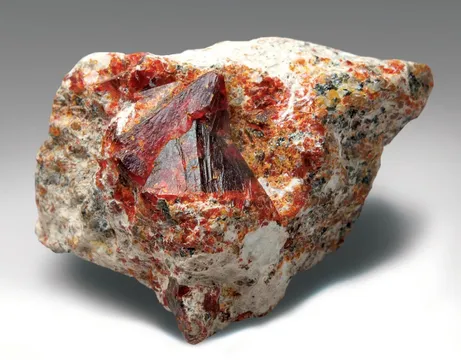
Franklin Mine, USA - premier New Jersey locality famed for franklinite, willemite, and zincite; striking black octahedra on calcite with vivid UV fluorescence.
Key facts
Franklin Mine at Franklin, Sussex County, New Jersey, is one of the great mineral localities of the world: a compact, deeply studied zinc-iron-manganese orebody in the Franklin Marble of the New Jersey Highlands, transformed by Grenvillian high-grade metamorphism into an assemblage unlike ordinary zinc deposits anywhere else. Its classic ore is not sphalerite-rich sulfide, but the instantly recognizable triad of black franklinite, green-to-brown or reddish willemite, and red zincite in white to gray calcite. For collectors, that combination is doubly compelling: under daylight it can be stark and graphic, with black octahedra and ruby-red grains set in pale carbonate; under shortwave ultraviolet it becomes one of mineralogy’s signature spectacles, with calcite glowing red-orange and willemite a brilliant green.
The Franklin deposit is inseparable from nearby Sterling Hill, but the Franklin Mine has its own personality. It produced exceptional crystalline franklinite, some of the most desirable bright-pink rhodonite in calcite, classic zincite in the district where the species was first described, and a formidable suite of rare zinc, manganese, lead, calcium, and arsenate minerals. The locality’s type-mineral roster is astonishing: franklinite, zincite, hodgkinsonite, esperite, hardystonite, cahnite, clinohedrite, hancockite, margarosanite, nasonite, roeblingite, and many others are bound to Franklin Mine sublocalities such as the Parker Shaft, Buckwheat pit, Taylor Mine, Trotter Mine, and the broader Mine Hill workings. A fine Franklin specimen often carries two identities at once: a handsome mineral specimen by ordinary light and a carefully patterned fluorescent object when the lamp goes on.
Regional View
Country View
The best display pieces from Franklin are rarely “pretty” in a simple gemstone sense. Their appeal is structural and mineralogical: sharp black octahedra of franklinite on white calcite with willemite; granular red zincite woven through ore; massive hardystonite, clinohedrite, esperite, and calcite that look subdued by day but separate into violet-blue, orange, lemon-yellow, and red under shortwave ultraviolet; or rhodonite crystals whose saturated pink color is all the more striking because the matrix is the same industrial ore that fed the New Jersey Zinc Company for generations.


Search for specimens: View all specimens from Franklin Mine, USA
Franklin Mine is in the Borough of Franklin, Sussex County, northwestern New Jersey, in the Franklin Mining District. The ore lay on Mine Hill in the Franklin Marble, a coarse, white, Mesoproterozoic marble belt of the New Jersey Highlands. Modern interpretations treat the Franklin-Sterling Hill zinc bodies as metamorphosed stratiform zinc-iron-manganese oxide-silicate deposits, genetically tied to basin-margin chemical sedimentation and hydrothermal brines, then folded, recrystallized, and overprinted during the Grenville/Ottawan metamorphic history. Older literature often used skarn language for the district, and skarn-like reaction textures do occur, but the deposit is not adequately explained as a simple contact-metamorphic replacement of limestone by an intrusion.
The productive ore was dominated by franklinite, willemite, zincite, and calcite, with important calcium-manganese-zinc silicates and subordinate sulfides, arsenates, borates, and lead silicates. In hand specimen the ordinary ore can look deceptively plain: black, red, tan-green, and white grains in a tough carbonate-silicate rock. The microscope and the ultraviolet lamp reveal the reason Franklin became legendary. Willemite occurs as granular ore, masses, veins, coatings, and crystals; calcite is the main red-orange fluorescent matrix; hardystonite, clinohedrite, esperite, margarosanite, and other species add uncommon colors and rare-species interest in selected assemblages.
Structurally, Franklin and Sterling Hill are paired but distinct deposits several miles apart along the same marble belt. Franklin is the northern deposit; Sterling Hill is the southern one. Both are folded, marble-hosted zinc-iron-manganese bodies, but Franklin’s orebody was truncated northward by erosion and unconformably overlain by younger Paleozoic rocks. Granite pegmatites and alkaline mafic dikes cut ore, marble, and gneiss at Franklin, and local reaction zones along pegmatite and ore contacts produced some of the district’s richest silicate assemblages, including rhodonite-andradite rocks and unusual zinc-bearing calcium silicates.
Mining began as surface and shallow work on Mine Hill and expanded into named operations that are still meaningful on specimen labels: Buckwheat, Taylor, Trotter, Parker, Palmer, Hamburg, and others. The Buckwheat Mine began in 1866 in a buckwheat field and later became the enlarged Taylor open pit operation, with ore hauled by aerial tramway. That open-pit phase ended around 1912, while underground mining farther north continued until 1954, when the Franklin ore was depleted. The Parker Shaft, begun in 1891 after successful exploratory drilling by Joseph A. Van Mater of the Lehigh Zinc and Iron Company, reached 975 feet and had its single landing at the 950-foot level; miners then crossed 315 feet westward to the orebody. Its output was short-lived but mineralogically famous, and “Parker Shaft minerals” remains a meaningful collector phrase for some of Franklin’s rare lead-silicate and fluorescent assemblages.
The Palmer Shaft became the main modern production shaft in 1910, replacing Parker Shaft operation and allowing systematic underground extraction of the remaining ore. New Jersey Zinc Company was the central operator in the mature period of the district, and Franklin was the dominant producer until its closure in 1954. After Franklin shut down, production shifted to nearby Sterling Hill, which continued into the late twentieth century; for collectors, however, the Franklin dumps, museum holdings, and old collections kept Franklin material circulating and actively studied.
Collecting today is not underground mine collecting. The old workings are closed, and serious access is through preserved dumps, museum grounds, organized events, and the collector community. The principal public collecting site is the Buckwheat Dump at the Franklin Mineral Museum, a 3.5-acre field of mine rock originally accumulated as waste from the Buckwheat and Taylor operations. The museum operates the dump seasonally with admission rules, weight limits or fees, safety requirements, and a darkroom with ultraviolet lamps so visitors can screen material. The dump is famous because it contains Franklin Mine rock from multiple Mine Hill sources; that breadth is a blessing for collectors but a complication for labels, because a specimen found there may be “Buckwheat Dump” in collecting locality while its rock may derive from a broader Franklin Mine sublocality.
Named specimen-producing zones and assemblages matter at Franklin. The Parker Shaft is associated with rare lead silicates such as esperite, margarosanite, nasonite, hancockite, and roeblingite. The Trotter Mine and Dump are tied to older and later finds of ore, rhodonite, bementite, nelenite, sussexite, and related manganese assemblages. The Buckwheat pit and Buckwheat Dump yielded, preserved, and redistributed many Franklin species, including ore minerals, fluorescent calcite-willemite combinations, hardystonite-clinohedrite-calcite rocks, zincite-rich ore, and rare species that continue to be checked analytically. The Hamburg Mine is represented on historical type-locality records for hodgkinsonite and sussexite. The Franklin collector’s label is therefore part geology and part history: “Franklin Mine” is a world-class locality, but a precise old sublocality—Parker Shaft, Trotter, Taylor, Buckwheat pit, Hamburg—can substantially sharpen both scientific and market value.
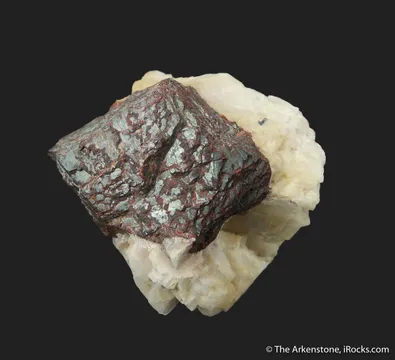
Franklinite is the black backbone of Franklin collecting: abundant in the ore, rare globally, and best here as lustrous octahedral crystals in calcite with willemite and, less commonly, red zincite. It occurs as euhedral to rounded grains, massive layers, and individual octahedra that may show dodecahedral, cubic, or trapezohedral modifications; ordinary pieces are granular black ore, while good collector specimens show isolated, sharp, lustrous crystals set cleanly in white calcite or contrasting fluorescent willemite. Franklin pieces are especially valued when the franklinite is visibly crystalline rather than merely granular, when octahedra stand proud of the matrix, and when the daylight aesthetics align with the ultraviolet view: non-fluorescent black franklinite cutting through green-fluorescent willemite and red-orange calcite.
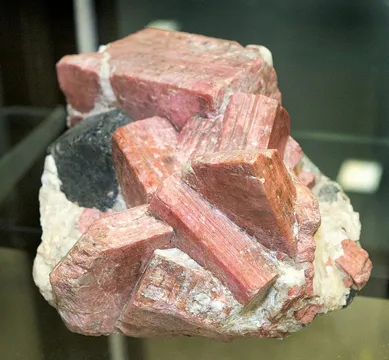
Franklin rhodonite ranges from massive vein material to fine, bright pink crystals in calcite, and the classic specimens are far more than generic manganese silicate: the premier Franklin assemblage consists of euhedral, vivid pink rhodonite crystals in white calcite with franklinite and minor willemite, with individual crystals commonly in the 1–7 cm range and exceptional crystals reported much larger. Other Franklin habits include elongate gray-pink pseudoprismatic composite crystals, bladed crystals in seams, and massive aggregates in calcium-silicate units with andradite, mica, amphiboles, feldspar, quartz, fluorite, gahnite, sphalerite, and other species. The best pieces have saturated pink color, visible crystal form, clean calcite contrast, and minimal brown alteration; ordinary material is more massive, duller, or too tightly intergrown to display the rhodonite as a distinct specimen mineral.
Calcite is the common matrix and one of the great visual engines of Franklin collecting: in daylight it is typically white, gray, or colorless and may host franklinite octahedra, zincite grains, rhodonite crystals, willemite, and rare silicates, while under shortwave ultraviolet manganese-activated calcite gives the district’s famous red to orange-red fluorescence. At Franklin, calcite is not valued simply as a carbonate species but as the stage on which ore textures, crystal contrast, and fluorescent patterning appear; specimens with clean white calcite, sharp black franklinite, green-fluorescent willemite, or pink rhodonite are far more desirable than massive broken dump rock. Collectors should also note calcite’s brief phosphorescence in many Franklin-Ogdensburg pieces, a quick afterglow that can help distinguish local fluorescent character when viewed with a proper shortwave lamp.
Willemite is Franklin’s essential zinc silicate and the principal green-fluorescent partner to red calcite; it occurs as granular ore with franklinite and zincite, as masses, veins, coatings, hexagonal crystals, acicular needles, and sought-after fibrous radial sprays. Daylight color is famously variable at Franklin—tan, brown, pink, green, gray, white, reddish, orange, yellowish, and more—but the shortwave ultraviolet response is usually a strong green, making even visually subdued pieces important to fluorescent collectors. Excellent Franklin willemite specimens show either attractive crystal habit or strong, sharply bounded fluorescence with calcite and franklinite; ordinary pieces are simply granular ore, useful as locality representatives but less compelling unless they show color zoning, contrasting ore minerals, or a fine fluorescent pattern.
Zincite, the red zinc oxide species first described from Franklin, is typically disseminated through the ore as rounded grains, scales, specks, splinters, thin layers, blebs, coatings, or irregular masses with franklinite, willemite, and calcite. Freestanding, well-formed natural zincite crystals from Franklin are extraordinarily rare; most legitimate pieces are massive to granular, deep red to dark reddish brown, locally associated with zincite-rich layers or secondary vein assemblages. Good Franklin zincite specimens are rich, visibly red, and clearly natural in Franklin ore matrix—ideally with black franklinite and white calcite or green-fluorescent willemite—whereas ordinary pieces may show only sparse red grains; large glassy orange, yellow, or green “zincite crystals” without Franklin ore matrix should be treated as synthetic or smelter-produced material, not Franklin Mine specimens.
Andradite is the dominant garnet of Franklin’s calcium-silicate assemblages and occurs as massive material and crystals, chiefly brown to yellow-brown but also black, green, reddish brown, and intermediate hues. It is especially important in reaction zones and calcium-silicate units with rhodonite, calcite, microcline, mica, willemite, and pegmatite-border assemblages, where it may form dodecahedral crystals with trapezohedral modifications and, in exceptional cases, crystals reaching cabinet scale. The finest Franklin andradites show identifiable garnet form, warm brown to yellow-brown color, and associations that anchor them unmistakably to the orebody—rhodonite, willemite, franklinite, or calcite—while common material is granular brown garnet in dense silicate rock, scientifically interesting but less displayable.
Hodgkinsonite is one of Franklin’s most attractive rare species, a zinc manganese silicate hydroxide first described from Franklin and best known here as reddish pink, violet-pink, lavender, beige, light orange, brown, yellowish, or rarely darker crystals and masses in secondary vein assemblages. Franklin crystals are typically millimeter-scale to about 1.5 cm, lustrous and euhedral when good, while massive material can reach several centimeters; it is almost invariably associated with willemite and commonly with franklinite or hetaerolite, with barite important in prized vuggy assemblages. The best pieces show pink to violet crystals or drusy coatings sharply separated from willemite and black ore, sometimes with weak cherry-red fluorescence under midwave or longwave ultraviolet; ordinary material can be massive, dull, or difficult to separate visually from altered manganese silicates without testing.
Esperite is a Franklin type-locality calcium-lead-zinc silicate and one of the collector minerals that shows why the Parker Shaft and northern Franklin orebody matter: it occurs as white to pale yellow, fine-grained massive or nodular aggregates, commonly with hardystonite, willemite, franklinite, and less commonly calcite. The original material came from the 400-foot level north of the Palmer Shaft pillar, and later occurrences were noted in the northern end of the orebody and on the 1100 level with glaucochroite. In daylight many esperite specimens look modest or dingy, but strong lemon-yellow to yellow-green shortwave fluorescence is diagnostic and highly desirable; the best pieces show bright, clean esperite fluorescence in pattern with hardystonite, willemite, calcite, or franklinite rather than dull, massive pale material with little contrast.
manganosite from Franklin is a dark green manganese oxide, easily oxidized and therefore commonly appearing nearly black, known as massive material intimately associated with zincite rather than as free euhedral crystals. Octahedral fragments separated along parting planes by zincite can be around 1 cm and, rarely, much larger; specimens combining dark green to black manganosite with red zincite are among the more specialized Franklin ore-mineral pieces. Quality depends on verified identity, fresh color where possible, clear zincite association, and an old or analytical pedigree, because altered or black massive manganese oxides from Franklin can be visually ambiguous and ordinary pieces may not show the rich green color collectors hope for.
Beyond these featured species, Franklin Mine is extraordinary for its type-locality and near-type-locality minerals. Hardystonite, clinohedrite, cahnite, hancockite, margarosanite, nasonite, roeblingite, larsenite, hendricksite, johnbaumite, marsturite, minehillite, turneaureite, wawayandaite, chlorophoenicite, franklinphilite, petedunnite, jarosewichite, bementite, nelenite, sussexite, and many others make Franklin a systematic collector’s lifetime locality. Many of these are visually modest without ultraviolet light or magnification, but in the right assemblage—a Parker Shaft lead-silicate piece, a hardystonite-clinohedrite-calcite fluorescent slab, a cahnite association, or a rare arsenate seam—they are among the most locality-specific specimens in American mineralogy.
Franklin specimens demand locality literacy. The most common market confusion is Franklin versus Sterling Hill: both deposits share franklinite, willemite, zincite, calcite, and many fluorescent habits, but many species, habits, and sublocality assemblages are not interchangeable. A label reading “Franklin, New Jersey” may mean Franklin Mine, the Buckwheat Dump, the broader Franklin Mining District, or simply the Franklin-Sterling area. For high-value pieces, old labels, mine-level information, and credible collection provenance are worth a premium, especially for Parker Shaft lead silicates, hodgkinsonite crystals, rich zincite, manganosite, and rare type-locality species.
The most important authenticity issue is zincite. Natural Franklin zincite is generally massive, granular, platy, or embedded in recognizable Franklin ore. Large, glassy, freestanding, brightly orange-red, yellow, or green crystals without ore matrix are usually synthetic or smelter-produced zincite and should not be accepted as Franklin Mine natural crystals. Natural crystals do occur but are exceptionally rare and generally tied to very specific Franklin-Sterling ore associations; if a zincite specimen looks like a loose gemmy furnace product, it probably is not a natural Franklin specimen.
A second issue is overconfident species identification. Franklin’s mineral list is famously large, and many rare species cannot be identified reliably by color, fluorescence, or casual appearance alone. The Franklin-Ogdensburg community has documented past problems with sight-identifications, insufficient analytical data, and even fabricated species claims where financial value was involved. Collectors should be cautious with small rare-species labels—especially for visually similar white, tan, pink, brown, or black minerals—and should value specimens accompanied by analytical notes, old museum or specialist labels, or well-documented assemblage context.
Buckwheat Dump pieces are legitimate Franklin collecting material, but the dump has its own labeling nuance. Because the public collecting area contains material from multiple Mine Hill sources, “collected at Buckwheat Dump” is not always the same as “from the Buckwheat pit orebody.” Additionally, museum children’s or worldwide material has occasionally migrated into collecting areas, so obvious exotic minerals reported from the dump should be treated skeptically. Local collectors can usually recognize non-Franklin material quickly, but buyers should still be wary of anomalous specimens with no convincing Franklin assemblage.
Condition issues are typical of dense mine and dump rock: bruised calcite, cleaved rhodonite, rubbed franklinite faces, weathered zincite surfaces, blackened or oxidized manganosite, and broken fluorescent slabs are common. Calcite can be scratched and bruised easily; rhodonite has good cleavage and can be edge-worn; willemite and hardystonite-bearing fluorescent rocks are often sawed, polished, or trimmed to show ultraviolet patterns. Cutting and polishing are not inherently deceptive for Franklin fluorescent specimens, but they should be disclosed when the specimen is sold as a display slab rather than as a natural crystal specimen.
For fluorescence, a proper filtered shortwave ultraviolet lamp is essential. Longwave flashlights will miss or understate many classic Franklin responses, and fluorescence color alone is not a species identification. Calcite commonly fluoresces red-orange, willemite green, esperite lemon-yellow, hardystonite violet-blue to purple, clinohedrite orange, and some hodgkinsonite weak cherry-red, but assemblage, texture, and testing still matter. Store fluorescent specimens away from prolonged direct sunlight when color-sensitive minerals such as some rhodonite are present, and avoid unnecessary cleaning acids on calcite-rich ore because etching can degrade both aesthetics and labels.
Market availability remains strong for common Franklin ore, calcite-willemite fluorescent pieces, franklinite in calcite, and Buckwheat Dump material. Fine rhodonite crystals, sharp franklinite octahedra, natural crystallized zincite, convincing manganosite-zincite specimens, and well-documented Parker Shaft or rare type-locality species are much less common. The very best Franklin pieces combine aesthetics, locality specificity, and mineralogical documentation; ordinary dump pieces are plentiful, but the top end of Franklin collecting is as provenance-driven as it is visual.
The Parker Shaft story reads like a compressed Franklin epic. Work began in 1891 after Joseph A. Van Mater, superintendent of the Lehigh Zinc and Iron Company, proved the ground by drilling. The shaft was designed with three compartments and ultimately reached 975 feet, but at 560 feet the miners hit a sudden inflow of water that delayed completion until 1894. Once finished, the shaft had only one landing, at the 950-foot level, and the men still had to drive 315 feet west through a crosscut to reach the ore. Its working life was short: by October 15, 1910, regular operation shifted to the Palmer Shaft. Yet in that brief span the Parker Shaft became a name collectors still speak with precision, because some of Franklin’s rarest and most fluorescent lead-silicate assemblages came from that part of the mine. On a label, “Parker Shaft” is not decoration; it is a mineralogical clue.
The Buckwheat story begins with a farm field. The water-filled pit near today’s Franklin Mineral Museum is the remnant of the Buckwheat Mine, started in 1866 in a field of buckwheat. Later, the Taylor Mine greatly expanded the open cut, using an aerial tramway to move ore. When open-pit work ended around 1912, the waste rock left behind and dumped nearby did not remain waste in the eyes of collectors. It became the Buckwheat Dump, now a 3.5-acre collecting ground where generations have searched for red calcite, green willemite, black franklinite, red zincite, hardystonite, clinohedrite, esperite, cuspidine, and rarer surprises. Thousands of tons have been removed by collectors over decades, yet the dump still produces finds, especially when material is turned or searched at night under ultraviolet lamps.
The museum itself grew from the urgency of preservation. Franklin’s ore was gone by 1954, and the objects that defined the town—miner’s tools, ore specimens, labels, lamps, fluorescent displays, and the training culture of underground mining—could easily have scattered. In 1964, the Franklin Kiwanis Club founded the Franklin Mineral Museum to preserve the district’s mineral and mining heritage. The original brick Taylor Mine engine house became part of the museum setting and contains exhibits and a mine replica that originated as a New Jersey Zinc Company safety-training installation. For a locality whose underground workings are closed, that preservation changed the future of collecting: Franklin became not merely an old mine name, but an active center where specimens, research, field collecting, and public memory still meet.
A modern Buckwheat visit has its own ritual. Collectors descend the unpaved ramp into the collecting area, sort through dense gray and white mine rock by daylight, and then carry likely pieces to a darkroom or return for night digs when the ground itself becomes searchable by fluorescence. The beginner learns quickly that the most valuable rock is not always the brightest one, and that a dull-looking pale patch might be esperite, hardystonite, clinohedrite, or simply weathered calcite. Experienced Franklin collectors often work by pattern: black franklinite that does not fluoresce, white calcite that burns red-orange, willemite that answers green, and odd lemon, blue-violet, cream, or cherry notes that demand a second look.
Franklin also has a cautionary collector folklore: the “worldwide” rock that does not belong. Because the museum has used separate dump areas for children and nonlocal material at various times, occasional exotic pieces have found their way into the Buckwheat Dump proper. That creates a peculiar Franklin problem: the site is so mineralogically diverse that almost anything seems possible, yet not everything found there is automatically Franklin. The best local collectors are conservative. They ask whether the matrix, fluorescence, associations, and species make sense in Franklin ore before adding another remarkable claim to an already remarkable district.
_1_(32403279061).jpg)
