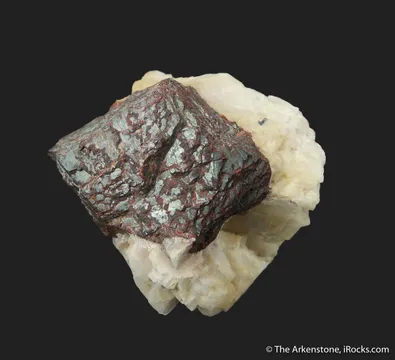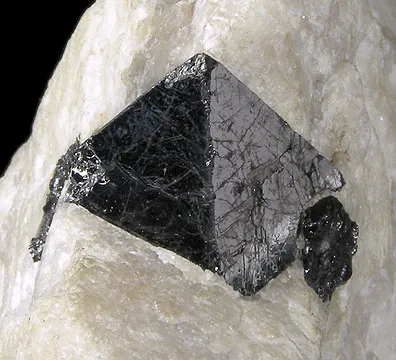
Buckwheat Dump — Franklin Mine, New Jersey: abundant franklinite and willemite with zincite and calcite, plus UV-fluorescent varieties for dedicated collectors.
Key facts
The Buckwheat Dump is the collector’s public window into the Franklin Mine: not a natural outcrop in the usual sense, but a concentrated field of mine rock from one of the strangest zinc deposits ever worked. Its importance comes from both abundance and possibility. On an ordinary visit a collector may still break open the classic Franklin ore assemblage — black franklinite, red zincite, white to gray calcite, and greenish to brown willemite — while the same dump also yields vuggy Buckwheat dolomite, calcium-silicate rock, pegmatitic material, altered ore, fluorescent coatings, and microscopic rarities that keep the locality scientifically alive decades after mining ceased.
The parent deposit is the Franklin zinc orebody of Sussex County, New Jersey, a metamorphosed Zn-Fe-Mn oxide-silicate ore enclosed in Precambrian Franklin Marble in the New Jersey Highlands. The ore was mined from folded, steeply plunging bodies whose mineralogy is instantly recognizable: franklinite and willemite are the workhorses; zincite gives the red sparks; calcite forms the familiar pale matrix and, under ultraviolet light, much of the red-orange glow that made Franklin a pilgrimage site for fluorescent-mineral collectors.
Regional View
Country View
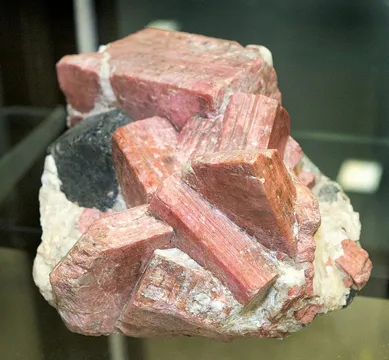
The best Buckwheat specimens have a compact, high-contrast look: blood-red zincite grains or crude crystals sitting against black metallic franklinite, set in calcite with green willemite that answers sharply under shortwave ultraviolet. Other pieces are less theatrical in daylight but better under lamps — gray-white calcite suddenly becomes orange-red, willemite burns green, hydrozincite can add blue, and rare cuspidine may appear as a bright yellow fluorescent surprise. For serious collectors, Buckwheat is not merely a souvenir dig; it is a sorting ground where patient eyes, a shortwave UV lamp, and a willingness to study ugly broken rock can still turn up locality-worthy material.
Search for specimens: View all specimens from Buckwheat dump mineral collecting site, USA
The Buckwheat Dump sits behind the Franklin Mineral Museum at 32 Evans Street in Franklin, Sussex County, New Jersey. In collecting terms it is a mine dump; in mineralogical terms it is a deliberately preserved sample of the Franklin Mine complex. The Franklin-Ogdensburg Mineralogical Society defines the dump as an area created to hold waste rock from the Buckwheat and Taylor mines, and that mixed origin is essential to understanding the specimens. A single day’s collecting may bring up zinc ore, Franklin Marble, Buckwheat dolomite, calcium-silicate assemblages, pegmatitic material, and secondary coatings — not because all of these formed in one neat pocket, but because the dump received rock from a mineralogically crowded mine environment.
The deposit represented by the dump is the Franklin zinc orebody, the northern member of the Franklin-Sterling Hill pair. The ores occur in and with Franklin Marble, a Precambrian marble unit in the New Jersey Highlands. The orebody was not a simple vein. It was a folded tabular mass, classically described as a synclinal structure, with principal ore minerals franklinite, willemite, and zincite, and with calcite as the familiar carbonate matrix and gangue. In hand specimen this makes Franklin ore deceptively simple: black, white, red, and greenish grains. In detail it is one of the richest mineralogical systems on Earth, with scores of primary, metamorphic, hydrothermal, and secondary species.
The nearby Buckwheat Pit, historically known as the Buckwheat open cut, occupied the southern “keel” of the northward-plunging Franklin orebody. Its rock record included zinc and iron ore, Franklin Marble, late Ordovician lamprophyre dike rock, and the vuggy Buckwheat dolomite body that became a separate collector’s specialty. The pit also obliterated or incorporated earlier workings, including the Southwest Opening, the Black Hole, the Weights & Measures pit, parts of the Buckwheat/Taylor workings, several smaller openings, and old shafts. That complicated mining footprint explains why “Buckwheat” labels may refer to the pit, the mine, the dump, or older mine names; good labels should be as specific as possible.
The Buckwheat Mine itself began in 1866 in what was literally a field of buckwheat. Later Taylor Mine operations enlarged the open pit and used an aerial tramway to move ore. Open-pit operations ended around 1912, while mining at Franklin continued through underground shafts farther north until 1954, when the Franklin Mine was exhausted and closed. The New Jersey Zinc Company, formed after the consolidation of competing zinc interests in 1897, was the dominant operator in the mature period of Franklin mining. The Franklin Mineral Museum was founded in 1964 to preserve the district’s mineral and mining heritage, and the Buckwheat Dump became the collecting ground that keeps that heritage physically accessible.
Today the Buckwheat Dump is a controlled, fee-based collecting site operated by the Franklin Mineral Museum. It is fenced and is normally accessed through museum admission or special collecting events. The main dump covers about 3.5 acres and is reached by descending an unpaved earthen ramp to a collecting area about 60 feet below the museum level. The museum also maintains a more accessible collecting area behind the building. Hours, seasonal opening, admission, poundage fees, night digs, and safety rules change, so serious collectors should check the museum’s current schedule before traveling. The rules are not ornamental: closed-toe footwear, eye protection when using tools, hand tools only at many events, and no claw hammers are the sort of practical restrictions that keep a public collecting site open.
Notable finds have often followed physical reworking of the dump. The site has been turned, replenished, and dug over repeatedly, yet reports continue to mention new or newly recognized material. The productive 2002 turnover brought rich ore back to the surface, along with hardystonite with clinohedrite, fluorapatite, cuspidine, sphalerite-calcite-hydrozincite combinations, chlorophane fluorite, scheelite-powellite material, fluorescent microcline, and abundant micro material. A 2020 report from the dump still described calcite with willemite and franklinite, green willemite crystals, gneissic willemite ore, microcline including green amazonite-like material, sphalerite in veins, chlorophane fluorite, hydrozincite, aragonite, and multi-wavelength calcite. The lesson is clear: Buckwheat is heavily collected, but it is not finished.
Buckwheat zincite is the red signature of the dump, but the ordinary form is not a big showy crystal; the classic material is made of small scattered reddish grains disseminated through granular black franklinite, white calcite, and pale-green to yellow-green willemite, with better pieces showing richer red patches, banded streaks, or crude crystals on contrasting matrix. Historical dump descriptions emphasize that zincite was abundant in Buckwheat specimens but rarely present in large amount in any one piece, and that crystals were exceptional rather than routine. That is why documented Buckwheat zincites in the centimeter range matter: intergrown crystals around 1.4 cm on calcite-cemented breccia, a 2.5 cm crystal on a 12 cm matrix, and 5.1 cm zincite crystals on franklinite and calcite are all far above the day-to-day dump standard. Good Buckwheat zincite has saturated blood-red to orange-red color, exposed relief rather than hidden grains, and a clear association with franklinite, willemite, and calcite; ordinary pieces are red-flecked ore fragments whose locality appeal improves dramatically under a good label and a shortwave lamp.
At Buckwheat, franklinite is the black metallic backbone of the ore, present as granular aggregates, rounded grains, misshapen crystal groups, massive patches, and occasional small octahedra in calcite-rich matrix. Contemporary descriptions of Buckwheat and Parker dump material note franklinite as the dominant ore mineral of the district, usually confined to zinc-ore specimens rather than the ordinary limestone material, and record Buckwheat examples with small octahedral crystals embedded in white calcite with associated phlogopite and willemite. A particularly attractive Buckwheat style is black franklinite in white to gray calcite with green willemite and red zincite, where the black grains provide the visual structure and the fluorescent minerals provide the lamp effect. The better collector pieces show recognizable octahedral faces, high metallic luster, blue or peacocky iridescent tarnish where natural, or balanced contrast with calcite and willemite; common pieces are simply heavy black-grained ore and are best appreciated as matrix specimens unless the franklinite is sharp, lustrous, unusually coarse, or compositionally important.
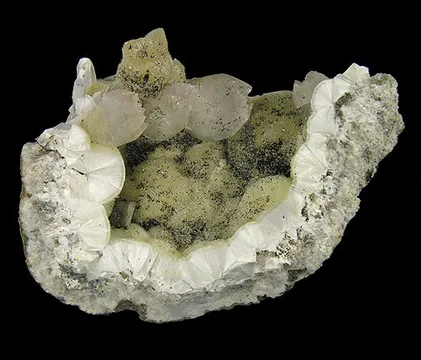
Buckwheat calcite is both matrix and show: white, gray, cleavable, granular, and locally vuggy in daylight, then orange-red, red, pink, blue, or multicolored under ultraviolet depending on activators, impurities, and wavelength. The familiar Buckwheat hand specimen is calcite enclosing franklinite grains and willemite, with shortwave UV bringing out bright orange to red calcite and green willemite while franklinite remains dark. FOMS-documented Buckwheat examples include a 3 by 3 inch calcite-willemite-franklinite specimen with bright orange calcite and green willemite under shortwave, and a 5 by 4 inch calcite-franklinite piece whose calcite shows blue and dark pink under longwave, blue under midwave, and red-orange under shortwave. The best Buckwheat calcites are not judged merely by crystal form; they are judged by clean contrasting fluorescence, attractive zoning or wavelength change, fresh broken surfaces, and association with willemite, franklinite, hydrozincite, sphalerite, or rare fluorescent species.
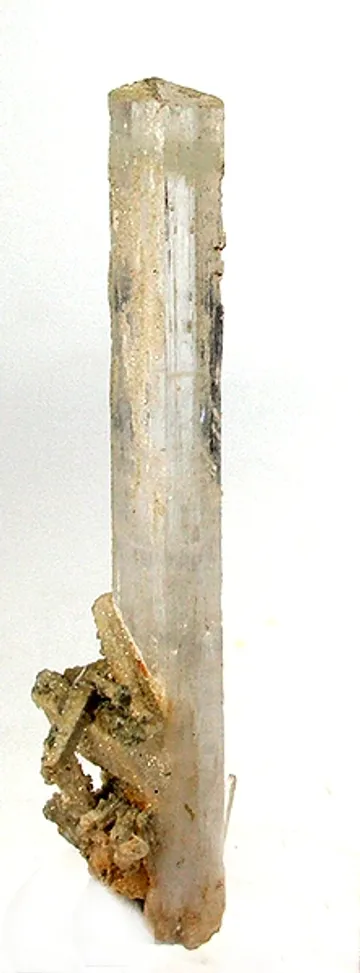
Willemite is abundant on the Buckwheat Dump, but the dump’s common willemite is often reddish, red-brown, grayish, or granular and does not always deliver the blazing fluorescence associated with the very best Franklin cabinet pieces. Bruce T. Mitchell’s long collecting account describes the common Buckwheat willemite as red to red-brown in daylight, usually with gray calcite, fluorescing green best under shortwave UV; he notes that the brightest fluorescent pieces tend to be naturally green willemite, associated either with black franklinite alone or with franklinite and calcite, and that cabinet-sized examples require systematic searching. Especially desirable Buckwheat pieces combine granular green willemite with black franklinite and bright red zincite, while more unusual dump finds include reddish-purple “grape” willemite and coatings of white willemite. A good Buckwheat willemite specimen should have visible daylight character, strong clean green response, and contrast with calcite and franklinite; the merely common material is pale, granular ore that fluoresces modestly but lacks pattern or composition.
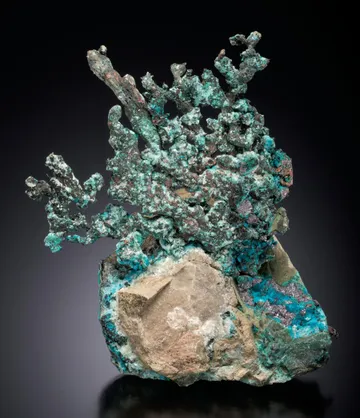
Beyond the four staples, the Buckwheat Dump’s species list is impressively deep. The vuggy Buckwheat dolomite assemblage has yielded microscopic quartz, dolomite, calcite, pyrite, sphalerite, hematite, brookite, anatase, rutile, ilmenite, marcasite, manganite, smithsonite, hemimorphite, heulandite-subgroup and stilbite-subgroup zeolites, talc, and zircon. Ore and silicate material add andradite, bustamite, clinohedrite, esperite, fluorapatite, fluorite variety chlorophane, cuspidine, hardystonite-bearing material, sphalerite, hydrozincite, microcline including green amazonite-like material, bornite, malachite, uraninite, thorite, thorutite, wallkilldellite, flinkite, chlorophoenicite, and other rarities that often require microscopic or analytical confirmation. The name franklinphilite also belongs in Buckwheat label history: it was described from material found on the Buckwheat Dump, but later mineralogical treatment has regarded it cautiously because the name has been discredited as a mixture in some modern references.
Buckwheat specimens need to be evaluated in two modes: daylight mineralogy and ultraviolet response. A plain gray-and-black ore fragment may become a fine fluorescent specimen under shortwave UV, but a gaudy fluorescent rock is not automatically mineralogically important. Serious collectors should carry or use shortwave UV for calcite and willemite, longwave UV for sphalerite and some coatings, and a visible-light hand lens for franklinite, zincite, garnet, pyroxene, dolomite cavities, and microcrystals. At home, examine freshly broken surfaces as well as weathered rinds; dump-weathered material often hides better color inside.
Condition is a practical issue. Calcite cleaves and bruises readily, willemite-rich ore can be granular and crumbly, zincite may be partly concealed in dense ore, and thin fluorescent coatings such as hydrozincite can rub away. Vuggy Buckwheat dolomite micros should be trimmed conservatively because the crystal-lined cavities are easy to destroy. Many matrix specimens are heavy for size because of franklinite and zincite; shelves, boxes, and shipping should be planned accordingly.
Mislabelling is common enough to matter. “Franklin,” “Buckwheat,” “Buckwheat Mine,” “Buckwheat Pit,” “Buckwheat Dump,” “Franklin Mine,” and “Trotter” have all been used loosely on older labels, and the dump itself contains mixed material from more than one mine source. A specimen found on the modern collecting site is legitimately a Buckwheat Dump specimen even if the rock originally came from elsewhere in the Franklin Mine complex, but that is not the same thing as saying the mineral formed at the dump. Mindat also warns that exotic “worldwide” specimens from children’s dump areas have sometimes been left in the Buckwheat Dump proper and then mistakenly reported as local minerals. Anything wildly inconsistent with Franklin mineralogy should be treated with suspicion unless it has a strong field label or analytical work.
There is also a long Franklin-area tradition of repaired or enhanced franklinite specimens, especially older crystal pieces. District literature records franklinite crystals repaired with plaster and blackened to disguise breaks, particularly among historic specimens. That warning applies most strongly to large, old, showy franklinite crystals rather than ordinary modern dump finds, but it should be in every collector’s mind when buying “Buckwheat” or “Franklin” franklinite with major crystals. Check for unnatural black coatings, filled corners, mismatched luster, glue lines, and matrix that fails to continue logically around the crystal.
Market availability is split. Common Buckwheat fluorescent ore — calcite with willemite and franklinite, with or without small red zincite — is still obtainable and often inexpensive. Well-composed pieces with strong multicolor fluorescence, obvious red zincite, clean green willemite, and a reliable Buckwheat label are much scarcer. True zincite crystals from the Buckwheat mine/dump tradition are in another category entirely: documented centimeter-scale crystals with provenance to old collections, publications, or institutions should be treated as significant Franklin specimens, not casual dump material.
On August 1, 2020, the Buckwheat Dump offered the sort of field day that explains why collectors keep coming back to a site everyone says has been picked over. It was brutally hot — the kind of humid northern New Jersey summer day when even determined diggers could manage only an hour or two on the rock pile. Shade became equipment. Tents and tarps sprang up across the dump, and Bill Pazik and his sons James and John built the most memorable shelter of the day: a working darkroom against the sun and heat, complete with a battery-operated electric fan. The fluorescent collectors were improvising as much as collecting.
The same day still produced enough material to keep the old dump’s reputation intact. Collectors saw the expected calcite with willemite and franklinite grains, but also tiny fine green willemite crystals, massive gneissic willemite ore with good green color on fresh breaks, abundant microcline including green amazonite-like material, sphalerite in gray veins, silvery sphalerite, and an unusual association of sphalerite in hendricksite mica. Chlorophane fluorite was common enough to become a small theme of the day: weathered surfaces showed dark blue under longwave UV, while freshly broken fluorite flashed a teal-green fluorescence that was beautiful but fleeting.
The night dig changed the rhythm completely. The daytime work ended at 5 p.m.; another group returned from 7 to 11 p.m. with UV lamps, headlamps, and the special optimism that comes when the dump itself starts glowing. About 30 additional attendees registered. The hazards were ordinary and memorable at once — stumbling over loose rock, swinging a sledge in darkness, and being swarmed by insects attracted to the collectors’ lights. One collector worked with a 12-pound sledgehammer and watched promising fragments fly off into the dark. Luck still found him: a boulder of multi-wavelength calcite, red under shortwave UV and red-purple under longwave. Another collector found a large boulder rich in orange-fluorescing sphalerite and decided not to trim it at all, hauling the whole thing home in one piece.
The most generous part of that report is not the mineral list but the social scene. Experienced diggers shared chlorophane, sphalerite, and other finds with newcomers. Families with children received extra identification help, advice, and sample rocks. Someone brought extra UV flashlights for sale; once beginners saw what the lamps revealed, the flashlights all disappeared into new hands. At the end of the evening, collectors climbed the ramp out of the Buckwheat Dump under heavy burdens — tired, insect-bitten, and carrying the kind of rocks that look dull in a bucket until the room goes dark.
Charles Palache, “The minerals of Franklin and Sterling Hill, Sussex County, New Jersey,” U.S. Geological Survey Professional Paper 180, 1935 — The foundational monograph on Franklin-Sterling Hill mineralogy, still essential for historical species descriptions and district context.
Thomas A. Peters, Robert J. Koestler, Joseph J. Peters, and Christian H. Grube, “Minerals of the Buckwheat Dolomite, Franklin, New Jersey,” The Mineralogical Record, 14(3), 183–194, 1983 — The key modern paper on the vuggy Buckwheat dolomite assemblage and its microminerals.
Mindat reference page for Peters et al., “Minerals of the Buckwheat Dolomite, Franklin, New Jersey” — Useful for tying the 1983 paper to specific mineral occurrences recorded from the Buckwheat dump and Buckwheat pit.
Wendell E. Wilson, “The best zincite specimens from Franklin, New Jersey,” The Mineralogical Record, 44(5), 509–534, 2013 — Important illustrated review of major Franklin zincite specimens, including documented Buckwheat examples.
EarthWonders record: Zincite crystal, 2.5 cm, on 12 cm matrix from the Buckwheat (Franklin) mine — Documents a major Buckwheat zincite with provenance from William “Billy” Ball through Raymond and Alvin Shortmann to Archibald N. Goddard and the Cranbrook Institute.
EarthWonders record: Zincite crystals on franklinite and calcite, 5.1 cm, from the Buckwheat (Franklin) mine — Documents an important Buckwheat zincite specimen with Washington Roebling and Smithsonian provenance.
EarthWonders record: Zincite, franklinite, calcite, and willemite from the Buckwheat (Franklin) mine — Documents intergrown zincite crystals to 1.4 cm on a calcite-cemented ore breccia matrix.
P. J. Dunn, D. R. Peacor, and Shu-Chun Su, “Franklinphilite, the manganese analog of stilpnomelane, from Franklin, New Jersey,” The Mineralogical Record, 23, 465–468, 1992 — Abstracted in American Mineralogist; historically important for the Buckwheat Dump material later discussed under the franklinphilite name.
Journal of the Russell Society, Vol. 16, discussion of franklinphilite at the Franklin type locality — Gives useful comparative detail on the holotype specimen found on the Buckwheat Dump and its friedelite-bearing vein assemblage.
Franklin Mineral Digest, 1958 issue — Contains period descriptions of Buckwheat dump zincite, franklinite, bornite, quartz, hematite, dolomite, and related associations.
The Picking Table, Vol. 61, No. 2, Fall 2020 — Field report from a Buckwheat Dump dig documenting modern finds, UV behavior, and collecting conditions.
The Picking Table, Vol. 43, No. 2, Fall 2002 — Reports the productive 2002 turnover of the dump and the return of material not seen on the surface for decades.
Mindat locality page: Buckwheat dump mineral collecting site — The best single online locality database entry for species list, locality hierarchy, and collecting cautions.
Mindat locality page: Buckwheat pit — Essential companion page explaining the adjacent open cut, its mining footprint, and its geological components.
Franklin Mineral Museum activities page — Official description of the Buckwheat Dump collecting area, access, darkroom facility, and museum collecting setup.
Franklin Mineral Museum visit page — Current museum hours, season, admission framework, and practical visitor information.
Franklin Mineral Museum events page — Current night-dig dates, special collecting events, and fees when posted.
Franklin Mineral Museum history page — Concise official background on the Franklin mine, zinc production, closure, and preservation of the site.
Sussex County: Franklin’s World-Renowned Zinc Mines — Useful historical overview of the Buckwheat Mine, Taylor Mine, open-pit period, and museum setting.
FOMS Franklin Terms and Definitions — Valuable glossary for local terms such as Buckwheat Dump, black ore, buckshot ore, and other Franklin collector vocabulary.
FOMS Zincite mineral page — Detailed Franklin-Sterling Hill zincite information with references and fluorescent notes.
FOMS Franklinite mineral page — Detailed treatment of franklinite habits, chemistry, alteration, fakes, and local importance.
FOMS Calcite mineral page — Useful for understanding Franklin calcite fluorescence and documented Buckwheat examples.
FOMS Willemite mineral page — Strong overview of willemite colors, habits, and fluorescence in the Franklin-Ogdensburg district.
Bruce T. Mitchell, “Collecting at the Buckwheat Dump, Franklin, New Jersey — Thirty Years and Counting” — Collector-focused long-form account with practical observations on Buckwheat minerals and field technique.
Fluorescent Mineral Society trip report: Franklin Super Diggg 2017 — Firsthand account of a Franklin collecting event including Buckwheat Dump collecting and night-dig context.
USGS Professional Paper 180: The minerals of Franklin and Sterling Hill, Sussex County, New Jersey — Classic government monograph for the district’s mineralogy and historical descriptions.
Smithsonian repository record: “Minerals of the Buckwheat Dolomite, Franklin, New Jersey” — Stable repository entry for the key Buckwheat dolomite paper.