






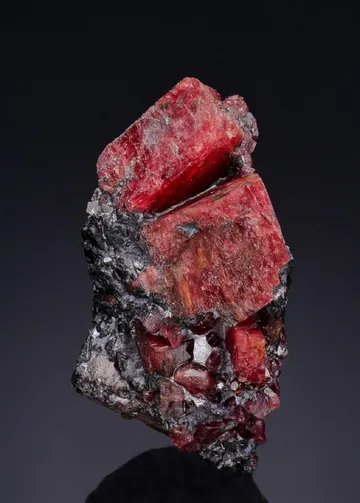
Rhodonite—a manganese silicate famed for rose-pink color with black manganese oxide veining, prized crystals, notable localities, and strong collecting appeal.
Key facts
Rhodonite is a manganese silicate best known for its rich rose to crimson-pink color and bold contrast with black manganese oxide veining. Crystals are comparatively uncommon and often blocky, tabular, or prismatic with good cleavage and a vitreous to pearly luster; massive material is far more abundant and widely used as an ornamental stone. In specimen form, rhodonite ranges from elegant, sharp crystals in sulfide-rich metamorphosed deposits (classic Broken Hill or Oppu Mine pieces) to sculptural manganese-skarn associations from Sweden’s Långban. Black manganese oxides (hausmannite, pyrolusite) frequently accent pink faces and fractures, enhancing visual contrast. Collectors prize the species for saturated color, sharp terminations when present, and striking associations (quartz, galena, calcite, rhodochrosite, bustamite, spessartine). While slabs and carvings are affordable and ubiquitous, fine unpolished crystal specimens from benchmark localities are scarce and can be highly valuable.
Rhodonite occupies a dual identity: an accessible decorative stone recognized worldwide and a connoisseur’s species in crystal form. Carving-grade rhodonite has adorned architectural objects since the 19th century (especially from the Urals and Lake Baikal area), ensuring broad recognition. Among mineral collectors, the allure centers on locality-specific aesthetics: brilliant red crystals from Broken Hill; gemmy, sharply formed Japanese crystals from the Oppu Mine; fluorescent Franklin pieces; or sculptural Långban skarns rich in uncommon manganese companions. Supply of top crystal specimens is limited, particularly from long-exhausted districts, so the best pieces with strong color, luster, and clean terminations are avidly pursued. Meanwhile, attractive thumbnails and small cabinet pieces remain obtainable, offering newcomers an entry into a classic pink species with excellent shelf presence.
Below are renowned sources known for producing distinctive and collectible rhodonite. Each locality’s identity is tied to particular habits, associations, and historical finds.
The world standard for rhodonite crystal specimens. Broken Hill produced intensely colored red to deep rose crystals—often stout, lustrous, and sharply terminated—accompanied by galena, sphalerite, quartz, and jet-black manganese oxides for dramatic contrast. Many pieces show attractive etching or oxide lacework on pink faces, and matrix combinations can be architectural and bold. Unrepaired crystals with bright, even color and clean terminations are very scarce; fine vintage examples anchor major collections.
Rhodonite is 5.5–6 on the Mohs scale with perfect cleavage and fair toughness—handle gently.
By focusing on intense color, crisp form, and clean condition—ideally on a contrasting matrix from a benchmark locality—you can build a rhodonite suite that spans both the decorative and the truly collectible, with a few choice specimens standing as pink highlights in any display.