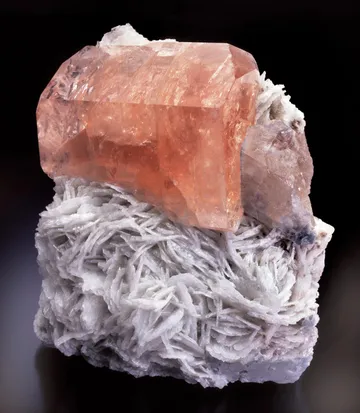
Elizabeth R. Mine, USA — premier morganite locality in the Chief Mountain pegmatites; pastel pink morganite on cleavelandite, often with pale aquamarine.
Key facts
The Elizabeth R. Mine is one of the modern keystones of the Pala pegmatite story: a Chief Mountain rare-element pegmatite locality whose best specimens are not simply “California beryl,” but among the defining North American morganites. It lies in the Pala Mining District of northern San Diego County, where lithium- and boron-rich granitic pegmatites cut the crystalline rocks of the Peninsular Ranges. The deposit is best understood as part of the same Chief Mountain pegmatite system that includes the adjacent Oceanview and Pala Chief workings: zoned, pocket-bearing, internally complex dikes where late-stage fluids concentrated beryllium, lithium, boron, tantalum-niobium oxides, phosphates, and a suite of bismuth-vanadate rarities.
For collectors, Elizabeth R. means pastel beryl on pale feldspar. The classic look is a sharp, tabular to short-prismatic morganite crystal—soft rose, peach-pink, or pinkish orange—perched on white to grayish cleavelandite or albite, often with muscovite, lepidolite, quartz, black tourmaline, or tantalum-niobium oxides. The finest pieces can show the characteristic Chief Mountain bicolor personality: pink morganite grading into pale blue aquamarine in the same crystal or on the same plate. These specimens have a particularly Californian restraint: not the saturated, candy-colored morganite of some later world finds, but glassy, delicately colored crystals with strong form, important provenance, and unmistakable pocket-mineral context.
Regional View
Country View
The historical importance of the mine is unusually concentrated in a few names and dates. The original Hazel W. claim was made early in the twentieth century, but the locality became a collector’s mine under Roland Reed, who acquired the claim in 1974 and renamed it Elizabeth R. Later, the downhill Oceanview workings, developed on the Elizabeth R. lode area and the adjacent Ocean View pegmatite ground, extended the same specimen-producing story into the twenty-first century. Together, the Reed-era Elizabeth R. finds, the 2005 morganite strike, the Oceanview 49er Pocket, and the Big Kahuna spodumene zones make this small part of Chief Mountain one of the best documented modern gem-pocket environments in California.

Photo: Wikimedia Commons
The specimen illustrated above, “Pala Princess III,” is an ideal visual summary of the locality’s appeal: broad, glassy beryl faces with both aquamarine-blue and morganite-pink color, set on albite from the famous Pala Princess find. It is the sort of piece that explains why Elizabeth R. material is evaluated as much by history, matrix, and crystal architecture as by color alone.
Search for specimens: View all specimens from Elizabeth R. Mine, USA
The Elizabeth R. Mine, also recorded as the Hazel W. claim, is on the northwest slope of Chief Mountain, roughly 2.5 miles northeast of Pala in San Diego County, California. It is immediately part of the crowded Chief Mountain gem-mining landscape, adjacent to the Pala Chief mine area and tied geologically and historically to the Oceanview workings. The locality is a mine in a complex rare-element pegmatite system, not a vein mine in the traditional metallic-ore sense: its collector value comes from discrete gem pockets and altered pocket zones within pegmatite, rather than from continuous ore shoots.
The regional setting is the Pala Mining District, a classic Southern California gem-pegmatite field within the Peninsular Ranges batholith. The older district literature describes hundreds of pegmatite dikes exposed over the Pala area, many hosted by gabbroic and related crystalline rocks, with internal zoning from wall zones and graphic granite through coarse feldspar-quartz assemblages into quartz-rich, feldspar-rich, spodumene-bearing, and replacement zones. The Elizabeth R. and neighboring Chief Mountain dikes fit this rare-element, LCT-style pegmatite model: lithium minerals, beryl, tourmaline, lepidolite, columbite-tantalite minerals, phosphates, and late clay-pocket assemblages occur together in a way typical of evolved granitic pegmatites.
The most productive collector mineralization at Elizabeth R. has come from pockets and clay-filled cavities. In the Reed workings, gem beryl—especially morganite, aquamarine, and bicolor beryl—occurred with albite and cleavelandite, muscovite, lepidolite, quartz, tourmaline, feldspar, and accessory tantalum-niobium oxides. Later Oceanview development, down-dip and along the same Chief Mountain pegmatite system, exposed additional mineralized zones that produced bicolor beryl, quartz, tourmaline, spodumene, kunzite, lepidolite, and phosphates. The collector should think of the locality as a series of episodic pocket environments: some beryl-rich, some lithium-rich, some quartz-rich, and some oxidized enough to produce rare secondary bismuth-vanadate species.
The mining history begins under the Hazel W. name. A claim to the deposit was made in 1907 by Frank A. Salmons, and the Hazel W. was later associated with the Pala Chief Gem Mining Company’s group of lode claims. The original claim was considered abandoned by the early 1950s. Roland Reed acquired a later Hazel W. claim in April 1974 and renamed it Elizabeth R., after his wife according to one major locality record, though another modern Chief Mountain account states that the name honored his daughter. Either way, Reed’s name is inseparable from the locality. His underground work over nearly three decades produced the specimens that established Elizabeth R. as a serious collector locality: outstanding morganite, aquamarine, some polychrome tourmaline, kunzite, lepidolite, apatite, lithium phosphates, columbite-tantalite minerals, quartz, and feldspar.
The early Reed-era morganite production included important finds in 1974–1975 and 1982. The most famous specimen, later known as the Pala Princess, was recovered on May 15, 1982. It was a large repaired plate of morganite and aquamarine on albite, later separated and prepared into several major specimens, with “Pala Princess III” becoming the best-known surviving display piece. The mine was not exhausted by that discovery. A 1992 strike produced more important morganite, and a new adit begun around 2000 led to another significant morganite pocket in early 2005, yielding around one hundred fine specimens, including tabular crystals to about 8 cm across in the pieces reported on the collector market.
Modern mine geography can be confusing because “Elizabeth R.” and “Oceanview” are closely intertwined. The Oceanview mine name is used for the later, lower adits and workings developed on the western downhill portion of the Elizabeth R. lode claim and the adjacent Ocean View pegmatite ground. Work on those lower adits began around 2000 under Jeff Swanger and partners, ultimately following the Oceanview pegmatite for more than 400 feet along strike. A quitclaim deed filed in 2010 transferred the Elizabeth R. lode mining claim from Roland Reed to Jeff Swanger, and the Chief Mountain mines—Oceanview, Elizabeth R., and Pala Chief—became part of a modern, interconnected operation.
Collecting access should be treated as private, controlled, and changeable. The old underground workings are not casual rockhounding sites, and the mine area includes private claims, active workings, steep terrain, and land-status complications involving the Pala Band of Mission Indians and valid existing mining rights. Public collecting in the broader Chief Mountain operation has been offered through scheduled fee-dig programs at Oceanview and Pala Chief, where visitors screen mine material under operator rules; that is entirely different from entering Elizabeth R. workings or dumps independently. Serious collectors should obtain specimens through reputable dealers, documented old collections, or operator-sanctioned dig programs, and should verify current access directly with the operator before making plans.
Morganite is the signature mineral of the Elizabeth R. Mine. The Reed-era crystals are typically tabular to short-prismatic beryl, pale rose to peach-pink or pinkish orange, commonly glassy and sharply formed, with the finest examples showing partial gemminess and strong basal faces on albite or cleavelandite matrix. Important finds in 1974–1975, 1982, 1992, and early 2005 produced the locality’s reputation; the 1982 Pala Princess assemblage is the best-known example, combining morganite and aquamarine on albite, while the 2005 pocket yielded sharp, lustrous crystals reported to about 8 cm across. Good Elizabeth R. morganites are not judged merely by depth of pink: the best pieces combine complete crystal outline, natural luster, matrix placement, bicolor aquamarine-morganite zoning where present, and convincing old Chief Mountain provenance.
Beryl from Elizabeth R. is best known through its morganite and aquamarine expressions, but the locality also produced pale to colorless beryl, bicolor crystals, and beryl groups that sit aesthetically between named varieties. The most distinctive habit is broad-faced, tabular to short hexagonal crystals in pocket assemblages with albite, cleavelandite, quartz, muscovite, lepidolite, tourmaline, and locally tantalum-niobium oxides. The strongest pieces are those where the beryl preserves sharp form and carries either a visible color transition from pale blue to pink or a clean, sculptural relationship to the feldspar matrix; ordinary pieces tend to be incomplete, very pale, etched, or detached fragments without a meaningful association.
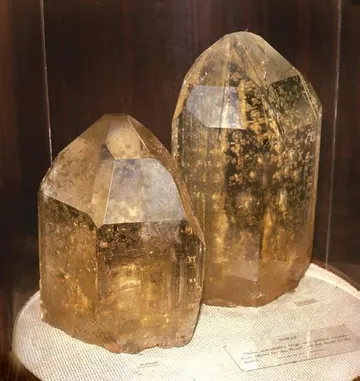
Quartz is a major pocket companion at Elizabeth R. and in the linked Oceanview workings, occurring as colorless rock crystal, smoky quartz, citrine to smoky-citrine, and massive to crystalline quartz in core-zone pegmatite. In the morganite pockets it commonly serves as an accessory rather than the principal attraction, but in the Oceanview 49er and related zones quartz crystals accompanied beryl, feldspar, schorl, and tourmaline, and large gem-quality citrine crystals were specifically noted among the pocket products. The desirable quartz specimens from this locality are clean, undamaged pocket crystals with meaningful associations—especially beryl, schorl, albite, lepidolite, or colored tourmaline—rather than isolated quartz points with no mine-level context.
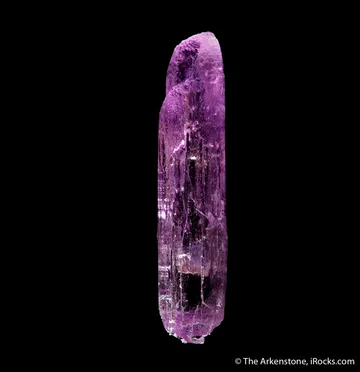
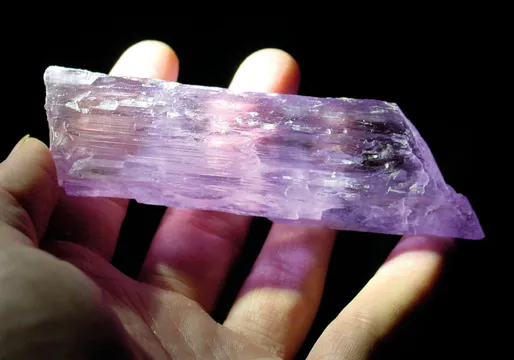
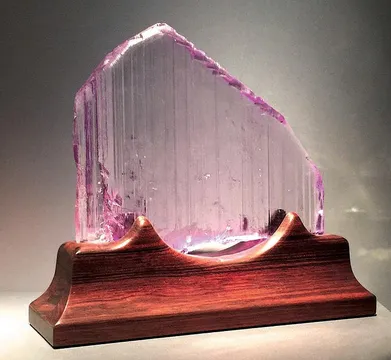
Kunzite from Elizabeth R. and the closely connected Oceanview workings occurs as pink to pinkish purple spodumene, often tabular, bladed, etched, and strongly pleochroic. Reed’s workings produced small quantities of kunzite in several episodes, including material documented in the early 2000s, while the down-dip Oceanview development on Chief Mountain later produced important kunzite pockets in 2009–2010. The best pieces show complete or near-complete bladed crystal form, saturated lilac to deep purple color, good translucency or gemminess, and association with albite, lepidolite, quartz, and tourmaline; because kunzite can fade in sunlight and cleaves readily, intact color-rich crystals from this locality are much more desirable than bright but cleaved fragments or sun-paled blades.
Lepidolite at Elizabeth R. is both a pocket indicator and an aesthetic matrix mineral, appearing as lilac to purple granular or micaceous masses, books, aggregates, and coatings associated with albite, cleavelandite, quartz, beryl, tourmaline, elbaite, schorl, spodumene, and tantalum-niobium oxides. It was encountered in small masses in the Reed-era upper and lower workings and became especially visually important in some Oceanview lithium-rich zones, where richer purple lepidolite formed attractive matrices for tourmaline and spodumene. Good specimens show strong purple color, fresh mica sparkle, and compositional balance with beryl or tourmaline; dull, clayey, friable, or massive lepidolite without a display mineral is more geological than collectible.
Albite, especially the platy cleavelandite habit, is the chief stage on which Elizabeth R. specimens perform. It occurs as white, grayish white, or pale bluish platy aggregates and crystalline feldspar masses in pocket zones, commonly carrying morganite, aquamarine, quartz, lepidolite, muscovite, schorl, elbaite, and columbite-tantalite minerals. The best albite specimens are not valued as feldspar alone, but for their matrix architecture: clean, snow-white cleavelandite plates that lift a pink beryl, dark tourmaline, or lustrous oxide into a balanced cabinet composition. Ordinary albite from the mine is abundant enough as broken feldspar or massive pegmatite, but undamaged cleavelandite matrix with a well-placed associated crystal is a major plus for provenance and aesthetics.
Spodumene at Elizabeth R. spans pale, greenish, colorless, and kunzite-variety material, usually as flattened laths or blades that may be etched, cleaved, clay-altered, or partly gemmy. The locality and the connected Oceanview zones have produced both specimen crystals and rough, with the most dramatic modern spodumene production coming from the down-dip Big Kahuna zones, including very large kunzite and triphane-related finds nearby on Chief Mountain. Elizabeth R. spodumene is collectible when it preserves form, color, termination, or matrix association with lepidolite, albite, quartz, and tourmaline; broken cleavage plates and altered pseudomorphic masses are common geological material unless they document an important pocket or carry unusual associations.
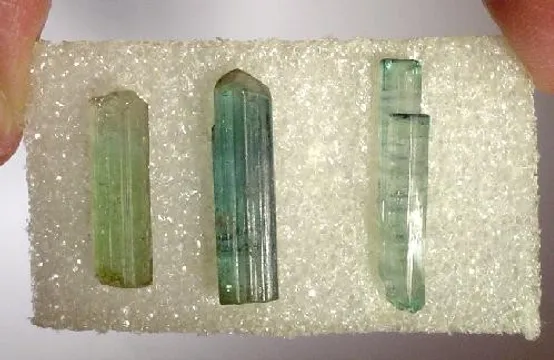
Tourmaline from Elizabeth R. and the related Oceanview workings ranges from black schorl through blue, pink, cranberry-red, green, and bicolor elbaite-bearing material. Reed’s work produced some polychrome tourmaline, while later Oceanview zones yielded pale blue, dark purple to black, pink, green, and bicolor crystals, including “blue-cap” styles and pencils associated with albite, lepidolite, quartz, spodumene, and beryl. The best tourmaline pieces here are slim, lustrous, terminated crystals or well-composed matrix specimens with clear color zoning; ordinary pieces are broken black prisms, partial embedded sections, or heavily clay-coated fragments without a diagnostic or aesthetic association.
Muscovite is a common and important accessory at Elizabeth R., forming books, plates, silvery mica aggregates, and matrix material with albite, quartz, beryl, lepidolite, microcline, and tantalum-niobium oxides. It is part of both the pegmatite wall-zone and pocket assemblage, and it also appears in aplite/pegmatite studies of the Pala Chief–Elizabeth R. composite dikes. Collector-quality muscovite from this locality depends on context: bright, undamaged books associated with morganite, tantalite-(Mn), columbite-(Mn), or feldspar are attractive and locality-reinforcing, whereas loose mica books or ragged flakes are common pegmatite material and rarely carry high specimen value by themselves.
Schorl is the black tourmaline face of the Elizabeth R. assemblage, occurring as striated black prisms, embedded crystals, broken pocket pieces, and matrix partners with quartz, albite, cleavelandite, lepidolite, beryl, and sometimes colored tourmaline rims or caps in the broader Oceanview system. It is especially important visually because it provides the dark contrast that makes pastel beryl and white feldspar specimens read strongly in the case. The best schorl pieces preserve termination, luster, and a clean feldspar or quartz association; ordinary material is abundant as broken black rods or massive tourmaline in pegmatite, and such pieces need either strong form or a meaningful association to rise above study-specimen grade.
Tantalite from Elizabeth R. is best represented by black, submetallic to metallic, tabular or bladed crystals of the tantalite-(Mn) style in albite-cleavelandite, quartz, lepidolite, muscovite, and beryl-bearing assemblages. The locality’s tantalite specimens are classic rare-element pegmatite accessories rather than large display minerals, but they can be very choice when a sharp black blade is isolated on white feldspar or paired with pink morganite. Good pieces are lustrous, well-formed, and visibly perched or embedded in attractive matrix; ordinary pieces are small, broken, massive, or so darkly embedded in mica and feldspar that the crystal form is difficult to read.
Elbaite at Elizabeth R. and in the Oceanview workings is the colored tourmaline counterpart to schorl, appearing as pink, red, green, blue, and bicolor crystals, though generally in smaller quantities than the beryl and feldspar that made the mine famous. Documented specimens include gemmy blue-green crystals, red to cranberry-red pieces, pink-and-green bicolor pencils, and elbaite on albite-lepidolite matrix from lithium-rich pocket zones. The strongest Elizabeth R./Oceanview elbaites are terminated, lustrous, color-zoned crystals on matrix or with lepidolite and albite; loose broken tourmaline sections can still be attractive, but without termination, color zoning, or a clear Chief Mountain provenance they are much less compelling.
Columbite from Elizabeth R. is represented principally by columbite-group minerals, including columbite-(Mn), as tabular to bladed black crystals associated with albite, cleavelandite, lepidolite, quartz, muscovite, schorl, and beryl. In the Oceanview workings, columbite-group crystals were reported from pockets along early haulage and later zones, with some friable crystals altered or encrusted by earthy yellow secondary minerals. The best examples are crisp, lustrous, identifiable blades on contrasting white feldspar, especially where they preserve a complete outline; lesser pieces are granular, altered, embedded, or require analytical confirmation to separate confidently from tantalite-(Mn).
Other minerals documented from the Elizabeth R. Mine and its closely related Oceanview workings make the locality far more than a morganite source. The broader list includes aquamarine, goshenite, microcline, cleavelandite, montmorillonite, kaolinite, cookeite, fluorapatite or strontiumapatite, montebrasite, lithiophilite and altered lithium phosphates, purpurite, hopeite, hureaulite, fairfieldite, spessartine, goethite, pyrite, native bismuth, pucherite, clinobisvanite, eulytine, namibite, gahnite, zircon, and related bismuth-vanadate or phosphate species. Eulytine is especially notable: material from Elizabeth R. helped establish the species as new to California and probably new to the United States in the mid-1990s literature. Gahnite, though microscopic and not a specimen mineral here, is scientifically important from the Elizabeth R. and Pala Chief layered pegmatite-aplite dikes because its chemistry has been used to interpret melt evolution in the Chief Mountain system.
Elizabeth R. material is desirable enough that locality confidence matters. Loose pastel beryl crystals from Pala, generic “San Diego County” morganites, and pieces from Oceanview, Pala Chief, White Queen, Stewart, or other district mines can be visually similar, so strong labels, old collection history, dealer documentation, and matrix association are important. A specimen labeled simply “Pala” or “Chief Mountain” should not automatically be promoted to Elizabeth R. without supporting provenance. The reverse is also true for Oceanview material: because the lower Oceanview workings are historically and physically tied to the Elizabeth R. lode area, labels may legitimately mention both, but collectors should preserve the exact original wording rather than simplifying away useful locality nuance.
No major, well-documented pattern of artificial fakes specific to Elizabeth R. morganite is established in the standard collector literature, but ordinary pegmatite-market cautions apply. Broken beryl crystals can be glued to albite matrix, repairs may be skillfully hidden, and older important pieces such as the Pala Princess material have complex preparation histories that should be disclosed. Repaired does not necessarily mean undesirable—many great pegmatite specimens required stabilization or trimming—but undisclosed reassembly materially affects value. Bicolor beryl should also be examined carefully: natural Chief Mountain aquamarine-morganite zoning is real, but color claims should be consistent with the crystal and not merely a lighting effect through pale material.
Condition is the central issue for most Elizabeth R. specimens. Morganite can be edge-worn, cleaved, bruised on basal faces, or partly etched; kunzite and spodumene are more fragile still, with excellent cleavage and sensitivity to sunlight. Lepidolite and clay-pocket matrix can be friable, montmorillonite-rich pocket material can soften or shed, and cleavelandite plates can snap if handled by the matrix edge. Specimens should be supported from beneath, kept out of prolonged direct sun, and cleaned conservatively. Water and soft brushes may be safe for solid quartz or feldspar associations, but soaking clay-rich pocket pieces, lepidolite-rich matrix, or repaired specimens can cause damage.
Fluorescence is not the locality’s main collecting feature, but some accessory minerals are worth checking. Montebrasite from Elizabeth R. has been recorded with patchy green fluorescence under shortwave ultraviolet light, and phosphates in similar pegmatite environments may respond variably. Fluorescence should be treated as a supplemental observation rather than an identification method, especially in mixed pocket material.
Market availability is episodic. Morganite, beryl, quartz, lepidolite, albite, and black tourmaline from Elizabeth R. appear periodically from old collections and modern dealer inventories, but fine matrix morganites with strong color, sharp form, and old Reed-era provenance are scarce. Major Pala Princess-related specimens are effectively museum-grade and rarely trade. Tantalite-(Mn), columbite-(Mn), elbaite, and kunzite from the locality are less common in high aesthetic quality, while scientific rarities such as eulytine, clinobisvanite, namibite, pucherite, and gahnite are primarily micromount, analytical, or research-interest species rather than mainstream cabinet specimens.
The great Elizabeth R. story begins with Roland Reed’s long, stubborn work on Chief Mountain. He bought the Hazel W. deposit in April 1974, renamed it Elizabeth R., and spent nearly three decades pursuing pockets in a pegmatite that had not yielded its best specimens in the old Pala boom years. Unlike the early twentieth-century rush, with companies, export markets, and crews chasing tourmaline, this was a modern miner’s locality: narrower in scale, more personal, and more dependent on patience underground. Reed’s early success in 1974–1975 and again in 1982 proved that Chief Mountain’s pastel beryls were not exhausted relics of the prewar gem era.
On May 15, 1982, Reed opened the pocket that produced the Pala Princess. The specimen was not a single isolated crystal but a broad plate of beryl and albite: pink morganite, pale blue aquamarine, and feldspar in a combination that immediately belonged to the top tier of American pegmatite specimens. John Sinkankas reportedly judged it the finest beryl specimen found in North America to that date. Later, the plate’s history became as complicated as the specimen itself. It had been a repaired large plate made of several pieces; in 2003, it was purchased from a private collector, disassembled, trimmed, and prepared into separate unrepaired specimens. “Pala Princess III,” measuring 15.2 x 9.1 x 7.0 cm, is the best-known of those survivors, with one large beryl crystal showing an aquamarine-blue core and morganite-pink body on albite.
The mine had another chapter in 1992, when Reed encountered a rich morganite zone remembered for some of the finest Southern California morganite specimens. One reported standout was a cleavelandite base roughly 50 cm across carrying seven large morganite crystals to about 15 cm, plus smaller crystals. That description is worth pausing over because it captures the scale collectors usually do not associate with pale Pala morganite. Elizabeth R. is often represented in collections by thumbnails, miniatures, and small cabinet pieces; the 1992 zone shows that, under the right pocket conditions, Chief Mountain could produce full cabinet-scale beryl plates with crystals large enough to anchor a major display.
A further strike came in early 2005, just as the Tucson show was underway. A pocket in the newer Elizabeth R. development yielded around one hundred fine morganite specimens, and a small group reached the collector market quickly enough to be noticed in the major show-and-internet reports of the time. The best pieces were miniature to small-cabinet specimens: sharp tabular crystals, high luster, good pink color, and at least partial gemminess, with crystals to about 8 cm across. For collectors, this find was important not just because the specimens were pretty, but because it linked the old Reed reputation to a living, twenty-first-century Pala market. Elizabeth R. was not only an old label; it was still capable of producing fresh, high-grade pocket beryl.
The Oceanview story begins downhill and down-dip, but it belongs in the same Chief Mountain narrative. Jeff Swanger approached Roland Reed in 1999 and acquired the Oceanview property in 2000, then began driving a new adit with partners and crew. For years the work yielded only minor finds. The miners followed the pegmatite deep into the mountain, extending the tunnel hundreds of feet, chasing the expectation that the same system that had produced beryl above might open again below. The reward came on September 22, 2007—Swanger’s 49th birthday—when the crew broke into the pocket that became the 49er Pocket.
The name “49er” worked two ways: Swanger’s birthday and the old California treasure-hunting myth. The pocket took months to excavate and produced remarkable morganite and aquamarine specimens, many on albite or cleavelandite, with quartz, feldspar, and schorl. The unusual feature was not simply that both varieties occurred, but that they appeared together so intimately: aquamarine and morganite adjacent on the same specimen, and in some cases bicolor in the same crystal. The colors were often pale, but the combinations were unlike anything else in the region at that quality level. Large gem citrine also came from the pocket, adding another signature to the find.
Then came the lithium-rich chapters. In December 2009, Oceanview miners opened a basketball-sized spodumene pocket with lavender and deep purple kunzite, green and bicolored spodumene, blue-capped tourmaline, lepidolite, and cleavelandite. Nearly all of the kunzite showed strong green-to-purple trichroism. In spring 2010, the Big Kahuna zone produced hundreds of kilograms of gem spodumene and a large crystal lath about 21 cm tall and nearly a kilogram in weight. Later that year, the down-dip Big Kahuna II zone on the Baker Boulevard level produced even richer purple kunzite and cranberry-red tourmaline on albite-lepidolite matrix.
The most famous Big Kahuna II crystal was found on December 20, 2010: a kunzite measuring 28 x 15.6 x 2 cm and weighing 2.2 kg. It has been called one of the finest American kunzite crystals and perhaps one of the largest extant U.S.-origin examples. Photographs of miners with freshly extracted crystals from the Big Kahuna pockets capture the essence of modern Pala mining: not industrial ore extraction, but careful hand recovery of fragile, color-zoned crystals from clay and feldspar, with pocket tools replacing blasting once the prize zone is reached.