A collector's guide to Dassu, Pakistan: its geology, mining history and notable minerals, illustrated with the 268 specimens documented from this locality on EarthWonders.
Key facts
Dassu is one of the great collector names of the Karakoram: a village and pegmatite district in the Braldu Valley of Shigar District, Gilgit-Baltistan, where miarolitic granitic pegmatites have yielded aquamarine and topaz specimens with the poise, color and transparency that define world-class cabinet minerals. The productive bodies lie in a high, severe mountain landscape north of Skardu, around the lower Braldu drainage and its side localities—Dassu village, Niyit Bruk, Gone, Tigstung and neighboring workings—where pegmatite dikes and lenses cut biotite gneiss, granodiorite and rocks of the Karakoram Metamorphic Complex. For collectors, the setting matters because these are not low-temperature veins or alpine clefts: the best specimens came from coarse inner pegmatite zones and clay-lined cavities, the classic pocket environment where crystals could grow free, sharp and lustrous.
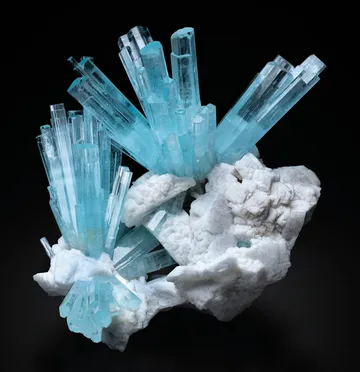
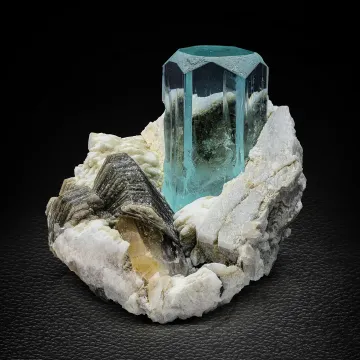
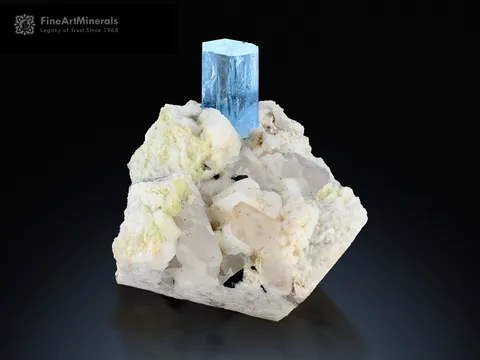
The Dassu signature is the contrast of gem crystals against white pegmatite matrix. Fine aquamarine appears as upright, hexagonal, glassy blue prisms on feldspar, albite and muscovite, commonly with black schorl and occasionally red garnet. Topaz, especially from the Dassu–Niyit Bruk–Gone belt, ranges from colorless to pale champagne and sherry-brown, as sharply formed prismatic crystals, many of them doubly terminated and water-clear. Around those two headline species is a complete Karakoram pegmatite assemblage: quartz, albite-cleavelandite, microcline, muscovite, schorl, fluorite, garnet, hydroxylherderite, beryl varieties including goshenite and morganite, tantalum-niobium oxides, phosphates and rare late-stage species.
Historically, Dassu has unusual depth. Its aquamarine mines were noted in Geological Survey of India work in 1918, became familiar to international dealers through the late 20th-century Pakistani gem-specimen trade, and then rose again in the 2000s and 2010s as collectors began demanding intact matrix specimens rather than only loose gem crystals. The finest Dassu-area pieces have the look that serious collectors immediately recognize: transparent blue beryl standing out from snowy feldspar, champagne topaz perched on mica and cleavelandite, black tourmaline adding architectural contrast, and—on rare elite plates—red spessartine or almandine-spessartine garnets dotting the matrix like sparks.
Regional View
Country View
The locality name needs care. Labels may read Dassu, Dasso, Daso, Dusso, Braldu Valley, Shigar Valley, Skardu District, Northern Areas, Gilgit-Baltistan or simply “Pakistan.” There is also a separate Dassu/Dasu name used elsewhere in northern Pakistan, and “Haramosh Dassu” is a distinct usage that can lead to confusion. For a collector, the most useful modern label is “Dassu, Braldu Valley, Shigar District, Gilgit-Baltistan, Pakistan,” with the mine or sublocality—Namlook, Niyit Bruk, Gone, Tigstung, Goand/Gawand or related names—preserved when known.

Photo: Wikimedia Commons
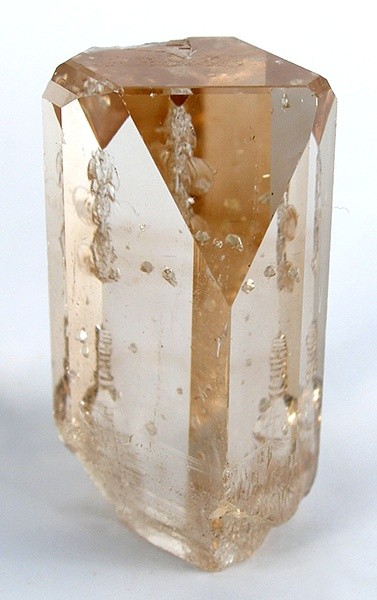
Photo: Wikimedia Commons

Photo: Wikimedia Commons
Search for specimens: View all specimens from Dassu, Pakistan
Dassu is a gem-bearing granitic pegmatite district, not a single mine in the narrow sense. The productive bodies occur as dikes, lenses and irregular pegmatitic masses, with swarms concentrated at and around Dassu village, Niyit Bruk about 8 km northeast of Dassu, Gone about 8 km east of Dassu, and Tigstung about 5 km southwest of Dassu. The classic Dassu pegmatites intrude biotite gneiss and can reach roughly 8 m thick and 45 m long in the older published descriptions; the broader field reports also describe pegmatite veins in the area ranging from about 15 to 200 ft long and 5 to 30 ft thick. They generally show a fine-grained aplitic or border zone and a coarser inner pegmatitic zone containing vugs, cavities and pocket clay.
Mineralogically, the basic pegmatite framework is feldspar, quartz, muscovite, biotite, beryl and schorl. Plagioclase, especially albite, is abundant; microcline and orthoclase are important in some zones, particularly in more feldspar-rich pockets. Gem crystals are concentrated in the coarse central zones, core-margin zones and vugs rather than evenly through the rock. Beryl and aquamarine occur in segregated feldspar bands and cavities; topaz is especially associated with the central vug zones of Niyit Bruk and other topaz-bearing dikes; garnet, galena, pyrite and massive rose quartz are noted locally; fluorite is rare but prized when it occurs as transparent green crystals.
The geology is part of a much larger Karakoram pegmatite story. The Shigar Valley pegmatites are linked to post-collisional granitic magmatism and intrusion of highly fractionated pegmatites into metamorphic and meta-igneous host rocks. Recent work on Be-Li-Nb-Ta pegmatites in the Shigar Valley separates a Dassu–Yuno sector of beryl-tourmaline pegmatites from other pegmatite suites and interprets the upper Shigar systems as highly evolved, volatile-rich, rare-metal-fertile pegmatites. For collectors, that translates into exactly the minerals seen on good labels: beryl, schorl, muscovite, albite, microcline, quartz, fluorite, topaz and a fringe of rare phosphates and tantalum-niobium oxides.
Dassu’s mining history reaches back at least to the early 20th century, when aquamarine mines on the Braldu River were described in Geological Survey of India records. By the 1980s, Pakistani pegmatite localities including Dassu and the broader Shigar-Braldu region were supplying the international trade with aquamarine, topaz, fluorite, schorl, garnet and feldspar-matrix specimens. Much of the work has remained small-scale, seasonal and local: miners open pits, adits and short tunnels into visible pegmatite veins, follow pockets, and sell production through Skardu, Peshawar’s Namak Mandi market, international shows and dealers. Government and development reports emphasize that much production has historically passed through local hands without reliable centralized production records.
At Dassu and Tigstung, published field visits recorded numerous small pits and adits for topaz mining. One larger adit in a leased area near the Dassu bridge at Tigstung was described as driven into an exposed pegmatite vein, with a main opening about 6 ft high and 7 ft wide that split into smaller branches about 4 ft high and 5 ft wide, extending roughly 20 ft at the time of the visit. The same report noted no visible mine-safety arrangements, a sober reminder that the pristine cabinet specimens reaching collections often come from difficult, improvised underground and cliff-face work.
Collecting access today is not a matter of casual surface collecting. The productive mines and tunnels are worked by local miners, families and village groups, often on steep slopes or across the Braldu River, and access depends on local permission, relationships and field conditions. Serious collectors generally acquire Dassu specimens through established Pakistani dealers, international fine-mineral dealers, auction houses and specimen marketplaces. The best provenance is precise: Dassu alone is useful, but Dassu with a sublocality or mine name—Namlook, Niyit Bruk, Gone, Tigstung or Goand—can add both scientific and market value.
The notable modern finds include the famous aquamarine-garnet association from the Dassu mine area, particularly the 2018 “Aqua-Garnet” pocket that produced large matrix plates with aquamarine, garnet, quartz, feldspar and muscovite. Another celebrated Braldu Valley episode, the 2019 “King of Kashmir” aquamarine extraction from the nearby Nyet Bruk/Goand area, transformed expectations for preserving Pakistani aquamarine on matrix. Although that specimen is best labeled to its own Braldu Valley mine rather than casually folded into Dassu, the story belongs to the same collecting landscape: steep cliff pegmatites, family mining groups, diamond-saw extraction, and a shift away from breaking crystals free toward conserving whole pocket plates.
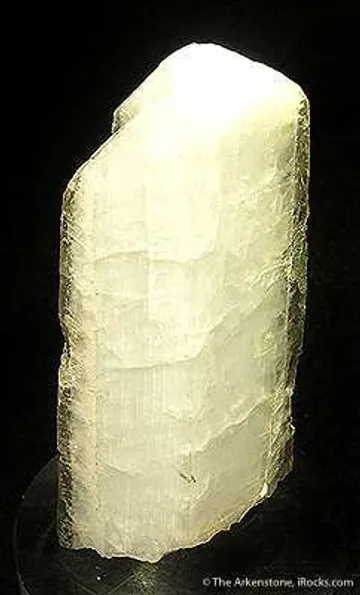
Dassu topaz is prized for clarity and form more than sheer color: the best crystals are colorless, champagne, pale brown or sherry-brown, commonly transparent to water-clear, sharply prismatic and often doubly terminated, with clean faces that can make a natural crystal look almost faceted. The Niyit Bruk pegmatites, about 8 km northeast of Dassu, are specifically noted for fine brown topaz in central vugs and cavities, where crystals commonly range from 5 to 200 grams and occur with quartz, feldspar, muscovite and rosette-like platy albite; Gone also produced colorless to brown gem topaz in pegmatite cavities, and Dassu labels commonly cover this broader cluster of Braldu Valley workings. Superior specimens here retain undamaged terminations and natural matrix—white albite or cleavelandite, muscovite, quartz, black schorl and occasionally fluorite—while ordinary pieces are loose, bruised, cleaved, overcleaned or lacking the balanced matrix that gives Dassu topaz its classic architecture.
Aquamarine is Dassu’s defining mineral, occurring as pale to medium blue hexagonal beryl prisms in cavities of zoned pegmatites, commonly on albite, feldspar, muscovite and schorl, and locally with quartz or red garnet. Older and modern studies describe transparent to translucent aquamarine crystals from Shigar-Braldu pegmatites in the centimeter to dozen-centimeter range, with early reports and later literature noting larger museum-quality Dassu examples; field descriptions place the gem crystals in vugs within coarse pegmatite zones, especially near core-margin areas and feldspar-rich bands. The finest Dassu aquamarines are upright, glassy, well terminated and naturally seated on undisturbed white matrix, with enough blue saturation to read across a cabinet; lesser examples are pale, etched, repaired, loose, chipped at the termination or planted on unrelated mica.
Beryl at Dassu includes aquamarine, goshenite and reported morganite, though careful analytical work in the broader Shigar Valley has shown that some pink material locally called morganite may actually be apatite rather than beryl. In the Dassu pegmatites, beryl occurs both as gem crystals in vugs and as less transparent crystals or phenocrystic masses in feldspar-rich groundmass, with X-ray work confirming beryl from Dassu samples. Collectors should distinguish fine beryl specimens by transparency, termination quality, natural attachment and association: blue aquamarine on albite-muscovite-schorl matrix sits at the top of the locality’s beryl hierarchy, while goshenite and pale beryl are more desirable when the crystal is sharp, damage-free and accompanied by characteristic Dassu matrix minerals.
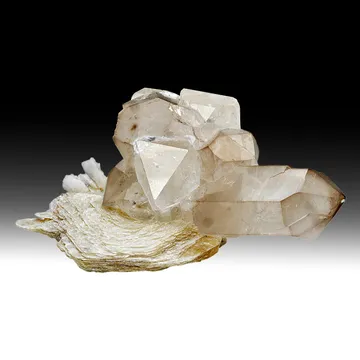
Quartz is a fundamental Dassu pegmatite mineral and an important part of the best specimen compositions rather than merely background matrix. It occurs as massive quartz in the pegmatite cores, transparent euhedral crystals in pockets with aquamarine or topaz, smoky quartz in some side pockets, and rose quartz reported specifically from the Dassu area. The most attractive quartz-bearing Dassu specimens use quartz structurally: sparkling crystals framing aquamarine, clear points associated with topaz and albite, or smoky quartz adding contrast to feldspar-rich plates; ordinary quartz from the locality is common, but quartz that proves pocket context and supports gem crystals is highly valued.
Albite is one of the essential matrix minerals of Dassu and often the reason a specimen works visually. Published descriptions of the topaz-bearing pegmatites mention white, platy albite in rosette-like groupings associated with topaz, quartz and feldspar, and broader Shigar pegmatite studies describe gem crystals growing on and between albite plates. Good Dassu albite specimens show crisp, pearly white blades or rosettes supporting aquamarine, topaz, schorl, fluorite or garnet; lesser examples are massive, chalky, stained or broken feldspar with little crystallographic definition.
The garnet on Dassu specimens is commonly described analytically as almandine-spessartine rather than pure spessartine, but the orange-red to reddish-brown “spessartine” label is entrenched in the collector market for the brightest garnet-bearing aquamarine plates. Dassu and Yuno are specifically noted as important hosts for gem-quality garnet in the Shigar pegmatites, with typical studied crystals small—often under 1 cm—but the locality’s great aesthetic strength is association: red garnets scattered across quartz, albite, feldspar and muscovite around blue aquamarine. Fine pieces are judged by bright garnet color, abundance and placement, undamaged aquamarine, and natural matrix continuity; loose garnets or dark reddish-brown grains in massive pegmatite are far less significant.
Cleavelandite, the platy albite habit, gives many Dassu specimens their snowy, bladed matrix and is especially important on topaz and aquamarine combinations. In the best pieces it forms white, pearly, stacked blades and rosettes that contrast with black schorl, transparent topaz, blue beryl or green fluorite, producing the crisp “Pakistan pegmatite” look collectors prize. Strong examples have sharp, unwilted plates and open composition; weaker ones show crushed, stained or sugary feldspar that no longer reads as distinct cleavelandite.
Muscovite is ubiquitous in the Dassu pegmatites and is a key matrix species on the locality’s topaz, aquamarine and rare phosphate specimens. It occurs as platy books, silvery to tan sheets and rosettes intergrown with feldspar, quartz, albite and schorl; in topaz specimens it often forms the warm, reflective matrix against which colorless or champagne crystals stand out. Collectors favor intact mica books with luster and structure, especially when they anchor a gem crystal naturally; crushed, flaky or glue-obscuring mica around an aquamarine should be examined carefully because it is also a common place to hide repairs or artificial attachments.
Schorl is the black tourmaline backbone of Dassu’s pegmatite assemblage, present as striated prismatic crystals, sprays, embedded rods and pocket clusters. Studies of the Shigar pegmatites describe schorl as widespread, and X-ray work on Dassu samples has identified iron-rich tourmaline in the foitite-schorl range, a reminder that “schorl” on labels is often a field and collector term for black tourmaline rather than a confirmed end-member analysis. The best Dassu schorl specimens use the mineral sculpturally, pairing glossy black prisms with aquamarine, albite, muscovite, quartz, topaz or fluorite; ordinary material is abundant in the pegmatites and may be discarded in tailings when miners are chasing aquamarine.
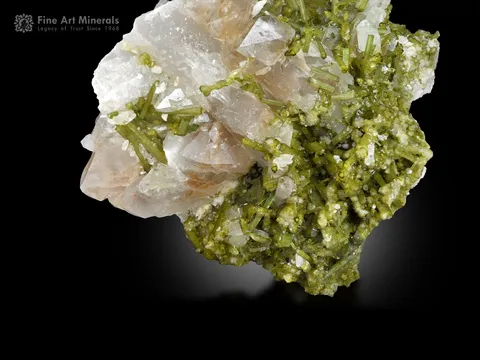
Fluorite from Dassu is far less abundant than aquamarine or feldspar, which is why a sharp green fluorite on a Dassu association is such a welcome addition. Shigar Valley fluorite is described as light to dark green, commonly associated with tourmaline, beryl, quartz, topaz and muscovite, and some Dassu-area collector specimens show transparent mint-green cuboctahedral crystals or spinel twins with topaz, schorl and cleavelandite. The best examples are glassy, sharply formed, visibly green and naturally integrated into the pegmatite assemblage; many lesser fluorites are etched, worn, isolated, or relegated to small accents in groundmass.
Feldspar is the dominant stage on which Dassu’s gem minerals grew. The local pegmatites contain plagioclase, albite, microcline and orthoclase in varying proportions, with feldspar-rich bands and pocket walls especially important for aquamarine and topaz. As a collector species, “feldspar” from Dassu is most meaningful when the crystal habit is visible—blocky white microcline or orthoclase, bladed albite, cleavelandite rosettes—or when it preserves natural relationships among aquamarine, topaz, schorl, quartz, muscovite and garnet. Massive white feldspar alone is common; aesthetic feldspar matrix with gem crystals is one of the locality’s great strengths.
Microcline is an important K-feldspar in the Dassu and nearby Braldu Valley pegmatites, appearing as blocky white matrix crystals and intergrowths with albite, quartz and muscovite. It is especially visible in large aquamarine matrix plates, where microcline and albite form the pale pegmatite base supporting blue beryl and, on the best garnet-bearing specimens, red garnets scattered across the matrix. Fine microcline-bearing Dassu pieces show sharp feldspar faces, clean white color and undisturbed pocket relationships; ordinary material is visually subordinate unless it helps document the original growth setting of aquamarine, topaz or quartz.
Other documented minerals from Dassu and its immediate sublocalities include almandine, fluorapatite, goshenite, morganite, hydroxylherderite, triplite, viitaniemiite, tantalite-(Mn), columbite-series minerals, oxynatromicrolite, fluornatromicrolite, pollucite, pyrite, galena, orthoclase, rose quartz and stellerite, with väyrynenite reported but treated cautiously in locality notes because nearby Braldu Valley sources may be involved. No IMA species is best known as a Dassu type-locality mineral, but Namlook Mine above Dassu is a particularly important rare-mineral sublocality because of triplite and associated phosphate-suite material, and Dassu has produced confirmed viitaniemiite, a rare sodium-calcium-manganese-aluminum phosphate much more familiar to specialists than to general collectors.
The first collector problem with Dassu material is labeling. Older labels may use Dusso, Dasso, Daso, Skardu, Shigar Valley, Northern Areas or Pakistan; modern labels should refine this to Dassu, Braldu Valley, Shigar District, Gilgit-Baltistan when possible. Be cautious with “Haramosh Dassu,” which can refer to a different northern Pakistan pegmatite context and is easily confused with Dassu in the Braldu Valley.
The second problem is construction and repair. Pakistani and Afghan pegmatite specimens have long included both legitimate repairs and deceptive assemblies, and aquamarine on mica or feldspar is especially vulnerable: a real aquamarine crystal can be glued to a real matrix and still be a fake specimen. Examine the contact under magnification and ultraviolet light; look for glue meniscus, unnatural white filler, mica flakes scratched away to make a socket, mismatched luster at the base, or a crystal that seems to float visually rather than emerge from the pocket matrix. A clean repair of a broken crystal to its original matrix is acceptable when disclosed; an added crystal is not.
Topaz from Dassu should be checked for cleavage bruises, repaired breaks, edge dings and suspicious color. Natural champagne and sherry tones are part of the locality’s appeal, but irradiated or otherwise color-modified Pakistani material exists in the broader market, and very dark smoky quartz associations with topaz from Pakistan have been specifically flagged by collectors as suspicious. Because topaz has perfect basal cleavage, avoid ultrasonic cleaning, steam cleaning and sudden thermal shock; many sharp-looking crystals have hidden cleavage stress or old repairs.
Aquamarine is generally more durable than topaz but still needs scrutiny. Terminations chip, prism edges bruise, and matrix plates break during extraction from cliff and adit workings. Pale blue is normal for Dassu; a fine, naturally attached, saturated blue crystal on clean matrix is much scarcer than a loose or repaired crystal. Be wary of over-oiled, polished or dyed-looking surfaces, and ask whether any glue or stabilization is present. On high-value aquamarine-garnet plates, matrix continuity and old pocket clay remnants are often more reassuring than a suspiciously immaculate base.
Fluorite from Dassu is uncommon and comparatively delicate, with perfect cleavage and lower hardness than the associated beryl, topaz and quartz. Green fluorite accents are marketable, but their softness means edges and corners commonly show bruising. Fluorite also fluoresces variably depending on impurities; a fluorescence response may be interesting, but it should not be treated as proof of locality or authenticity.
Muscovite, albite and cleavelandite matrices are attractive but fragile. Platy albite blades crush easily, mica books split or shed, and pocket plates may include old reinforcements. Store matrix specimens so that aquamarine and topaz crystals do not carry the weight of the piece. Avoid water soaking fragile mica-rich matrix unless you are certain there are no repairs, soluble residues or unstable clays.
Market availability is good at the ordinary level and competitive at the top. Small topaz, aquamarine, schorl and feldspar specimens from Dassu and the broader Braldu-Shigar area appear regularly, but truly fine specimens—undamaged, unrepaired, natural matrix pieces with precise locality and strong aesthetics—are much scarcer. The most desirable Dassu pieces are aquamarine on matrix, aquamarine with red garnet, champagne or sherry topaz on cleavelandite-muscovite matrix, and rare green fluorite-topaz-schorl combinations. Rare phosphate specimens from Namlook are specialist pieces and should be treated as analytical-mineral material unless identification is secure.
The most important modern Dassu story begins not with a single crystal, but with a change in attitude. For decades, many northern Pakistan pegmatite pockets were worked with one goal: get the gem crystals out. Matrix was weight, nuisance and risk. Dealers and collectors might beg miners to save the “mother-rock,” but a loose aquamarine was easier to carry down a cliff and easier to sell quickly. In the years leading up to 2018, international dealers working with local intermediaries pushed a different idea: preserve the plate, preserve the pocket, and the value of the whole specimen may exceed the value of the individual crystals.
In 2018 that lesson took hold at Dassu with the “Aqua-Garnet” pocket. The pocket produced an association that collectors dream of but rarely see on a grand scale: blue aquamarine, red garnet, quartz, albite, feldspar and muscovite in coherent matrix plates. The miners used drilling methods and breaking bars to extract large sections, and some of those plates were so heavy that they tested the cable system used to lower specimens from the cliffs. A diamond saw was used in the Dassu region for the first time—not to fake a specimen or polish a face, but to reduce huge matrix pieces to movable size without destroying the pocket architecture. One major piece from the pocket, later illustrated at 55 cm wide in the Mim Museum collection in Beirut, shows a central flowerlike aquamarine cluster rising from quartz, albite, feldspar and muscovite, with red garnets scattered across the matrix. It is the sort of specimen that changed what collectors expected a Pakistani aquamarine could be.
The following season brought the Braldu Valley’s most famous aquamarine drama, the 2019 recovery of the “King of Kashmir” from the Nyet Bruk/Goand area, near Dassu in the same mountain corridor. The first sign came at the end of April, when an explosive charge cracked open the rim of a pocket without breaching the pocket itself. The miners opened a window and looked inside. On the floor were loose aquamarines resting in clay and mud; above them, still attached to the pocket ceiling, was a huge cluster of nearly 30 pristine aquamarine crystals mixed with quartz on white albite and microcline. Instead of hacking it apart, the miners stopped. That pause—the decision to ask for help—may be the reason the specimen survived.
On June 5, 2019, photos and videos of the pocket reached Marco Amabili and Daniel Trinchillo’s team. The specimen was still in place but not safe. Negotiations dragged on for nearly a week while an extraction technician waited in Ali’s house, losing precious days of his trip. On June 20 and 21, Amabili was reportedly on the phone with Ali for almost 24 hours straight. By the night of June 22, a deal was finally struck. The team had only a few photos, a five-second video of the piece in situ, and videos of loose crystals already brought down to the village, but the chance was too great to ignore.
The extraction itself was a study in discomfort and precision. The pocket was nearly 300 m up a sheer cliff and about 30 m into the mountain. On June 17 the technician first climbed by headlamp with the miners, after a four-hour jeep ride from Skardu along the Shigar and Braldu valleys. The opening was so tight he had to remove his helmet to peer inside. Later, when the real work began, miners slept on cots in a small tunnel entrance and worked in constricted positions with drills, wedges and a diamond saw. The first wedges were only 2 cm in diameter—too small for the job—so the team descended to find larger drill bits and wedge sets, even stopping by a quarry and, unexpectedly, watching a polo match before finally obtaining five larger wedges through Haji-Ali’s help.
The work was dangerous in precise, memorable ways. On June 28 a miner using an electric drill was struck in the jaw when the tool lurched, bursting his lip and swelling his cheek. Days later another drill jam hit a miner in the jaw again, cracking a front tooth; after cursing for five minutes, he went back to work. The diamond saw broke when a metal pin snapped, and Ali sent his son to Peshawar for a spare saw; by 2 p.m. the replacement was back at the mine. Miners bandaged at-risk crystals with nylon tape and foam before sawing. One young miner, Yawr, made critical cuts while the crew worked for more than eight uninterrupted hours with only a short lunch break; when they emerged from the pocket, other miners were sitting relaxed in the tunnel eating watermelon.
The hardest cut came on July 4. The team decided the specimen was too large, heavy and unbalanced to remove as one piece, so they took off a tail section with two aquamarines first. Then the miners had to cut from inside the pocket, holding the saw sideways while lying upside down as water and mud poured into their faces. The blade had to pass between two aquamarine crystals less than 2 cm apart. A single centimeter of error could have ruined the specimen. After three hours of exhausting work, the cut was finished perfectly.
When the main piece finally came free, the crew turned the matrix over so the crystals pointed upward and saw that it was intact. They dragged it out on a thick blanket, took photographs despite pleas not to, and then still had to solve the second problem: getting the specimen down 300 m of cliff. On July 7, the largest piece was packed in foam panels from Skardu, wrapped in a padded blanket, and secured inside a dense web of climbing ropes. Four men in harnesses attached the bundle to the steel cable. If the cable or anchor failed, the piece would shatter below and the men could be killed. It descended safely; everyone cheered. The pieces were loaded into Haji-Ali’s car and taken to his home, where final documentation videos were made. The “King” eventually entered a private collection, but the larger lesson for Dassu collectors remained public: in the Braldu Valley, the difference between a broken pile of loose crystals and a world-class specimen can be patience, trust, proper tools and a few centimeters of control.
A more recent field visit by Origin Gems brought the scene back down from legend to daily work. Their team described the Goand mining area opposite the Braldu River, reached by a wooden bridge, with Nyet Bruk and Dassu nearby. They recorded a local account that the “King of Kashmir” specimen was bought around 2019 for about 7 crore Pakistani rupees, roughly $450,250 at the time, after hard negotiations at the mine site. They also emphasized the social reality behind such a find: some people fund wages, others dynamite or rations, miners divide production by percentage, and top specimens may first be shown to trusted investors or dealers. In that world, a great crystal is not simply “found.” It is financed, guarded, negotiated, carried, argued over and finally named.
At Dassu itself, the same field account shows how much valuable mineralogy can be hidden in plain sight. Inside one Dassu mine, the floor was unstable with tailings and debris, dangerous enough that one slip could send a person deeper into the workings. In the wall was a pocket of black tourmaline—schorl embedded in the pegmatite—material that might be thrown out because miners were searching for aquamarine. For collectors, that is a useful corrective. The white feldspar, black schorl, mica books and small garnets on a Dassu specimen are not decorative extras; they are pieces of the very pocket environment that miners risked reaching and often overlooked while hunting for blue beryl.