A collector's guide to Chino Mine, USA: its geology, mining history and notable minerals, illustrated with the 158 specimens documented from this locality on EarthWonders.
Key facts
Chino is the great mineral locality hidden in plain sight: a world-scale copper operation whose collector fame rests not on ore tonnage, but on the improbable elegance of native copper grown in fractures of a large porphyry copper system. The mine occupies the old Santa Rita del Cobre ground in Grant County, New Mexico, east of Silver City, where Laramide intrusive rocks and carbonate-rich country rocks produced both porphyry copper mineralization and adjacent skarn-style ores. For collectors, Chino means copper first: lustrous red metallic plates, arborescences, spear-like and blade-like spinel-law twins, and cuprite-flushed pieces that carry the oxidized-zone story on their surfaces.
Regional View
Country View
The best Chino coppers have a look unlike the thick, rugged masses of the Lake Superior district. They are often thin, sculptural, and crystallographically expressive: elongate axes flanked by sharp copper “fins,” open skeletal margins, or sprays of repeated twinning that flash copper-red to bronze in changing light. Many pieces are essentially fracture fillings released from altered granodiorite or skarn, so they can be surprisingly flat, yet the finest examples have complete edges, three-dimensional branching, bright native-metal luster, and just enough cuprite, quartz, sericite, or pale alteration material to prove their geological setting without burying the copper.

Photo: Wikimedia Commons
Chino also has unusual depth as a mineral locality. It is one of New Mexico’s essential copper and cuprite sources, a documented source of fine native copper for prehistoric and historic metal use, and the type locality for meurigite-K, a fibrous potassium iron phosphate found as delicate pale to yellowish druses. Its modern collector fame was renewed by specimen recoveries in the early twenty-first century, especially the 2001–2006 production of blocky native copper crystals and exceptional spinel-law twins. Those finds gave Chino a place in the cabinet rather than merely in the mining statistics.

Search for specimens: View all specimens from Chino Mine, USA
Chino Mine, also historically known as the Santa Rita Mine or Santa Rita del Cobre, is an open-pit copper mining complex in the Santa Rita district of Grant County, New Mexico. It lies about 15 miles east of Silver City, near Hanover and Vanadium, in the Cobre Mountains. The present open pit is the industrial descendant of the old Santa Rita copper workings, whose original village site was ultimately removed and then consumed by the expanding mine.
Geologically, Chino is a porphyry copper deposit centered on and around the Santa Rita stock, a granodioritic intrusive body emplaced during the Laramide magmatic episode. The mineralization sits in a complex structural block bounded by major northwest-trending faults, with older Proterozoic basement and a thick Paleozoic-to-Cretaceous sedimentary cover that includes limestones and dolomites favorable for skarn formation. This is why the locality is not simply a porphyry copper mine in the narrow collector sense: it also includes copper-bearing skarn and replacement-style mineralization where intrusive fluids encountered carbonate rocks.
The ore system includes leachable oxide copper mineralization, secondary sulfide enrichment, and millable primary sulfide mineralization. Chrysocolla is the principal oxide copper mineral in the modern ore description; chalcocite is the key secondary sulfide; and chalcopyrite plus molybdenite dominate the primary sulfide assemblage. Mindat and MRDS-style locality summaries also record native copper, cuprite, malachite, azurite, covellite, bornite, pyrite, magnetite, molybdenite, enargite, garnet, epidote, actinolite, quartz, sericite, and a suite of late secondary phosphates.
The collector copper belongs mostly to the oxidized and supergene history of the deposit. Weathering of pyrite-bearing mineralized rock generated acidic, oxidized copper-bearing solutions; when these solutions encountered different chemical conditions near the water table or along reactive fractures, copper was redeposited as chalcocite or reduced further to native copper. Some Chino native copper occurs as fracture fillings in the Santa Rita granodiorite stock, and important later finds were associated with the East pit area beneath retrograde skarn mineralization in Syrena Formation rocks. Flattened shiny copper specimens recovered from fractures in skarn were interpreted by Chino specialists as reflecting a pH-controlled depositional shift rather than the usual simple redox story.
Mining at Santa Rita predates the American industrial period by more than a century. Native copper was known to Indigenous peoples before Spanish and Mexican exploitation; Spanish interest followed at the turn of the nineteenth century, when José Manuel Carrasco and Francisco Manuel Elguea became associated with the Santa Rita del Cobre grant and shipments of copper to Chihuahua and Mexico City. Open-pit mining began in 1910 under the Chino Copper Company. The first concentrator at Hurley went into operation in 1911, the Hurley smelter began in 1939, the modern Ivanhoe concentrator replaced the original facility in 1982, SX/EW operations began in 1988, and the smelter was permanently closed in 2005. The property became part of Freeport-McMoRan in 2007 and remains an active Freeport-McMoRan copper operation.
For collectors today, Chino is not a casual field-collecting locality. It is an active, large-scale industrial mine on controlled property, and access requires permission and mine-safety authorization. Most specimens in the market came out through employee collecting, mine-approved salvage, old collections, dealer dispersals, or specific historic finds. Chino pieces should therefore be treated as finite specimen material, especially the well-crystallized native copper twins from the early 2000s and older cuprite-bearing specimens with reliable provenance.
The most important modern specimen events were the 2001 discovery of a boulder that yielded roughly fifty stout spinel-law twinned copper specimens and a 2006 pocket in the pit that produced about two hundred native copper specimens from thumbnail size to about 8 cm. Published New Mexico Mineral Symposium material also singles out finds from 2001 through 2006 by Stan Espenshade and Jay Rosenbauer, noting large well-developed blocky copper crystals and exceptional spinel twins. Fine cuprite, including crystals reported up to 2.5 cm and aggregates intergrown with copper several inches across, is also especially associated with Chino among New Mexico localities.
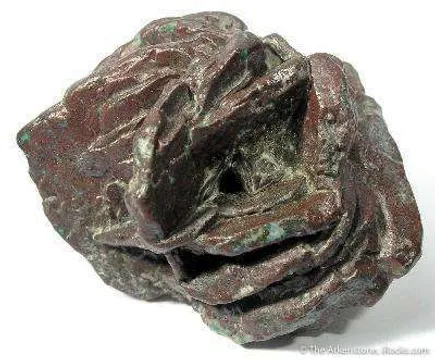
Native copper is Chino’s signature collector mineral, occurring chiefly as fracture-fill plates, arborescent growths, blocky crystals, and especially spinel-law twinned forms from supergene parts of the Santa Rita porphyry-skarn system. Ordinary Chino copper can be flat, oxidized, bent, or ragged-edged, but the best specimens show bright copper-red to bronze luster, complete crystallized margins, skeletal or fern-like branching, and sharply developed flanges along a central twin axis. Plates may be far larger than display quality would suggest, but cabinet and miniature specimens from the 2001 boulder and 2006 pocket are the most prized: stout twins, thumbnails to about 8 cm, and larger sculptural pieces with minimal bruising, little dull black oxidation, and associations of cuprite, quartz, sericite, gypsum, alunite, or pale alteration material.
At Chino, “spinel” on specimen labels most often refers to spinel-law twinned native copper rather than the separate mineral species spinel, MgAl2O4; this distinction matters because many marketplace listings use “spinel” as shorthand for the habit. The classic Chino examples are copper crystals twinned in repeated, blade-like or spear-like geometries, with radially arranged flanges and skeletal margins that recall the twin law first described in spinel-group minerals. The strongest examples are from the early 2000s finds, especially the 2001 boulder and 2006 pit pocket, and they range from thumbnail crystals to small-cabinet pieces; value rises sharply with sharp terminations, clean crystallography, lustrous native-copper color, and freedom from bends or flattened broken edges.
Cuprite at Chino occurs both as an oxidation product coating native copper and as distinct crystals, recorded in cubic, octahedral, and dodecahedral habits, as well as chalcotrichite-like acicular material. Its color ranges from deep red to red-black, and the best pieces either show lustrous cuprite crystals on or with native copper, or cuprite-rich aggregates where the red oxide gives a richer surface than ordinary dull oxidized copper. New Mexico symposium reports note cuprite crystals up to about 2.5 cm and aggregates of small cuprite crystals intergrown with copper several inches across; top Chino cuprite is therefore judged by crystal definition, red translucency or glow in strong light, association with sharp copper, and preservation of delicate surfaces.
Other documented Chino minerals broaden the locality well beyond copper, especially in the oxidized and skarn-related assemblages. Meurigite-K is the standout rarity: Chino is its type locality, where it occurs as drusy coatings of fibrous yellowish to cream rosettes in the oxidized copper-sulfide environment. The locality has also produced or documented chalcotrichite, chrysocolla, malachite, azurite, libethenite, pseudomalachite, dufrénite, beraunite, ducktownite, delafossite, apatite, andradite, epidote, ilvaite, magnetite, chalcopyrite, chalcocite, bornite, molybdenite, pyrite, quartz, muscovite/sericite, orthoclase, and turquoise. A 2022 New Mexico Mineral Symposium abstract reported delafossite, CuFeO2, from specimens collected from the Oswaldo ore body and identified by XRD, with copper and chalcotrichite in association.
The first authentication issue is nomenclature. Chino “spinel” specimens are usually native copper spinel-law twins, not mineral-species spinel; labels that say simply “Spinel, Chino Mine” should be read with caution unless the specimen is plainly a copper twin or the label gives full context. For EarthWonders-style cataloging, this is a useful habit category, but serious collection labels should state “native copper, spinel-law twin” to avoid future confusion.
The second issue is provenance. Chino has been an active industrial mine for generations, and genuine specimens generally come through old collections, mine-related collecting, or well-known dealer dispersals rather than ordinary public digging. A credible Chino copper should have a label history, dealer history, or morphology consistent with the locality: thin fracture plates, arborescent edges, bright spinel-law copper twins, or cuprite-on-copper associations. Generic massive copper, heavily acid-cleaned copper, or pieces with no locality chain can be difficult to separate from other western U.S. copper localities without documentation.
Condition is central to value. Many Chino coppers are naturally thin, skeletal, and sharp-edged, so breaks at the tips, bent flanges, compressed twin axes, and rubbed high points are common. Older pieces may show dull brown to black oxidation; gentle patina is acceptable and often attractive, but harsh brightening can leave an unnatural brassy or over-cleaned surface. Cuprite-bearing specimens are especially vulnerable because red cuprite crystals and chalcotrichite sprays can be detached or abraded more easily than the copper substrate.
Handling should be minimal. Copper is soft and can bend or mark under pressure, while cuprite coatings and secondary phosphates are more fragile still. Avoid repeated bare-hand handling of bright copper surfaces, as oils accelerate uneven tarnish. Keep fine twins in a fitted box or acrylic mount so the projecting flanges do not carry the specimen’s weight. There is no particular collecting reason to expect Chino copper or cuprite to be fluorescent; for display, the locality’s strength is crystallography and native-metal color, not UV response.
Market availability is uneven. Small to moderate Chino coppers appear regularly enough that collectors can be selective, but truly sharp, undamaged, well-balanced spinel-law twins from the 2001–2006 period are much scarcer and command a premium. Cuprite is notably less available than copper, especially as crystallized red material rather than a dull coating. Meurigite-K and other secondary phosphate rarities are specialist material, generally seen in micromount or analytical collections rather than mainstream show stock.
Long before Chino was an open pit, its copper was a visible desert fact. Native copper lay at or near the surface around Santa Rita, and trace-element work discussed by Robert M. North and Virgil W. Lueth connected native copper artifacts from a Georgia archaeological site dated to A.D. 880 to Chino. The same abstract notes a copper bell excavated from a Mogollon site and dated around A.D. 1150. That is a remarkable journey for a metal specimen: copper from the future open pit moving through Indigenous exchange systems centuries before the Spanish documents, railroad grades, steam shovels, or concentrators existed.
The Spanish-era discovery story has the texture of frontier mineral legend, but it is repeated in the serious histories of the district. Around 1799–1801, José Manuel Carrasco, a Spanish military officer connected with presidios in northern Chihuahua, was shown the copper by Apaches. He recognized “El Cobre” as something extraordinary, and Francisco Manuel Elguea of Chihuahua soon became the central entrepreneur behind Santa Rita del Cobre. By 1804, copper from the district was tied to contracts for Mexican coinage. One New Mexico mining-district account gives the scale as 200 mule trains per year, amounting to roughly 6,000,000 pounds of copper annually, with simple adobe furnaces used where processing was required. The collector looking at a bright Chino copper twin is seeing the same element that made the place strategically important when the ore was still hand-dug and mule-packed.
The modern open-pit era began with a single mechanical gesture. On September 23, 1910, the Chino Copper Company’s Marion 91 steam shovel Number 2 took the first bucket of low-grade porphyry copper from the ground. That scoop marked a profound change in what Santa Rita meant. The old high-grade native copper and oxide workings had belonged to miners following obvious metal; the new Chino operation belonged to the age of immense tonnage, benches, rail haulage, and milling. In 1911 the Hurley concentrator came on line, and Santa Rita joined the small group of early low-grade open-pit copper operations that reshaped the economics of copper mining.
The town paid the price for the orebody beneath it. Santa Rita became one of the stark western examples of a community literally overtaken by the mine that created it. Huggard and Humble’s history describes the vanished settlement as the “town in space,” not even a ghost town in the ordinary sense, because the ground itself disappeared. By 1970 Santa Rita no longer existed as a townsite; the expanding pit and related mine works had erased the earthen foundation under homes, streets, company buildings, and social memory. That vanishing gives old Santa Rita labels a special poignancy: they do not point merely to a mine, but to a place no longer physically there.
The collector renaissance came much later and far more quietly than the shovel era. In the summer of 2001, a single boulder reportedly yielded about fifty stout spinel-law twinned copper specimens. It was the kind of improbable event every mine collector understands: not a district-wide production run, not a dependable zone, but one rock that happened to preserve a pocket of crystallographic luck. In 2006, another pocket in the pit produced roughly two hundred more specimens, from thumbnail size to about 8 cm. New Mexico collectors Stan Espenshade and Jay Rosenbauer are specifically associated in symposium literature with the 2001–2006 finds of large, well-developed blocky crystals and exceptional spinel twins. Those discoveries are why modern Chino coppers can stand with the finest American native copper specimens despite coming from a mine better known to industry than to the public.