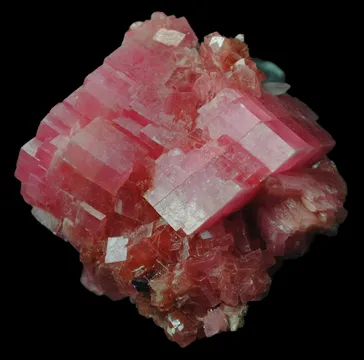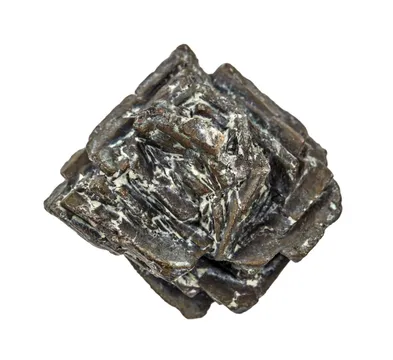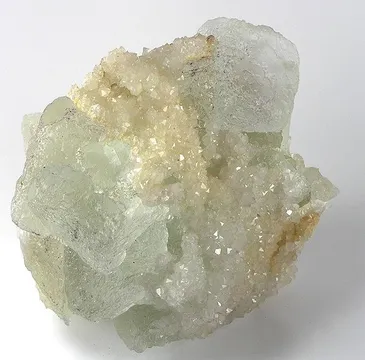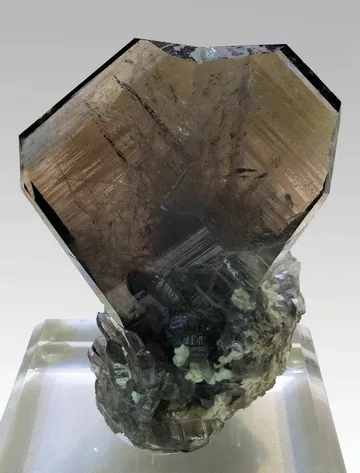
Silver City, USA - a classic Grant County locality yielding copper carbonates and native copper, cuprite, azurite, malachite, magnetite, prized by collectors.
Key facts
Silver City, in southwestern New Mexico’s Grant County, is not a single-species cabinet locality so much as the collecting name for one of the great mineralized landscapes of the American Southwest. Serious collectors will recognize it as the market shorthand that often covers the mining districts around the town: the porphyry copper giants at Chino/Santa Rita and Tyrone, the iron-zinc-copper replacement deposits of Hanover-Fierro, the old silver ground of Chloride Flat and Boston Hill, and the rarer peripheral districts that made Grant County a classic New Mexico mineral province. The specimens that carry “Silver City” on older labels therefore need to be read with care, but the mineralogical personality is unmistakable: copper carbonates and oxides in the oxidized zones, native copper from deep supergene settings, cuprite and chalcotrichite from Chino, azurite rosettes and copper-after-azurite replacements from Hanover-Fierro and Grant County copper occurrences, and a supporting cast of pyrite, chalcocite, chrysocolla, malachite, magnetite, hematite, sphalerite, galena, chlorargyrite, acanthite, and silver-bearing tellurides.
The broad geologic frame is Laramide and younger magmatism imposed on Paleozoic sedimentary rocks, Proterozoic crystalline basement, and later volcanic cover. At Chino and Tyrone, collectors are dealing with large porphyry copper systems: altered intrusive stocks and fractured host rocks carrying disseminated and veinlet copper sulfides, then oxidized and enriched by groundwater. Around Hanover-Fierro, replacement and skarn-style mineralization brought together magnetite, zinc-lead sulfides, pyrite, and secondary copper minerals. At Chloride Flat, the very name of Silver City comes from oxidized silver chloride ores localized near the contact between limestone and shale.
Regional View
Country View
The best Silver City-area cabinet pieces are rarely huge show specimens in the Bisbee or Tsumeb sense. Their appeal is more local, older, and sharper-edged: a copper twin from Chino rising like a thin burnished leaf; a cluster of dark-blue azurite rosettes set in reddish gossan; a copper “rose” preserving the bladed azurite form after replacement; a cherry-red cuprite crust from Chino; or a dense Fierro-Hanover ore specimen where pyrite and chalcopyrite glitter against naturally magnetic black magnetite. The finest examples are specimen-grade survivors from industrial districts, not products of modern specimen mining, and that gives good labels unusual importance.

Photo: Wikimedia Commons
Search for specimens: View all specimens from Silver City, USA
For collectors, “Silver City” should be understood as a regional label unless a specimen tag gives a more precise mine. The town lies at the hub of several Grant County mining districts. East of town is the Chino Mine, historically Santa Rita del Cobre, one of the classic American porphyry copper deposits and the source of much of the area’s native copper and cuprite reputation. South of town, the Tyrone open pit works another porphyry copper system in the Big Burro–Little Burro Mountains area. North and northeast of the copper pits, the Hanover-Fierro district belongs to the iron-zinc-copper replacement and skarn story, with magnetite-rich ores, sphalerite, pyrite, chalcopyrite, galena, chalcocite, and secondary copper minerals. Immediately west and southwest of town, Chloride Flat and Boston Hill preserve the older silver and manganese-iron history that gave Silver City its name.
The Chino/Santa Rita deposit is a porphyry copper system centered on intrusive rocks of the Santa Rita stock and related altered rocks. Primary copper was carried mainly by sulfides such as chalcopyrite and chalcocite, with pyrite and accessory molybdenite in the broader ore system; oxidation and supergene enrichment produced native copper, cuprite, chalcotrichite, chrysocolla, malachite, azurite, tenorite, covellite, and secondary chalcocite. Native copper at Chino is especially important because it occurs not merely as massive historical ore but also as specimen-grade crystals, spinel twins, flattened plates, dodecahedral and modified cubic forms, delicate “wool,” and fracture fillings. Documented modern finds placed some of the best native copper in the Santa Rita granodiorite stock and in skarn-hosted fractures in the East pit, with associated alunite, quartz, sericite, gypsum, minor orthoclase, cuprite, chrysocolla, and chalcotrichite.
The Tyrone district is geologically related but has its own collecting identity. It is a porphyry copper district where oxidized copper minerals and turquoise were known long before large-scale open-pit production. Modern Tyrone is primarily a leach/SX-EW copper operation, so specimen recovery is incidental and controlled by mine access. Older labels from the Tyrone area may include chrysocolla, malachite, azurite, turquoise, cuprite, and rare sulfosalt or sulfotelluride material. Because the older town and workings were overtaken by mining, precise early labels can be frustratingly vague.
The Hanover-Fierro district supplies many of the better azurite labels encountered as “Silver City” or “Hanover Mine, Silver City.” Its mineralization differs from the broad porphyry model: carbonate replacement, skarn, and iron-rich replacement bodies gave the district massive magnetite, hematite, pyrite, sphalerite, galena, and chalcopyrite, later oxidized locally to azurite, malachite, smithsonite, and iron oxides. Good azurites from this district are typically small rosettes or bladed groups, sometimes on gossanous matrix and sometimes as floaters; the matrix pieces are far scarcer and more desirable than loose, worn blue balls.
The original Silver City story belongs to Chloride Flat and Boston Hill. Chloride Flat, about a mile and a half west of town, produced silver chiefly from chlorargyrite, with native silver and argentite or acanthite-like material reported in the older literature. Ore bodies were irregular and localized near the upper part of limestone beneath shale, an excellent trap for ascending mineralizing fluids. Boston Hill, including the Legal Tender ground, began as a silver prospect but became better known for manganiferous iron ore. Its common minerals include hematite, pyrolusite, specularite, quartz, calcite, dolomite, and barite, with the old workings now incorporated into public open space and safeguarded where necessary.
Mining began long before the town of Silver City existed. Native peoples used local copper and turquoise; trace-element work has connected Chino native copper to archaeological copper objects far from New Mexico. Spanish-period exploitation of Santa Rita copper began in earnest in the early 1800s, when high-grade native copper and malachite ore were shipped south by mule train for smelting and coinage. In the American period, attempts to mine Santa Rita underground and by stamp mill struggled with remoteness and low-grade ore until John M. Sully recognized that the low-grade porphyry could be mined on a large scale. The Chino Copper Company began open-pit production in 1910, and concentration followed soon after. Tyrone saw underground work and concentrating from 1916 to 1921, restarted as a large open pit in 1967, and later became an SX-EW operation. Today Chino and Tyrone are operated by Freeport-McMoRan.
Collecting access today is sharply divided. The active Chino and Tyrone mines are industrial sites, not public collecting localities, and the best modern copper or cuprite specimens are recovered only when mine operations and company policy permit. Many old dumps and prospects around Grant County are private, patented, reclaimed, hazardous, or posted. Public-land collecting is possible in appropriate areas, but collectors must verify land status, claim status, road access, and current restrictions before picking up material; BLM casual collecting rules allow limited noncommercial collection on many public lands, but not on every parcel, not in protected cultural sites, and not with mechanized disturbance. Boston Hill is a public open-space trail system with historic mine features; it is valuable for context and education, not a place to enter old workings or disturb safeguarded mine hazards.
The most important specimen-producing episodes for collectors are the Chino native copper finds, including older massive vein fillings, 1970s–early 1980s spinel-twinned and polycyclic crystals, a late-1993 crystallized copper and cuprite find, and the March 2001 stockpile recovery that yielded spectacular crystalline copper sold in early 2002. Hanover-Fierro supplied old azurite rosettes and copper-after-azurite replacements, while the wider Grant County “Copper Rose” material—often folded into Silver City dealer labels—became famous for sharp native copper pseudomorphs after bladed azurite.
Silver City-area azurite is most collectible when it comes from Hanover-Fierro labels, where it forms dark navy to richer blue rosettes and bladed clusters in gossanous, iron-stained matrix; individual clusters are commonly thumbnail-scale to small miniature size, with good examples showing discernible monoclinic blades, pearly to vitreous luster on protected faces, and association with malachite, iron oxides, quartz, magnetite-rich ore, or weathered carbonate host. Chino and Tyrone also document azurite in the oxidized copper assemblage, but much of the attractive “Silver City” azurite in commerce traces to older Hanover or Hanover-Fierro material rather than to the active porphyry pits. The best pieces here are not judged by sheer crystal size; they are judged by complete rosettes, strong saturated color, lack of chalky surface alteration, visible crystal form, and, most importantly, matrix context that preserves the iron-rich New Mexico character rather than a loose blue nodule of uncertain mine origin.
Native copper is the prestige species of the Silver City mining region, above all from Chino/Santa Rita, where it occurs as massive vein filling, flattened fracture plates, sharp spinel twins, branching and arborescent aggregates, dodecahedral or modified cubic crystals, and rare finely crystalline “wool,” commonly with cuprite, chalcotrichite, chrysocolla, alunite, quartz, sericite, gypsum, minor orthoclase, pyrite, and hematite. Historical and modern studies place important copper specimen production in the Santa Rita stock, East pit skarn-hosted fractures, and South pit fractures, with significant zones encountered hundreds of feet below the original surface. The most desirable Chino coppers have crisp metallic form, old natural patina, sculptural isolation, and convincing mine-level or collection provenance; ordinary pieces are simply massive copper, acid-bright fragments, or unattributed “New Mexico copper.” Separate but often grouped under Grant County or Silver City labels are the celebrated copper pseudomorphs after azurite—copper roses—which preserve bladed azurite rosettes as copper, sometimes with malachite or cuprite overprinting.
Beyond azurite and copper, the Silver City region is rich enough that a collector can build a serious sub-collection without leaving Grant County labels. Chino is the key New Mexico locality for cuprite, including cherry-red crusts and crystals as well as chalcotrichite, and it also documents chalcocite, covellite, tenorite, chrysocolla, malachite, alunite, anhydrite, calcite, siderite, smithsonite, magnetite, hematite, quartz, and rutile. Hanover-Fierro adds magnetite, pyrite, chalcopyrite, sphalerite, galena, chalcocite, smithsonite, and secondary copper species. Chloride Flat and the older Silver City mines bring in the silver suite—chlorargyrite, acanthite, native silver, galena, pyrolusite, manganite, goethite, and hematite—while the broader Grant County region is notable for treasurite at Tyrone, tellurides such as sylvanite in Silver City-area ore specimens, emmonsite from W.P.H. Mine material, and the unusual nickel-cobalt-native silver-uranium mineralization of the Black Hawk district west of town.
The first rule with Silver City specimens is to interrogate the label. “Silver City, New Mexico” may mean the town itself, Chloride Flat, Boston Hill, Hanover-Fierro, Chino/Santa Rita, Tyrone, or simply “somewhere in Grant County.” That matters greatly: a Chino native copper is not the same occurrence as a Hanover-Fierro azurite rosette, and a Grant County copper rose from the Georgetown/San Lorenzo area should not be casually folded into Chino. Older dealer labels may also use obsolete or loose forms such as “Hanover Mine, Silver City,” “Fierro,” “Fiero,” “Santa Rita,” “Chino,” or “Grant Co.” without modern district precision.
I do not know of a well-documented modern fake industry aimed specifically at Silver City-area azurite or Chino copper, but the normal copper-specimen cautions apply. Native copper may be acid-cleaned, wire-brushed, lacquered, darkened, or artificially brightened; such treatment can flatten the surface character and obscure the warm, old patina expected on long-held Chino pieces. Copper roses are often heavily patinated and may carry malachite, cuprite, or clay in crevices; avoid pieces whose surfaces look uniformly painted, waxed, or abraded. Fine Chino copper twins are prone to bending, edge bruising, and mounting repairs, so inspect the base and any hidden attachment points.
Azurite from Hanover-Fierro is usually small and often somewhat matte or weathered. Damage hides easily in rosettes: look for broken blade tips, rubbed high points, and dull surfaces where the azurite has started to alter or abrade. Loose rosettes are commoner and less informative than matrix specimens, and clusters embedded in friable gossan can shed grains if overhandled. Malachite association is normal, but complete malachite replacement lowers the value as azurite unless the pseudomorph is especially sharp or historically labeled.
Cuprite and chalcotrichite from Chino deserve careful handling and storage. Cuprite can be brittle; chalcotrichite is extremely delicate and easily crushed by cotton, tissue, or a shifting thumbnail box. Keep fibrous cuprite out of dusty drawers and avoid repeated brushing. Fluorescence is not a major reason to buy Silver City copper specimens, though some associated calcite may respond under UV; the locality’s value is in crystallography, history, and provenance, not fluorescent display.
Market availability is uneven. Silver City-area azurite appears periodically as small older Hanover-Fierro pieces, usually thumbnails to miniatures. Chino native copper ranges from affordable massive or small crystalline pieces to expensive, highly sculptural spinel-twinned specimens, with top pieces increasingly held in older collections. Copper roses from Grant County remain recognizable and desirable, but precise mine labels command a premium. Chino cuprite is scarcer than copper in the market, and undamaged chalcotrichite is much scarcer still.
The oldest Silver City collecting story is older than Silver City itself. At Santa Rita, copper did not first announce itself as an orebody hidden under a mountain of drilling data; it showed at the surface as native metal and green copper carbonate. Spanish accounts treated such places almost as natural marvels, places where metal appeared to “grow” in the earth. By the early nineteenth century, Don Francisco Manuel Elguea had turned the occurrence into a copper enterprise, and the product moved south by mule train toward Chihuahua and Mexico City. The early material was not low-grade industrial ore. It was native copper and high-grade malachite-rich copper ore—exactly the kind of surface mineralization that would have attracted prehistoric users, Spanish soldiers, Mexican merchants, and, two centuries later, mineral collectors.
The most striking modern mineralogical detective story is the trace-element link between Chino native copper and prehistoric copper artifacts. Native copper objects from an archaeological site in Georgia dated to A.D. 880 have been chemically tied to Chino, and a copper bell dated around A.D. 1150 was recovered from a Mogollon site. That is a remarkable collecting fact: a Chino copper specimen in a cabinet is not only a mineral from a famous mine, but a piece of the same geochemical source that moved through Native exchange networks long before industrial mining.
The specimen story at Chino changed with depth. Early museum examples tended to be massive native copper vein fillings, with only occasional arborescent crystal growths. Later, particularly from the 1970s into the early 1980s, better crystallized specimens appeared with spinel and polycyclic twinning. A late-1993 discovery added crystallized copper and cuprite, and then came one of the great collector episodes: in March 2001, a single specimen mined from an inactive concentrator stockpile led to spectacular crystalline copper specimens reaching the market in early 2002. Those pieces showed spinel twins, dodecahedrons, modified cubes, and, on some examples, fine copper “wool.” For a mine built to move immense tonnages, it was a reminder that the collector’s treasure may be a few kilograms rescued from the wrong place at the right moment.
Silver City’s name comes from another kind of ore altogether. At Chloride Flat, west of town, the silver was mostly chlorargyrite—horn silver—localized in irregular bodies near the top of limestone beneath shale. In the early accounts, the deposits sound maddeningly discontinuous: pockets, streaks, and shoots rather than neat veins. Yet they were rich enough to create the town’s identity. Boston Hill, now a public open-space landmark, began as the Legal Tender silver ground and later shifted to manganiferous iron ore. The hill was mined for roughly a century; the silver faded, then the iron-manganese flux ore carried the place through later industrial demand. Today hikers pass old pits, cuts, and rail grades where a working mineral landscape has been converted into a community trail system.
One of the more human stories belongs to Hanover-Fierro rather than to the blue azurite rosettes themselves. The Empire Mine at Hanover became the setting for the 1951–1952 strike later dramatized in the film “Salt of the Earth.” The dispute centered on a dual-wage system that paid Hispanic miners less than Anglo miners. When a court order stopped the miners from picketing, their wives took the line. The film that followed was made with blacklisted Hollywood artists and with miners and family members from the district, then suppressed in much of the United States after release. For collectors, the story adds social weight to the district’s massive magnetite, sphalerite, pyrite, and copper minerals: these were not abstract ores, but the rocks beneath a community’s labor struggle.