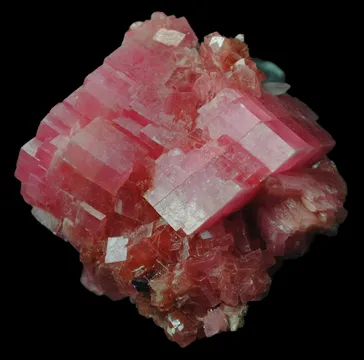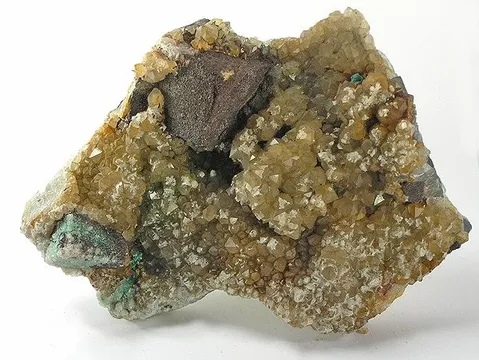
Bingham, New Mexico — a compact Rio Grande Rift locality famed for blue fluorite cubes, barite, and galena, with cabinet-quality specimens from vugs and seams.
Key facts
Bingham, as collectors use the name, is the small New Mexico locality at the north edge of the Hansonburg mining district, Socorro County—not the better-known Bingham Canyon copper mine in Utah. Its importance rests on a compact but remarkably productive suite of carbonate-hosted, Rio Grande Rift–related barite-fluorite-galena deposits exposed along the western flank of the Sierra Oscura Mountains. The best specimens have a look that is instantly recognizable: frosted to lustrous “Bingham blue” fluorite cubes and modified cubes, commonly with purple zoning; white to gray quartz and bladed baryte; black to metallic galena; and, in oxidized seams, electric blue linarite, emerald brochantite, cyanotrichite, spangolite, cerussite, anglesite, wulfenite, and other secondary lead-copper-zinc minerals.
Regional View
Country View
The district’s collector reputation was built less by large-scale ore production than by specimen recovery from open-space fillings, vugs, solution channels, and silicified limestone adjacent to faults. Commercial operators pursued barite, fluorite, and lead at various times, but the metallurgy was troublesome and the desert setting short on water. That practical failure was a collector’s good fortune: from the later twentieth century onward, the Royal Flush, Mex-Tex, Blanchard, and associated workings became famous for cabinet pieces, small-cabinet plates, thumbnails, and micros rather than anonymous ore.

Photo: Wikimedia Commons
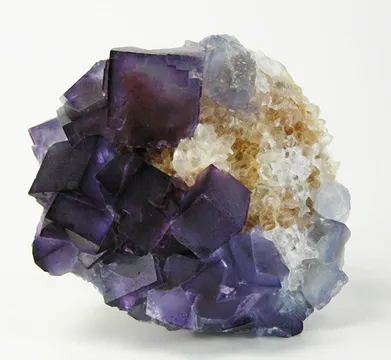
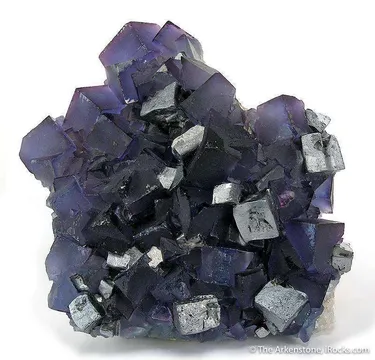
The classic fluorite is not the glassy Illinois or English style. Bingham pieces are often somewhat frosted, delicately stepped, internally zoned, and soft-looking in color—pale ice blue, saturated blue, blue-purple, teal, colorless, green, and occasional mixtures of several colors in one crystal. Good specimens are prized for undamaged cube faces, visible zoning, contrast on quartz or baryte, and the elusive saturated blue that gave “Bingham blue” its name.

Photo: Wikimedia Commons
The oxidized assemblage gives the locality its second personality. Rich brochantite carpets, blue linarite sprays and crusts, spangolite, cyanotrichite, chrysocolla replacements, and lead alteration products can turn otherwise plain quartz-galena-fluorite matrix into vividly colored, highly local pieces. For advanced collectors, Bingham is not just a fluorite locality; it is one of New Mexico’s great districts for secondary lead-copper mineralogy and a type locality for scrutinyite.
Search for specimens: View all specimens from Bingham, USA
Bingham lies in south-central New Mexico, in Socorro County, near U.S. Highway 380 and the west side of the Sierra Oscura Mountains. The mineral locality most collectors mean is the Hansonburg mining district, whose principal mines and prospects lie several kilometers south of the village of Bingham, near the northern boundary of White Sands Missile Range. The important specimen-producing workings include the Blanchard Mine group, the Mex-Tex Mine group, the Royal Flush Mine, the Desert Rose or Downey stope area, the Ora Mine, the Hickey No. 1 Mine, and a scatter of smaller adits, trenches, cuts, and prospect pits.
Geologically, the district is the largest of the Rio Grande Rift barite-fluorite-galena deposits recognized in southern New Mexico. Earlier literature often treated it as Mississippi Valley-type mineralization, and the comparison is understandable: the ores are carbonate hosted, low-temperature, open-space fillings dominated by fluorite, baryte, galena, and quartz. Later work has emphasized its Rio Grande Rift setting, abundant fluorite, variable brine salinity, association with extensional tectonics, and probable links to rift-related heat flow and deep basin fluids.
The host rocks are chiefly Pennsylvanian limestones of the Madera Group, especially the Council Spring Member, with mineralization also reported from other carbonate units and locally from Permian sedimentary rocks and Proterozoic basement rocks. The Sierra Oscura block is cut by north-south rift faults and cross faults; the favorable ground is not a single neat vein but a fractured, silicified, locally karstified limestone system. Ore and specimen material occur in veins along steep fault structures, in bedding-plane cavities, in solution channels, in breccia, and in vuggy open spaces. The best crystallized specimens formed where hydrothermal fluids had room to deposit free-growing baryte, fluorite, quartz, and galena rather than only massive ore.
The primary assemblage is simple and strong: fluorite, baryte, galena, and quartz, with minor sphalerite, pyrite, and chalcopyrite. In places, the ore shows layered or “coontail” textures: silicified limestone bands bordered by galena and fluorite, with spaces containing tabular baryte, galena, and later fluorite and quartz. Oxidation of the lead-copper-zinc-bearing assemblage produced the small but mineralogically rich secondary suite for which the district is admired by micromounters and systematic collectors.
Mining history is tangled because names shifted and individual adits were renamed or grouped differently by different workers. The Blanchard Mine group includes the Portales adit, also known as the Glory Hole, MacCarthy Lead Mine, Hansonburg Lead Mine, and Blanchard Mine, together with the Sunshine No. 1 through No. 6 adits and other nearby workings. The Upper Mex-Tex group includes the Snake Pit, Byrd Tunnel and pit, and Upper Mex-Tex or Julian-Malachite workings; the Lower Mex-Tex group includes the Ora, Caliche, and Hickey No. 1 areas. The Royal Flush group includes the Royal Flush north and south adits and the Desert Rose or Downey stope area.
The first substantial commercial effort in the barite-fluorite-galena part of the district began in 1916, when Western Mineral Products Company built a 50-ton dry mill and worked ground that would later be associated with the Portales/Blanchard workings. In 1936, William Edward Blanchard, Francis L. Blanchard, and E. L. King located claims that helped attach the Blanchard name permanently to the district. From 1947 to 1954, the Blanchard claims were leased to the Portales Mining Company, which expanded the Portales adit and built a crusher and ore bin near its entrance; that operation ended after the San Antonio mill burned in 1954.
The Mex-Tex and Royal Flush claims were established in 1947 by A. R. Hickey, W. Hickey, and F. Kay of Artesia, New Mexico. Development accelerated around 1949, and a 200-ton-per-day barite mill was built the following year. Between 1951 and 1960 the Hansonburg district was New Mexico’s leading barite producer, accounting for most of the state’s barite output in that period. Galbar Inc. later mined and explored parts of the Mex-Tex and Royal Flush groups and shipped lead concentrates to the ASARCO smelter in El Paso.
The Blanchard property saw another important episode from 1958 to 1960, when Sunshine Mining Company drove six exploratory adits. Those tunnels did not lead to marketed ore, but they became central to the district’s specimen history; the Sunshine adits have yielded many of the fluorite, linarite, brochantite, and secondary lead-copper specimens now scattered through collections. In 1977, Hansonburg Mines, Inc. built a 400-ton-per-day mill complex and began a drilling program, but the intended separation of baryte, galena, and fluorite failed and no ore was marketed from that venture either.
Since the late 1980s the collector story has dominated. Claims in the Royal Flush, Mex-Tex, Blanchard, and related areas have been controlled by individuals interested in specimen recovery. Some collecting has occurred by fee arrangement, appointment, or organized trips, but collectors should treat the district as claimed ground, not an open public collecting area. Permission from claim holders is essential, and old adits, cuts, shafts, collapses, desert heat, and the proximity of restricted military lands all make casual wandering a bad idea.
Documented specimen finds include “Blanchard blue” fluorite and purple-green-blue zoned fluorite from the Blanchard group; sky-blue fluorite with baryte blades from the Rose Mine; rich brochantite, spangolite, cyanotrichite, linarite, murdochite, pseudomalachite, plumbogummite, tsumebite, and related secondary minerals from the Mex-Tex; quartz clusters, smoky quartz, and amethystine quartz from the Mex-Tex; baryte-fluorite-galena plates; and a large Royal Flush pocket that yielded more than 4,000 pounds of specimens carrying small but gemmy fluorite on matrix. Fluorite and baryte pieces with butterscotch-yellow wulfenite crystals were found near the old wooden ore bin on the Blanchard property.
Fluorite is the defining collector mineral at Bingham, especially from the Blanchard Mine group, Royal Flush, Mex-Tex, Ora, and related workings. It occurs as cubes, modified cubes, cubo-hexoctahedra, tetrahexahedral and hexoctahedral forms, and less commonly crystals showing octahedral, dodecahedral, or trisoctahedral development; many crystals are frosted, etched, stepped, or internally zoned. The district’s signature color is “Bingham blue,” but teal, purple, green, colorless, and mixed-color crystals are well documented, with green commonly representing an earlier generation and blue to purple later growth. Crystals up to about 7 cm on edge are known, though most fine collector pieces are smaller matrix specimens with crystals in the thumbnail to small-cabinet range. Associations with quartz, baryte, galena, linarite, brochantite, anglesite, cerussite, wulfenite, and chrysocolla are especially desirable. The best pieces combine saturated blue or blue-purple color, crisp cubic geometry, visible zoning, attractive quartz or baryte matrix, and minimal bruising; ordinary pieces are pale, heavily etched, damaged, or merely massive fluorite in tough silicified limestone.
Brochantite at Bingham belongs chiefly to the oxidized copper-bearing suite and is best known from the Blanchard Mine, especially the Sunshine adits, and from the Mex-Tex system, where it occurs as rich emerald-green microcrystalline coatings, acicular sprays, crusts, and sparkling mats on quartz, baryte, galena-bearing matrix, and secondary lead-copper assemblages. It is commonly associated with linarite, quartz, fluorite, galena, anglesite, cerussite, chrysocolla, spangolite, cyanotrichite, calcite, and baryte; at the Mex-Tex it appears with particularly fine spangolite and cyanotrichite, while at Blanchard some brochantite has been replaced or coated by chrysocolla. Individual crystals are usually small, but specimens can be visually strong when the brochantite forms a continuous bright green carpet over a contrasting pale or rusty matrix. Fine examples are judged by intensity of green color, sparkle, richness, association with blue linarite or spangolite, and lack of dusty alteration; mediocre pieces are dull green stains that need magnification to resolve.
Beyond fluorite and brochantite, Bingham is notable for baryte, galena, quartz, calcite, linarite, cerussite, anglesite, wulfenite, spangolite, cyanotrichite, chrysocolla, hemimorphite, smithsonite, rosasite, aurichalcite, caledonite, libethenite, pseudomalachite, plumbogummite, tsumebite, murdochite, plattnerite, covellite, cuprite, malachite, pyromorphite, mottramite, jarosite, goethite, hematite, and gypsum. Its most important rarity is scrutinyite, alpha-PbO2, for which the Sunshine No. 1 Adit at the Blanchard Mine is a co-type locality with the Ojuela Mine at Mapimí, Mexico. The New Mexico Bureau of Geology and Mineral Resources Mineral Museum has been noted as housing one of the finest Hansonburg mineral collections, an appropriate home for a district whose most important specimens range from cabinet-size fluorite to sub-millimeter analytical rarities.
The first authenticity issue is locality precision. “Bingham” alone is not enough on a label. A well-labeled specimen should specify Bingham, Hansonburg District, Socorro County, New Mexico, USA, and ideally the mine or sublocality—Blanchard Mine, Sunshine No. 1 Adit, Sunshine No. 3 Adit, Portales adit, Mex-Tex Mine, Snake Pit, Royal Flush Mine, Ora Mine, Hickey No. 1 Mine, Desert Rose Mine, or another documented working. Do not confuse these specimens with Bingham Canyon, Utah. The Utah locality is a major porphyry copper mine with its own mineralogy; a “Bingham” fluorite or brochantite label without state, county, or district should be treated as incomplete.
Condition is the dominant collecting concern. Much Bingham fluorite formed in hard, silicified limestone or tough quartz-baryte-galena matrix, and specimens commonly show corner cleaves, bruised edges, contact points, iron staining, clay, or etched and pitted faces. Frosted faces are normal and can be attractive; fresh-looking sharp cleaves on exposed cube corners are damage. Large plates require especially careful inspection because repaired or trimmed edges may be hidden by the rugged matrix.
The celebrated blue color requires care. Published work notes the sunlight sensitivity of “Bingham blue” fluorite, and collectors have long observed that strong light can fade or alter some blue fluorites. Keep good Bingham fluorites out of direct sun, away from bright display lighting, and ideally in a shaded case. Some specimens show purple fluorescence, but fluorescence is variable and should not be used alone to confirm locality.
Cleaning needs restraint. Quartz and fluorite are usually robust enough for gentle washing, but Bingham specimens may carry delicate linarite, brochantite, cyanotrichite, spangolite, gypsum, cerussite, anglesite, or soft alteration crusts that can be damaged by aggressive brushing, acids, ultrasonic cleaning, or prolonged soaking. Lead-bearing minerals are common, including galena, cerussite, anglesite, linarite, plattnerite, and scrutinyite; wash hands after handling dusty material and do not grind, saw, or clean specimens dry without proper precautions.
Market availability is better than for many classic American fluorite localities, but the best Bingham material is not ordinary. Modest blue fluorite on matrix, small brochantite-rich pieces, and mixed secondary specimens still appear regularly from older collections and occasional collecting activity. Saturated “Bingham blue” cabinet pieces, sharp large fluorite crystals, highly aesthetic fluorite on quartz, fluorite with good galena or baryte, rich linarite, fine spangolite-cyanotrichite-brochantite combinations, and well-documented old Blanchard or Mex-Tex specimens command stronger interest. Provenance to collectors and operators such as Ray DeMark, Tom Massis, Mike Sanders, or other district workers can add confidence and historical value.
The first surprise in the Hansonburg story is that a district so celebrated by collectors was a stubborn disappointment to miners. Western Mineral Products Company entered the district in 1916 with a 50-ton dry mill, chasing galena. Later operators came with larger plans: the Mex-Tex operation built a 200-ton-per-day barite mill around 1950, and Hansonburg Mines, Inc. later erected a 400-ton-per-day mill complex in 1977. The rock held baryte, fluorite, and galena in abundance, but that was exactly the problem. Separating the mixed minerals was difficult, water was scarce, and more than one serious industrial attempt ended without the expected ore shipments. The remains of that ambition—adits, bins, foundations, cuts, and mill scars—became the stage on which specimen collectors later found what the mills could not value properly.
The Blanchard name entered the district in 1936, when brothers William Edward and Francis L. Blanchard, with E. L. King, located claims on the ground. After Francis died, his widow, Ora Wallace Blanchard, became part of local mineral lore. She lived reclusively in a small house at the base of the Oscura Mountains, and visitors in the 1950s and 1960s were often guided by her around the family claims. It is a wonderfully human image: a remote New Mexico mining camp, hard limestone ridges above the Jornada del Muerto, old workings in the hill, and a widow leading rockhounds through a place that would later become a classic American mineral locality.
In 1947 the Portales Mining Company leased the Blanchard claims, enlarged the Portales adit, and built a crusher and ore bin near the entrance. The operation lasted until 1954, when the mill at San Antonio, New Mexico, burned. Near that same old wooden ore bin, collectors later recovered fluorite and baryte specimens sprinkled with tiny butterscotch-yellow wulfenite crystals. It is a characteristic Hansonburg twist: the abandoned furniture of failed ore mining marking the ground for specimen minerals that would one day be treasured far more carefully than ore.
The Sunshine Mining Company episode is equally ironic. Between 1958 and 1960, Sunshine drove six exploratory adits in the Blanchard property—Sunshine No. 1 through No. 6—and excavated roughly 701 meters of tunnel. No ore was marketed. For a mining company, that was failure; for collectors, those adits became famous names. The Sunshine workings went on to furnish blue fluorite, galena, quartz, linarite, brochantite, cerussite, anglesite, and rare lead oxides. Sunshine No. 1 became especially important mineralogically as a co-type locality for scrutinyite, a mineral so easily confused with plattnerite that its name itself invokes careful scrutiny.
By the late twentieth century, specimen recovery had become the point of the district. A 1998 account by Michael Sanders and Thomas Massis describes a deliberate shift from hand tools and occasional blasting to a larger mechanized approach using a tracked Caterpillar 320L excavator alongside hand digging. The work was timed around Memorial Day, ran about ten days at a time, and continued for several years. The authors’ dry aside—some years they “even made expenses!”—captures the economics of specimen mining perfectly: enough romance to keep digging, enough reality to keep expectations humble.
The pockets justified the effort. At the Royal Flush Mine, one large pocket yielded more than 4,000 pounds of specimens bearing small but gemmy fluorite crystals on matrix. At the Rose Mine, collectors recovered sky-blue fluorite groups with baryte blades. At the Mex-Tex, the reward was not only fluorite but a vivid oxidized suite: brochantite, crandallite, creedite, cyanotrichite, libethenite, linarite, murdochite on smoky quartz, plumbogummite, pseudomalachite, spangolite, and tsumebite. The same work produced amethystine and smoky quartz clusters, some dusted with minute murdochite crystals. A district that had once frustrated mill operators with mixed ore became, for systematic collectors, a landscape of separate little triumphs: a blue cube here, a green brochantite carpet there, a spangolite spray, a linarite crust, a micro that needed analysis, and a label that mattered.