Mina Tiro Estrella, USA - Capitan Mountains, NM locality famed for Japan-law twin smoky quartz, glassy luster, REE-bearing veins, and small pockets.
Key facts
Mina Tiro Estrella is a small, high-country quartz claim in the Capitan Mountains of Lincoln County, New Mexico, but in collector terms it has an outsized reputation: it is one of the classic American sources of Japan-law twinned smoky quartz. The occurrence sits on the south side of the Capitan Mountains, within the Capitan Mining District, in a belt of brecciated, REE-bearing quartz–feldspar veins cutting the Tertiary Capitan pluton. Geologically, this is not a pegmatite in the usual pocket-miner’s sense, but a late magmatic-hydrothermal fracture-and-breccia vein system in alaskite/aplite granite, with quartz, feldspar, allanite-(Ce), titanite, chlorite/epidote, clay minerals and minor oxides recording hot, saline fluids driven through the cooling pluton.
For collectors, the signature look is unmistakable: flattened V-shaped or “butterfly” Japan-law twins, generally pale to medium smoky but occasionally darker, with brilliant luster and conspicuous striations on the flattened faces. The better specimens are sharply formed and glassy, sometimes perched on white to pink feldspar-rich matrix with smaller quartz crystals, allanite and reddish-brown titanite. The very best pieces from the late 1970s have a crisp, graphic quality—more like etched smoky glass than ordinary vein quartz—and those examples have long circulated as New Mexico classics.
Regional View
Country View
The locality also matters because it bridges two collector worlds. To quartz collectors, it is a Japan-law twin locality of national rank; to rare-earth mineral collectors, it is a small but instructive allanite–titanite REE vein in the Capitan pluton. The quartz pockets are not large: published descriptions and later field accounts describe vugs typically around hand size, with larger cavities uncommon. That scale is part of the charm. Mina Tiro Estrella did not yield the huge smoky quartz crystals for which nearby Sierra Blanca and the Smokey Bear area became famous; instead it produced small, precise, sculptural twins with a style all their own.
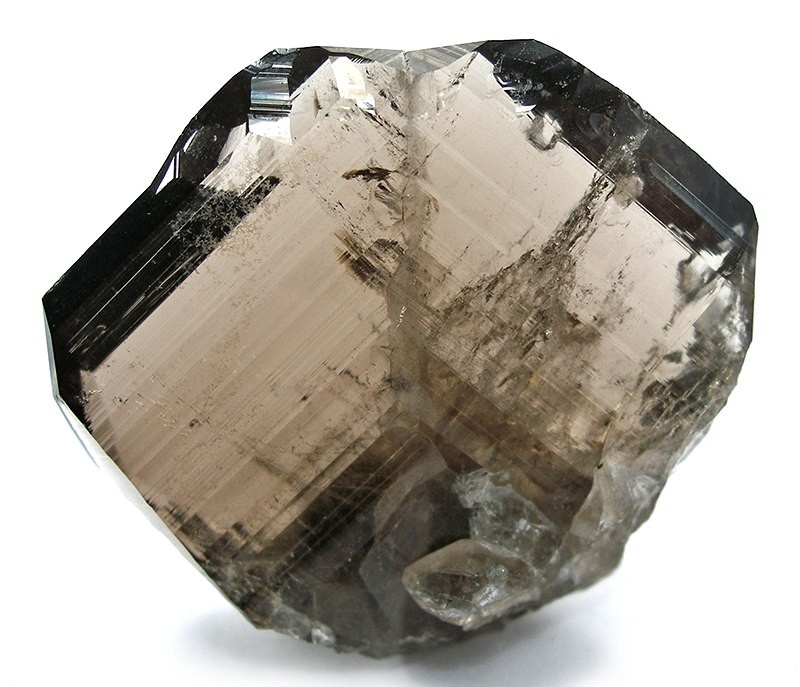
Photo: Wikimedia Commons

Photo: Wikimedia Commons
Search for specimens: View all specimens from Mina Tiro Estrella, USA
Mina Tiro Estrella lies in the Capitan Mining District of the Capitan Mountains, Lincoln County, New Mexico, at about 33°34′N, 105°21′W, on the south flank of the range northeast of the town of Capitan and near the broader Ruidoso–Capitan mineral belt. Published locality descriptions place the prospect in the NE1/4 of section 35, T8S, R16E, on the Capitan Peak 7.5-minute quadrangle, at roughly 2,255 meters, or 7,400 feet, elevation.
The host is the Capitan pluton, an east–west-trending Tertiary granitic intrusion classed broadly as alkali feldspar granite/alaskite. The pluton intrudes Permian Yeso and San Andres strata and is itself cut by faults, fractures and breccia zones. The mineral occurrences of the Capitan Mountains are varied—iron skarns, manganese veins, feldspar bodies, quartz–fluorite veins with Th-U-REE mineralization and the REE-bearing quartz veins typified by Mina Tiro Estrella. Mina Tiro Estrella belongs to the latter group: a quartz–feldspar vein system with allanite and titanite as the principal rare-earth-bearing minerals.
The MTE vein has been described as a weathered, brecciated zone in aplite or alkali granite. Published measurements give the vein a N48°E strike and 52°SW dip, traceable for roughly 275 meters by quartz-feldspar float. Much of it is poorly exposed beneath colluvium, and collecting has historically focused on pits, trenches and small open cuts rather than underground workings. The vein material consists mainly of quartz and alkali feldspar, with pockets and open spaces lined by quartz crystals and Japan-law twins; allanite-(Ce) occurs as black tabular crystals, titanite as reddish-brown wedges, and the feldspar is commonly altered or kaolinized to a crumbly white to pink mass.
The ore story is modest and mainly geological rather than commercial. The Capitan Mountains attracted prospecting during the mid-20th-century search for thorium and uranium, and a thorium mill was built by the New Mexico Thorium Company in the 1950s, though the mill did not process ore. Some iron and manganese were produced elsewhere in the range, and the Smokey iron mine became the economically important Capitan operation, but Mina Tiro Estrella’s enduring production has been mineral specimens rather than ore. MRDS records list uranium and thorium for the site, but the collector material is the quartz–allanite–titanite pocket assemblage.
Specimen production is most closely associated with the late 1970s and early 1980s, when Dick Jones worked the locality and brought striking smoky Japan-law twins to market. Subsequent owners and collectors have reopened or reworked portions of the claim, but accounts agree that the early find produced the strongest run of dark, high-luster twins. Later collecting has yielded many pale to medium smoky twins and single Tessin-habit quartz crystals, but good matrix specimens remain difficult because the feldspar-rich vein material is often deeply decomposed and breaks down easily during extraction.
Collecting access today should be treated as closed unless one has explicit permission from the legal land and mineral-rights holders. Mindat’s current locality note states that the Mina Tiro Estrella claim is under ownership and that collecting is not allowed. The site is also small, heavily worked and sensitive: casual digging is inappropriate, and collectors should assume that any modern access requires prior arrangement, claim-owner permission and careful attention to federal and local land-management rules.
The productive pockets are described as small openings in the brecciated quartz–feldspar vein, commonly around 10 cm and only rarely larger. Many of the finest twins have been reported along the contact of the vein with a clay-rich hanging-wall zone. The characteristic association is smoky or colorless quartz on quartz/feldspar matrix, with black allanite crystals and small reddish titanites in or near the same openings. The locality’s best specimens are not simply “Japan-law twins”; they are sharply lustrous, flattened twins with strong smoky color, clean re-entrant geometry, glassy terminations and, ideally, enough matrix to show their original pocket setting.
Quartz is the dominant mineral at Mina Tiro Estrella, occurring as massive to somewhat transparent vein quartz, as clear to smoky single crystals in open spaces, and most famously as Japan-law twins averaging around thumbnail size but ranging from sub-centimeter pieces to broad twins several centimeters across, with exceptional later-collected twins reported to more than 10 cm wide. The single crystals are commonly prismatic and may show Tessin habit, while the twins are flattened, lustrous and strongly striated, often associated with white to pink feldspar, black allanite-(Ce), reddish-brown titanite and clayey vein material. Fine Mina Tiro Estrella quartz is judged by sharpness of the twin plane, symmetry of the “V” or butterfly outline, glassiness, undamaged terminations, visible smoky color and whether it remains naturally seated on matrix; loose, contacted or dull crystals are far more common than clean, aesthetic matrix pieces.
Smoky quartz is the locality’s emblematic collector mineral, especially in Japan-law twins whose color ranges from very pale tea-smoky through medium gray-brown to the much darker examples associated with the classic Dick Jones production of the late 1970s. Most documented later material is pale to medium smoky, probably influenced by natural radiation from thorium-bearing allanite in the REE vein environment, and occurs as flattened twins, “heart” or “butterfly” forms, rabbit-ear twins and occasional elongated twins, with brilliant luster and striations perpendicular to the c-axis. The strongest smoky quartz specimens from Mina Tiro Estrella combine saturated but transparent color, clean re-entrant angles, mirror-bright faces, minimal edge bruising and attached feldspar–quartz matrix; very dark old pieces are desirable but require especially careful provenance because questions have been raised about possible irradiation of some early material.
Other minerals documented from Mina Tiro Estrella include allanite-(Ce), titanite, K-feldspar including adularia, epidote, actinolite, chlorite/epidote material, clay minerals, hematite, magnetite, ilmenite and microlite-group material, with tourmaline reported only tentatively from nearby float. Allanite-(Ce) is the most important accessory for collectors: it occurs as black tabular crystals, sometimes sharp and lustrous to thumbnail size, and is the principal REE host in the vein. Titanite forms reddish-brown wedge-shaped crystals, generally small but attractive when scattered on quartz/feldspar matrix. Hematite is noted as rose-like material in some records, while magnetite and ilmenite are collector-mineral records rather than the visual draw of the locality.
The principal authenticity issue is locality attribution. Mina Tiro Estrella, Smokey Bear and other Lincoln County smoky quartz occurrences are close enough in collector memory that labels can be confused, yet their specimen styles differ. Large smoky crystals of the Sierra Blanca/Smokey Bear type should not be casually accepted as Mina Tiro Estrella material; published locality notes specifically warn that some smoky quartz specimens reported from Mina Tiro Estrella are almost certainly from the nearby Smokey Bear prospect instead. A true MTE label is most convincing when the specimen is a flattened Japan-law twin, commonly small to miniature, with feldspar-rich matrix, allanite or titanite association, and old provenance to Dick Jones, Richard Hauck, Ron K. Sohn, known New Mexico collectors or later documented claim owners.
Color is the second major concern. The vein contains thorium-bearing allanite and has elevated radioactivity, so natural smoky coloration is geologically plausible, and many pale to medium smoky crystals are accepted as natural. However, long-standing collector reports question whether some very dark Dick Jones-era twins were artificially irradiated, possibly at a University of Arizona laboratory. That does not automatically condemn every dark example, but it does mean that the premium for very dark smoky color should rest on provenance, overall style and transparency rather than color alone. Avoid paying top locality prices for an isolated dark twin with no old label, no collection history and no convincing MTE matrix or association.
Condition is a serious value factor. The twins are flattened and broad, so their edges, terminations and re-entrant notches are vulnerable to small bruises. Many specimens show contact marks from pocket growth; minor contacts are normal, but chipped wing tips and broken re-entrant areas hurt value sharply. Matrix pieces are far rarer because the feldspar-rich host is commonly kaolinized, crumbly and clay-coated. A twin still naturally attached to stable quartz/feldspar matrix is substantially more desirable than a loose crystal of the same size and color.
Cleaning should be conservative. Clay can obscure luster, but aggressive soaking, ultrasound or heavy mechanical work can undercut altered feldspar and detach crystals. Avoid harsh acids on mixed pieces with feldspar, allanite and titanite unless there is a clear reason and expert familiarity with the assemblage. Allanite-bearing specimens should be stored and handled sensibly: the radioactivity reported for the locality is low-level compared with many uranium minerals, but allanite may be metamict from thorium content, and dusty or friable matrix should not be abraded, blown off or handled carelessly.
Market availability is sporadic. Small pale smoky twins and loose thumbnails appear from time to time, including modern pieces with minID documentation, but fine old dark twins, aesthetic matrix specimens and sharp allanite thumbnails are genuinely scarce. The locality is small, privately controlled and heavily worked, so the supply is not comparable to more continuously productive quartz localities. For serious collectors, the best buys are specimens with an old label and a credible chain of ownership, or newer pieces documented directly from a collector with known access to the claim.
The best-known Mina Tiro Estrella story begins in the 1970s with Dick Jones, a prominent southwestern field collector. As the story is preserved in locality accounts, Jones learned of quartz float and Japan-law twins found by a hunter in the Capitan Mountains during a deer or elk hunt. He followed that lead to the vein, located the source and filed claims in the area. In a maneuver that has become part of the locality’s lore, he reportedly recorded the claims about a half mile away from their actual physical location to protect the diggings from claim jumpers. That misdirection gave him a short window of privacy, and in 1978–1979 he hit the pockets that made the locality famous.
Those Jones-era pockets produced the dark, glassy, flattened twins that later became the benchmark for Mina Tiro Estrella. They appeared at shows, especially Tucson, and were quickly recognized as something different from ordinary New Mexico smoky quartz: small, sharp, lustrous Japan-law twins with a distinctive smoky body color and unusually crisp face striations. The find also carried a shadow. Later collectors repeatedly noted that no one else working the claim found the same quantity of very dark material, and rumors persisted that some crystals had been irradiated to deepen their color. Whether every dark example deserves suspicion is another matter, but the debate itself has become part of the locality’s collecting history.
Once word got out, the claim became difficult to protect. High-grading followed, and Jones eventually let the claim lapse. For years the locality was more famous in collections than active in the field, with old labels circulating through dealer stocks while the site itself lay largely quiet. Other people later held mineral rights, but the post-Jones production never matched the dramatic early run.
A second chapter began decades later, when New Mexico collector Philip Simmons set out to find the locality he had wanted to collect since childhood. Around 2012 he tracked down the claim, only to find that the old pit had become hard to recognize. A fire in the early 2000s had changed the vegetation, and plants had overgrown the workings. Near the end of his first day, he finally located the old 5 by 15 meter pit. Within two hours of digging along its side, he found several good twins to about 3 cm, enough to turn the search into a long-term commitment.
Simmons’s later field notes give the modern collector’s view of the claim in practical detail: a 2.3-mile hike to the dig, a small camp for several nights in 2013, digging with family and friends, and pocket work in a vein he described as a feldspar/quartz vein that produces Japan-law twinned quartz. The human moments are as memorable as the mineral ones—his father finding a twin in June 2012, then Simmons getting his turn, then Tim Dorris finding two nice twins after a couple of hours of digging in 2013.
One field photograph caption captures the locality’s central frustration. A twin had been extracted in good condition, but the matrix fell apart immediately after collecting. Simmons called that the hardest problem at Mina Tiro Estrella: twins can be found, but twins in good condition on matrix are uncommon. That single detail explains the market better than any price guide. The vein can make beautiful crystals; preserving the specimen as a natural pocket object is the hard part.
Timothy A. Hanson, “Mina Tiro Estrella [New Mexico],” The Mineralogical Record, vol. 20, no. 1, 1989, pp. 51–53 — The classic collector article on the locality, published in the New Mexico issue of The Mineralogical Record.
Randall S. Phillips and Virginia T. McLemore, “Mineralogy and geochemistry of veins in the Capitan Mountains, central New Mexico,” 10th Annual New Mexico Mineral Symposium, 1989, pp. 29–31 — A concise symposium abstract with the key geology, mineral assemblage, crystal sizes and fluid-inclusion data for the MTE vein.
Virginia T. McLemore and Randall S. Phillips, “Geology of mineralization and associated alteration in the Capitan Mountains, Lincoln County, New Mexico,” New Mexico Geological Society Guidebook, 42nd Field Conference, 1991, pp. 291–298 — The best open-access geologic treatment of the Capitan mineralization, including the MTE vein description, mineral assemblage and resource context.
Randall S. Phillips, Geochemistry of hydrothermal Th-U-REE quartz/fluorite veins from the Capitan pluton, M.S. thesis, New Mexico Institute of Mining and Technology, 1990 — A detailed graduate thesis covering the Capitan hydrothermal vein system, including the Mina Tiro Estrella prospect description and fluid-inclusion work.
Virginia T. McLemore, Radioactive occurrences in veins and igneous and metamorphic rocks of New Mexico with annotated bibliography, New Mexico Bureau of Mines and Mineral Resources Open-file Report 155, 1982 — The broader radioactive-occurrence compilation that places Capitan thorium and uranium occurrences in statewide context.
Wendell E. Wilson and John S. White, “What’s New in Minerals? — Detroit Show 1976,” The Mineralogical Record, vol. 8, no. 1, 1977, pp. 58–62 — Cited in Mindat’s locality references for early published notice of Mina Tiro Estrella quartz, hematite, microlite-group material and titanite.
Stuart A. Northrop and F. A. LaBruzza, Minerals of New Mexico, 3rd ed., University of New Mexico Press, 1996 — A standard New Mexico mineral reference cited for several Mina Tiro Estrella species records, including feldspar, adularia, epidote, magnetite and associated minerals.
Natural History Museum specimen listing, “Quartz var. smoky quartz — BM.1977,45 — Tiro Estrella mine, El Capitan, Lincoln Co., New Mexico, U.S.A.” in the 2025 New Mexico Mineral Symposium program abstracts — A documented museum specimen record showing Mina Tiro Estrella smoky quartz represented in a major institutional collection.
Mindat locality page: Mina Tiro Estrella — The central online locality record, with coordinates, mineral list, specimen photos, access warning, historical notes and references.
Mindat smoky quartz occurrence record — Focused occurrence page for smoky quartz from Mina Tiro Estrella, including photo-data associations and specimen documentation.
Wikimedia Commons: Minerals of Mina Tiro Estrella — Freely usable images of Mina Tiro Estrella quartz specimens, including Japan-law twins photographed by Rob Lavinsky.
New Mexico Mineral Symposium abstract: Phillips and McLemore, 1989 — A compact but highly useful summary of the Capitan vein mineralogy, MTE quartz habits and high-salinity fluid-inclusion evidence.
New Mexico Geological Society Guidebook paper: McLemore and Phillips, 1991 — Peer-reviewed guidebook article placing MTE in the larger Capitan pluton mineralization system.
New Mexico Tech thesis: Phillips, 1990 — Detailed technical treatment of the hydrothermal Th-U-REE quartz/fluorite veins of the Capitan pluton.
Mineralogical Record back issue, January–February 1989, New Mexico issue — Source for Timothy A. Hanson’s three-page article on Mina Tiro Estrella.
Western Mining History MRDS page: Mina Tiro Estrella — A convenient MRDS-derived summary listing the site’s uranium/thorium commodity record, coordinates and administrative context.
Friends of Minerals Forum: New Mexico Collecting — Mina Tiro Estrella field notes — Collector field account with useful first-hand details on modern digging, pocket size, twin habits and matrix fragility.
Fabre Minerals search results including Tiro Estrella Japan-law quartz — Dealer archive examples illustrating the locality’s sharp, smoky, flattened Japan-law twin style.
Mineral Auctions archived smoky quartz Japan-law twin — Market example describing condition, habit and collector desirability for an MTE smoky twin.
Minfind current/archived Mina Tiro Estrella smoky quartz listing — Useful snapshot of modern availability, size and pricing for a documented pale smoky Japan-law twin.