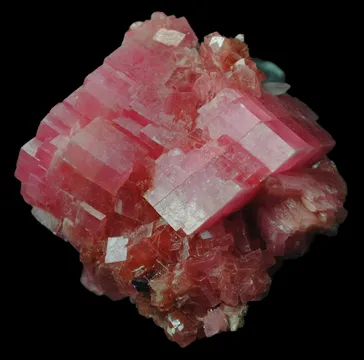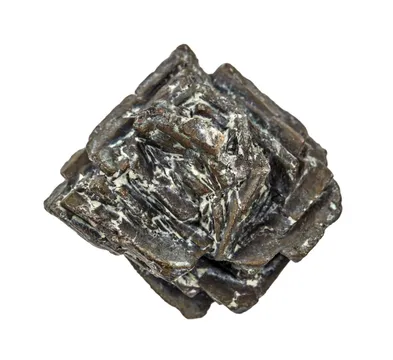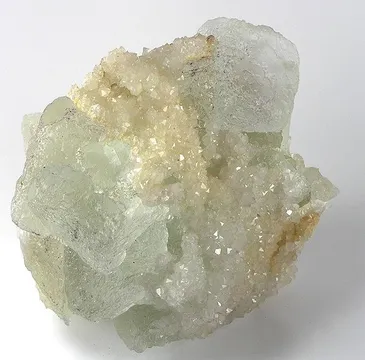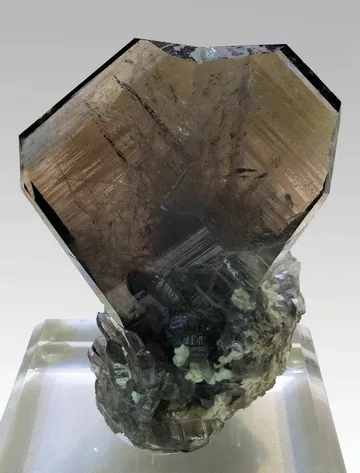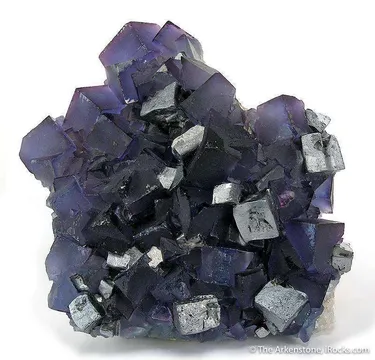
Pine Canyon, USA — classic fluorite locality renowned for octahedral rose-purple to wine-red crystals on quartz, with green zoning and strong collector appeal.
Key facts
Pine Canyon is one of the classic American fluorite specimen localities: a small, stubbornly discontinuous fluorspar system on the west side of the Burro Mountains of Grant County, New Mexico, famous not because it was a successful ore mine, but because it produced instantly recognizable octahedral fluorite plates in saturated rose-purple, violet, wine-red, and green-zoned colors. The locality lies in a faulted and dike-intruded granitic terrane of the West Burro Mountains, where fluorite and quartz occupy narrow veins, stringers, and pockets rather than broad, commercially mineable ore. That geologic inconvenience became a collector’s advantage: the best pieces are not anonymous massive fluorspar, but sparkling aggregates of octahedrons, commonly perched on white to spongy quartz and in places showing green interiors under purple outer zones.
Historically, Pine Canyon has a peculiar dual identity. Older economic-geology literature treated Pine Canyon with nearby Spar Hill as a small fluorspar prospect in the Burro Mountains. The specimen world later came to know its finest material through the Judith Lynn Claim, also formerly traded under the misleading “Catron County, New Mexico” label. By the late twentieth century, Robert M. North and Ramon S. DeMark had corrected the locality in print, and the deposit’s fluorite became a New Mexico classic: purple octahedrons on quartz, often etched free of drusy silica, with a surface texture that can look frosted, scalloped, blistered, or satiny rather than glassy.
Regional View
Country View
Collectors prize Pine Canyon fluorite for a very particular look. Ordinary examples are clusters of small rose-purple octahedrons, often with etched or quartz-frosted surfaces. Better examples have stronger color, sharper octahedral form, distinct green-to-purple zoning, a balanced plate or cabinet-size composition on quartz, and minimal bruising along the exposed octahedral edges. Exceptional pieces push the locality’s size range: documented specimens include plates in the 7–16 cm range, individual octahedrons around 2.5–3 cm on notable examples, and a much-publicized 5.5 cm single crystal collected by hand in 1984 from a shallow, nearly vertical vein.

Photo: Wikimedia Commons

Photo: Wikimedia Commons
Search for specimens: View all specimens from Pine Canyon deposit, USA
Pine Canyon deposit is in the West Burro Mountains of the Burro Mountains Mining District, Grant County, New Mexico, southwest of Silver City. In the older fluorspar literature it is grouped with Spar Hill, roughly half a mile away, on the west side of the Burro Mountains in the S 1/2 of sec. 27, T. 19 S., R. 16 W. Rothrock, Johnson, and Hahn placed the Pine Canyon prospect about four miles northwest of the peak of the Big Burro Mountains and about 29 miles by road southwest of Silver City; Gillerman’s later USGS treatment described Spar Hill and Pine Canyon as west-side Burro Mountains fluorspar deposits accessed by partly graded and partly ungraded roads.
Geologically, Pine Canyon is a small hydrothermal fluorspar vein and stringer system controlled by fractures in Precambrian granite cut by younger intrusive rocks. The country rock is chiefly granite, but the mineralized zone also involves aplite dikes, rhyolite dikes, and small andesite, diorite, or monzonitic bodies. The fluorite is not a broad replacement body. It occurs in numerous small, subparallel veins, stringers, fissures, and small pockets, intimately associated with quartz. The veins are discontinuous and spaced far enough apart that economic geologists consistently judged the deposit too narrow and irregular for commercial mining, despite locally high-grade fluorite.
The nearby Spar Hill workings help explain the structural setting. Spar Hill follows a northeast-striking, steep northwest-dipping fault zone that cuts granite and rhyolite; fluorite there is most abundant where granite forms one or both walls, and quartz is the only associated mineral noted in the classic USGS description. Pine Canyon lies southwest of Spar Hill and is probably on the same mineralized zone, but the mineralization at Pine Canyon is expressed as small fissure fillings and pockets rather than a persistent mineable body. In the broader Burro Mountains fluorspar province, green and purple fluorite predominate, quartz is the most common gangue, and multiple stages of fluorite deposition alternated with silicification.
Mining history at Pine Canyon is brief in an ore sense and rich in a specimen sense. Claims on the deposit were first located in the early 1940s. Rothrock and coauthors reported that in July 1943 the Pine Canyon property was owned by Charles F. Johnson, and they described fluorite in granite fissures and pockets as much as two feet thick, with medium- to coarse-grained green, purple, red, or white fluorite and little appreciable gangue. Gillerman later recorded only shallow trenches at Pine Canyon and no ore shipments from the deposit, while Spar Hill, by contrast, shipped about 800 tons of fluorspar between February 1942 and March 1944. In practical terms, Pine Canyon’s commercial mining never amounted to much; its real production was collector fluorite.
The specimen locality most collectors mean when they say “Pine Canyon” is the Judith Lynn Claim, also historically referred to as the T & G Prospect in some labels and databases. The claim was located in April 1983 after the earlier “Catron County” story unraveled. The fluorite had already circulated in the mineral market during the 1970s, but under that incorrect county attribution. After the death of Dick Jones of Casa Grande, Arizona, Robert M. North and Ramon S. DeMark investigated the old claim records and the suspected Burro Mountains locality; field checking by Robert Dickie and DeMark established the true source, and the lapsed ground was restaked as the Judith Lynn.
The famous pocket material came from steep to nearly vertical veins. DeMark and Sanders described three primary veins striking northeast-southwest and dipping about 70° northwest, with pinch-and-swell widths reaching about 20 cm. Crystals occurred as fracture linings on granite walls and as plates between clay seams. The southern, upslope veins yielded the curved, scallop-faced purple octahedrons most associated with the locality. The northern, downslope vein produced a different style: smaller, sharp octahedrons, in places associated with light green cubes under 1 cm. Nearly all material was covered by a drusy quartz layer up to about 1 mm thick when found, making cleaning central to the final appearance of specimens.
The best-documented production episode was the July 1–14, 1994 mechanized dig by Ramon S. DeMark, Michael R. Sanders, Mike New, and Joe Kielbaso of Top-Gem Minerals, undertaken with U.S. Forest Service authorization because the claim lay within the Gila National Forest. A 40-ton Caterpillar 320L excavator opened the veins to about 2.5–3 m depth, after which drilling and blasting extended work to roughly 4 m. Vein material was removed by hand after machine exposure, carried in buckets, soaked overnight, scrubbed, and graded. On the last day, a section of the center vein produced unusually sharp, exceptionally clear octahedrons with more obvious green internal zoning; some were considered suitable for faceting.
Collecting access today should be treated as closed unless the collector has explicit permission from the claim holder and complies with land-management requirements. The Judith Lynn Claim has been an active mineral claim in the modern specimen era, and published accounts describe formal Forest Service oversight and required reclamation for mechanized work. A later mechanical dig in 2019 was reported as unproductive, followed by reclamation under U.S. Forest Service directives. The locality’s old trenches and shallow workings are not an invitation to collect: the combination of claimed mineral rights, federal land management, fragile reclaimed ground, and steep vein workings makes casual collecting inappropriate.
Pine Canyon fluorite is overwhelmingly octahedral and is best known as rose-purple to deep violet crystals on quartz, commonly with green cores, green underlayers, or green fluorite matrix visible where a specimen is broken or seen from the back. Typical crystals are small, often in the 5 mm to 1.5 cm range on plates, but better-known examples reach 2.5–3 cm, and the celebrated 1984 hand-dug single crystal is reported at 5.5 cm. The classic Judith Lynn style is a plate of lustrous to satiny, curved or scallop-faced octahedrons on white, drusy, or spongy quartz; some pieces show a frosted or lightly etched surface from natural silica coating and subsequent cleaning. Good pieces here are separated from ordinary ones by saturated purple or wine-red color, strong zoning, sharp complete octahedrons, attractive quartz contrast, and the absence of bruised crystal tips or over-etched, sugary surfaces.
Quartz is the only other mineral consistently documented from Pine Canyon and its principal sublocalities in the public locality databases and classic deposit descriptions. It occurs as vein quartz, drusy coatings, silica cement, and quartz matrix; in much of the specimen material it originally coated the fluorite so thoroughly that careful removal was needed before the octahedrons could be evaluated. No type-locality minerals are documented from Pine Canyon, and the deposit is not a rarity locality in the species-count sense. Its significance rests on a narrow but superb assemblage: fluorite and quartz, produced in a highly distinctive New Mexico style.
The principal authenticity issue for Pine Canyon fluorite is locality, not species. The classic mislabel is “Catron County, New Mexico,” a label that appeared on the market in the 1970s before the Burro Mountains source was corrected. Older specimens with Catron County labels may in fact be Pine Canyon/Judith Lynn material, especially if they show rose-purple octahedral fluorite on quartz with green zoning or green fluorite matrix. Conversely, a vague “New Mexico fluorite” label should not automatically be upgraded to Pine Canyon without a credible old label, collection history, or visual match to the Judith Lynn habit.
Treatment and cleaning are central to the locality. Much Pine Canyon fluorite was originally covered with a thin druse of quartz, and published locality notes describe specimens being etched with hydrofluoric acid to expose the octahedrons; some were also placed in bright sunlight to improve the rosy color. For collectors, this means etched surfaces are not necessarily a defect here—they are part of the specimen history—but over-cleaned pieces can look dull, sugary, or unnaturally rounded. The best examples retain recognizable octahedral geometry and a lively surface despite the etched or frosted texture.
Condition is a serious grading point. Pine Canyon fluorite plates are often low relief, with many exposed octahedral points, so edge nicks and bruised tips are common. On older pieces, look closely at the high points of the octahedrons and at the contact between fluorite and quartz matrix. Some matrix is naturally porous or “spongy,” and thin plates can be fragile. Repairs are not especially notorious from this locality, but any larger, freestanding octahedron on quartz deserves careful inspection under side light.
Fluorescence is a useful bonus but not the primary value driver. Pine Canyon specimens have been reported as fluorescent under both longwave and shortwave UV, and some auctioned examples note purple to blue fluorescence. The market, however, rewards daylight aesthetics first: saturated rose-purple color, zoning, sharpness, size, and matrix composition matter more than UV response. Exceptional examples have become harder to buy than they once were. A 1994 dig produced a significant volume of specimens, but later accounts report that the 2019 mechanical effort was barren and that future recovery from the Judith Lynn Claim is doubtful. As a result, good Pine Canyon fluorite is now most often encountered from old collections, dealer back stock, or resales of specimens collected between the 1970s and 1990s.
The Pine Canyon story begins with a false address. In the early 1970s, purple octahedral fluorites began circulating as “Catron County, New Mexico.” The material was distinctive enough that collectors remembered it: rose to purple octahedrons, commonly on quartz, not quite like the better-known New Mexico fluorites from Hansonburg, Cookes Peak, or the Gila district. Dick Jones of Casa Grande, Arizona was the principal seller, and the county label served its purpose for a time. Later accounts state plainly that the Catron County location was wrong; one specimen note from the Robert Whitmore collection even says such labels were used “to deceive potential claim jumpers.”
After Jones died in 1982, the mystery became solvable. Robert M. North and Ramon S. DeMark searched for the occurrence, including an unsuccessful look through Catron County fluorite localities. When that failed, they turned to Bureau of Land Management claim records associated with Jones. The paper trail pointed not to Catron County at all, but to the Burro Mountains southwest of Silver City, in Grant County. Robert Dickie and DeMark investigated the suggested site and found the source of the elusive fluorite. The claims had lapsed, so in April 1983 new ground was filed and named the Judith Lynn Claim.
One of the great individual specimens from the locality came out the following year, not by heavy equipment but by hand. On September 1, 1984, Ray DeMark collected a 5.5 cm fluorite from a nearly vertical vein about two feet below the surface. Published specimen notes describe it as possibly the largest single crystal from the location. It is the kind of object that explains the deposit’s appeal: not a great tonnage story, not a mine-office production statistic, but one improbable crystal pried from a tight vein in weathered Burro Mountains granite.
By the early 1990s, hand work had nearly reached its limit. The veins were steep, the trenches were deepening, and the best pockets were increasingly awkward to reach safely with picks and shovels. At the Denver Show in September 1993, DeMark and Sanders consulted Mike New of Top-Gem Minerals of Tucson, who recommended a tracked, 40-ton Caterpillar 320L excavator—the same kind of serious machine that had already proved useful for specimen recovery at Morenci, Arizona. An agreement followed with Mike New and Joe Kielbaso, and the operation was scheduled to begin July 1, 1994.
Because the claim was in the Gila National Forest, the dig had to pass through the U.S. Forest Service. The plan required a Notice of Intent, a mining description, an archaeological survey, and clearance. Forest Service employee Robert Schloss helped complete the archaeological survey in time for the July start date. The plan even included the possibility of drilling and blasting, but it also committed the crew to backfill the trenches and restore the surface topography as nearly as possible.
The work area was a rectangle of ground roughly 75 m by 50 m. The crew recognized three principal veins trending northeast-southwest and dipping about 70° northwest. The veins pinched and swelled, but even at their best were only about 20 cm wide. The excavator did the heavy exposure work, cutting as close to the veins as practical; then the specimen work reverted to hand tools. Each day’s production—sometimes 6 buckets, sometimes 15—was hauled down to a washing area at a windmill and stock tank in Pine Canyon. The clay and organic matter were so heavy that the day’s finds could not be judged in the trench. Buckets soaked overnight, and only after the clay-fluorite masses were broken apart and scrubbed with brushes could the fluorite be sorted.
The grading system was wonderfully blunt: A for high quality, B for medium grade, and “54s” for student or beginner specimens. The two southern, upslope veins gave the classic Pine Canyon look—curved, scallop-faced purple octahedrons. The northern, downslope vein was different, yielding much smaller but sharper octahedrons, commonly with light green cubes under 1 cm. Nearly everything wore a drusy quartz skin up to about 1 mm thick, meaning that the finished specimen was only partly visible in the field and partly revealed later by cleaning.
The excavator could break and remove rock to about 2.5–3 m. To go deeper, Mark Kielbaso drilled and blasted. DeMark and Sanders described series of 8 to 11 holes, each 3 feet deep, drilled parallel to the veins. These were loaded with ANFO charges and a Kinepak trigger and fired together with detonation cord, fuse, and cap. That pushed the practical working depth to about 4 m. On the last day of excavating, the center vein rewarded the effort with a small run of unusually sharp octahedrons. After cleaning, they proved unusually clear, and some had a more prominent green interior zone. Those were the only crystals from the dig considered suitable for faceting.
On July 14, 1994, the collecting ended and the reclamation began. The trenches were filled, the slope contoured, and Bob Schloss inspected the work that afternoon. That evening, the specimens were divided under the partners’ agreement and packed for transport. DeMark and Sanders ended their published account with the sort of sentence field collectors rarely get to write honestly: no one was hurt, the machine worked, the crew got along, and a large volume of superb fluorite had been recovered. “It doesn’t get better than that!”
The epilogue is sobering. A later mechanical dig in 2019 was reported as completely unproductive, and the area was reclaimed according to U.S. Forest Service directives. The conclusion in the more recent New Mexico fluorite literature is that future specimen recovery from the Judith Lynn Claim is doubtful. That gives the old Pine Canyon plates a finite, historical character: they are not just attractive New Mexico fluorites, but survivors from a small set of veins whose best moment may already have passed.