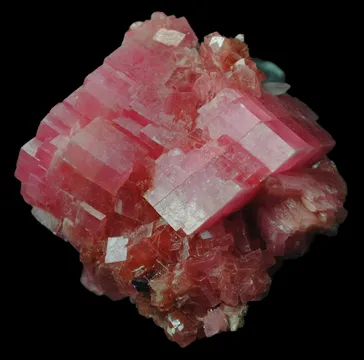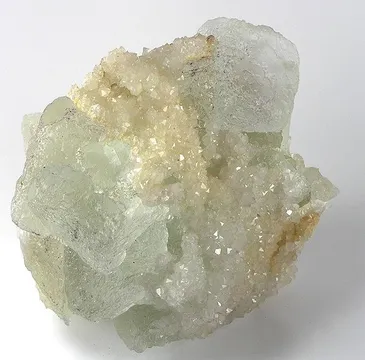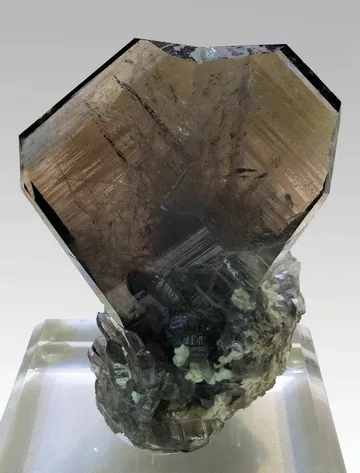
Copper Rose Mine, USA — famed for copper rose crystals resembling azurite, with native copper in calcite, cuprite, and malachite; a collectible locality.
Key facts
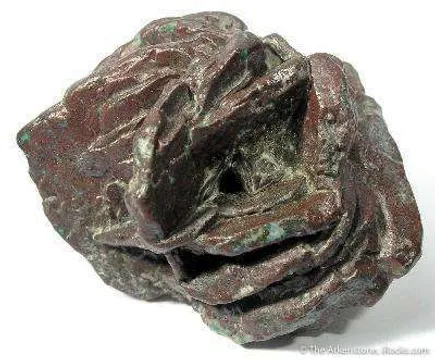
The Copper Rose Mine near San Lorenzo in Grant County, New Mexico is one of those small, improbable American localities whose fame is almost entirely mineralogical rather than industrial. The old Rose, McGregor, Copper Glance, and Potosi workings lie in the Georgetown district, in the southern Basin and Range country east of Silver City, where Paleozoic carbonate rocks and igneous dikes provided the chemical and structural setting for a peculiar copper occurrence. The mine is not remembered for tonnage. It is remembered for “copper roses”: sharply bladed rosettes that preserve the crystal form of azurite but are now composed chiefly of native copper intimately mixed with calcite, with cuprite and malachite as later alteration products.
Regional View
Country View
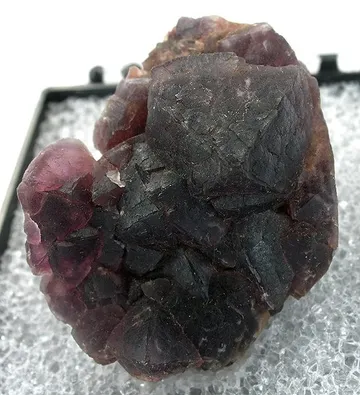
For collectors, the Copper Rose Mine matters because it produced a highly recognizable morphology rather than a broad suite of display minerals. The finest specimens look like dark, metallic-brown azurite rosettes cast in copper: stacked blades, open flower-like clusters, moderately lustrous coppery to chocolate patinas, and occasional green malachite accents along edges and crevices. Many examples are thumbnails and small miniatures, with published modern summaries noting most crystal groups in the 2.5–4.5 cm range, while nineteenth-century reports record much larger masses of the same strange material.

Photo: Wikimedia Commons
The best Copper Rose specimens are deceptively simple. They invite the label “copper after azurite,” and that remains convenient collector shorthand, but the published work on the occurrence makes the material more subtle: the copper occurs as microscopic arborescent aggregates in a calcite-bearing pseudomorph, commonly with cuprite and malachite involved. That complexity is part of the locality’s appeal. A good Copper Rose is not just a pretty copper specimen; it is a compact record of oxidation, reduction, carbonate chemistry, clay, calcite, and late supergene alteration acting in an unusually sculptural way.
Search for specimens: View all specimens from Copper Rose Mine, USA
The Copper Rose Mine is in the San Lorenzo area of the Georgetown Mining District, Grant County, New Mexico, at about 32° 46′ 56″ N, 107° 57′ 43–44″ W. It is historically associated with the Rose Mine, McGregor Mine, Copper Glance Mine, and Potosi Mine names. The locality lies in the broader Hillsboro–San Lorenzo mineralized region, where Laramide and middle Tertiary intrusions cut a carbonate-dominated Paleozoic section and produced a variety of base- and precious-metal occurrences across the surrounding districts. At the Copper Rose itself, the essential setting is compact and specific: an igneous dike in limestone, with oxidized copper mineralization developed in and around clayey, carbonate-rich vein or replacement material.
The historic Copper Glance and Potosi claims were filed in 1887. Early descriptions emphasize tabular, azurite-shaped coppery masses in a clay-rich material, rather than a conventional orebody that yielded sustained copper production. The nineteenth-century literature linked the forms to azurite crystallization by measurement and comparison, while later study refined the identity of the pseudomorphing material. The commonly encountered collector specimens are not solid copper replacements in the simple, massive sense. They are azurite-form pseudomorphs in which fine native copper aggregates, calcite, cuprite, and malachite may all play a role, the copper forming microscopic branching groups within the former azurite form and adjacent mold spaces.
Mining history here is short in comparison with the large Grant County copper camps. The claims belong to the great late-nineteenth-century rush of New Mexico mineral exploration, but the mine’s commercial copper story was modest. Good specimens were already in mineralogical circulation by the 1890s, marketed by dealers including George L. English and A. E. Foote to Eastern American and European collectors. Later accounts describe the workings as having produced almost no copper ore and ceasing operation around 1913. The locality’s second life was specimen-driven: collectors revisited dumps and old underground backfill long after economic work had ended.
The most important modern specimen recovery publicly noted was in 1991, when about one hundred excellent copper-rose pieces were reportedly found in backfill in the old underground workings. That find helped explain why attractive examples, though never abundant, continued to surface in collections and the trade during the late twentieth and early twenty-first centuries. The pockets and backfill that produced the best material were not typical open cavities lined with bright azurite; they were clayey, altered zones preserving bladed azurite morphology in copper-calcite-cuprite-malachite pseudomorphs. Specimens with open rosette structure, sharp blade outlines, minimal crushing, and natural floater form are distinctly better than tight, lumpish, or heavily worn pieces.
Collecting access should be treated as restricted. Published New Mexico mineral-symposium material cautions that mines discussed in the area are privately owned or on private mining claims and require permission. Mindat also warns collectors not to visit locality sites without confirming permission, mineral rights, and safety conditions. Old underground workings in clayey oxidized ground are inherently unstable, and the Copper Rose Mine should not be approached as a casual public collecting site.
Azurite from the Copper Rose Mine is famous less as surviving blue crystals than as the lost original architecture of the “roses”: tabular to bladed crystals grouped in rosettes, later preserved as pseudomorphs dominated by copper-bearing material. The azurite habit was convincing enough that nineteenth-century workers compared the forms with Bisbee azurite and made goniometer measurements to demonstrate the correspondence. Most collectible groups encountered today are small, commonly around thumbnail to small-miniature size, and modern summaries give 2.5–4.5 cm as the usual range for crystal groups. The finest pieces retain crisp, separated blades and flower-like geometry rather than collapsing into compact nodules; malachite films, cuprite-darkened surfaces, calcite, chrysocolla, clay, and rare traces of blue azurite or turquoise-like color may occur, but the value lies in how faithfully the azurite form survived replacement and alteration.
Native copper is the collector mineral of the Copper Rose Mine, but the best specimens are not ordinary wires, sheets, or dendrites; they are copper-bearing pseudomorphs after bladed azurite rosettes, typically with dark brown to reddish copper patina, local green malachite, and calcite or clayey matrix. Careful published interpretation shows that many “copper roses” are composite pseudomorphs rather than homogeneous metallic copper: fine microscopic copper aggregates occur with calcite, and later alteration may convert part of the copper to cuprite and malachite. Good Copper Rose copper specimens are sharply bladed, three-dimensional, and balanced, often thumbnail to small-miniature in scale; ordinary examples tend to be crowded, rounded, broken, or so altered that the azurite blades are difficult to read. Complete floaters with crisp blade terminations, old labels, and documented nineteenth- or early twentieth-century provenance are especially desirable.
The documented mineral list for the Copper Rose Mine is short but collector-relevant: calcite, chalcocite, chrysocolla, cuprite, halloysite, malachite, quartz, and turquoise accompany azurite and native copper. No fame here attaches to a type-locality species; the locality’s rarity is textural and paragenetic. Cuprite and malachite are especially important because they are not merely accessories on many specimens but part of the later alteration history of the copper-bearing pseudomorphs. Calcite is equally significant, since the “roses” have been described as copper-and-calcite pseudomorphs or mold fillings rather than simple solid copper casts.
Copper Rose specimens deserve close label scrutiny. They have been sold for more than a century under several related names: Copper Rose Mine, Rose Mine, McGregor Mine, Copper Glance Mine, Potosi Mine, San Lorenzo, Georgetown District, Grant County, New Mexico. These names can all refer to the same classic occurrence, but vague labels such as “Grant County copper after azurite” should be checked carefully because New Mexico has many copper localities and more than one mine named Rose. The distinctive rosette morphology is helpful, but not a substitute for provenance.
The principal authenticity issue is not widespread faking so much as oversimplified identification. Many labels say “native copper after azurite.” That is acceptable collector shorthand, but serious descriptions should recognize the composite nature documented in the literature: copper with calcite, often with cuprite and malachite, preserving azurite form. A specimen that is unusually heavy, bright, freshly metallic, or suspiciously solid-looking deserves extra examination, because classic Copper Rose pieces commonly have a dark patina and can be lighter, more porous, or more composite than a massive native-copper specimen of similar size.
Condition matters enormously. Bladed pseudomorphs chip, bruise, and round off easily; once the sharp azurite blade geometry is lost, the specimen becomes visually ordinary. Look for separated blades, an open rose-like cluster, natural terminations, and no obvious fresh breaks. A little green malachite can enhance contrast, especially when it outlines former azurite blades, but heavy earthy alteration may obscure the form. Calcite or pale clay matrix on the reverse is normal on some pieces and should not be mistaken automatically for repair or filler.
Fluorescence is not a major collecting feature here. Dealer records for Copper Rose material commonly note no fluorescence, and the value is in morphology, patina, and pseudomorph chemistry. Handle specimens dry and gently; avoid acid cleaning because calcite may be integral to the pseudomorph, and acids can destroy matrix, loosen copper-bearing aggregates, and permanently change the surface. Polishing, oiling, lacquer, or aggressive removal of malachite/calcite would all reduce scientific and collector value.
Market availability is limited but real. Attractive examples appear intermittently from old collections, usually as thumbnails, toenails, and small miniatures. Recent dealer and auction records show a wide spread: modest small or less aesthetic pieces can sell in the low hundreds, while sharper examples with better form, patina, and provenance may be priced much higher. The strongest pieces are instantly recognizable, have clean old labels, retain crisp azurite blade architecture, and show the rich brown copper surface that made the locality famous.
In 1889, W. S. Yeates described one of the oddest copper forms then known from the American Southwest: material that looked like native copper but behaved wrong in the hand. It was brittle, too light for solid copper, and carried the shape of azurite. Reported masses ranged from a single ounce to seventy pounds. When examined, the coppery material proved to be intimately mixed with clay, giving the appearance of copper without the weight of pure metal. That mismatch between form, color, and density is the beginning of the Copper Rose story.
Charles H. Snow’s 1893 account of the Copper Glance and Potosi material added the field setting and the early attempt at explanation. He described a copper-bearing solution, probably derived from an eruptive dike near the copper vein, working through clay that had become soft and plastic. The idea feels very nineteenth-century in language, but it captures the essential observation: these were not ordinary open-space copper crystals. They were mineral forms shaped by clay, carbonate, and copper chemistry in a narrow altered zone.
The specimens then entered commerce with remarkable speed. George L. English advertised the crystals in The American Geologist in 1890, and later summaries note that English and A. E. Foote marketed good examples during the 1890s to Eastern collectors, museums, and European buyers. That early distribution explains why Copper Rose specimens turn up with venerable labels out of proportion to the mine’s tiny production. The mine made little copper ore, but it made unforgettable mineral specimens.
The modern collector story has one especially important chapter: the 1991 recovery. Long after the workings had ceased to matter economically, collectors found about one hundred excellent pieces in backfill in the old underground workings. That small number is enough to be a famous find for this locality, because first-rate Copper Rose pieces are small, sculptural, and highly individual. The best of them look as if azurite rosettes had been cast in aged copper and then dusted by desert-green malachite.
In 2025, Tom Moore’s online “What’s New in the Mineral World” column noted six fine examples offered by Mineral Classics, calling them “copper roses” and emphasizing how rarely good material appears. The reported pieces were thumbnail to small-miniature clusters, with one illustrated specimen measuring 3.1 cm, and prices ranged from $400 to $1,750. For a mine that once produced almost no copper ore, that is an elegant collector’s afterlife: a handful of small pseudomorphs carrying more cultural weight than tons of metal.