A collector's guide to Central Bohemian Region, Czech Republic: its geology, mining history and notable minerals, illustrated with the 186 specimens documented from this locality on EarthWonders.
Key facts
Central Bohemia is not a single mine locality in the tidy cabinet-label sense; it is a mineral province. For collectors, however, its center of gravity is unmistakable: the Příbram ore area southwest of Prague, with the Březové Hory–Bohutín Ag-Pb-Zn veins and the later Příbram uranium and base-metal district around Bytíz, Háje, Dubno, Lešetice, Brod, Třebsko and related shafts. Together they form one of the great European hydrothermal vein districts, worked for silver, lead and zinc from medieval time into the modern mining era, and then reopened on a vast scale for uranium after the Second World War. The veins cut Neoproterozoic and Cambrian sedimentary rocks of the Teplá-Barrandian domain close to the exocontact of the Central Bohemian Plutonic Complex; their gangue is dominated by quartz, siderite, calcite, dolomite and baryte, with galena, sphalerite, pyrite, Ag-Sb sulfosalts, native silver, antimony minerals, arsenides and, in the eastern uranium district, uraninite and a remarkable selenium suite.
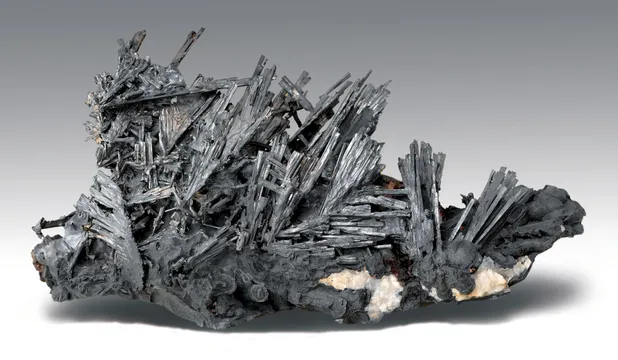
The best Central Bohemian specimens have a look that is quite unlike the alpine cleanness or big-crystal bravura of younger open-cavity districts. Příbram pieces tend to be compact, metallic, old-European and paragenetically busy: dark sphalerite and galena in hard quartz-siderite ore; brassy pyrite dusting brown carbonates; tabular baryte partly crusted by dolomite or calcite; red to black silver sulfosalts in small but superb crystals; and the famous native silver pseudomorphs after dyscrasite or pyrargyrite, their original blades and prisms translated into dull silvery-grey sculptural forms. In the uranium district, the collector’s eye shifts to calcite-uraninite veins, botryoidal pitchblende, grey-black massive ore, and rare Se-bearing minerals that make Příbram an analytical locality as much as an aesthetic one.
Regional View
Country View
The region’s other great mining name is Kutná Hora, east of Prague, where medieval silver made the city a financial power of the Bohemian kingdom and later left collectors an arsenic-rich oxidation mineralogy at Kaňk and nearby mine dumps. Bukovskýite, kaňkite and related hydrated ferric arsenates from the Kutná Hora district add a second Central Bohemian personality: pale, earthy to reniform secondary minerals born not in shining vugs but in the long weathering of arsenopyrite-bearing medieval waste.


Photo: Wikimedia Commons
Search for specimens: View all specimens from Central Bohemian Region, Czech Republic
The specimen-producing geology of Central Bohemia is best understood through two linked but different mining stories. The older western Příbram base-metal district, especially Březové Hory and Bohutín, is a classic Ag-Pb-Zn hydrothermal vein system. Its principal veins occupy structures in Cambrian greywackes, sandstones and conglomerates, locally guided by dolerite, historically called diabase, dykes and by major faults such as the Clay Fault. The veins strike roughly north to northeast in much of the old district, dip steeply, and show the repeated opening, sealing and brecciation that made Příbram famous among paragenetic mineralogists. Early quartz-siderite-sphalerite-galena assemblages pass into complex carbonate-baryte-sulfide and sulfosalt stages, then into later oxidation products and late carbonates.
The eastern Příbram uranium and base-metal district, mined through a network of numbered shafts after 1947, is also a vein district but with a different emphasis. Deposits such as Bytíz, Háje, Dubno, Lešetice, Brod, Třebsko, Jerusalem, Skalka and Kamenná were developed for uraninite-bearing carbonate veins, commonly accompanied by base-metal sulfides, arsenides and selenides. In the uranium district, mineralogical papers distinguish an older siderite-sulfidic stage, a calcite stage, a calcite-uraninite stage and later calcite-sulfidic or reactivated vein events. That sequence matters to collectors because it explains why an apparently simple calcite vein may carry black botryoidal uraninite, silver sulfosalts, native silver, galena, sphalerite, baryte and a suite of microscopic Se minerals.
Březové Hory was one of the great lead-silver mining districts of the Habsburg lands. Příbram’s silver and lead workings were known in medieval records, but the district’s technical and economic height came in the 19th century. The Vojtěch shaft reached a vertical depth of 1,000 m in 1875, an achievement celebrated locally as a world first for a mining shaft. By the late 19th century Příbram supplied an overwhelming share of the Austro-Hungarian production of silver and lead. The old base-metal district was mined down to extraordinary depths, with the Prokop shaft ultimately associated with depths around 1,500 m, and exploitation of Březové Hory and Bohutín continued, intermittently and with diminishing profitability, into the late 1970s.
The uranium era began with anomalies discovered in 1947 and rapid shaft development from 1948 onward. Large-scale extraction followed in the 1950s, and the Příbram uranium district became the largest hydrothermal vein-type uranium accumulation in the Czech lands and a world-class example of its kind. Shaft No. 16 at Háje and the Bytíz area are especially prominent in modern mineralogical literature because of uraninite, selenides and rare secondary uranium-selenium minerals. Uranium mining ceased by the early 1990s, after which remediation, water treatment and landscape reclamation became the work of the state enterprise DIAMO and its successors.
Collectors encounter Central Bohemia today mostly through old collections, mine-dump finds, museum material and the international specimen trade. Underground workings are closed except where preserved as formal museum tours, notably the Mining Museum Příbram at Březové Hory and newer heritage access connected with the Bytíz uranium mine. Dumps around Příbram vary greatly in condition, ownership and remediation status; some have been regraded, capped, overgrown, quarried for aggregate, incorporated into industrial remediation, or made unsafe by steep slopes and loose material. Serious collecting here is therefore not a matter of wandering into an old shaft landscape: permissions, current land status, radiation awareness and respect for remediation works are central to responsible collecting.
The most important specimen finds span several generations. Old Březové Hory material includes bournonite, pyrargyrite, proustite, pyrostilpnite, miargyrite, diaphorite, galena, sphalerite, siderite, baryte and calcite, many represented in classic 19th-century European collections. Deep levels produced “hard ore” or compact quartz-siderite-sulfide material with disseminated galena, sphalerite, pyrite, boulangerite and Ag minerals. The Jánská vein, between the Anna and Vojtěch shafts, is famous not only for base-metal ore but for local uranium mineralization and for silver-rich apophyses near the Clay Fault. In the uranium district, shafts at Třebsko, Háje, Bytíz and Dubno yielded the dyscrasite, native silver pseudomorphs, pyrargyrite replacements, uraninite specimens and selenide associations that still define Příbram for modern collectors.
Kutná Hora belongs in the same regional guide because its silver history and secondary arsenate mineralogy are central to Central Bohemian collecting. Medieval workings at Kutná Hora, Kaňk and Poličany produced the ores that made the town a minting and financial center; later weathering of arsenopyrite-bearing dumps created bukovskýite, kaňkite, zýkaite, parascorodite, scorodite and associated ferric arsenates. These are not showy cabinet minerals in the Příbram sense, but they are important to systematic collectors, type-locality specialists and anyone interested in how centuries-old mine waste becomes a low-temperature mineral laboratory.
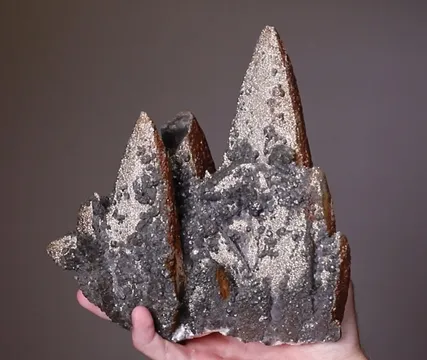
Calcite from Central Bohemia is above all a Příbram mineral, occurring in several generations in the Březové Hory base-metal veins and as the dominant pale carbonate in many uranium-district calcite-uraninite veins. In the Jánská vein it is recorded on older museum specimens as brown massive aggregates surrounding uraninite, while the broader district produced white to pale pink, lenticular, scalenohedral and complexly twinned crystals associated with pyrite, sphalerite, galena, baryte, siderite and quartz. Good pieces are not merely “calcite from Czechia”; they show the Příbram context—calcite with black uraninite seams, brassy pyrite, dark sphalerite or silver minerals, sometimes with long- and short-wave UV response—while ordinary pieces are massive vein carbonate lacking sharp form, matrix contrast or a reliable mine-level provenance.
Pyrite in the Central Bohemian specimen trade usually comes from the Příbram veins as small brassy cubes, modified crystals, granular coatings or later overgrowths in quartz-carbonate ore, most commonly with siderite, calcite, sphalerite, galena, baryte and Ag-Sb sulfosalts. In older paragenetic schemes pyrite appears in multiple generations, including pyrite with calcite and later pyrite associated with younger sulfosalts such as pyrargyrite and proustite; at the Jánská vein younger pyrite is known overgrowing botryoidal uraninite. The best collector pieces use pyrite as an accent—bright metallic crystals against dark sphalerite, brown siderite or pale calcite—rather than as large isolated crystals, and fine Příbram examples often owe their appeal to crispness, luster and association more than individual crystal size.
Siderite is one of the signature gangue minerals of the Příbram district and a key to recognizing older Ag-Pb-Zn assemblages from Březové Hory and Bohutín. It occurs as brown to tan rhombs, lenticular aggregates, massive bands and fine crystalline druses with quartz, galena, sphalerite, pyrite, boulangerite, bournonite and calcite; deep-level “hard ore” is described as intimate siderite-quartz-sulfide material, and older studies noted Mn-rich siderite in the deepest levels. Good siderite specimens from Central Bohemia are those where the brown carbonate is sharply crystallized and compositionally integrated with metallic minerals—especially boulangerite needles, galena-sphalerite bands or bright pyrite—while dull massive siderite without ore contrast is much less desirable.
Quartz at Central Bohemian ore localities is less often the star than the architecture: it is the hard framework of Březové Hory “hard ore,” the pale to grey gangue of Pb-Zn-Ag veins, and the carrier of small cavities in which siderite, pyrite, sphalerite, galena, bournonite and silver sulfosalts developed. In the Jánská vein, quartz is described as the most common upper-level gangue, chiefly grey to reddish massive vein filling with rare crystals to about 1 cm, turning grey to black near uranium minerals. The most collectible pieces are matrix specimens where quartz provides sparkle and contrast for metallic species—particularly octahedral galena, black sphalerite, brown siderite or pseudomorphed silver—rather than plain milky vein quartz.
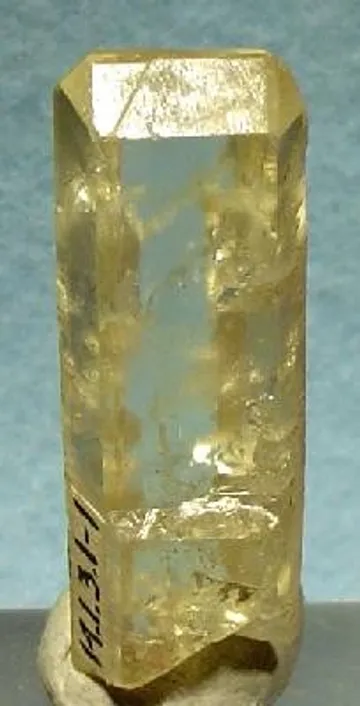
Barite from the Příbram district belongs to the classic European vein suite and occurs in more than one generation, from older thick tabular crystals commonly yellowish, grey-yellow, pale blue or pinkish and sometimes crusted by dolomite, calcite or pyrite, to younger transparent prismatic crystals of yellow or bluish color. In the Jánská vein, barite appears as veinlets of tabular grains and imperfect tabular crystals to about 1 cm in cavities, associated with uraninite and base-metal minerals on the shallow levels, with a rarer younger generation accompanying silver ores and uranium mineralization. Strong Central Bohemian barite specimens have color, tabular form and true Příbram associations—pyrite dusting, calcite crusts, galena-sphalerite ore or pyromorphite in vugs—whereas massive white baryte without label detail is far less compelling.
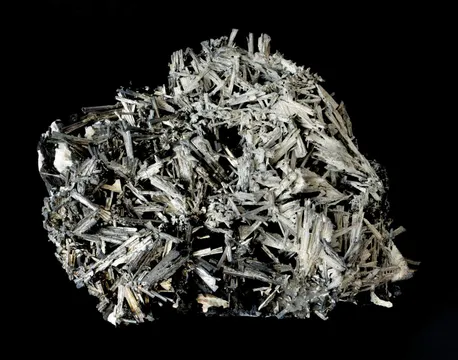
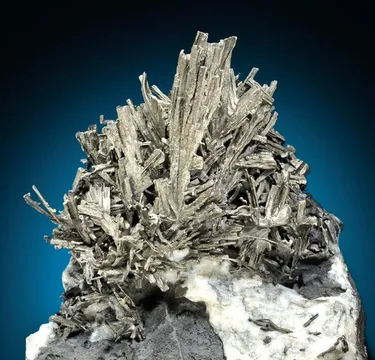
Native silver from Central Bohemia is most prized from the Příbram uranium and base-metal district, especially as grey to silvery pseudomorphs after dyscrasite or pyrargyrite from mines such as No. 7 at Třebsko and No. 21 near Háje/Dubno, as well as arborescent or wirelike aggregates on calcite-rich matrix. The celebrated 1980s material shows silver replacing earlier Ag-Sb minerals while preserving blade, fan, spike or stout prismatic forms; such specimens are important because they bridge mineralogy and morphology, letting the collector read both the vanished precursor and the native silver replacement. Good examples show complete, sharp pseudomorphic form, three-dimensional spray or fan structure, minimal breakage and a matrix that fixes the Příbram uranium-district setting; ordinary silver is massive, tarnished and shapeless.
Baryte—the same mineral commonly spelled barite in American usage—is one of the most characteristic late gangue minerals of the Příbram veins and is worth treating under its European name because so many older Bohemian labels use that spelling. The district’s baryte ranges from thick rectangular tablets to later clearer prismatic crystals, with colors reported from grey and yellowish tones to pale blue and pink; it sits in the paragenesis among dolomite, calcite, pyrite, galena, sphalerite and silver minerals rather than as the isolated desert-rose-style baryte familiar from other localities. Superior Central Bohemian baryte pieces are old, mine-specific, color-noted and crystallized, ideally with secondary pyromorphite or classic sulfide associations; a baryte label reading only “Bohemia” or “Pribram” should be treated as incomplete until the specimen’s style and provenance support it.
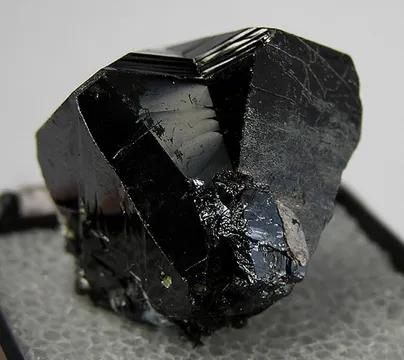
Sphalerite is one of the foundation ore minerals of the Central Bohemian Ag-Pb-Zn veins, appearing early in the Příbram paragenesis and recurring in uranium-district base-metal stages. Příbram sphalerite is commonly black to dark brown, massive to sharply crystallized, and associated with galena, quartz, siderite, calcite, pyrite, baryte and chalcopyrite; some specimens show flat bands of massive sphalerite with small lustrous galena crystals and hyaline quartz, while others carry tetrahedral or twinned sphalerite crystals with white lenticular calcite and pyrite. Good examples combine glassy luster, visible crystal form, dark contrast and a lively matrix; ordinary ore specimens are compact black bands with little relief, valuable more for locality representation than display.
Galena from Central Bohemia is most collectible from Příbram, where it occurs both as a major ore mineral and as small but brilliant crystals in quartz-carbonate-sphalerite assemblages. The old name “steinmannite” is historically tied to Příbram-style octahedral to cuboctahedral galena with rounded or modified forms, and although not a valid species name, it remains useful collector shorthand when clearly explained on a label. Fine pieces show bright metallic galena crystals—commonly millimetric but locally approaching centimeter scale—on dark sphalerite, quartz, siderite, calcite or pyrite; the best have crisp modified octahedra, undamaged faces and strong contrast, whereas massive cleavable galena in ore is common and much less aesthetic.
Pyrargyrite is one of the classic Příbram silver sulfosalts, historically abundant enough in selected upper and silver-rich zones to place Březové Hory among Europe’s great localities for red silver minerals. It occurs as dark red to nearly black crystals and aggregates with proustite, pyrostilpnite, polybasite, pyrite, galena, sphalerite, siderite, quartz and calcite, and the Jánská vein literature records uraninite locally intergrown with pyrargyrite or proustite where the Jánská vein and its upper branch meet. The best Central Bohemian pyrargyrites are sharp, lustrous, visibly red on edges or in transmitted light, and safely protected in matrix cavities; many attractive “silver after pyrargyrite” pieces preserve stout crystal forms but should be labeled as pseudomorphs rather than primary pyrargyrite.
Pyromorphite is a secondary lead phosphate of the Příbram oxidation sequence and was counted by early mineralogists among the more frequent gossan minerals of the district, often grouped historically with campylite and other oxidized lead species. At Příbram it is typically a small-crystal mineral rather than a large-cabinet centerpiece, occurring as green to dull green needle-like or barrelly crystals in vugs, on baryte or oxidized galena-bearing matrix, and with other late secondary minerals of the old Ag-Pb-Zn workings. The most desirable examples are sharply crystallized, bright green and securely perched in open cavities on a recognizable baryte, calcite or galena matrix; dull crusts or powdery coatings are far less significant unless they come with old provenance.
Dyscrasite is one of the great Central Bohemian collector minerals, especially from the Příbram uranium district, where it occurs as metallic grey orthorhombic crystals, blades, columnar groups and aggregates with native arsenic, stibarsen, calcite and other Ag-Sb-As assemblages. Háje, Dubno, Třebsko and related uranium-district shafts are known for unusually good dyscrasite and for native silver pseudomorphs after dyscrasite; Brod has also been cited for granular dyscrasite aggregates in siderite-calcite gangue. The finest pieces show distinct, unreplaced or partly replaced metallic crystals with sharp terminations or sculptural sprays, while the silver pseudomorphs are judged by how faithfully they preserve dyscrasite’s bladed or prismatic architecture.
Dolomite is a recurrent carbonate in the Příbram paragenesis and a useful association mineral for identifying the classic Březové Hory and Bohutín vein suite. It appears as crusts on older baryte, as later carbonate generations following calcite and siderite, and in uranium-district vein assemblages with siderite, calcite, quartz, baryte, galena and sphalerite. Collector-grade Central Bohemian dolomite is generally valued as a matrix or association mineral—pale rhombs or crusts setting off baryte tablets, pyrite, galena or sphalerite—rather than as large freestanding dolomite crystals; good pieces show clean rhombohedral sparkle and clear paragenetic placement, while ordinary dolomite is visually subordinate.
Goethite from the Příbram district is historically notable as “velvet ore,” a fibrous to spherulitic iron oxide-hydroxide product that appears in the oxidized part of the paragenesis and was recorded even from surprisingly deep mine levels. It forms dark brown to black velvety coatings, spherules, botryoidal masses and earthy oxidation products with calcite, pyrite, manganese oxides and altered sulfide ore, especially where earlier pyrite, siderite or other iron-bearing minerals were attacked by later fluids or weathering. Fine specimens have a silky velvet surface, botryoidal relief and clear association with Příbram matrix; common brown iron coatings are abundant and only become collectible when they are lustrous, textural and well labeled.
Bournonite is a classic Příbram sulfosalt, recorded from the Ag-Pb-Zn veins as tabular twinned crystals and massive grey ore in association with siderite, calcite, sphalerite, pyrite, quartz, galena and rhodochrosite. Old collector descriptions emphasize bright silvery-grey “cog-wheel” twins to a few millimeters on matrix, and museum specimens include massive grey bournonite with siderite layers and calcite crystals from the Příbram district. The best Central Bohemian bournonite is sharply twinned, metallic, visibly crystallized and in association with dark sphalerite, pyrite or pale carbonates; massive bournonite-rich ore can be important historically but lacks the display appeal of crisp cog-wheel crystals.
Beyond the listed species, Central Bohemia is exceptionally rich in rare and type-locality minerals. Příbram is tied to diaphorite, historically described from the district, and to modern uranium-selenium mineralogy including příbramite, bytízite, kristekite and members of the hakite series from Bytíz and related mine dumps. The broader Příbram district also records uraninite, coffinite, native arsenic, stibarsen, proustite, pyrostilpnite, miargyrite, stephanite, polybasite, boulangerite, jamesonite, stibnite, wurtzite, chalcopyrite, arsenopyrite, millerite, witherite, cerussite, wulfenite, mimetite and many secondary U-bearing species. Kutná Hora contributes a different suite of Central Bohemian rarities, especially bukovskýite, kaňkite, zýkaite, parascorodite and other hydrated arsenates from Kaňk and nearby medieval waste-rock environments.
The first authenticity issue with Central Bohemian specimens is label precision. “Příbram,” “Bohemia,” “Central Bohemia” and “Czech Republic” all appear on labels, but they are not equivalent. A Březové Hory base-metal specimen, a Bohutín stibnite-bearing specimen, a Vrančice silver-copper specimen, a Třebsko dyscrasite-silver pseudomorph and a Bytíz uraninite-selenide specimen are geologically related but not interchangeable. Better labels name the mine, shaft number, vein, level or dump; older labels may use German names such as Birkenberg for Březové Hory or Adalbert for Vojtěch.
The second issue is nomenclature. “Steinmannite” should be treated as a historical or varietal label for Příbram-style galena, not as a valid species. “Silver after dyscrasite” and “silver after pyrargyrite” should be sold as pseudomorphs, not as dyscrasite or pyrargyrite unless the precursor remains. Likewise, “allemontite” on old Bohemian labels may refer to intimate mixtures involving arsenic and antimony rather than a clean modern species assignment. Many rare selenides and uranium secondaries require analytical confirmation; color alone is not enough.
Radioactive material from the Příbram uranium district deserves disciplined handling. Botryoidal or massive uraninite in calcite can be quite active, and fine secondary uranium minerals may be powdery, fragile or soluble enough that casual cleaning is a bad idea. Store such specimens in closed, labeled boxes with good ventilation practice, keep dust controlled, avoid sleeping or working for long periods next to high-activity pieces, and wash hands after handling. Do not acid-clean calcite-uraninite specimens: the calcite may be the structural matrix and may also host the very associations that give the specimen its identity.
Condition problems are common and locality-specific. Calcite cleaves and bruises easily; slender silver pseudomorphs after dyscrasite or pyrargyrite break at crystal junctions; dyscrasite blades can be brittle; pyromorphite and arsenate coatings from Kutná Hora can be soft or powdery; and old sulfide-rich Příbram ore can carry oxidation films that collectors should not automatically “improve.” Many Příbram specimens were trimmed from dense vein material, so sawn or broken backs are normal, but the display face should show intact crystals and undisturbed associations.
The market is steady but uneven. Common calcite, siderite, pyrite, sphalerite and galena combinations from Příbram appear regularly, especially as thumbnails to small cabinet specimens. Sharp bournonite, good pyrargyrite, unreplaced dyscrasite, old Březové Hory sulfosalts with historic labels, and aesthetic native silver pseudomorphs are much scarcer and command strong prices. Fine uranium-district rarities are often bought by systematic collectors before they become broadly visible, and the best material with mine number, shaft, vein or analytical documentation is increasingly hard to replace.
In July 1875, the Vojtěch Mine at Březové Hory entered mining history by reaching a vertical depth of 1,000 m. The achievement was not simply a local milestone but a symbol of Příbram’s 19th-century technical confidence: steam power, cable hoisting, drainage and deep-vein mining pushed a Central Bohemian silver-lead district into the front rank of world mining. The museum at the Vojtěch shaft still treats that moment as a central episode, and for collectors it gives extra force to labels reading Vojtěch or Adalbert Mine. A siderite, galena, bournonite or boulangerite specimen from those workings is not just an ore sample; it is a fragment from a district that made depth itself part of its reputation.
The darkest story is the Marie Mine disaster of 31 May 1892. A fire broke out in the Marie shaft at Březové Hory during the afternoon shift, and smoke and toxic gases spread through connected workings of the ore district. Of the miners underground, 319 died. Contemporary and later accounts describe hastily dug mass graves, the shock of Březové Hory and Příbram under mourning, and the enormous human aftermath: hundreds of widows and hundreds more children left fatherless. The disaster ended more than lives; it marked the psychological close of the district’s golden 19th-century confidence. For a collector holding an old Příbram specimen dated before 1892, the label belongs to that earlier world.
Kutná Hora tells a different kind of underground story. Its medieval silver mines were so central to Bohemian power that the city became the seat of the royal mint, where the Prague groschen was struck after the mining reforms of King Wenceslaus II. The modern Czech Museum of Silver leads visitors into medieval workings beneath the historic city, and the museum’s own account preserves a wonderful uncertainty: when the mine was rediscovered, the discoverers initially believed it might be the famous Osel, or Donkey, mine, long ranked among the richest and deepest of Kutná Hora. Whether or not that identification held, the episode captures the region perfectly—archival memory, collapsed workings, royal silver, and real stone passages crossing under a city built by ore.