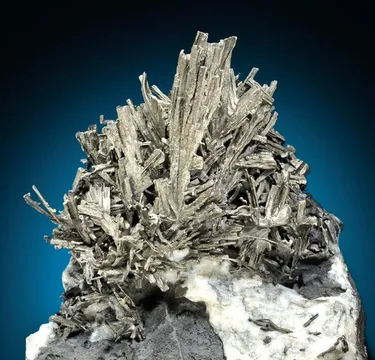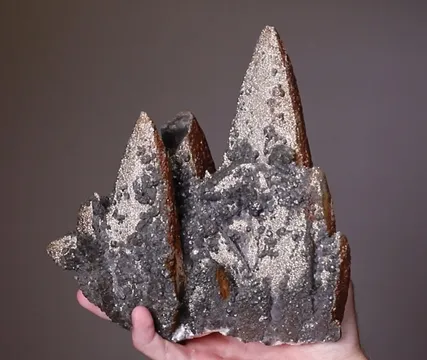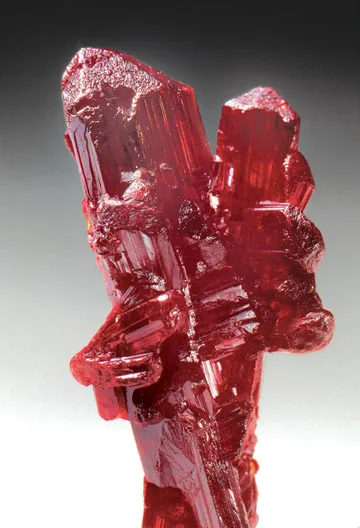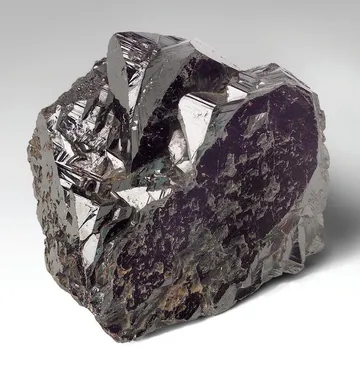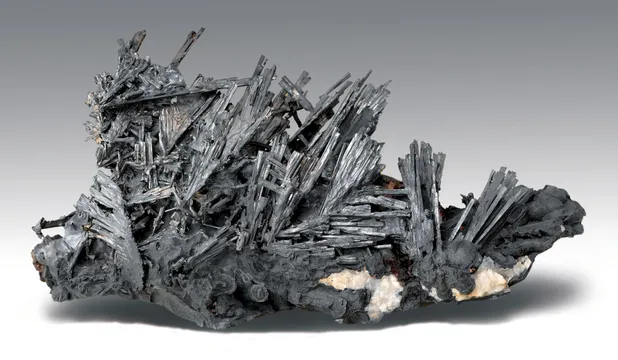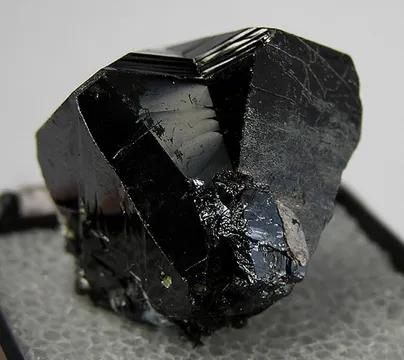
Ústí nad Labem Region - European mineral province famed for zeolite-lined vesicles, gemmy aragonite from Číčov, and notable localities such as Mariánská skála…
Key facts
The Ústí nad Labem Region is not a single-mine locality in the usual specimen-label sense; it is a whole North Bohemian mineral province where several classic European collecting stories overlap. To the south and east of Ústí nad Labem, the České středohoří volcanic field gives collectors zeolite-lined vesicles, salmon-pink natrolite, apophyllite, calcite, aragonite, and the old Bohemian pyrope-garnet gravels. Along the Krušné hory, the same administrative region reaches into one of Europe’s great mining belts, with medieval-to-modern tin, tungsten, fluorite, bismuth, silver, cobalt-nickel-arsenic, and lithium-bearing greisen and vein systems at Krupka, Cínovec, and Moldava. For specimens, the region’s signature “look” is divided between two extremes: lustrous, pale amber, chisel-terminated aragonite crystals from Číčov near Hořenec, and fine, cavity-grown zeolite/apophyllite pieces from the phonolitic body of Mariánská skála above the Elbe.
Regional View
Country View
For a serious collector, the region matters because its best-known minerals are not merely “Czech examples” of common species. The Číčov aragonites are a recognized world locality for individual gemmy aragonite crystals, including rough capable of producing unusually large cut stones. Mariánská skála, the old Marienberg of Aussig, is a classic European zeolite locality with old-time specimens in major museum collections. Krupka is one of the historically important tin districts of the Erzgebirge/Krušnohoří mining landscape, while Moldava and Cínovec add a modern mineralogical dimension through rare bismuth arsenates, complex sulfides, lithium mica greisens, cassiterite, wolframite, fluorite, and associated rare-metal minerals.

Photo: Phoenix CZE / Wikimedia Commons

Photo: Rob Lavinsky / Wikimedia Commons
The best cabinet specimens from the region tend to be small but highly characterful. Hořenec aragonite rewards the collector who values crystal form, transparency, and history over bulk; the finest pieces are sharp, glassy, honey-yellow to pale wine-yellow single crystals, often thumbnail to small-miniature size, with chisel-like orthorhombic terminations. Mariánská skála material is more architectural: vugs in grey phonolitic rock lined with dense nests of fragile pink, white, or reddish natrolite needles, commonly carrying calcite or apophyllite. The Ore Mountain specimens are usually less showy in a cabinet sense but more mineralogically dense: fluorite and baryte, cassiterite and wolframite, bismuth minerals, and micromount rarities from old adits and dumps.
Search for specimens: View all specimens from Ústí nad Labem Region, Czech Republic
The region covers the meeting of several geological worlds. The České středohoří part is an alkaline volcanic province of basaltic to phonolitic bodies, diatremes, lava flows, volcaniclastic rocks, and laccoliths set into older sedimentary and crystalline basement. These volcanic rocks are responsible for the region’s famous zeolite and carbonate cavity minerals. At Mariánská skála in the city of Ústí nad Labem, the quarried body is described as natrolite-bearing sodalite phonolite, more precisely a sodalite-natrolitic trachyte in local Czech descriptions. Cavity minerals formed in gas cavities and fractures as late hydrothermal to low-temperature alteration products; natrolite is exceptionally abundant there, and fine specimens show it as delicate needles lining vugs, with later apophyllite and calcite perched on the natrolite.
Číčov, near Hořenec in the Louny District, is a very different volcanic specimen environment. The Číčov-Dlouhá ridge consists of olivine nephelinite, nephelinitic basanite, and associated volcanic clastics. Its famous “Hořenec-type” aragonite formed under low-temperature, near-surface conditions during alteration and autohydration of calcareous basaltic volcanic rocks. The collectible material occurs as individual crystals and crystal fragments in cavities, fissures, and weathered material derived from the volcanic body. The characteristic specimens are transparent to translucent, colorless to honey-yellow, wine-yellow, or rarely faintly violet, and the most desirable examples preserve crisp terminations rather than rounded, frosted, or etched surfaces.
The Krušné hory belt in the northern part of the region belongs to the Saxo-Thuringian segment of the Bohemian Massif and carries the old Erzgebirge/Krušnohoří ore systems. Krupka is a classic tin district, with cassiterite-bearing greisen and vein mineralization, plus later and associated tungsten, copper, bismuth, molybdenum, potash feldspar, and fluorite mining. The Starý Martin adit follows the Lukáš tin-bearing vein, a flat lode reported at roughly 15–50 cm thick and traceable for about 2 km, making it one of Central Europe’s longest tin ore veins. The greisen systems of Krupka and Cínovec are products of late Variscan rare-metal granites and fluorine-lithium-rich hydrothermal fluids; their principal collectible and ore minerals include quartz, zinnwaldite, topaz, fluorite, cassiterite, wolframite, scheelite, and accessory Nb-Ta-Ti minerals, with complex sulfides and bismuth phases in later overprints.
Cínovec, on the Czech-German border, is one of the best-known Li-Sn-W greisen-type deposits in Europe. The mineralization occurs both as pervasive greisen in a cupola-shaped granite system and as quartz-zinnwaldite veins. Historically, the high-grade tin and tungsten veins in the upper part of the cupola were mined; modern geological interest focuses strongly on lithium hosted largely by zinnwaldite mica. Mining of tin and tungsten ores at Cínovec ended in 1990, but the deposit remains heavily studied because of its lithium, tin, tungsten, rubidium, scandium, and rare-metal potential.
Moldava, near Teplice, represents another side of the Ore Mountain suite: a Mesozoic fluorite vein deposit associated with faults and notable for a Bi-Ag-As-Co-Ni mineral association. For collectors it is especially important as the type locality of tetrarooseveltite, Bi(AsO4), and as a source of rare bismuth arsenates and related secondary species. Much of the collectable material from Moldava is dump or old-mine material rather than active-production ore, and the best specimens are generally micromount-scale or small hand specimens requiring magnification and analytical confirmation.
Mining history in the region reaches from medieval tin washing and adit driving to modern quarrying and rare-metal exploration. Krupka’s tin district has about 800 years of mining history and is part of the Erzgebirge/Krušnohoří UNESCO World Heritage mining landscape. Tin was mined there by surface pits, shallow shafts, openworks, and adits from medieval times through the 20th century. In the Starý Martin sector, Lewald and Schiller purchased the mines in 1864 and began driving the adit; by 1868 it had reached 227 m. Military administration later enlarged the adit profile and installed rails in 1916, the rights passed to Škoda Works the same year, and Hugo Mautner became owner in 1919. Production stopped in 1923, although maintenance and later wartime tungsten exploration continued. The adit was finally closed in the late 1960s, reconstructed in 1999–2000, and opened to the public on September 15, 2000.
Mariánská skála has been quarried for building stone since the late 19th century, and quarrying transformed an old city landmark into a world-famous mineral locality. Its most celebrated specimen-producing period was the 1940s, when abundant cavities produced natrolite and associated minerals now represented in major European museums. The Ústí nad Labem museum records nearly 730 geological specimens from the site in its holdings. The locality remains an active quarry environment, so collecting is not a casual field trip; access requires permission from the operator, and old specimen material is normally encountered through collections, trades, and the market.
Current collecting access varies sharply across the region. Číčov is a protected nature reserve, declared in 1951, and mineral collecting or digging on the hill is prohibited. Some Czech dealers note that only material from adjacent fields, where legal and with landowner permission, is collectable; in any case the reserve itself is off limits. The site is protected not only for aragonite but also for steppe flora and fauna, including the Czech pasqueflower population on its slopes. Mariánská skála is an operating quarry. Krupka’s Starý Martin adit is a public show mine and mining-heritage site, not a collecting ground. Old dumps around historical Ore Mountain localities can be tempting, but permission, safety, heritage protection, and local conservation rules must be settled before any visit.
The most important documented specimen episodes are the 1990–1995 development work at Číčov, which yielded loose gemmy aragonite crystals to record sizes, and the older productive quarry period at Mariánská skála, particularly the 1940s. For collectors today, these two histories shape the market: Číčov aragonite is still seen as loose crystals or mounted miniatures, often from older finds or field-edge recoveries, while fine Mariánská skála natrolite/apophyllite/calcite pieces are mostly old collection material. Ore Mountain rarities from Krupka, Moldava, and Cínovec circulate more often as micromounts, analytical study pieces, or historical mine specimens than as large showy cabinet pieces.
Aragonite is the collector mineral for which the Ústí nad Labem Region is most instantly recognized, above all from Číčov hill near Hořenec. The classic crystals are individual orthorhombic prisms, commonly chisel-terminated, transparent to translucent, and colorless, pale amber, honey-yellow, wine-yellow, or rarely faintly violet; good thumbnails may run from a few millimeters to several centimeters, with documented specimen crystals around 4 cm and gem-quality portions of larger crystals capable of yielding unusually large faceted stones. They occur in and around altered volcanic rocks and weathered material on the Číčov slopes, associated in the locality record with calcite, gypsum, opal, pyrite, quartz, and chalcedony. The best pieces from here are not big “sputnik” clusters but clean, bright, glassy single crystals with intact edges, sharp terminations, and enough body color to glow without losing transparency; ordinary examples are more rounded, frosted, cleaved, incomplete, or iron-stained, and modern labels should distinguish protected-reserve material from legally recovered older or field-collected specimens.
Other minerals from the region make a much broader and more technical list. Mariánská skála is classic for natrolite, fluorapophyllite-(K), calcite, analcime, thomsonite, opal var. hyalite, and microscopic hibschite, an old hydrogrossular name first recorded from this very locality by Felix Cornu and named for Josef Emanuel Hibsch. Krupka contributes cassiterite, wolframite, fluorite, baryte, molybdenite, bismuthinite, aikinite, and kettnerite, CaBiCO3OF, the latter described from the Barbora adit in the Knöttel area as small brown to yellow plates. Moldava is the type locality for tetrarooseveltite, Bi(AsO4), and has produced rare bismuth arsenates, selenides, fluorite, quartz, acanthite, and associated Ag-Bi-Co-Ni-As species. Cínovec is essential for collectors of rare-metal granites and greisens: quartz, zinnwaldite, cassiterite, wolframite, scheelite, topaz, fluorite, columbite-group minerals, ixiolite, sulfides, and bismuth phases all belong to its mineralogical story. The southern slopes of the České středohoří add Bohemian pyrope from the Třebenice–Měrunice–Podsedice area, historically one of the great gem materials of Bohemia.
The first authenticity issue with Ústí nad Labem Region specimens is locality precision. “Ústí Region,” “Aussig,” “Bilin,” “Horenec,” “Spitzberg,” “Číčov,” “Marienberg,” and “Mariánská skála” all appear on old labels, and they do not mean the same thing. Fine aragonite should be labeled Číčov hill, Hořenec, Libčeves, Louny District, not merely “Ústí.” Old zeolite specimens labeled “Aussig” or “Marienberg” commonly refer to Mariánská skála in Ústí nad Labem, but some broader old labels may simply indicate the district or historical export center. For Ore Mountain minerals, Krupka, Cínovec, Moldava, and Vejprty-type labels should be kept distinct; a vague “Erzgebirge” label may cross the modern Czech-German border.
There is no well-documented commercial tradition of fabricated Číčov aragonite comparable to some altered aragonite cluster localities, but there are real condition and presentation concerns. Aragonite is relatively soft, has imperfect cleavage, reacts with acid, and can be etched or dulled by aggressive cleaning. Some modern market examples from Číčov are naturally rounded or etched; dealers have specifically contrasted sharp old-style pieces with rounded newer material. Avoid specimens whose luster looks artificially “polished,” whose broken base has been ground flat without disclosure, or whose color and shine seem inconsistent with the rest of the crystal. A loupe should show natural growth faces and edges, not waxy coatings or re-cut surfaces.
Hořenec aragonite is often sold as loose crystals in small boxes or membrane frames. That is normal for the locality: many crystals occur detached or are recovered from weathered ground rather than as matrix pieces. Matrix aragonites from Číčov are scarcer and should be scrutinized for glue, reconstructed associations, or artificially planted crystals, especially if the matrix relationship looks too theatrical. Because aragonite and calcite are both CaCO3, a simple acid reaction does not separate them; habit, density, optical properties, Raman, XRD, or experienced comparison with known Číčov material are better tools.
Mariánská skála zeolite specimens are fragile. Natrolite needles break readily, calcite edges chip, and apophyllite can lose corner sharpness in careless storage. Old pieces may carry quarry dust in needle aggregates; over-cleaning is more damaging than a little matrix dust. Keep these specimens dry and stable, and avoid ultrasonic cleaners. The best specimens show undisturbed vug linings with intact salmon-pink or white natrolite and well-situated secondary crystals; poorly handled pieces look bald, brushed, or crushed inside the cavity.
Micromount rarities from Krupka, Moldava, and Cínovec require analytical humility. Kettnerite, tetrarooseveltite, neustädtelite, Ag-sulfosalts, and secondary arsenates can be visually misleading. A serious label should include the exact mine, adit, vein, dump, or district, and analytical confirmation is valuable for anything sold as a rare species rather than as an association. For Moldava in particular, bismuth arsenates may occur as small grains or coatings with fluorite and quartz, and visual identification alone is not enough for high-value claims.
Market availability is uneven. Small Číčov aragonite crystals remain obtainable, including modest pieces in Czech dealer stock, but sharp, transparent, large, undamaged crystals are not common and have a strong classic-locality premium. Fine Mariánská skála zeolite cabinet specimens are much less frequently available and tend to come from old collections. Krupka and Moldava rarities appear mostly through specialist micromount circles, Czech and German collectors, and occasional dealer parcels. Bohemian pyrope from the wider České středohoří is plentiful as gem material, but well-documented mineral specimens and historical gravel-suite examples are more specialized.
Číčov is the kind of locality where the collector’s eye and the conservationist’s eye collide. The hill is small, bare, and conspicuous above Hořenec, a volcanic mound whose fame rests on crystals that can fit in a matchbox. In the ground they do not announce themselves like a vein wall underground; they appear as pale yellow to nearly colorless flashes in weathered volcanic debris. One Wikimedia photograph from 2019 shows the experience in miniature: a single pale aragonite crystal lying among soil grains, plant stems, and rusty dark volcanic fragments. That is the romance of Hořenec aragonite — not tonnage, but the possibility of a transparent, perfectly shaped crystal emerging from an otherwise ordinary patch of earth.
The same smallness is what made Číčov vulnerable. The hill has been protected as a nature reserve since 1951, and Czech geological and nature-protection sources explicitly treat collecting as a conflict at the site. The reserve is valued both for “Hořenec-type” aragonite and for dry steppe vegetation; Czech pasqueflowers form part of the protected botanical character of the slope. Reports describe collectors digging holes on the aragonite-bearing slopes, and local guidance now states plainly that collecting and extraction on the hill are prohibited. The result is a locality with an unusually sharp ethical boundary: a collector may admire the history, own old or legally obtained specimens, and study the material, but the hill itself is no longer a digging ground.
One of the more telling modern episodes came in 2019, when Czech press reported damage by an illegal searcher who drove an off-road vehicle into the world-famous aragonite site in the České středohoří protected landscape area. The story matters to collectors because it shows how quickly a classic locality can become a policing and conservation problem. The aragonite that made Číčov famous is exactly what makes careless collecting conspicuous there: new pits scar a protected steppe hillside, and the mineralogical value cannot be separated from the damage left behind.
Mariánská skála tells a different story: a mineral locality born from industrial cutting into a city landmark. The rock rises above Ústí nad Labem, close enough to the center that it is not a romantic remote quarry but part of the urban landscape. A chapel built in thanksgiving for the end of a plague epidemic stood on the summit from 1680 until 1976. Beneath and within the same hill are unfinished air-raid shelter passages driven during the German occupation. At the end of the 19th century quarrying for building stone opened the interior of the phonolitic body, and those cuts revealed the cavities that made Marienberg specimens famous. By the 1940s the locality was in its glory years, producing natrolite, apophyllite, calcite, and other cavity minerals that entered the cabinets of Europe.
Krupka’s Starý Martin adit brings the old mining world into almost tangible scale. The adit follows the Lukáš tin vein, a flat lode only about 15–50 cm thick in places but traceable for roughly 2 km. For much of its early working life, miners attacked the deposit from the surface through pits and shallow workings; the Starý Martin adit itself was begun after Lewald and Schiller acquired the mines in 1864. Four years later the tunnel had reached 227 m. In 1916, under military administration, the profile was enlarged and rails were laid for mine carts. That same year the rights passed to Škoda Works in Plzeň, and by 1919, under Hugo Mautner, three stopes employed 120 miners. Production stopped in 1923, wartime exploration later chased tungsten for strategic reasons, and the adit finally closed in the late 1960s before reopening as a show mine in 2000. For a mineral collector, the story gives context to every Krupka label: these are not abstract greisen minerals, but products of a landscape where the same veins structured work, ownership, war needs, heritage preservation, and specimen collecting.