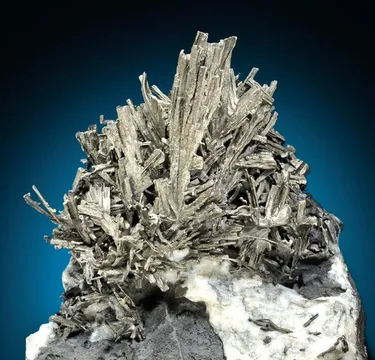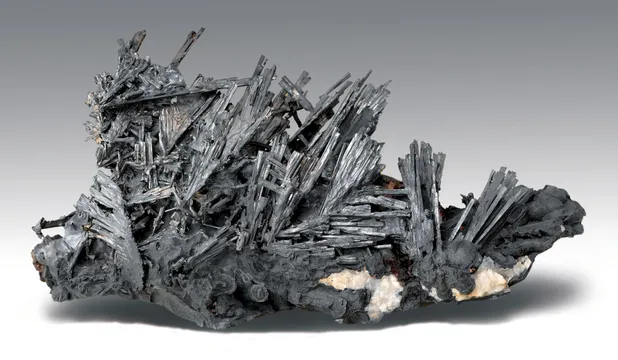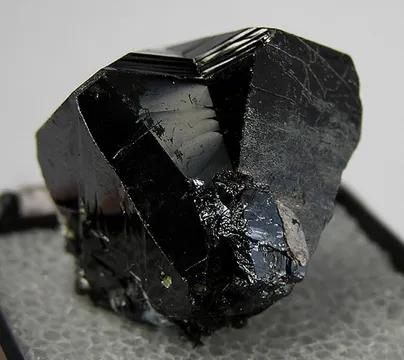
Háje, Czech Republic — dyscrasite-silver calcite and native silver from the Příbram district; a classic yet modern type-locality for Sb-rich minerals and micro…
Key facts
Háje, a small municipality just southeast of Příbram in Central Bohemia, is a deceptively large name on mineral labels. In specimen terms it points into one of the great European hydrothermal vein systems: the Příbram uranium and base-metal district, where carbonate veins cut strongly tectonized Neoproterozoic rocks along the exocontact of the Central Bohemian Plutonic Complex. The locality’s collecting fame rests especially on silver-antimony mineralization in the Háje vein node, where calcite-rich veins yielded dyscrasite, native silver, allargentum, Sb-rich arsenic, miargyrite, pyrargyrite, stibarsen and a suite of rare Pb-Sb-Ag sulphosalts. The best cabinet specimens have a look unlike ordinary “Příbram” ore: dense, tin-white to grey metallic dyscrasite blades and columns packed in pale calcite, spongy or wiry native silver replacing earlier dyscrasite, and compact silver-rich masses whose internal textures are a palimpsest of corrosion, replacement and late hydrothermal re-growth.
Regional View
Country View
The collector should read a Háje label with some geological nuance. Specimens may be marked simply “Háje,” “Příbram-Háje,” “shaft No. 16,” “shaft No. 21,” “Uranium Mine No. 21,” or, less helpfully, just “Příbram.” The important specimen-producing contexts include the Háje deposit and its H32A vein, the Háje vein node mined from shaft No. 21, and mine-dump material from shaft No. 16, which drew from the Háje, Bytíz and Jerusalem parts of the district. This explains why the locality is both a classic source of displayable dyscrasite-silver-calcite specimens and a modern type-locality cluster for microscopic selenides and tetrahedrite-group minerals.
Search for specimens: View all specimens from Háje, Czech Republic
Háje belongs to the Příbram uranium and base-metal district, a late- to post-Variscan hydrothermal vein system developed in a narrow, strongly tectonized belt at the contact between older sedimentary and volcanosedimentary rocks and the Central Bohemian Plutonic Complex. The host rocks in the Háje area include folded Neoproterozoic sandstones, siltstones and related units; the vein structures occupy faults, fractures and splays in a district-wide network where uranium, base-metal, silver-antimony, arsenide, selenide and carbonate stages overprinted one another. For collectors, the most productive mineralogical point is that these were not single-event veins. Earlier siderite-sulphide fillings were reopened, dissolved, brecciated and locally replaced by later calcite-sulphide and silver-antimony fluids, giving Háje specimens their characteristic intergrowths and pseudomorphs.
The Háje vein node lies in the central part of the Příbram uranium-base-metal district. Its structural position is controlled by the intersection of the Háje fault, the Dubenec fault and branches of the Kovářov and Petrovice tectonic zones, with anticline-folded Neoproterozoic sediments close to the plutonic exocontact. Principal veins in the node include Bt1, H24, H14, H14J, H14E, H29 and H30, and these are accompanied in the upper parts by many smaller splays, including H14F, H14F3, H64A, H61Z, H14P and H14I. It is on such dominantly calcite-bearing splays that the remarkable monometallic silver and Ag-Sb mineralization was developed.
The H14F3 vein, one of the best-documented specimen veins, was followed between the 7th and 9th levels of shaft No. 21. It strikes roughly 190–200° and dips steeply west-northwest, with a variable thickness from only about 1 cm to 30 cm, more commonly 5–10 cm. Around the 8th level the vein thickened locally to about 15 cm and was dominated by calcite containing macroscopic native silver and subordinate pyrargyrite. Around the 7th level the character changed: Sb-rich arsenic became abundant, dyscrasite appeared in extraordinary concentrations, and locally the dyscrasite made up a very large proportion of the vein filling. The published mining-block descriptions for H14F3 place the most intensively studied Ag mineralization between the 7th and 9th levels in blocks such as HD14F3-901, HD14F3-801 and HD14F3-701.
A second highly important Háje context is the H32A vein of the Háje deposit, worked from shaft No. 16. Modern study of H32A describes a Pb-Zn-Sb-Ag vein with a rich assemblage of 44 mineral phases formed during two major district-wide stages: siderite-sulphidic and calcite-sulphidic. The vein is carbonate-dominated, especially by siderite-rhodochrosite, with dolomite-ankerite-kutnohorite less frequent and calcite rarer in that specific H32A paragenesis. The ore assemblage is dominated by Ag-poor galena, with Fe-poor sphalerite, pyrrhotite, löllingite, arsenopyrite, sulphosalts, dyscrasite, native antimony and native arsenic as subordinate or accessory phases. Silver enrichment in H32A is tied particularly to late minute veinlets and inclusions of Ag minerals such as dyscrasite, especially in shallower parts of the Háje deposit.
Mining history at Háje is part of the postwar uranium chapter of Příbram. The broader uranium district was mined from 1948 to 1991, and the scale was immense: tens of kilometres of shafts, thousands of kilometres of horizontal workings, hundreds of kilometres of raises and chutes, and more than 2,500 hydrothermal veins exposed underground. Shaft No. 16 at Háje reached a depth of 1,838.4 m and is repeatedly cited as one of Europe’s deepest shafts in a single vertical length. After regular uranium mining ended in 1991, parts of the underground system connected with shaft No. 16 were adapted for the Háje underground gas storage facility, with construction beginning in the early 1990s and the storage complex subsequently becoming an unusual second life for a former uranium mine.
Collecting access today must be treated conservatively. The underground mines are closed industrial and post-mining workings, not collecting sites. Material on the market comes from old mine production, mine-dump collecting, research material, and specimens dispersed from Czech collections. Shaft No. 16 dump material is famous among micromineralogists and radioactive-mineral collectors, but such dumps are post-mining, regulated, potentially unstable and locally radioactive. Permission, land status and radiation safety are not formalities here; they are part of collecting responsibly at any uranium district.
The notable specimen finds cluster around very specific settings. H14F3 yielded the classic dyscrasite-calcite and silver-after-dyscrasite style pieces, with 7th-level material rich in dyscrasite, Sb-rich arsenic and calcite, and 8th-level material richer in native silver, Hg-bearing silver, allargentum and pyrargyrite. One documented preserved specimen from about 15 m below the 8th level was a free silver wire approximately 4 cm long, partly overgrown by small pyrrhotite crystals. H32A supplied a different flavor: Pb-Zn-Sb-Ag vein material rich in galena-sphalerite-carbonate textures and locally enriched in dyscrasite-bearing late silver veinlets. Shaft No. 16 dump material added the modern supergene and selenide story, including uranyl carbonates, arsenates and sulphates formed in dump conditions, plus microscopic type-locality selenides that would be invisible without polished sections and analytical work.
Calcite is the collector’s stage on many Háje specimens rather than the star by itself: in the H14F3 silver-antimony veins it is the commonest non-ore mineral, forming grey, white or faintly pink coarse-cleavable masses and vein fillings several centimetres thick, commonly enclosing or surrounding dyscrasite, native silver, Sb-rich arsenic, miargyrite, pyrargyrite and allargentum; published work notes that broad drusy cavities were not a feature of H14F3, so the better calcite specimens here are valued for sharp contrast and association, especially metallic dyscrasite or wiry silver standing in or against pale carbonate, while ordinary pieces are merely cleaved calcite veinstone with dispersed ore.
Dyscrasite is the great Háje species: confirmed, world-class material from the shaft No. 21 system occurs in H14F and especially H14F3, where 7th-level zones produced a wide morphological range from thin needles and plates to stout columnar crystals, average crystals around 1–2 cm and the longest thin columnar crystals reaching about 6 cm; the finest pieces show lustrous tin-white to lead-grey Ag3Sb crystals in calcite, commonly with Sb-rich arsenic coatings, native arsenic, stibarsen, native silver, allargentum and miargyrite, and the connoisseur looks for recognizable crystal form, minimal corrosion, good contrast in calcite, and clear survival of dyscrasite rather than complete replacement by younger silver or sulphosalts.
Native silver from Háje is most characteristic as wires, bush-like and spongy aggregates in calcite-rich Ag-Sb veins, particularly near the 8th level of H14F3 where late fluids dissolved and replaced earlier mineralization; much of the showy silver preserves, more or less clearly, the shapes of former dyscrasite crystals, and documented material includes aggregates to several centimetres and a free silver wire about 4 cm long from below the 8th level, while H32A is represented by rich wire silver with grey-white botryoidal calcite from the 1980s; top examples show three-dimensional wiry growth, bright fresh silver or attractive old patina, and an identifiable Háje/Příbram shaft or vein provenance rather than a vague “Bohemia” label.
Pyrite is a documented but secondary collecting interest at Háje, recorded from the H32A vein and from the shaft No. 16 and shaft No. 9 sublocalities, where it belongs to the broader sulphide-carbonate-uranium-base-metal environment rather than to the famous dyscrasite bonanzas; collectors should expect brassy FeS2 as accessory grains, small aggregates or sulphide-rich veinstone in association with calcite, sphalerite, galena, siderite, quartz and locally uranium-related assemblages, not the large freestanding cubes that define pyrite at other localities, so good Háje pyrite pieces are judged chiefly by fresh lustre, intact carbonate matrix, associated Příbram species and precise shaft or vein attribution.
Beyond the four collector-facing species above, Háje is a serious analytical locality. The H14F3 assemblage includes allargentum, miargyrite, pyrargyrite, freieslebenite, andorite, semseyite, stibnite, native antimony, Sb-rich arsenic, stibarsen, freibergite, löllingite, galena, sphalerite and pyrrhotite. H32A adds a broad Pb-Zn-Sb-Ag sulphosalt assemblage including bournonite, diaphorite, geocronite-jordanite series minerals, owyheeite, seligmannite, tetrahedrite-group species and the distinctive Sb-, Zn- and Pb-enriched chamosite. In the wider Háje municipality and shaft No. 16/No. 9 sublocalities, type-locality minerals and rarities include příbramite, bytízite, pošepnýite, hakite-(Cd), hakite-(Fe), hakite-(Zn), grimmite and hrabákite, along with liebigite, schröckingerite, uranospinite, metazeunerite, natrozippeite, schoepite, tyuyamunite, uranopilite and other secondary uranium minerals formed in mine-dump material.
Háje specimens are rarely simple, and labels matter. A dyscrasite-silver-calcite specimen may be accurately labelled “Háje,” “Příbram,” “Příbram-Háje,” “Uranium Mine No. 21,” “shaft No. 21,” “Dubno,” “shaft No. 16,” or “H32A,” depending on when it was collected and how the collector understood the sublocality. For high-value pieces, the best labels specify shaft and vein: H14F or H14F3 for many classic dyscrasite and silver-after-dyscrasite specimens, H32A for the Pb-Zn-Sb-Ag Háje vein material, and shaft No. 16 dump for many uranium-secondary and selenide microminerals. Vague “Příbram” labels are not automatically wrong, but they reduce scientific and market value.
The main authenticity issue is not a well-documented fake industry, but misidentification within a visually treacherous Ag-Sb assemblage. Dyscrasite, allargentum, Hg-bearing silver, native silver and some replacement textures can look deceptively similar in hand specimen. Native silver may preserve the habit of earlier dyscrasite, while miargyrite and pyrargyrite can pseudomorph dyscrasite as well. If a specimen is sold as true dyscrasite rather than “silver after dyscrasite,” a confident old label, analytical history, or at least careful visual support is important. For microminerals such as hakite-series species, příbramite, bytízite, pošepnýite, grimmite or hrabákite, visual identification alone is not enough.
Condition issues are typical of dense metallic minerals in carbonate veins. Dyscrasite can be corroded, bent, altered or partly replaced; native silver can be flattened, broken, etched loose from calcite, or darkly tarnished; calcite cleaves readily and may show saw cuts, acid etching or contact marks from extraction. Some silver specimens on the market have been intentionally freed from calcite by acid preparation. That can produce attractive wires, but it may also erase paragenetic context and loosen fragile aggregates. On intact pieces, preserve the calcite unless cleaning is essential.
Handling considerations are real. The silver-antimony-arsenic assemblages may include native arsenic, stibarsen, Sb-rich arsenic, arsenopyrite and other arsenic-bearing phases; avoid dust, avoid grinding, and wash hands after handling. Shaft No. 16 and related Háje uranium material may contain uraninite, uranium-bearing bitumen and bright secondary uranium minerals. Those specimens should be stored with ordinary radioactive-mineral discipline: labelled boxes, minimal handling, no bedroom display for hot pieces, good ventilation, and no acid cleaning or mechanical trimming without appropriate knowledge and monitoring. Liebigite and several uranyl minerals from the dumps may fluoresce green under ultraviolet light, but fluorescence should not be used casually as a species identification.
In today’s market, Háje dyscrasite remains one of the more obtainable world-class dyscrasite localities in small to medium specimens, but fine examples with clear crystal form, calcite contrast and exact vein provenance are much scarcer than massive or replacement-rich fragments. Native silver from Háje/Příbram appears periodically, especially as older Czech collection material, and attractive wires or pseudomorphs can still be found. Type-locality selenides are a different market entirely: they are mostly polished-section or micromount material, valuable to specialists because of provenance and analytical significance rather than visual display.
The most dramatic Háje story begins not with a pocket, but with depth. Shaft No. 16 at Háje reached 1,838.4 m below the surface, a staggering vertical number in a district already riddled by postwar uranium mining. The Příbram uranium workings as a whole exposed more than 2,500 hydrothermal veins. Over the 1948–1991 mining period the district accumulated an underground geography of shafts, levels, crosscuts and chutes on a scale difficult to imagine from the quiet fields and villages above. For collectors, that industrial scale is the reason such narrow mineralogical events could later become famous: without kilometres of development, a calcite vein only centimetres to decimetres thick might never have intersected a stope, a mine geologist’s notebook, or a collector’s tray.
The H14F3 vein tells the more intimate story. Between the 7th and 9th levels of shaft No. 21, miners and geologists followed a structure that could shrink to a centimetre and swell to a hand’s breadth or more. Around the 8th level it made a vein about 12 cm thick in which pale calcite held native silver and pyrargyrite, including silver that had eaten its way into the shapes of earlier dyscrasite. About 15 m below the 8th level, one remarkable specimen preserved a loose silver wire roughly 4 cm long, partly overgrown by tiny pyrrhotite crystals. Upward, near the 7th level, the vein changed personality: Sb-rich arsenic became the dominant ore in places, but in the most interesting pockets it retreated into thin coatings on dyscrasite. There the dyscrasite could be astonishingly rich, with varied crystals — needles, plates, stout columns — locally making up most of the visible vein filling.
That vertical change through a few mine levels is one of the keys to understanding Háje specimens. Around and above the 8th level, later hydrothermal fluids dissolved older Ag-Sb material and reprecipitated native silver, Hg-bearing silver, pyrargyrite and allargentum. Around the 7th level, the older Sb-rich arsenic and dyscrasite assemblage survived better, accompanied by regenerated miargyrite and rare Pb-Sb-Ag phases. The result is that two specimens from the same vein can look like different localities: one a spongy, wiry silver mass in calcite, the other a dense nest of metallic dyscrasite blades with arsenic skins and calcite seams.
The shaft No. 16 dump has its own quieter but scientifically potent afterlife. Dumped calcite-uraninite material sat exposed for decades, and in dry, locally alkaline microenvironments it produced recent or sub-recent uranium minerals. Liebigite from the dump, for example, formed yellowish-green coatings and tiny imperfect crystals in cavities of calcite-vein fragments, with a strong green fluorescence under both short- and long-wave ultraviolet light. What began as mine waste became a low-temperature chemical laboratory, growing uranyl carbonates, arsenates and sulphates while also preserving microscopic selenide assemblages that later yielded new mineral species.