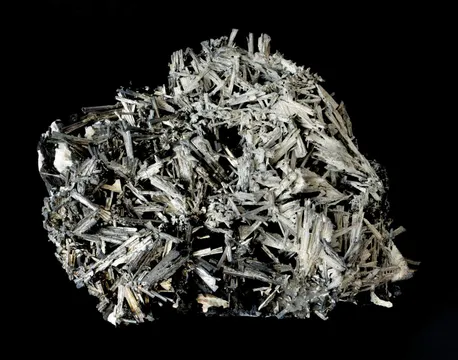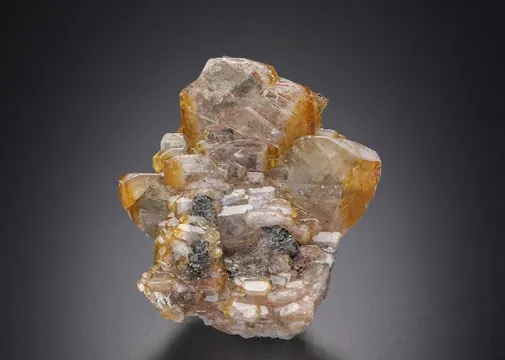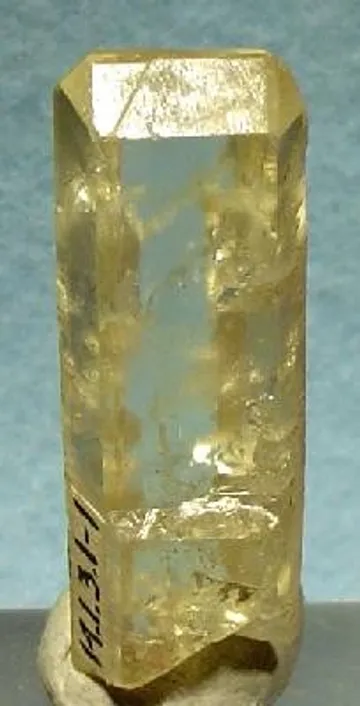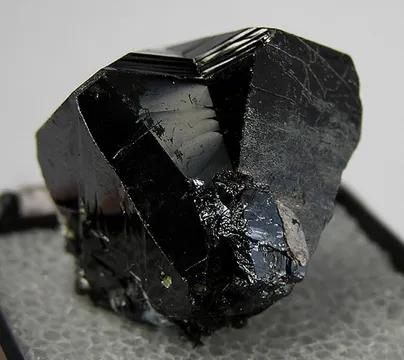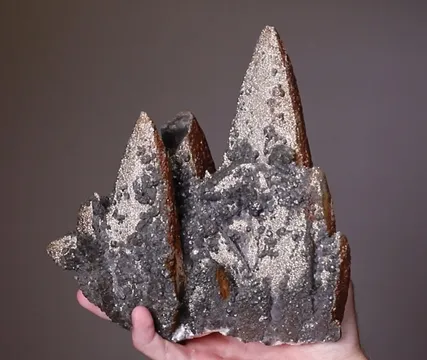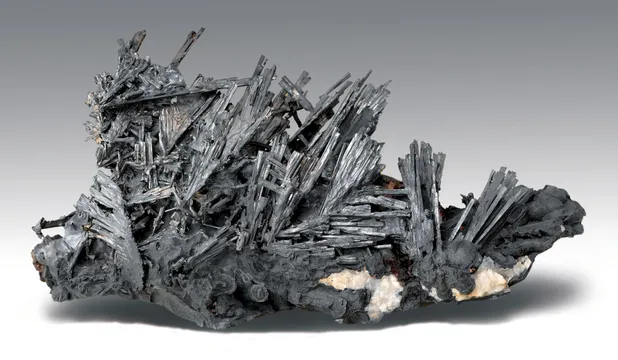
Uranium Mine No.21, Czech Republic - a Příbram locality famed for distinctive dyscrasite and native silver pseudomorphs in Ag-Sb-U veins, prized by collectors.
Key facts
Uranium Mine No.21 at Háje–Dubno in the Příbram District is a locality whose collector reputation is much larger than its footprint in the immense Příbram uranium-base-metal field. The broader district is one of the great hydrothermal uranium vein systems of Central Europe, developed in the Bohemian Massif and worked on an industrial scale during the second half of the twentieth century. Shaft 21 matters to collectors for a narrower, more spectacular reason: in its late Ag-Sb mineralization, especially on the H14F and H14F3 vein systems, it produced some of the most distinctive dyscrasite and native silver pseudomorph specimens known from Europe.
The best pieces have a look that is immediately Příbram: metallic, lead-gray to tin-white dyscrasite in blades, needles, flattened prisms, and columnar aggregates; native silver preserving the forms of earlier dyscrasite or pyrargyrite; dark arsenic-stibarsen masses; and contrasting white to gray calcite or siderite gangue. These are not broad alpine-style pockets with sparkling druses. They are specimens born from compact, chemically extreme carbonate veins, where silver, antimony, arsenic, mercury, lead, zinc, and uranium all left their signatures in small but intensely mineralized zones.
Regional View
Country View
For the serious collector, Uranium Mine No.21 sits at the intersection of two classic Příbram collecting traditions. One is the uranium-mining history of the district: deep shafts, enormous underground development, and the transformation of an old silver-lead mining region into one of the major uranium producers of postwar Europe. The other is the miniature world of silver-antimony minerals, where a few localized finds in the 1980s created cabinet specimens that now circulate mainly through old Czech collections, specialist dealers, and occasional market dispersals.

Photo: Wikimedia Commons

Photo: Wikimedia Commons
Search for specimens: View all specimens from Uranium Mine No.21, Czech Republic
Uranium Mine No.21, also recorded as Shaft No.21, belongs to the Háje part of the Příbram uranium and base-metal ore district in Central Bohemia. The district occupies a long, tectonically prepared belt of hydrothermal veins within the Bohemian Massif, close to the Central Bohemian Plutonic Complex and its surrounding metamorphosed and sedimentary rocks. The deposit type is best described as a hydrothermal vein uranium-base-metal system with late silver-antimony specialization. Uraninite and pitchblende define the uranium character of the district, while galena, sphalerite, pyrite, arsenopyrite, löllingite, carbonate gangue, and a remarkable late silver suite define the polymetallic overprint.
At district scale, Příbram was vast. Published geological work describes more than 2,500 exposed hydrothermal veins in the uranium-base-metal district, including more than 1,600 uranium-bearing veins, several dozen base-metal veins, and a much smaller group of silver-rich veins. This context is important: Shaft 21 is not famous because every vein in the mine was a specimen producer, but because a few Ag-Sb-rich structures in the Háje ore node produced superb, very localized pockets.
The collector-relevant veins are H14F, H14F3, and, for some silver-sulfosalt material, H61Z. The H14F3 vein was studied in detail between the 7th and 9th levels of Shaft 21, in mining blocks HD14F3-901, HD14F3-801, and HD14F3-701. Its mineralization is described as a unique monometallic to Ag-Sb-rich occurrence dominated in places by native silver, dyscrasite, allargentum, and Ag-Sb sulfides. Calcite and siderite are the principal gangue minerals in the studied H14F3 material, while galena, sphalerite, and löllingite occur more sparingly.
The paragenesis is more complicated than the hand specimens first suggest. Early arsenic-antimony-rich assemblages were overprinted by later hydrothermal solutions that dissolved and replaced parts of the primary mineralization. In the H14F3 material, the vertical zoning is especially significant. Around the 7th level, Sb-rich native arsenic with dyscrasite and regenerated miargyrite is prominent. Around and above the 8th level, richer native silver, mercury-bearing silver, pyrargyrite, and allargentum become more important. This is the key to understanding why some specimens from the mine are true dyscrasite, while others are native silver, miargyrite, or pyrargyrite preserving earlier dyscrasite-like forms.
Mining history at Příbram is long, but Uranium Mine No.21 belongs chiefly to the modern uranium era. The Příbram uranium operations developed after the Second World War and continued until the early 1990s at district level, with successive reorganizations of the state uranium-mining enterprises. The broader operation passed through names and structures including Jáchymovské doly and Uranové doly Příbram, and after the end of uranium extraction the successor structure became part of DIAMO. In total, the Příbram uranium district produced tens of thousands of tonnes of uranium along with lead, zinc, and silver, and it left a landscape of shafts, dumps, and mining infrastructure that remains one of the defining industrial legacies of Central Bohemia.
For specimens, the critical production interval is the late mining period. Preliminary exploration for silver ore on H14F and H14F3 between the 6th and 9th levels of Shaft 21 identified the monometallic Ag and Ag-Sb mineralization during the years 1980–1990. That is the era from which the most desirable dyscrasite, silver-after-dyscrasite, and silver-after-pyrargyrite material entered collections. Later collecting has not replaced those finds; it has mostly redistributed them.
Access today should be treated as closed-mine access, not a casual field-collecting opportunity. The underground workings are not available to collectors, and the important dyscrasite and native silver specimens should be considered mining-era pieces. The Příbram region still has a strong mining-museum and historical presence, but specimen acquisition is mainly through old labels, Czech collections, specialist dealers, auctions, and curated marketplace material. Labels that preserve “Shaft 21,” “Uranium Mine No.21,” “Háje,” “Dubno,” and where possible “H14F,” “H14F3,” or “H61Z” are materially better than a vague “Příbram” label.
Dyscrasite from Uranium Mine No.21 is the locality’s signature species and one of the classic European expressions of Ag3Sb. The best specimens occur as metallic gray to dark lead-gray blades, needles, flattened prisms, tabular crystals, and columnar aggregates, commonly in association with calcite, siderite, native arsenic, stibarsen or allemontite-like As-Sb material, allargentum, miargyrite, pyrargyrite, and native silver. Published work on the H14F3 vein emphasizes the morphological variety of the dyscrasite, from columnar forms through tabular crystals to thin prismatic crystals, and notes chemical zoning related to Ag/Sb and in some cases Sb/Hg variation. Collector pieces range from small thumbnails with millimeter-scale blades to miniatures with crystals around 1–2 cm; exceptional historical material reaches several centimeters, with the best Shaft 21 crystals prized for sharpness, separation, metallic luster, striation, and contrast against carbonate or dark arsenic-rich matrix. Ordinary pieces tend to be dense, bruised, dull, or visually confused with pseudomorphs; the top pieces have unmistakable sculptural architecture and a label precise enough to distinguish true dyscrasite from later silver-rich replacements.
Native silver from Uranium Mine No.21 is most admired where it records the replacement history of the Ag-Sb veins: wires and bush-like aggregates occur, but the famous collector material includes fan-like, bladed, columnar, or thick prismatic pseudomorphs after dyscrasite and, more rarely, after pyrargyrite. On the H14F3 vein, silver is especially characteristic around and above the 8th level, where later hydrothermal solutions dissolved earlier mineralization and produced rich native silver together with pyrargyrite and allargentum; the silver may carry measurable mercury and minor antimony, a chemical detail consistent with the complex late-stage fluid history. Good specimens show clearly recognizable crystal habits inherited from the replaced phase, bright to gray metallic luster, and enough matrix or carbonate contrast to read as mineral specimens rather than merely silver masses. The most desirable pieces are crisp pseudomorphs with obvious bladed or prismatic geometry, while lesser pieces are tangled, flattened, rubbed, or too massive to show the replacement texture.
Beyond dyscrasite and silver, Uranium Mine No.21 has an unusually rich silver-antimony-arsenic suite for a uranium mine. H14F3 has documented allargentum, miargyrite, pyrargyrite, freibergite-subgroup minerals, freieslebenite, andorite, semseyite, stibnite, native antimony, native arsenic, stibarsen, löllingite, galena, sphalerite, pyrrhotite, calcite, siderite, dolomite, and quartz. H61Z adds important silver-sulfosalt records including acanthite, proustite, pyrostilpnite, stephanite, xanthoconite, argentojarosite, and associated sulfides. The mine is rarity-rich rather than type-locality-driven: its importance rests on the quality of its Ag-Sb specimens, the unusually well-studied replacement textures, and the number of uncommon silver sulfosalts documented from a compact late-stage vein environment.
The first collector issue is locality precision. “Příbram” is not enough for a top dyscrasite or silver pseudomorph if a better label can be recovered. Příbram can mean the town, the historic Březové Hory base-metal district, the wider uranium-base-metal district, or any number of shafts and vein systems. A strong label for this material should ideally read Uranium Mine No.21 or Shaft 21, with Háje or Dubno, Příbram District, Central Bohemian Region, Czech Republic. The best technical labels go further and identify H14F, H14F3, or H61Z.
The second issue is identity. Dyscrasite, native silver pseudomorphs after dyscrasite, miargyrite after dyscrasite, pyrargyrite after dyscrasite, and mixed replacement material can look deceptively similar. Habit alone is not always enough. True dyscrasite tends to show metallic lead-gray blades or prisms, sometimes with strong striation and a denser, darker appearance. Silver pseudomorphs may preserve the same bladed or prismatic form but show a brighter silver surface, granular replacement texture, or more sparkling metallic skin. Where value depends on the distinction, old provenance, analytical confirmation, or at least a knowledgeable comparison with published material is important.
Condition is a major pricing factor. Dyscrasite is not a forgiving species in display specimens: thin blades and prismatic terminations chip, bend, snap, and lose luster easily. Many Shaft 21 pieces are old mining-era specimens that have passed through several hands, so edge bruising and broken blades are common. For silver pseudomorphs, look for intact form rather than just brightness; a dark or lightly patinated surface may be entirely natural and preferable to an aggressively cleaned, unnaturally bright piece.
Be cautious with cleaning. Carbonate gangue is part of the locality’s visual language, and acid work can remove useful contrast or destabilize delicate silver and dyscrasite forms. Native arsenic, stibarsen, antimony minerals, and uranium minerals require sensible handling: avoid dust, do not saw or grind without professional precautions, wash hands after handling, and store friable or arsenic-rich pieces in closed boxes. If uraninite or other uranium minerals are present, treat the specimen as a radioactive mineral specimen and store it with appropriate spacing, labeling, and radon-conscious practice.
Fluorescence is not the main reason collectors buy Shaft 21 material, but calcite gangue may fluoresce under longwave or shortwave ultraviolet light. This is a supporting feature, not a primary value driver. Dyscrasite and native silver themselves are valued for habit, luster, replacement texture, association, and provenance.
Market availability is limited but not imaginary. Small dyscrasites, compact silver pseudomorphs, and mixed Ag-Sb pieces appear periodically from Czech dealers, European show stock, auctions, and older private collections. Fine miniatures and cabinet-quality specimens with large, sharp, aesthetic dyscrasite crystals are much harder to obtain. Pieces with documented old labels, ex-collection history, and precise Shaft 21 vein information should command a premium over generic “Příbram” examples.
The most memorable story at Uranium Mine No.21 is not a single cavern of crystals, but a chemical drama played out over only a few levels of a working uranium mine. On H14F3, the geologists followed the vein between the 7th and 9th levels in blocks with the hard, functional names HD14F3-901, HD14F3-801, and HD14F3-701. The specimens that collectors now admire as sculptural dyscrasite or silver pseudomorphs came from this industrial geometry: numbered levels, numbered blocks, and narrow carbonate-rich ore structures in a mine whose chief purpose was never cabinet minerals.
The 7th and 8th levels tell different chapters of the same story. Around the 7th level, Sb-rich native arsenic, dyscrasite, and miargyrite record an older Ag-Sb-As assemblage. Lower in the system, later hydrothermal solutions became more destructive and more silver-rich. They dissolved primary dyscrasite and arsenic, then left behind native silver, mercury-bearing silver, pyrargyrite, and allargentum. That is why a Shaft 21 specimen can look like a dyscrasite blade but be silver, pyrargyrite, miargyrite, or a composite of several phases. The beauty of these specimens is inseparable from that replacement history: the crystal form survived even when the original mineral did not.
There is also a broader human backdrop that gives every Příbram uranium specimen weight. The Příbram Mining Museum describes the uranium district as one of the most important hydrothermal uranium deposits of Europe and the world, and the numbers are staggering: thousands of underground workings, more than 2,000 km of horizontal adits and crosscuts, and more than 48,000 tonnes of uranium produced from the district. After the communist takeover of February 1948, political prisoners were also forced into uranium work in the region. A specimen from Shaft 21 is therefore not merely a mineralogical object; it is a fragment of one of the defining industrial and political landscapes of twentieth-century Czech history.
The modern collecting story has its own afterlife. The famous dyscrasite material from Shaft 21 emerged during the final decades of mining and then largely disappeared into collections. When good pieces resurface, they often do so with the aura of closed-mine classics: old Czech labels, dealer annotations, ex-collections, and the repeated recognition that the mine will not produce another pocket. A fine Shaft 21 dyscrasite is not just “rare” in the abstract. It is rare because the geology was localized, the mine is closed, and the specimens that survived did so by being recognized and saved at the right moment.
Pavel Škácha, Jiří Sejkora, František Knížek, Vladimír Slepička, Jiří Litochleb, and Ivana Jebavá, “Výskyty unikátního monometalického stříbrného zrudnění na žíle H14F3 mezi 7. a 9. patrem šachty č. 21 Háje, příbramský uran-polymetalický revír (Česká republika),” Bulletin mineralogicko-petrologického oddělení Národního muzea v Praze, 20(2), 230–254, 2012 — The essential technical paper on H14F3, documenting dyscrasite, native silver, allargentum, Ag-Sb sulfosalts, vertical zoning, and replacement relationships at Shaft 21.
Full PDF of the H14F3 paper, National Museum, Prague — Direct access to the full article, including mineral descriptions, chemistry, and figures.
František Knížek, Jiří Litochleb, Jiří Sejkora, and Pavel Škácha, “Charakteristika výskytu Ag-mineralizace na žíle H61Z pod 6. patrem, šachta 21, příbramský uran-polymetalický revír,” Bulletin mineralogicko-petrologického oddělení Národního muzea v Praze, 14(1), 107–113, 2007 — Important record for Ag mineralization on H61Z below the 6th level of Shaft 21, including silver sulfides and sulfosalts.
Jan Laufek, Jiří Sejkora, and colleagues, “Pyrargyrite from the H61Z vein, shaft No.21, Háje ore deposit, Příbram uranium–base metals ore district,” Journal of Geosciences, 55, 161–167, 2010 — Crystallographic and mineralogical work tied to pyrargyrite from the H61Z vein at Shaft 21.
Proceedings of the Joint 5th Mineral Sciences in the Carpathians Conference and 3rd Central-European Mineralogical Conference, 2012 — Includes a concise conference treatment of Ag-Sb-Pb mineralization at H14F3 and comparison with the better-known H14F dyscrasite occurrence.
Mindat locality page: Uranium Mine No.21, Dubno, Příbram District, Central Bohemian Region, Czech Republic — Locality-level mineral list, commodity record, and references for Uranium Mine No.21.
Mindat sublocality page: Vein H14F3, Uranium Mine No.21 — Focused listing for the H14F3 vein and its Ag-Sb mineral assemblage.
National Museum page for the H14F3 monometallic silver mineralization paper — Best single source for the Shaft 21 H14F3 dyscrasite-silver assemblage.
Mindat: Uranium Mine No.21, Dubno — Quick reference for mineral species, locality hierarchy, and cited records.
Mindat: Vein H14F3, Uranium Mine No.21 — Focused sublocality entry for the vein most often cited in technical Ag-Sb studies.
Škácha et al. H14F3 paper PDF — Full technical article with mineral chemistry and paragenetic details.
Selenide mineralization in the Příbram uranium and base-metal district — Modern district-scale geological context for Příbram’s diverse late hydrothermal mineralization.
Uraninite, coffinite and ningyoite from vein-type uranium deposits of the Bohemian Massif — Useful broader context for Czech vein-type uranium deposits including Příbram.
Příbram Mining Museum: Uranium in Czech History — Historical and museum context for the Příbram uranium district and its human legacy.
History of the former Uranové doly Příbram — Detailed Czech-language overview of operators, reorganizations, production totals, and underground development.
Wikimedia Commons: Dyscrasite-lw57a.jpg — Photograph and label data for a Shaft 21 dyscrasite miniature.
Wikimedia Commons: Dyscrasite-Silver-d38a.jpg — Photograph and label data for a silver pseudomorph after dyscrasite from Příbram.
Wikimedia Commons: Dyscrasite-Stibarsen-158539.jpg — Photograph and label data for dyscrasite with stibarsen from Uranium Mine No.21.