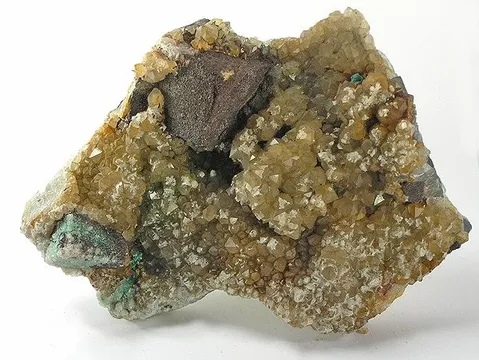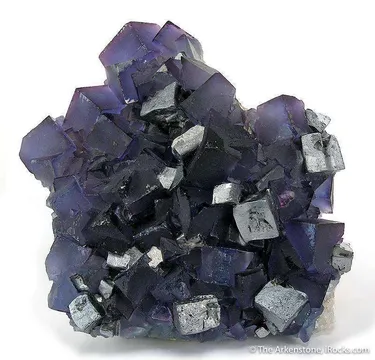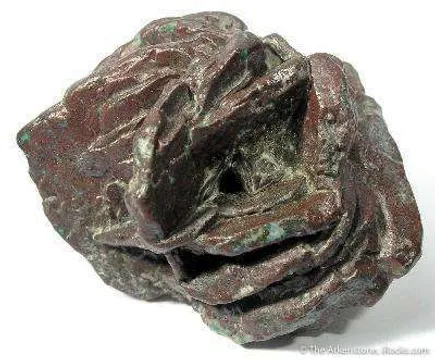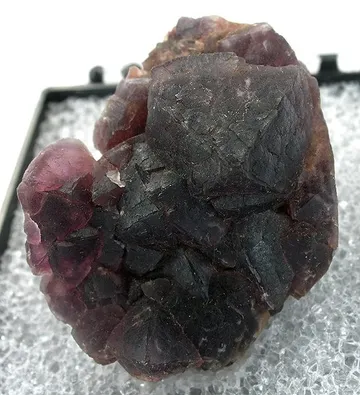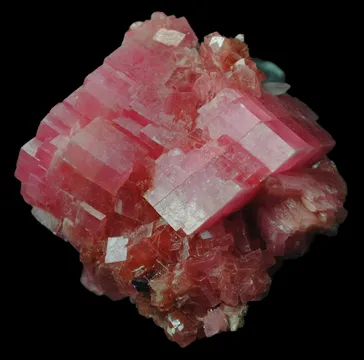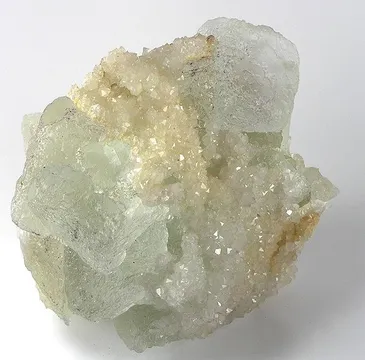
Blanchard Mine, USA — famed New Mexico locality for blue fluorite, crystal cubes with purple edges set on quartz druses; a classic for specimen collectors.
Key facts
The Blanchard Mine is the collector’s name most often attached to the great blue-fluorite heart of the Hansonburg District, near Bingham in Socorro County, New Mexico. It sits on the west side of the Sierra Oscura Mountains, looking out over the Jornada del Muerto, in one of the classic Rio Grande Rift barite-fluorite-galena districts. For specimen collectors, its importance is not merely that it produced fluorite; it produced a distinctive, recognizable kind of fluorite: translucent to gemmy cubes and modified cubes in the celebrated “Blanchard blue,” often with purple edge-zoning, perched on snowy to iron-tinted drusy quartz and accompanied by blocky galena, bladed baryte, anglesite, brochantite, linarite, and other secondary copper-lead minerals.
Geologically, the Blanchard is a cavity deposit. Mineralizing brines moved through faulted and shattered Pennsylvanian limestone, especially the Council Spring limestone interval, filling fissures, fault breccias, bedding-plane openings, and solution cavities rather than forming a simple continuous vein. That open-space origin is the reason the mine matters so much to collectors: the ore minerals had room to grow. Instead of only massive fluorite-barite-galena ore, Blanchard produced vugs and pockets lined with sharp crystals, quartz druses, blue and purple fluorite cubes, galena blocks, and delicate oxidation-zone species.
Regional View
Country View
Historically the mine has lived two lives. As an ore property, it repeatedly disappointed operators who tried to turn mixed lead, fluorite, and baryte mineralization into an economic mining venture. As a specimen locality, it became one of New Mexico’s most loved classics. The Sunshine adits, the Portales or Glory Hole workings, the ore-bin area, and later surface and reclamation projects all added to the supply of specimens. Blanchard labels span crude early ore pieces, richly altered galena, superb blue fluorite-on-quartz cabinet specimens, and rare thumbnail- to miniature-sized secondary mineral specimens that reward close viewing.

Photo: Wikimedia Commons
The best Blanchard fluorites have an unmistakable architectural quality: stacked blue cubes, ghostly lavender rims, small glassy faces breaking the cubic outline, and a sparkling quartz foundation that throws light back through the fluorite. The finest linarites and brochantites are a different pleasure—intense blue and emerald-green secondary minerals, often small, but saturated and alive against quartz, baryte, fluorite, or altered galena. Serious collectors prize pieces that show this locality’s whole story in one hand specimen: hypogene galena, fluorite, baryte, and quartz, followed by a skin of secondary lead and copper minerals.
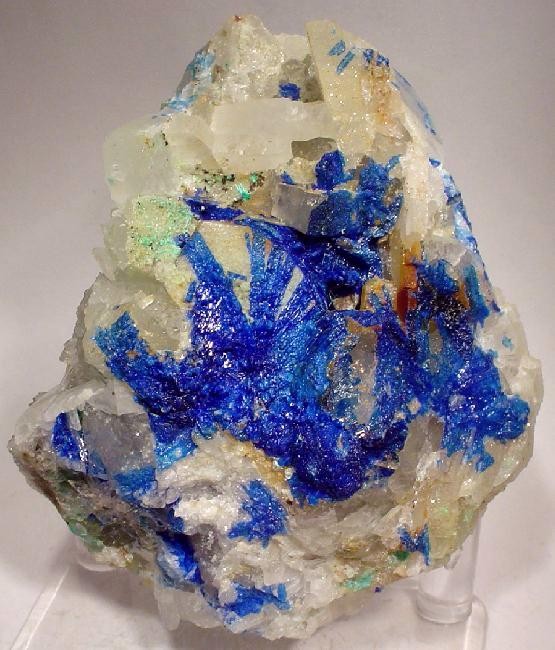
Photo: Wikimedia Commons
Search for specimens: View all specimens from Blanchard Mine, USA
The Blanchard Mine is part of the Hansonburg District at Bingham, Socorro County, New Mexico, on the western flank of the Sierra Oscura Mountains. The broader district trends roughly north-south along the mountain front and lies near the eastern margin of the Rio Grande Rift. The Blanchard group is south of the Mex-Tex workings and includes the Portales adit, also known historically as the McCarthy Lead Mine, Hansonburg Lead Mine, Blanchard Glory Hole, or simply the Blanchard Mine, as well as Sunshine adits numbered 1 through 6 and related surface workings.
The deposit is one of the Rio Grande Rift barite-fluorite-galena deposits of south-central New Mexico. Older literature often compared these deposits with Mississippi Valley-type systems, and the comparison is understandable: carbonate host rocks, open-space textures, low-temperature brines, galena, fluorite, baryte, and quartz are all part of the picture. Later work emphasized differences, especially the abundance of fluorite, the rift setting, the association with extensional tectonics, and the role of fluorine-rich fluids. At Blanchard, those brines exploited broken limestone, bedding-plane cavities, fault breccia, and paleokarst openings. The mineralization is discontinuous, pockety, and structurally controlled; that discontinuity frustrated ore mining but made the locality ideal for pockets of crystallized specimens.
The principal hypogene minerals are fluorite, baryte, galena, and quartz, with lesser sphalerite, chalcopyrite, and pyrite. In the collector’s cabinet, the primary assemblage usually appears as blue, purple, green, or colorless fluorite; bright to altered galena cubes or blocky masses; white, cream, or translucent tabular baryte; and drusy to prismatic quartz. These are overprinted by a much smaller but visually important secondary suite: linarite, brochantite, anglesite, cerussite, spangolite, caledonite, antlerite, wulfenite, hemimorphite, pyromorphite, rosasite, smithsonite, chrysocolla, murdochite, plattnerite, scrutinyite, and other oxidation-zone minerals.
The mine’s ore history is a long sequence of attempts, leases, and disappointments. Prospecting in the district was reported from the nineteenth century, and the Blanchard property was known under several names before the Blanchard family name became fixed to it. Lead mineralization was worked intermittently in the early twentieth century. F. L. Blanchard of Roswell was associated with the property by the 1940s, and the Portales Mining Company later milled lead ore and shipped concentrates. In the late 1950s, Sunshine Mining Company drove six exploratory adits, but despite hundreds of meters of underground work, no ore was marketed from that campaign. The mixed nature of the baryte, fluorite, and galena ore, the remoteness of the Sierra Oscura front, lack of water, and metallurgical separation problems all worked against sustained production.
The specimen era is the more successful chapter. The Sunshine workings, especially Sunshine No. 1, became famous for linarite and later for fluorite, galena, gypsum, and rare secondary species. In 1987, after a period when district claims had been open, the Blanchard Mine group was restaked by collectors and specimen miners, notably Ray DeMark and Brian Huntsman; Mike Sanders later became one of the key figures in specimen work and interpretation of the property. Since then, Blanchard has been treated primarily as a mineral-specimen mine rather than an ore property.
Collecting access is controlled and should never be assumed. The mine lies on federal land under mining claim, and access depends on the claim holders and the safety status of particular workings. Historical accounts mention fee collecting and organized visits at times, but underground collecting has been restricted or prohibited for safety. Several adits and portals have been dangerous, buried, backfilled, reclaimed, or otherwise inaccessible. For modern collectors, the correct approach is to regard Blanchard as a claimed, permission-only locality, not as an open public collecting site.
Several specific zones have entered collector vocabulary. The Sunshine No. 1 adit produced the celebrated linarite material that reached the Tucson market in 1978 and 1980, and later yielded a remarkable pocket with fluorite, selenite, and galena. The Portales or Glory Hole area has produced fluorite and galena on quartz, especially through specimen recovery tied to reclamation work. The ore-bin area produced fluorite-on-quartz specimens, including pieces with large blue cubes, and fluorite and baryte specimens sprinkled with small yellow wulfenite. Sunshine No. 6 was long associated with Blanchard spangolite, though the original area became inaccessible; later spangolite was recovered from loose material below the adit and from other Sunshine workings. In 2023, the Ice Cream Igloo pocket brought renewed attention to the mine by producing large to very large fluorite and quartz museum specimens, some with galena, including the approximately 1,100-pound “Blanchard Beast.”
Fluorite is the signature mineral of the Blanchard Mine. The classic material is translucent “Blanchard blue” to lavender-blue cubic or modified cubic fluorite on quartz, commonly with galena and baryte; green, pale green, teal, purple, colorless, and color-zoned crystals also occur. District-wide crystals have been reported to about 7 cm on edge, while a Sunshine No. 1 pocket found after the 1987 claiming produced blue and purple cubes reported to 9 cm on edge, and a documented Ray DeMark specimen from near the ore-bin area carried a 5.4 cm crystal on a 21 cm matrix. Blanchard fluorite may show cubes, cubo-hexoctahedral modifications, frosted or etched faces, purple edge phantoms, green cores with blue-purple overgrowths, and dense drusy quartz coatings beneath the fluorite. Good pieces here are not judged by color alone: the best have saturated blue or blue-purple zoning, undamaged prominent cubes, open three-dimensional composition, sparkling quartz contrast, and meaningful association with galena or baryte rather than a crowded mass of bruised fluorite.
Quartz at Blanchard is both a collector species and the stage on which the mine’s best fluorite and galena specimens perform. It occurs as drusy white to colorless coatings, sparkling needles, prismatic crystals, and in some cases smoky quartz, lining limestone cavities and covering massive fluorite, galena, or silicified matrix. Quartz-rich matrix is especially important in Portales and Sunshine material, where blue fluorite cubes, altered galena, anglesite, cerussite, linarite, and brochantite sit on glittering quartz surfaces. A desirable quartz specimen from Blanchard is sharply crystallized and clean enough to provide contrast; ordinary pieces are merely drusy matrix, but strong pieces use quartz to frame blue fluorite, metallic galena, or vivid secondary minerals without swallowing them in iron stain or broken pocket rubble.
Blanchard linarite is one of the mine’s great secondary-mineral prizes, especially from the Sunshine No. 1 adit, where galena crystals coated with lustrous blue linarite druse appeared at the Tucson Gem and Mineral Show in 1978, followed by a more celebrated discovery of world-class linarite in late 1979 that reached collectors in 1980. It occurs as intense azure-blue blades, flattened crystals, coatings, and sparkling druses on or with galena, quartz, baryte, fluorite, brochantite, anglesite, and cerussite; Sunshine No. 3 and the informal Sunshine No. 3 1/2 area also yielded linarite-bearing secondary assemblages. Good Blanchard linarite is judged by saturation, coverage, sparkle, and association: a small patch of dull blue is common enough to be a locality curiosity, but a rich, undamaged carpet of bright linarite on quartz, baryte, or altered galena is a serious New Mexico classic.
Galena is one of the primary ore minerals at Blanchard and a crucial aesthetic partner to the fluorite. It occurs as cubes, intergrown blocky crystals, fortification-like aggregates, and massive to partially altered crystals, commonly with quartz, blue fluorite, baryte, anglesite, cerussite, linarite, and brochantite. District-wide galena crystals have been reported to 10 cm, and Blanchard specimens regularly show smaller cubes from millimeter scale to several centimeters; some of the most attractive pieces combine metallic or partly altered galena with blue fluorite and sparkling quartz. Fresh, lustrous galena is less common than altered gray or drusy material, so collectors value sharp cubic form, stable surfaces, sculptural placement, and attractive partial alteration more than mere size.
Anglesite is a characteristic lead-sulfate alteration product at Blanchard, especially where galena has been oxidized along pocket surfaces. It occurs as colorless to gray-white, lustrous, sparkly microcrystals and crusts on galena and quartz, and in the Sunshine No. 1 tunnel excellent crystals to about 6 mm were specifically noted as uncommon elsewhere on the property. Many Blanchard galena specimens show ambiguous gray-white drusy alteration that may be anglesite, cerussite, or both, so the best anglesite pieces are those with well-defined crystal faces, bright luster, and credible locality-specific association rather than a vague “white alteration” label. Attractive specimens show anglesite preserving the cubic architecture of galena while adding a glittering oxidized skin.
Brochantite from Blanchard belongs to the mine’s vivid secondary copper suite and appears as bright to dark emerald-green sprays, acicular crystals, coatings, and drusy aggregates with quartz, linarite, fluorite, galena, anglesite, cerussite, chrysocolla, baryte, spangolite, and cyanotrichite. Sunshine No. 3 is particularly well represented in photographed and collected brochantite associations, while Sunshine No. 3 1/2 produced attractive brochantite with linarite, spangolite, and cyanotrichite. The best pieces show sharp green crystals or rich sparkling coverage that contrasts against blue linarite or white quartz; less desirable specimens are simply green staining or confused chrysocolla-brochantite coatings without crystallinity.
Barite, usually written baryte in formal mineral nomenclature, is one of the principal minerals of the Blanchard ore assemblage. At the mine it occurs intergrown with fluorite, galena, and quartz, and older descriptions note white to pale-green to purple fluorite intergrown with barite as well as medium to coarse platy barite crystals standing alone in cavities. In collector specimens, barite is often tabular, bladed, cream to white, translucent to opaque, and associated with blue fluorite, galena, linarite, brochantite, anglesite, and occasional wulfenite. Good Blanchard barite specimens are not simply bulky gangue; they have clean, open blades, crystal-lined vug texture, and an attractive relationship to fluorite or secondary minerals.
Spangolite is a scarce, prized Blanchard secondary copper aluminum sulfate-chloride, best known from very small but intensely colored blue-green to emerald-green crystals. For many years the recognized Blanchard occurrence was near the portal on the south side of Sunshine No. 6, but that adit was buried and closed in 1979 and the original spangolite spot became inaccessible. A notable May 2003 find in a boulder below Sunshine No. 6 produced a crystal over 6 mm long, described as the largest known from the Blanchard Mine; other Blanchard occurrences include tiny crystals in Sunshine No. 4, rare material from Sunshine No. 1, and later material from the Sunshine No. 3 1/2 adit with cyanotrichite, brochantite, and linarite. Strong specimens need sharp, identifiable trigonal crystals or rich blue-green coverage under magnification; ordinary pieces can be mere greenish microcrystalline coatings that require analytical caution.
Cerussite at Blanchard is another lead-oxidation mineral tied to altered galena and the secondary suite. It occurs as colorless to white or pale gray sparkling microcrystals, crusts, and replacement textures, commonly with galena, anglesite, quartz, fluorite, linarite, brochantite, and baryte; district summaries also mention large cerussite occurrences and pseudomorphic relationships in the broader Hansonburg assemblage. On specimens, cerussite and anglesite can look similar when they form fine glittering druse on galena, so good cerussite labels should be supported by habit, provenance, or analysis. The best Blanchard cerussites are bright, crystalline, and compositionally interesting, especially when they preserve galena form or sit in association with blue fluorite and vivid secondary copper minerals.
Baryte is the formal species name for the barite of Blanchard’s barite-fluorite-galena ore, and it is worth considering in its specimen context rather than only as an industrial mineral. Sunshine No. 1 produced handsome linarite-baryte-fluorite combinations, and Blanchard cavities elsewhere yielded platy to tabular baryte with fluorite, quartz, galena, anglesite, brochantite, and wulfenite. The finest pieces have baryte as an active visual component: crisp cream or translucent blades providing geometry and contrast, not simply hidden matrix. Baryte also helps identify authentic Blanchard paragenesis, because it belongs to the primary cavity-filling assemblage later overprinted by oxidation minerals.
Beyond these major collector species, the Blanchard Mine is documented for a broad oxidation-zone suite that includes antlerite, atacamite, aurichalcite, beaverite-(Cu), calcite, caledonite, chalcanthite, chalcopyrite, chrysocolla, cinnabar, connellite, corkite, covellite, creedite, cuprite, cyanotrichite, fluorapatite, gypsum var. selenite, hemimorphite, hydrozincite, jarosite, malachite, marcasite, murdochite, plattnerite, plumbojarosite, pyrite, pyromorphite, rosasite, sauconite, smithsonite, sphalerite, tenorite, wulfenite, and others. The locality’s most important rarity is scrutinyite, alpha-PbO2, for which Sunshine No. 1 at the Blanchard Mine is the type locality; it occurs as tiny reddish-brown micaceous crystals and belongs firmly to the mine’s specialist micromount literature rather than ordinary cabinet collecting.
Blanchard material is common enough on the American market that most collectors will encounter it, but quality varies enormously. Small blue fluorite on quartz is abundant relative to many classic localities; sharp, saturated, undamaged cabinet pieces with well-placed galena, baryte, or secondary minerals are much less common. Linarite, spangolite, and fine brochantite are locality classics in miniature and small-cabinet sizes, but truly rich, aesthetic specimens remain competitive.
The main authenticity concern is mislabeling rather than sophisticated fakery. Labels may read “Bingham,” “Hansonburg,” “Blanchard,” “Portales,” “Sunshine,” “Mex-Tex,” or “Royal Flush,” and these names are not interchangeable. They refer to a district, mine group, adit, or neighboring property depending on the label. A vague Bingham label on blue fluorite may be correct for the district but not necessarily for Blanchard Mine. For high-value pieces, especially linarite, spangolite, scrutinyite, or historically important fluorite, retain old labels and ask whether the specimen is from Sunshine No. 1, Portales/Glory Hole, Sunshine No. 3, Sunshine No. 3 1/2, Sunshine No. 6, the ore-bin area, or another part of the claim.
Condition is central. Blanchard fluorite commonly has frosted, etched, or pitted faces naturally, so a “matte” surface is not automatically damage. However, bruised cube corners, cleaved fluorite edges, abraded quartz druse, and chalky altered galena are common. Many specimens come from vugs in silicified limestone and breccia; removing them intact is difficult, and broken back edges or repaired matrix should be expected on larger pieces. Examine fluorite under strong side light for corner dings and internal cracks. On galena specimens, distinguish natural anglesite or cerussite druse from unstable powdery alteration.
Color deserves caution. The famous Blanchard blue is noted for sensitivity to sunlight, and prolonged display in direct sun can reduce the color in some pieces. Store and display blue fluorites away from sustained UV-rich sunlight and hot window exposures. This is particularly important for specimens whose value depends on vivid blue saturation or purple zoning. Shortwave fluorescence is not the main reason most collectors buy Blanchard fluorite, although fluorescent green fluorite was specifically noted from Sunshine No. 1 and Blanchard fluorescent specimens are known.
Secondary copper-lead minerals need gentle handling. Linarite, brochantite, spangolite, and cyanotrichite can be small, delicate, and easy to strip with aggressive cleaning. Avoid acids unless you have expert confirmation of the assemblage; acid cleaning can damage carbonates, destabilize some secondary minerals, and remove useful surface clues. Water, careful mechanical trimming, air abrasion by a professional, or minimal spot-cleaning may be appropriate depending on the specimen, but vivid secondary coatings should be treated as fragile.
Because Blanchard is a claimed locality, modern “self-collected” specimens should come with a clear permission history. Unauthorized collecting, especially underground entry, creates safety and legal problems. The strongest modern provenance comes from known claim-owner operations, organized permitted work, or named finds such as the Portales reclamation material and the Ice Cream Igloo pocket.
The Blanchard Mine’s ore history reads almost like a running joke played by geology on mining engineers. The mountain had lead, fluorite, and baryte in abundance; what it lacked was an easy way to turn the mixture into money. Operators drove tunnels, hauled ore, built mills, and tried separation schemes, but the mine’s real commercial triumph came later, when collectors realized the “failed” ore pockets were lined with specimens.
Ora Blanchard became part of the mine’s lore as firmly as the blue fluorite. Collectors remembered stopping at her small cabin along the access road to ask permission before collecting. The scene is wonderfully western: she might greet visitors carrying a shotgun, yet accounts describe her as pleasant and willing to allow collecting once the ritual of permission had been observed. In later reminiscence she became “The Lady on the Mountain,” one of the figures—along with Sam “Rattlesnake” Jones, Ray DeMark, Mike Sanders, and Brian Huntsman—who gave the locality its human texture as well as its mineralogical one.
Sunshine No. 1 became famous almost by surprise. Sunshine Mining Company began work there in November 1958, driving the first of six exploratory adits. The tunnel trended eastward and was described as 12 by 12 feet and 405 feet long. No ore was marketed from that work, and for years the tunnel was scarcely known as a specimen producer. Then, in February 1978, flats of galena crystals coated with lustrous blue linarite appeared at the Tucson Gem and Mineral Show. Late in 1979, an even better linarite discovery followed. When those specimens reached Tucson in February 1980, collectors moved fast; accounts say many were bought for thousands of dollars, a remarkable result for a mine whose ore economics had so often failed.
The search for more linarite became intense enough that a contract operation later went into Sunshine No. 1 trying to recover additional large crystals. It lasted several months, but the large linarites did not reappear, and the operation was eventually closed down by OSHA. That episode is a reminder that Blanchard is not a simple “dig and find” locality. The pockets are real, but they are discontinuous, hidden, and often dangerous; one spectacular find does not guarantee a second one a few feet away.
After the claims were taken up by specimen-minded collectors in April 1987, Sunshine No. 1 delivered another memorable surprise. In September of that year, a pocket was opened behind a large gypsum mass near the roof of a raise, reached by ladder. The first look revealed blue and purple fluorite cubes up to 9 cm on edge and water-clear selenite in spear-shaped and prismatic crystals, the largest selenite reaching 44 cm. The pocket was roughly 1 to 1.5 meters wide, 0.8 to 1 meter high, and 5 meters long, and it yielded dozens of superb fluorite, selenite, and galena specimens. For a mine famous for blue cubes, that pocket added a different image: clear gypsum spears glittering beside lavender fluorite in a high cavity reached from a ladder.
The mine’s smallest rarities produced stories of their own. For years, Blanchard spangolite was tied to an occurrence near the portal on the south side of Sunshine No. 6. That adit was buried and closed in 1979, making the original area inaccessible. Then, in May 2003, Ray DeMark was examining a boulder for brochantite in the debris field below Sunshine No. 6 when a piece of rock broke free with a single spangolite crystal more than 6 mm long. For most minerals, 6 mm sounds modest; for Blanchard spangolite, it was the largest known crystal from the mine. Later, the informal Sunshine No. 3 1/2 adit—named by Rex Nelson—yielded spangolite with cyanotrichite, brochantite, and linarite, giving micromounters another small but memorable Blanchard chapter.
In July 2013, the mine combined reclamation and specimen recovery in a practical, modern way. Claim owners Ray DeMark, Mike Sanders, and Brian Huntsman worked with Arizona specimen miners and dealers Mark Kielbaso and Bruce Barlow on a three-week project at the Portales tunnel. The portal was open to the surface, actively caving, and considered a serious hazard to unauthorized entrants. At the same time, older specimen work suggested that productive ground for fluorite and galena on quartz lay buried under sloughed rock at the portal entrance. The project used two track-mounted excavators, portable rock saws and drills, hand tools, and specimen-packing materials. One excavator carried a bucket; the other used a hydraulic hammer to break fractured rock and slabs. At the end, the portal was backfilled and sealed, the hazard was reduced, and boxes of high-quality specimens had helped offset the reclamation cost. The account even records the human details: minimal equipment trouble, no accidents or injuries, spectacular July monsoon storms, and improvised card games to pass time.
The most dramatic modern story is the 2023 Ice Cream Igloo pocket. In March 2023, Bradley Culebro and Michael Eggleton were granted access for surface collecting by claim owner Ray DeMark and began surface and near-surface exploration. They found a major fluorite pocket that produced large to very large fluorite and quartz museum specimens, some with galena. After the initial discovery, they showed Mike Sanders and DeMark a very large botryoidal green fluorite and galena specimen. The find was significant enough that funding support for extracting the largest piece came from Mel Huffman and Nancy Parsons of The Crystalary in Cincinnati.
Work began on April 23, 2023, and continued more or less continuously until June 6, with Culebro, Eggleton, and Sanders recovering multiple superb medium to very large specimens. One giant remained: the approximately 1,100-pound “Blanchard Beast.” Hand work was not enough. A track hoe had to be brought in, and Fred Ortega, a northern New Mexico collector and expert Taos Ski Valley equipment operator, was hired to operate it. The Beast was successfully and safely recovered on June 22, 2023. By September, specimens from the pocket were displayed by the New Mexico Mineral Museum at the Denver Hard Rock Summit, giving a twenty-first-century Blanchard pocket the same kind of public debut that earlier linarite had enjoyed at Tucson.