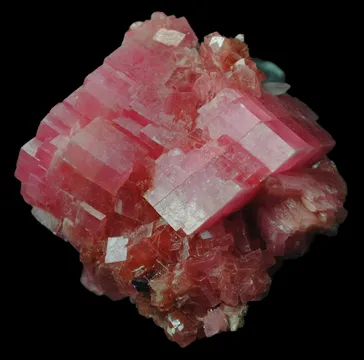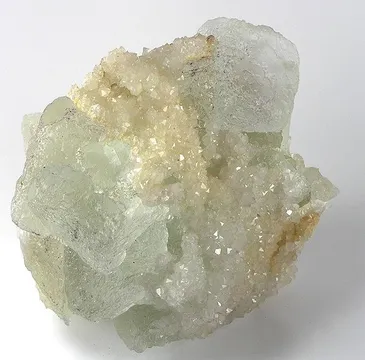
A collector's guide to Mex-Tex Mine, USA: its geology, mining history and notable minerals, illustrated with the 39 specimens documented from this locality on EarthWonders.
Key facts
The Mex-Tex Mine is one of the defining collector localities of the Hansonburg district near Bingham, Socorro County, New Mexico: a high-desert, carbonate-hosted barite-fluorite-galena system set on the west flank of the northern Sierra Oscura Mountains, at the eastern edge of the Jornada del Muerto. For specimen people, its importance is not tonnage but texture. The ore bodies are open-space fillings in fractured Pennsylvanian limestone—fault breccias, bedding-plane cavities, and solution openings lined with quartz, galena, fluorite, and barite, later overprinted by an unusually rich suite of lead-, copper-, and zinc-bearing secondary minerals. That combination gives Mex-Tex pieces their unmistakable look: pale to blue-green or purple fluorite perched on white drusy quartz, galena partly armored or replaced by secondary lead minerals, and vugs glittering with spangolite, brochantite, linarite, murdochite, or rarer microcrystals.
Historically the mine belongs to the larger Hansonburg barite-fluorite-galena belt, but the Mex-Tex name has its own weight. The Mex-Tex and Royal Flush groups were established in 1947, developed commercially from 1949, and tied to a 200-ton-per-day barite mill built the following year. During the 1950s, the Hansonburg district was New Mexico’s leading barite producer, and much of that production is attributed to the Mex-Tex and Royal Flush groups. After commercial ore work faded, the mine’s second life—as a specimen locality—became the one collectors remember. Since the late 1980s, the mine has been worked and revisited chiefly for specimens, with the best finds coming from the old cavities, stopes, adits, and later mechanized surface excavations.
Regional View
Country View
The finest Mex-Tex specimens are not simply “Bingham fluorites,” although fluorite is central to the locality’s appeal. They are miniature landscapes of sequential mineralization: silicified limestone opened by faulting; early quartz providing sparkling cavity walls; galena and fluorite filling structural voids; barite blades occupying remaining open space; and late oxidation chemistry painting the whole assemblage with blue, green, black, yellow, white, and rusty tones. In the best examples, one specimen tells the entire history of the pocket.

Photo: Wikimedia Commons

Photo: Wikimedia Commons
Search for specimens: View all specimens from Mex-Tex Mine, USA
The Mex-Tex Mine lies near Bingham in the Hansonburg district of Socorro County, New Mexico, roughly south of U.S. Highway 380 and on the west side of the Sierra Oscura Mountains. The classic locality coordinates are about 33°49′41″N, 106°22′00″W, placing it on the desert-facing side of the range, where the limestone escarpment looks west across the Jornada del Muerto. The mine is also historically known as the Malachite-Julian Mine or Julian-Malachite Mine, and older descriptions of the “Mex-Tex group” may include several related workings rather than a single adit.
Geologically the Mex-Tex belongs to the Hansonburg district’s Rio Grande Rift barite-fluorite-galena class of deposits. These resemble Mississippi Valley-type systems in their carbonate host rocks, open-space textures, and low-temperature hydrothermal character, but the Hansonburg district is notably fluorite-rich and is interpreted in modern work as part of a Rio Grande Rift family of deposits. Mineralizing fluids moved through north-trending rift-related structures, entered fractured Paleozoic carbonate strata, and precipitated ore where faults, breccias, bedding-plane openings, and solution cavities supplied the necessary space.
The principal host rocks at Mex-Tex are Pennsylvanian limestones in the Madera Limestone sequence, especially the Council Spring limestone and lower Burrego Formation in the district. Kottlowski’s early work emphasized that the ore was not a broad replacement body; rather, it occurred as discontinuous open-space fillings in fractured limestone. Silica locally sealed and silicified the limestone first. Galena and fluorite followed in cavity linings and bands, barite filled remaining openings, and late quartz druse coated vugs. Later oxidation produced the copper, lead, and zinc secondary species that make Mex-Tex micros and combination specimens so rewarding.
The ore texture is important for collectors. Classic Hansonburg “coontail” or banded ore can show silicified limestone bordered by fluorite and galena, with barite blades and quartz druse occupying open spaces. At Mex-Tex, the same structural style yielded specimen pockets rather than massive ore: plates and clusters of quartz, galena, fluorite, and barite, sometimes with secondary minerals spread as delicate crusts, sprays, or microcrystal carpets across the older minerals.
Mining in the wider Hansonburg district began much earlier than the Mex-Tex company era. Ore was first reported in the district in the 1870s, and small-scale copper, lead, barite, and fluorspar activity followed in the late nineteenth and early twentieth centuries. The Mex-Tex and Royal Flush claims were established in 1947 by A. R. Hickey, W. Hickey, and F. Kay of Artesia, New Mexico. Development under the Mex-Tex Mining Company began in earnest in 1949, and the company built a 200-ton-per-day barite mill in 1950. In the early 1950s, Mex-Tex operations trucked ore to the San Antonio mill, producing barite, galena, and fluorite. Commercial activity by the Mex-Tex Mining Company ended in the early 1960s, followed by Galbar Inc., which explored and mined the Mex-Tex and Royal Flush groups and shipped lead concentrates to the ASARCO smelter in El Paso.
After the commercial mining period, the property’s significance shifted decisively toward collecting. The modern collecting era began after the Mex-Tex and Royal Flush groups were reclaimed in May 1987 by individuals interested in specimen recovery. Published accounts name Tom Massis of Albuquerque as the claimant of the Upper Mex-Tex Mine group and Royal Flush Mine in the 2009 district review. Later club and field-collecting references continue to treat the Mex-Tex ground as claimed/private-access collecting ground, not casual public land. Collecting access should therefore be handled as permission-only: the Hansonburg area includes a patchwork of claims, private interests, state or federal land context, mine hazards, and White Sands Missile Range proximity. Old guidebooks that describe fee collecting through the Bingham rock shop are historically useful but should not be treated as current permission without direct confirmation from the present claimant or authorized access manager.
Specimen production has come from both underground and surface work. In the late 1950s and 1960s collectors found material in the large Mex-Tex stope, including linarite-, malachite-, fluorite-, barite-, and quartz-covered pillars and small black murdochite crystals on quartz and fluorite. Later specimen operators recovered high-quality secondary minerals, including brochantite, creedite, cyanotrichite, libethenite, linarite, murdochite on smoky quartz, plumbogummite, pseudomalachite, spangolite, and tsumebite. Reports from the 1990s also describe attractive amethystine and smoky quartz clusters, some dusted with murdochite microcrystals, and spangolite crystals to about 3 mm—small by cabinet-mineral standards, but exceptional for New Mexico spangolite.
Quartz is the scaffolding mineral of many Mex-Tex specimens: it occurs as silicified limestone, coarse cavity quartz intergrown with ore minerals, and sparkling drusy linings over which fluorite, galena, barite, and secondary species appear. Individual crystals are usually small—commonly under an inch—yet they can make very attractive plates and clusters, especially when clear, amethystine, or smoky crystals are present. The smoky variety is especially distinctive at Mex-Tex because the color may concentrate at the crystal tips rather than evenly through the crystal body, and published descriptions note striking associations with Naica-like pale blue fluorite or light green fluorite. Good Mex-Tex quartz pieces are judged less by crystal size than by architecture: clean cavity form, undamaged sparkling druse, smoky or amethystine tint, and the presence of locality-signature associates such as fluorite, galena, spangolite, brochantite, linarite, or murdochite.
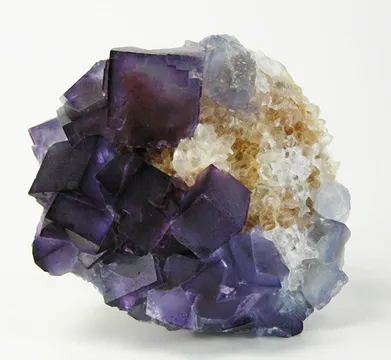
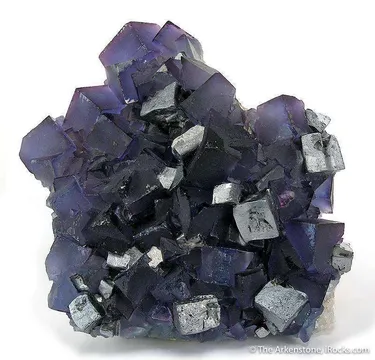
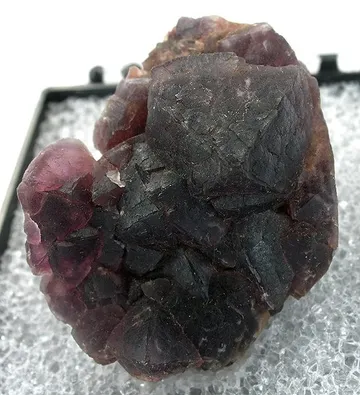
Fluorite is the glamour mineral of the Mex-Tex suite, and the mine is especially noted for complex crystals rather than simple, sharp cubes. Hexoctahedral and highly modified cubic forms are characteristic, with rounded edges, additional crystal faces, frosted or silky surfaces, and locally etched or pitted exteriors from later leaching. Color ranges from the classic sunlight-sensitive “Bingham blue” through surface blue, green, colorless, teal, purple, and maroon-purple tones; some crystals show both concentric and sectoral zoning, including Mex-Tex examples in which different crystal sectors beneath different faces carry different colors. Published specimen descriptions record single crystals exceeding 3 inches across in combinations, though most collectible pieces are smaller. The best Mex-Tex fluorites combine saturated or unusual color, visible zoning, attractive placement on quartz or barite, and association with galena or secondary minerals; ordinary pieces tend to be pitted, bruised, pale, isolated, or visually buried in massive matrix.
Mex-Tex spangolite is a micro-to-small-crystal collector’s mineral, most admired as blue-green to greenish-blue glittering crystal linings in quartz vugs, on barite, or with brochantite and malachite. The 1990s mechanized and hand-collecting work at Mex-Tex produced spangolite specimens regarded among the best from New Mexico, with crystals reported to about 3 mm. On hand specimens, the finest examples are those where the spangolite is not merely a dusting but a visibly sparkling carpet or cluster in a sculptural cavity—especially when framed by white quartz, pale barite, rusty iron-oxide staining, or contrasting malachite. Because the crystals are small and easily damaged, a good Mex-Tex spangolite is about luster, coverage, contrast, and intact vug geometry more than sheer crystal size.
Galena at Mex-Tex is both an ore mineral and a structural anchor for many specimens, occurring as cubes and modified cubes in the fluorite-barite-quartz assemblage. District descriptions record galena cubes as large as 4 inches, and early geologic work described galena and fluorite cubes up to about 2 inches across in ore bands; at Mex-Tex, however, galena is commonly coated, altered, or partly replaced by later minerals rather than exposed as bright, mirror-metallic cubes. Cerussite pseudomorphs after galena are repeatedly noted, and individual specimens may show galena partly altered to anglesite or coated by black lead oxides such as plattnerite. Strong Mex-Tex galenas are those that preserve recognizable cubic form while adding locality character—quartz matrix, fluorite companions, secondary lead minerals, and copper staining—whereas plain, corroded, or heavily broken cubes have less collector pull.
Brochantite from Mex-Tex belongs to the mine’s late copper-sulfate oxidation suite and is best appreciated under magnification, where it forms green to blue-green drusy coatings, tiny prisms, sprays, and crusts on quartz, barite, or older ore minerals. It is documented among the high-quality secondary minerals recovered from the Mex-Tex workings, and index references to the Mineralogical Record article note linarite druse frequently associated with brochantite at the mine. Brochantite may accompany spangolite, malachite, chrysocolla-like coatings, or other copper secondaries, making some Mex-Tex pieces easy to underrate until viewed with a loupe. The desirable specimens are richly covered, brightly colored, and compositionally balanced—green brochantite playing against white quartz, blue spangolite or linarite, or pale fluorite—rather than dull green smears or powdery coatings without crystal sparkle.
Beyond these five species, Mex-Tex has a deep roster of documented minerals. The confirmed and reported suite includes barite, anglesite, cerussite, calcite, chalcopyrite, sphalerite, pyrite, malachite, azurite, linarite, caledonite, wulfenite, hemimorphite, creedite, cyanotrichite, libethenite, murdochite, plattnerite, plumbogummite, pseudomalachite, rosasite, smithsonite, tsumebite, pyromorphite, vanadinite, stolzite, mottramite, fluorapatite, gypsum or selenite, goethite, hematite, dickite, and native sulfur. The locality’s most important rarity is scrutinyite, α-PbO2, for which the Snake Pit Mine within the Mex-Tex group is a type locality; it has been described as reddish micaceous crystals coating quartz and as alteration on galena, and it is easily confused visually with other black to reddish lead oxides unless analytically confirmed.
Mex-Tex material is often mislabelled because “Bingham,” “Hansonburg,” “Blanchard,” “Mex-Tex,” “Royal Flush,” “Ora,” “Snake Pit,” and even the mistaken inversion “Tex-Mex” are used loosely in the trade. Serious labels should preserve the most specific old information available. A specimen labelled simply “Bingham, New Mexico” may be visually plausible but should not be upgraded to Mex-Tex unless the old label, collection history, or species association supports it. Conversely, specimens from the Snake Pit, Byrd Tunnel, Upper Mex-Tex, Julian-Malachite, Hickey No. 1, or Ora Mine may appear in older collections under broader Mex-Tex group wording.
No well-documented modern fake industry is associated with Mex-Tex specimens, but identification errors are a real issue in the secondary suite. Scrutinyite versus plattnerite, brochantite versus malachite or other green copper species, tiny vanadate or phosphate minerals, and black murdochite-like microcrystals all deserve analytical caution when the species name drives value. For high-end micros, XRD, Raman, SEM-EDS, or reliable provenance from a known specialist collection is more meaningful than a confident visual label.
Condition expectations should be locality-specific. Fluorite from Mex-Tex may be naturally frosted, silky, rounded, etched, or pitted; those features are not automatically damage, though bruised corners and cleaves are common. The host rock is hard silicified limestone, and extracting clean plates without edge damage is difficult. Galena is commonly altered or coated, so a dull surface may be part of the specimen’s paragenesis rather than poor cleaning. Delicate spangolite, cyanotrichite, brochantite, linarite, and other secondary minerals should be kept dry, handled gently, and never cleaned aggressively.
Fluorite color deserves special care. The classic Bingham blue is known for sensitivity to sunlight, and collectors should avoid prolonged direct sun or intense display lighting. Store the strongest blue, teal, and purple pieces away from windows, and photograph them quickly rather than leaving them on a sunny sill. Fluorite can show attractive fluorescence, with some Hansonburg-area material giving a rich blue response, but display value under ultraviolet light should not justify repeated heating or unnecessary exposure.
Market availability is uneven. Ordinary quartz-fluorite-galena-barite combinations still appear from old collections and field-collected lots, but sharp, aesthetic, well-labelled Mex-Tex examples with strong color, large fluorite, fine spangolite, murdochite on smoky quartz, scrutinyite, or balanced multi-species vugs are much harder to replace. The best pieces usually trace to older collections, late twentieth-century specimen work, or small controlled access digs rather than casual modern collecting.
In the late 1950s, Sherman Marsh and his companions did not find the Mex-Tex Mine by map or invitation. They found it by following ore. While exploring near San Antonio south of Socorro, they noticed large rocks near a railroad loading dock; the rocks held galena, barite, and quartz. More ore samples lay near the turnoff from the highway to the loading dock. Curiosity became a trail, and the trail led them to Bingham, then south along a dirt road to the Mex-Tex Mine. At that time the mine presented itself as a large underground stope opening in the west side of a cliff, with mine buildings on the flat ground below and a forked road: one branch up toward the stope, the other down toward the buildings.
The road to the stope had a chain across it, but the chain did not quite stop determined young collectors. Marsh recalled that if two people held up both sides, a car could just barely pass underneath. About 200 feet inside the stope stood a pillar coated with linarite, malachite, fluorite, barite, and quartz. Off to the right, in a smaller area, they found quartz and fluorite covered with shiny black microcrystals. Those black crystals were later recognized as murdochite, one of the signature dark accents on Mex-Tex specimens.
One collecting trip became a chase scene. Marsh, Bill Atkinson, their wives, and two geology graduate students from Nepal—Biswa Man Pradhan and Yogendra Lal Singh—left after classes and reached the mine just before sunset. Marsh posted his wife Colleen outside on the dump as lookout while the others collected underground. Suddenly she came running in to warn them that someone was coming. Tools and packs were grabbed in haste. The group burst from the mine and saw car lights climbing toward the lower mine buildings. In complete darkness they loaded the trunk, slipped the car under the chain, and rolled down the road with engine and lights off so they would not be seen or heard. The two Nepalese students in the back seat, not fully briefed on the “clandestine operation,” were understandably alarmed.
About a mile down the access road the other car’s lights began moving. Marsh wrote that “the chase was on!” They accelerated past the fork and raced for the main road, reaching pavement at least a quarter-mile ahead. The pursuer gained on them; the passengers debated what might happen when it caught them. Then the other car simply drew closer, passed, and disappeared down the road. The episode ended without confrontation, but Marsh noted that the Nepalese students were reluctant to join future collecting trips.
Those stories also capture how much the district changed. The 1950s and 1960s were remembered as a time when specimens were plentiful and other collectors were rarely seen. Early visitors collected mainly for their own cabinets, not in commercial quantities. Later, as easy pockets disappeared, Mex-Tex collecting became harder, more organized, and more dependent on permission, mechanical excavation, and serious underground caution.