A collector's guide to Alchuri, Pakistan: its geology, mining history and notable minerals, illustrated with the 266 specimens documented from this locality on EarthWonders.
Key facts
Alchuri sits in the Shigar Valley of Gilgit-Baltistan, north of Skardu, where the great Pakistani pegmatite province and a much rarer alpine-cleft style of mineralization overlap in the same collecting district. That double identity is the key to the locality. The broader Shigar Valley is famous for granitic pegmatite pockets carrying aquamarine, feldspar, mica, schorl, quartz, apatite, topaz and garnet; Alchuri, however, is especially valued by advanced collectors for its alpine-type clefts on the ridges above the village, where calcium-rich metamorphic and metasomatic assemblages yielded clinozoisite, zoisite, epidote, titanite, diopside, adularia, albite, calcite, rutile, vesuvianite and tremolite/byssolite in remarkably sculptural combinations.
The best Alchuri specimens have the visual language of the Alps but the color and strangeness of the Karakoram: sharp green to brown-green epidote-group blades, glassy gem zoisite, minty to yellow-green diopside, butterscotch to green titanite, flattened adularia with white faden seams, and open, airy matrix groups on white albite or calcite. The locality is particularly important for collector-quality clinozoisite and zoisite. It has also become a benchmark locality for faden textures beyond quartz alone, with faden-type growths documented in quartz, fluorapatite, clinozoisite, orthoclase/adularia, titanite, zoisite and diopside.
Regional View
Country View
Historically, Alchuri entered the international collector market through local miners and dealers in the Shigar–Skardu–Peshawar chain, then received serious locality treatment in the mid-2000s when Dudley Blauwet documented the cleft deposits in detail for The Mineralogical Record. His account distinguished ridge workings above Alchuri and helped separate true Alchuri alpine-cleft minerals from look-alike material from Hashupa, Tormiq, Dassu, Nyet and other northern Pakistani localities. That distinction matters: an Alchuri label should not be treated as a generic “Shigar Valley” label, because the finest pieces have a very recognizable cleft assemblage and crystal style.

Photo: Wikimedia Commons

Photo: Wikimedia Commons

Photo: Wikimedia Commons
Search for specimens: View all specimens from Alchuri, Pakistan
Alchuri is a village and side-valley locality in the Shigar Valley, about northwest of Shigar and within the modern Shigar District of Gilgit-Baltistan. Mineral labels may use older administrative language such as Skardu District, Baltistan, Northern Areas, or spellings such as Alchori or Aschudi. In mineralogical use, the name covers both pegmatite occurrences around the village and the better-defined Alchuri alpine-type clefts on the surrounding ridges. Serious labels should ideally indicate whether a specimen is from the Alchuri pegmatite occurrences or the alpine-cleft workings.
The regional gem-bearing pegmatites of Shigar are granitic bodies intruded into metasedimentary and meta-igneous rocks of the Karakoram Metamorphic Complex and are commonly treated as part of the Karakoram Axial Batholith system. In the broader valley, gemstones concentrate in pockets, cavities and vugs within zoned pegmatite dikes and veins. The typical pegmatite suite includes aquamarine and goshenite, schorl, mica, feldspar, quartz, apatite, topaz, fluorite and garnet. Research on Shigar Valley gemstones separates this pegmatitic suite from the Alchuri–Hashupa epidote-group suite: zoisite, clinozoisite and axinite are interpreted as metamorphic and/or metasomatic rather than simply products of evolved pegmatite cavities.
The Alchuri alpine-cleft mineralization is the reason the locality has such weight with connoisseurs. The worked zone described in locality references is only several meters wide, yet it produced an unusually coherent cleft assemblage: clinozoisite, epidote, zoisite, titanite, diopside, adularia, albite, calcite, rutile, fluorapatite, tremolite/byssolite, vesuvianite, siderite, gypsum and rare barite, with additional documented species at the wider Alchuri locality. The best pieces look as though they grew in open fissures under changing fluid conditions: flattened and parallel-growth crystals, repaired or faden centers, recrystallized bases, gemmy terminations, and matrix plates that preserve delicate needles and inclusions.
Mining has been small-scale rather than industrial. The known specimen workings have been dug by local miners and collecting crews, with material passing through village dealers, Skardu rooms, Peshawar’s Namak Mandi trade, and international dealers. Dudley Blauwet’s published treatment distinguishes “Alchuri ridge #1 mine” and “Alchuri ridge #2 mine,” a useful reminder that Alchuri is not a single neat mine entrance but a cluster of ridgeline clefts and nearby pegmatite workings. Later gem reports also mention new pale zoisite/clinozoisite production from a site called Skinsar above Alchuri, at an elevation exceeding 4,000 meters, where drilling and blasting were used in a short tunnel.
Collecting access today should be understood as high-mountain mineral mining, not casual public rockhounding. The productive zones are steep, remote, and locally controlled; specimens are normally obtained through the established Pakistani dealer network rather than by independent visiting collectors. The old literature and dealer reports repeatedly emphasize altitude, difficult approaches, short working seasons, and the practical dependence on local miners. Any field visit would require local guidance, permission, and attention to regional travel conditions, and a collector’s best access remains the secondary market.
Notable finds span two different specimen styles. From the pegmatite side come aquamarine groups with cleavelandite, muscovite and schorl, along with feldspar, quartz, topaz and accessory gem minerals. From the cleft side come the truly diagnostic Alchuri pieces: world-class clinozoisite, gemmy green to yellow zoisite, epidote rivaling classic alpine material in form, deep green chromium-rich diopside, green to butterscotch titanite, faden adularia, fluorapatite with faden structure, rutile in sagenitic growths, and vesuvianite in reddish-brown to root-beer tones. Good pieces are often small to miniature, but they compensate with rarity, sharpness, luster and astonishing three-dimensional architecture.
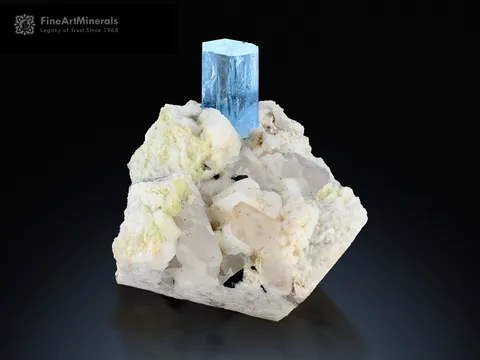
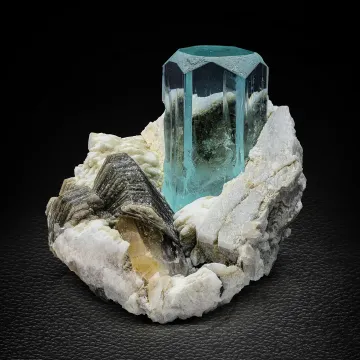
Aquamarine from Alchuri belongs to the pegmatite half of the locality, where pale blue beryl occurs with white cleavelandite or other feldspar, silvery muscovite and lustrous black schorl; a documented Alchuri specimen shows aquamarine crystals on the order of a few centimeters with schorl, cleavelandite and muscovite, which is the classic Shigar pegmatite look in miniature. The best Alchuri aquamarines are not judged solely by depth of blue, which is commonly pale to icy blue, but by natural attachment, crisp hexagonal form, clean faces, and the way the beryl is staged against contrasting white feldspar and black tourmaline. Ordinary pieces are loose, etched, repaired without disclosure, or merely labeled “Shigar”; better ones carry enough matrix and association to justify the more specific Alchuri attribution.
Quartz from Alchuri is best known in the alpine-cleft assemblage rather than as big pegmatite points: clear to milky crystals, faden quartz, and quartz plates with actinolite/byssolite, rutile, albite, adularia, titanite or epidote-group minerals. Documented Alchuri pieces include quartz with actinolite and quartz with rutile, and the locality is specifically noted for producing faden crystals in several species, making quartz part of a broader structural theme rather than an isolated accessory. Good Alchuri quartz is clean, undamaged at the terminations, and compositionally important—supporting or threading through green amphibole, rutile needles, or cleft minerals—while ordinary quartz is nondescript, bruised, or so generic that the locality adds little collector value.
Clinozoisite is the signature mineral of Alchuri and one of the reasons the locality is internationally famous. It occurs as elongated blades, flattened crystals, parallel bundles, doubly terminated crystals and transparent to translucent greenish-brown, yellowish-green or brown crystals, often with calcite, byssolite, fluorapatite, adularia, titanite, diopside, albite, rutile or zoisite. The best examples are bright, glassy, sharply terminated and sufficiently transparent to glow through the crystal; fine miniatures may be only a few centimeters but can show complex parallel growth, faden-like internal structure and recrystallized floater surfaces. Lesser pieces are dark, opaque, contacted, or sold ambiguously as “epidote” when the Alchuri epidote–clinozoisite distinction is not supported by habit, color, analysis or reliable provenance.
Zoisite from Alchuri is rare and highly collectible because well-crystallized gem zoisite outside Tanzania is unusual. Alchuri material ranges from colorless to light green, mint green, yellow-green, brownish yellow-green and pale brownish lavender in reported production, with crystals typically small but sometimes transparent enough for gem study and cutting. Fine crystals may be sharp, glassy and completely transparent, with documented specimens around thumbnail size and gem parcels containing clean one-to-three-gram pieces; the best collector pieces preserve complete terminations, attractive green or yellow-green color, and a confident Alchuri provenance rather than a vague “Pakistan tanzanite” trade label. Ordinary pieces are broken fragments, opaque brown crystals, or mixed zoisite/clinozoisite material where identification has been assumed from color alone.
Feldspar at Alchuri plays two roles: in pegmatite specimens it forms the white cleavelandite or feldspathic matrix for aquamarine, schorl and mica, while in alpine-cleft specimens it appears as albite, pericline-style albite and K-feldspar/adularia in sharper cleft habits. Good Alchuri feldspar is more than background—it frames the specimen, provides contrast, and helps prove the paragenesis, especially when white feldspar anchors green diopside, titanite, epidote-group minerals, quartz or aquamarine. In the best pieces the feldspar is fresh, lustrous and crystallized rather than sugary or crushed; ordinary examples are massive white matrix with little definition, rusty staining, or broken pegmatite rubble carrying more label interest than specimen quality.
Epidote from Alchuri occurs in the same alpine-cleft family as clinozoisite, typically as lustrous green to golden-green prismatic or bladed crystals, sometimes in faden groups and sometimes associated with calcite, albite, diopside, byssolite or titanite. The finest Alchuri epidotes have enough iron-rich green color to read as epidote rather than pale clinozoisite, but still retain clarity, sharp terminations and a lively alpine brightness; several market specimens show transparent to translucent crystals and elegant miniature-scale composition. Common problems are misidentification across the epidote–clinozoisite series, damaged terminations, and over-dark pieces that look impressive in backlight but flatten visually under normal display lighting.
Diopside is one of Alchuri’s most distinctive cleft minerals, occurring as bright green to deep green prismatic crystals, many in parallel growths, curved sprays, doubly terminated groups, or compact interlaced aggregates with titanite, clinozoisite, calcite and albite. Documented specimens include aerial doubly terminated crystals on transparent clinozoisite with twinned titanite, and deep green diopside with calcite and small white albite. The best pieces are sharp, lustrous, vivid green and visibly separated from the matrix so the individual prisms can be appreciated; ordinary pieces are dense tangles, opaque dark masses, or specimens with attrition at the delicate terminations.
Titanite from Alchuri ranges from greenish-yellow to butterscotch and brownish tones, commonly as flattened, twinned, wedge-shaped crystals with quartz, albite, diopside, rutile, actinolite or clinozoisite. The locality is well known for titanite as a supporting but visually important species: small sharp crystals can brighten a diopside spray, sit on quartz, or appear with rutile on albite in highly unusual compositions. Top specimens show sharp wedge form, transparency or translucency, bright luster and an undamaged edge; ordinary pieces are dark, crude, chipped, or so embedded in chloritic or amphibole-rich matrix that the titanite becomes hard to read.
Actinolite at Alchuri is typically an alpine-cleft accessory, occurring as green acicular crystals, sprays, byssolitic fibers or inclusions with calcite, quartz, fluorapatite, titanite and other cleft minerals. Its collector value lies less in large individual crystals and more in texture: fine green needles can give quartz, calcite or apatite a distinctly Alchuri character, and byssolite-like growths are repeatedly associated with the locality’s adularia, calcite and cleft assemblages. Good actinolite-bearing pieces are clean enough for the needles to be visible and undisturbed; ordinary ones become fuzzy, crushed or visually muddy, and fibrous material should be handled gently to avoid breaking the delicate sprays.
Albite is a major matrix mineral at Alchuri and appears both as cleavelandite in pegmatite specimens and as sharper cleft albite or pericline-type crystals in the alpine assemblage. It is especially important as the white stage for green diopside, titanite, epidote-group minerals, rutile, calcite, quartz and aquamarine. The best Alchuri albite specimens are crisp, fresh and three-dimensional, with the albite improving the mineral composition rather than merely holding it together; ordinary pieces are chalky, iron-stained, broken or massive. Because many Shigar pegmatite specimens carry albite, the strongest Alchuri examples are those whose associated species—clinozoisite, zoisite, diopside, titanite, adularia or faden textures—make the locality assignment persuasive.
Vesuvianite from Alchuri is a less common but appealing member of the cleft/metasomatic suite, documented as reddish-brown, root-beer to dark brown crystals, often associated with calcite and occasionally appearing as newly dug material in small miniature sizes. It lacks the instant recognition of clinozoisite or diopside but is important because it rounds out the calcium-silicate character of the locality. Good pieces show individual crystals with luster, color and some open space between them, ideally on calcite or with enough matrix to show paragenesis; ordinary examples are dark, crowded, damaged, or massive enough that the species and locality become hard to appreciate without a strong label.
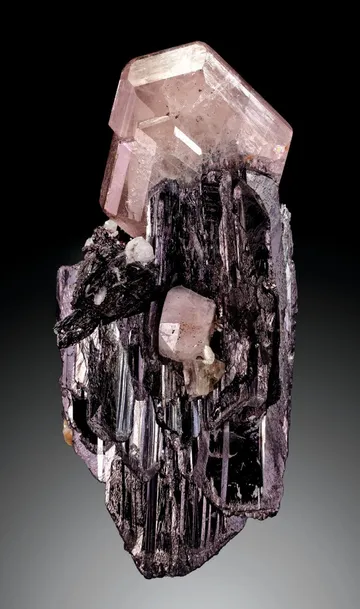
Apatite at Alchuri is best represented by fluorapatite in alpine-cleft specimens, including transparent to translucent light yellowish or pale pink tabular hexagonal crystals, sometimes showing faden structure and associations with actinolite, siderite or rutile. A documented Alchuri specimen combines sharp, gemmy, light pink apatite crystals to about centimeter size with chocolate-brown siderite and reticulated sagenitic rutile, a very alpine-style association for Pakistan. The best apatites are lustrous, tabular, complete, and visibly part of the cleft assemblage; ordinary pieces are small, colorless fragments or poorly labeled Shigar apatites whose exact Alchuri origin is uncertain.
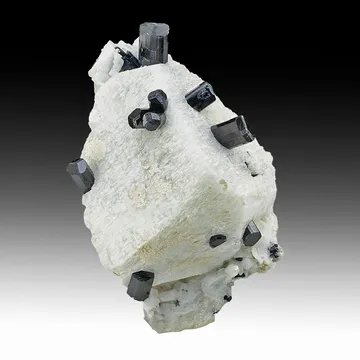
Tourmaline from Alchuri is chiefly schorl in the pegmatite assemblage, where black prisms occur with aquamarine, cleavelandite or other feldspar, muscovite and quartz. The best pieces use the black tourmaline as graphic contrast against pale blue beryl and white feldspar, and the most collectible examples keep the schorl crystals lustrous, terminated and naturally attached rather than as broken black rods embedded in pegmatite. Ordinary Alchuri tourmaline is abundant-looking pegmatite schorl with little composition; stronger specimens are those that clearly show the pegmatite pocket association and avoid confusion with many other schorl-producing localities in the broader Shigar and Braldu valleys.
Rutile from Alchuri is one of the locality’s more unusual accessory species, known as reddish to dark metallic acicular crystals, sagenitic nets, and pipe-like or crosshatched aggregates with albite, titanite, siderite, apatite or quartz. A notable documented specimen shows rutile with titanite and albite in a striking crosshatched arrangement, while another Alchuri association pairs sagenitic rutile with apatite and siderite. The best rutile specimens are judged by visibility and pattern: open reticulated sprays, clean contrast on light matrix, and attractive association with titanite or apatite; ordinary pieces are too fine, buried, broken, or visually lost in dark amphibole-rich matrix.
Topaz is part of the broader Shigar pegmatite mineral system and appears on Alchuri specimen lists through the pegmatite side of the locality rather than the classic epidote-group alpine clefts. In this district it is generally expected as colorless to pale yellow or lightly tinted transparent crystals in feldspar–quartz–mica pegmatite pockets, with the best pieces showing sharp form, intact terminations and natural matrix rather than cleavage fragments. Because many superior Pakistani topaz specimens come from other named Shigar and Braldu localities such as Dassu, Nyet, Yuno and Kashmal, an Alchuri topaz should be bought conservatively unless the label history is strong and the associated matrix supports a true Alchuri pegmatite origin.
Calcite is a common supporting mineral in Alchuri’s alpine-cleft assemblage and appears with actinolite, quartz, vesuvianite, diopside, epidote-group minerals and adularia. It can provide transparent to translucent white or colorless matrix for green diopside, epidote or clinozoisite, and dealer records note at least minor long- and short-wave fluorescence in calcite on some Alchuri diopside specimens. The best calcite-bearing pieces are clean, stable and compositionally useful, setting off the green silicates; ordinary pieces are bruised, cleaved, etched, or so dominant that the more valuable Alchuri species become incidental.
Schorl is the black tourmaline of the Alchuri pegmatites, occurring as prismatic crystals with aquamarine, cleavelandite/albite, muscovite and other feldspar-rich pocket minerals. Its appeal here is compositional: black schorl makes the pale blue aquamarine and white feldspar read strongly, and it helps place a specimen in the Shigar pegmatite context. Top examples have lustrous, undamaged prisms that are naturally integrated with beryl or mica; ordinary schorl is broken, massive, poorly terminated, or too generic to justify a premium. Because schorl is widespread across northern Pakistan, precise locality and association matter more than the species alone.
Mica at Alchuri is chiefly muscovite in the pegmatite assemblage, appearing as silvery plates and books with aquamarine, schorl, cleavelandite and feldspar. It is rarely the star species, but it is often the difference between a loose beryl and a complete pegmatite pocket miniature: mica gives texture, sparkle and geological context. The best mica-bearing Alchuri specimens have fresh, bright books or blades that support rather than obscure the aquamarine or schorl; ordinary pieces are flaky, unstable, iron-stained or shedding, and mica-heavy matrix can conceal repairs or reattachments if not examined carefully.
Garnet is part of the broader Shigar pegmatite suite, typically almandine–spessartine compositions in the valley’s pegmatites, though many of the best-known red garnet specimens come from other named Shigar or Braldu Valley localities. At Alchuri, garnet should be treated as a pegmatite accessory rather than a hallmark cleft mineral. Good pieces would show sharp red to reddish-brown crystals naturally seated with feldspar, quartz, mica, schorl or aquamarine; ordinary examples are crude matrix garnets or loose crystals whose Alchuri label may simply reflect the wider trading district. For collectors, garnet adds value mainly when it completes a convincing pegmatite association.
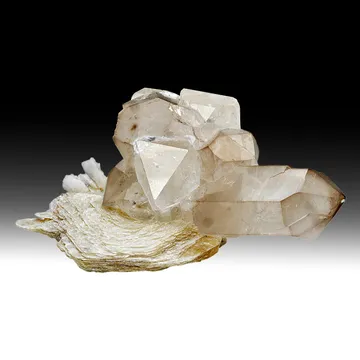
Smoky quartz from Alchuri is best understood within the feldspar–quartz–mica pegmatite environment of the Shigar Valley, with possible overlap into cleft-style quartz habits where color is present. The most desirable specimens would combine smoky transparency, sharp terminations and natural association with albite, K-feldspar, mica, schorl or aquamarine, rather than merely being loose smoky quartz sold under a broad Pakistani label. Compared with the locality’s clinozoisite, zoisite or diopside, smoky quartz is secondary in importance; its collector value depends on aesthetics, matrix, and label reliability more than on rarity alone.
Orthoclase at Alchuri is especially interesting as K-feldspar/adularia in the alpine-cleft assemblage, where transparent to very pale pink crystals may show faden-like white seams and parallel growth. Dealer and field accounts describe Alchuri adularia clusters with a distinctive winding white “rope” through the crystal, and pieces in the two-to-five-centimeter range are valued for both rarity and attractiveness. The best orthoclase/adularia specimens are sharp, lustrous, translucent and clearly faden-bearing, ideally with byssolite, quartz or other cleft associates; ordinary examples are dull feldspar fragments or massive K-feldspar that belong more to pegmatite rubble than to the celebrated Alchuri clefts.
Other documented minerals from Alchuri include axinite-(Fe), baryte, bavenite, chlorite group minerals, clay minerals, dolomite, ferro-pargasite, fluorapatite, hematite, natrolite, prehnite, scapolite-group minerals, siderite, tremolite, zircon and possible grossular, along with adularia as a K-feldspar variety and sagenitic rutile as a striking habit. No valid type-locality mineral is established from Alchuri itself in the sources consulted, but the locality is nonetheless mineralogically important because it yielded a coherent high-quality alpine-cleft assemblage in a region better known internationally for pegmatite gemstones.
Alchuri labels deserve close reading. The most common problem is not outright fakery but locality broadening: specimens from Hashupa, Tormiq, Dassu, Nyet, Yuno, Kashmal, Teston or other Shigar/Braldu localities can be traded simply as “Shigar,” “Skardu,” “Pakistan,” or sometimes optimistically as Alchuri. True Alchuri alpine-cleft specimens usually make geological sense as a group: clinozoisite, zoisite, epidote, diopside, titanite, adularia, albite, calcite, rutile, fluorapatite, vesuvianite, siderite, tremolite/byssolite and related cleft minerals. Pegmatite aquamarine from Alchuri should show a different but equally coherent association—beryl with cleavelandite/albite, muscovite, schorl, feldspar and quartz.
The most specific mislabeling issue concerns triplite and väyrynenite. Older trade attributions placed such phosphate material near Alchuri, but locality research separates triplite to the Namlook mine near Dassu, while väyrynenite is more plausibly from other localities such as Nyet or several possible Shigar/Braldu sources. Collectors should therefore be skeptical of “Alchuri triplite” or “Alchuri väyrynenite” unless accompanied by unusually strong documentation; they are not part of the normal Alchuri cleft assemblage.
The second issue is repair and fabrication. Northern Pakistan has produced many superb natural specimens, but the market has also seen glued, assembled and cosmetically enhanced pegmatite pieces, especially beryl, tourmaline, feldspar and quartz combinations sold to trekkers and less experienced buyers. Matrix aquamarines should be checked under magnification at every contact point: look for unnatural gaps, glue menisci, mismatched luster, powdered feldspar packed around a base, or a crystal that appears to sit on rather than grow from the matrix. Repaired specimens are not automatically unacceptable, but repairs must be disclosed and priced accordingly.
Species identification within the epidote-group suite can be subtle. Color alone is not enough to separate epidote, clinozoisite and zoisite, and Alchuri has produced all three. Clinozoisite may be pale to brownish or yellow-green; epidote may be greener and more iron-rich; zoisite is orthorhombic and may require Raman or X-ray confirmation in gemmy material. If the specimen is expensive, especially if represented as zoisite rather than clinozoisite, analytical support or excellent provenance adds real value.
Condition is a serious issue because Alchuri specimens tend to be small, sharp and delicate. Cleft crystals often have thin terminations, faden seams, recrystallized bases, acicular actinolite/byssolite, fragile rutile needles and brittle calcite or siderite associations. Examine edges, tips, and backs carefully. Diopside sprays and clinozoisite bundles commonly suffer edge bruising; rutile and actinolite can be partially rubbed away; calcite may be cleaved or chipped; mica-bearing pegmatite pieces can shed. Avoid ultrasonic cleaning. Use only gentle mechanical cleaning and minimal water unless the matrix and associated species are known to be stable.
Fluorescence is not a primary Alchuri selling point, but calcite on some diopside specimens has been reported to show minor fluorescence under both long-wave and short-wave ultraviolet light. UV response should be treated as a bonus, not as proof of locality. For display, these specimens benefit from strong side lighting or backlighting: many epidote-group and zoisite crystals reveal their quality only when light passes through the edges.
Market availability is modest but steady. Small Alchuri clinozoisite, epidote, diopside, titanite, adularia, vesuvianite and aquamarine specimens appear in dealer inventories and auctions, but top pieces are scarce. The finest miniatures—transparent zoisite, world-class clinozoisite, deep green diopside with titanite, faden adularia, rutile–titanite–albite combinations, and complete aquamarine-on-matrix pieces—are far less common than the generic “Pakistan aquamarine” material that floods the market. Buy the best example you can verify; for Alchuri, a small, sharp, honest miniature is usually preferable to a larger but battered or vaguely labeled piece.
Dudley Blauwet’s travel writing gives Alchuri the sort of human setting that specimen labels usually erase. In Peshawar’s Namak Mandi trade, where Afghan and Pakistani dealers carried boxes of minerals from the northern valleys, he encountered transparent pale pink Alchuri adularia crystals with white faden “rope” running through them. The group measured up to about 5 cm, and he selected nine pieces, one for his own collection. That small buying episode captures why Alchuri matters: not because the crystals were huge, but because the locality was producing alpine-style growth phenomena in species collectors did not expect to see as faden crystals.
On the road north, the Alchuri story becomes physical. Blauwet described leaving Skardu, moving through the Shigar Valley, stopping at Hashupa for cherries, and continuing toward Alchuri and Haiderabad. At Haiderabad, several hundred newly dug vesuvianites had been spread on a plastic tarp on the floor. They were reddish root-beer to brown crystals, new enough that local dealers treated them as exceptional, and priced them ambitiously. After bargaining, he walked away with three good small miniatures. The episode is memorable because vesuvianite was not yet a familiar Shigar Valley staple; it appeared as a new Alchuri surprise among the valley’s better-known aquamarines and feldspars.
The same journey includes one of the most useful authenticity anecdotes in northern Pakistani mineral collecting. In Haiderabad, Blauwet met a teashop owner nicknamed Alfi Hawaldar—“Sergeant Glue.” Alfi was described as short, squat, clever, with yellow-brown nubs for teeth and a belly laugh, and notorious for manufacturing fake mineral specimens for Western trekkers and climbers passing toward Askole and K2. The irony was that his skill made him useful: dealers could ask him to inspect other specimens for glue, because he was considered an expert at spotting the very fakery he practiced. The story is comic, but the lesson is practical: Pakistani matrix pieces can be magnificent and natural, yet they must still be examined like serious objects, not accepted as souvenirs.
Another field detail explains why Alchuri specimens are often small but hard-won. A later gem report described fresh pale zoisite/clinozoisite production from Skinsar above Alchuri, at an elevation exceeding 4,000 meters. The workings were being advanced by drilling and blasting in a tunnel extending about 15 meters into the hillside. Parcels totaling about 10 kg were seen, but only about 5–10 percent was gem quality. The gemmy portion consisted largely of clean one-to-three-gram pieces and larger translucent fragments, with colors ranging from mint green to yellow and pale brownish lavender. That is the economics of Alchuri in miniature: kilograms of mixed material for grams of fine gem and specimen quality.
Blauwet also recorded the ordinary hardship surrounding the trade. On one Shigar Valley day, a tractor became stuck in a raging meltwater stream and blocked the road near dusk. Minerals and equipment had to be loaded into backpacks for a 5 km walk back to the rest house, while an 18 kg Manebach-twinned microcline and other heavy feldspars remained a logistical nightmare. Such episodes are not romantic decoration; they explain the battered corners and repaired bases seen on many mountain specimens. A clean Alchuri miniature has survived mining, wrapping, walking, jeep transport, valley markets and export before it ever reaches a collector’s case.
Dudley Blauwet, “Famous mineral localities: Alchuri, Shigar Valley, Northern Areas, Pakistan,” The Mineralogical Record, Vol. 37, No. 6, 2006, pp. 513–540. The foundational modern locality article for Alchuri’s alpine-type clefts, ridge workings, mineral assemblage and field context.
https://www.mindat.org/reference.php?id=12909617
Wendell E. Wilson, “Minerals from Alchuri,” The Mineralogical Record, Vol. 37, No. 6, 2006, pp. 534–536. Companion article in the same issue, documenting Alchuri specimens and species.
https://mineralogicalrecord.com/product/mineralogical-record-vol-37-no-6-2006/
John S. White, “Let’s Get It Right: Clinozoisite and Epidote from Pakistan,” Rocks & Minerals, Vol. 76, No. 5, 2001, pp. 351–352. Useful for the epidote-group identification problem that affects Pakistani and Alchuri-labeled specimens.
https://www.tandfonline.com/toc/vram20/76/5
Muhammad Hassan Agheem, Mohammad Tahir Shah, Tahseenullah Khan, Mamoru Murata, Muhammad Arif and Humaira Dars, “Shigar valley gemstones, their chemical composition and origin, Skardu, Gilgit-Baltistan, Pakistan,” Arabian Journal of Geosciences, Vol. 7, 2014, pp. 3801–3814. Regional chemical and genetic study separating Shigar pegmatite gemstones from metamorphic/metasomatic zoisite–clinozoisite–axinite occurrences.
https://cir.nii.ac.jp/crid/1874242817891771776
M. Hassan Agheem, M. Tahir Shah and Tahseenullah Khan, “Gems and gem-bearing pegmatites of the Shigar valley, Skardu, Northern Pakistan,” Geological Bulletin, University of Peshawar, Vol. 37, No. 1, 2004, pp. 167–178. Regional pegmatite framework for Shigar Valley gem species, host rocks and pocket settings.
https://psa.pastic.gov.pk/SearchArticleView.aspx?articledetailId=26327
“Zoisite from Pakistan,” Gems & Gemology, Fall 2012, Gem News International. Documents Alchuri pale zoisite/clinozoisite production, gemological testing, Raman and XRD confirmation of zoisite, and later Skinsar production above Alchuri.
https://www.gia.edu/dam/jcr%3A00e9f6df-b6ad-4572-b253-a96c0fb42143/Fall-2012.pdf
Dudley Blauwet, The Road Goes on Forever, Axis, Vol. 1, No. 7, 2005. Travel report with first-hand trade and field observations from the Shigar Valley, including Alchuri adularia, vesuvianite and authenticity anecdotes.
https://mineralogicalrecord.com/wp-content/uploads/2020/10/pdfs/Dudleys-Report-1.pdf