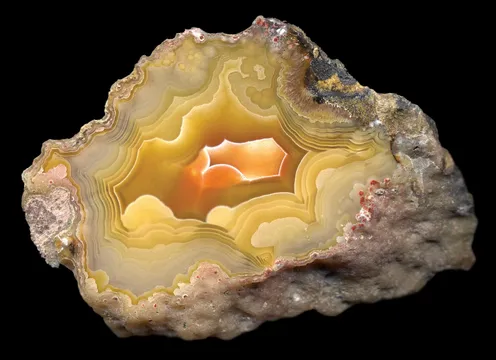
Ahumada Mine, Mexico - classic wulfenite locality in the Los Lamentos district, yielding orange to butterscotch crystals on calcite and prized by collectors.
Key facts
Ahumada Mine is the collector’s name most often attached to the great wulfenite-producing lower workings of the Erupción-Ahumada mine system in the Sierra de Los Lamentos, Ahumada Municipality, Chihuahua. It is one of the classic Mexican lead-vanadate-molybdate localities: a carbonate-hosted, oxidized lead-zinc-silver replacement manto in Cretaceous limestone where primary galena and sphalerite were transformed into cerussite, anglesite, hydrozincite, willemite, descloizite, vanadinite, and, most famously, wulfenite. The mine’s best specimens are unmistakable—thick, lustrous, orange to butterscotch wulfenite crystals, commonly perched on white calcite and dusted or partly jacketed by brown to olive arsenic-bearing vanadinite once widely called “endlichite.”
The deposit is historically important because it became a model example of a northern Mexican manto-type limestone replacement orebody and because its specimen output shaped the look of wulfenite in 20th-century collections. Unlike many Mexican districts with colonial roots, Los Lamentos was a modern desert discovery, developed for oxidized lead ore in the early 20th century and ultimately limited by water in the deeper workings. The irony is central to the locality’s mystique: the richest specimen zone lay deep, around the lower Ahumada levels, precisely where the mine began to meet the water table.
Regional View
Country View
Collector usage can be confusing. “Los Lamentos” may mean the mountain range, the mining district, or the connected Erupción-Ahumada workings. The upper Erupción ground is especially associated with anglesite, cerussite, gypsum, and sulfur, while the lower Ahumada ground is the source of the classic wulfenites. For a serious label, “Ahumada Mine, Erupción-Ahumada Mine system, Sierra de Los Lamentos, Ahumada Municipality, Chihuahua, Mexico” captures both the collector tradition and the geologic reality.

Photo: Wikimedia Commons
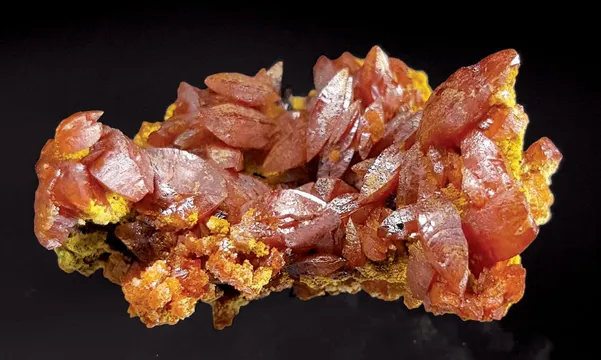
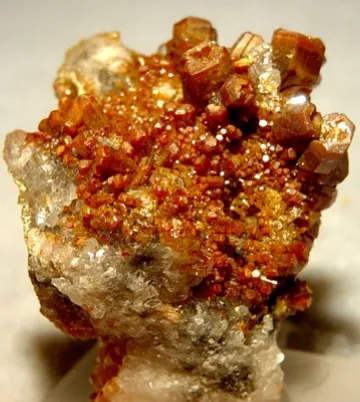
The most admired Ahumada pieces combine mass, contrast, and color. The wulfenite is typically far thicker than the fragile, wafer-like plates from many oxidized lead deposits, and the best crystals have crisp square outlines, bevelled edges, glowing orange interiors, and a resinous to vitreous luster. White calcite gives the classic “orange on snow” look; brown vanadinite or descloizite gives the more mineralogically complex, old-time Los Lamentos appearance. Some specimens show partial replacement or coating of wulfenite by arsenic-bearing vanadinite, making them as interesting genetically as they are attractive.

Photo: Wikimedia Commons
Search for specimens: View all specimens from Ahumada Mine, Mexico
Ahumada Mine lies in the Sierra de Los Lamentos, in the Chihuahuan desert of northeastern Chihuahua, roughly east of Villa Ahumada and south of the United States border. The mine is part of the Erupción-Ahumada system, a single inclined, tabular to pipe-like manto developed in a favorable Lower Cretaceous limestone bed. Published descriptions place the orebody in the Los Lamentos limestone succession, with mineralization controlled by bedding, permeability, fissuring, and folding—exactly the structural and lithologic combination that makes the great carbonate-replacement deposits of northern Mexico so specimen-rich.
The orebody was not a simple vein but a continuous replacement manto, shallowly dipping northward with the bedding. Mindat’s locality summary gives the manto as averaging about 15 meters high, 20–30 meters wide, and about 1,500 meters long down dip. A USGS deposit summary describes the Erupción-Ahumada manto as a continuous pipe-like body in the lower part of the Los Lamentos Formation, dipping about 14 degrees north parallel to bedding. The upper Erupción portion was dominated by massive and disseminated anglesite with gypsum and native sulfur, while the lower Ahumada portion contained hematite, cerussite, residual galena, and the specimen minerals that make the locality famous: wulfenite, vanadinite, and descloizite.
The mine workings followed this changing mineralogy downward. The system had levels at roughly 100-foot intervals, an adit, an internal decline, and a deep three-compartment shaft. The Erupción Mining Company originally controlled the ground from the surface to the 500-foot level, while the Ahumada Mining Company controlled the deeper ground from about the 500-foot to 800-foot levels. The two interests were later merged as the Erupción-Ahumada Mining Company, but the old ownership break mirrors the specimen break: above the 500-foot level the important collector pieces were chiefly anglesite and anglesite after cerussite in gypsum-sulfur matrix; below that, wulfenite and vanadinite became abundant.
The deposit was worked commercially for lead-silver oxide ore. Early accounts and later summaries record substantial production before water inflow overwhelmed the deeper mine. Rock & Gem’s Peter Megaw summary gives production of about 750,000 tons of cerussite-rich ore, yielding roughly 175,000 tons of lead and 3.5 million ounces of silver before unmanageable water inflows shut down mining in 1931. Other historical summaries emphasize the same end point: ore and specimen potential continued downward, but 1920s and early-1930s pumping could not keep the deeper workings dry enough for sustained mining.
Specimen production was concentrated in the lower mine. Wulfenite and vanadinite first appeared in quantity just below the 500-foot level. Between about the 500- and 650-foot levels, vanadinite and descloizite were abundant and commonly occurred as coatings on, or replacements after, wulfenite. Deeper toward the 700-foot level, the wulfenite improved in size, color, luster, and separation from the darker vanadate coatings. The best specimens were reported from just above and on the 700-foot level, including the partially flooded area known as Los Baños—“The Baths.”
Mining accounts describe the cerussite ore as friable enough that some material could be shoveled, with blasting needed mainly to remove calcite ribs and webs. That texture helped specimens survive: pods and pockets of wulfenite occurred in and around the sanded cerussite core, and some pockets could be worked by careful hand removal once exposed. At times in the 1950s and 1960s, wulfenite was abundant enough that a dedicated collector reportedly worked alongside the miners to recover specimens from the ore before they were lost.
The most important specimen periods include old commercial mining and collecting from the 1920s through the early 1960s, further recoveries in the late 1960s and 1970s, and a short but important early-1980s episode when mine rehabilitation and dewatering reopened deeper areas. Fresnillo exploration work in 1983 reportedly encountered cerussite containing substantial wulfenite below the old productive levels, reinforcing the long-held collector belief that excellent wulfenite remains below the flooded, inaccessible lower workings.
Access today should be treated as private, hazardous, and not suitable for casual field collecting. The old underground mine is extensive, water-affected, and structurally old; the best specimen ground lies deep in the historical workings. For collectors, Ahumada is now essentially a marketplace locality. Modern specimens normally come from old collections, dealer stocks, auction dispersals, and occasional reappearances of material mined decades ago, not from ordinary weekend collecting.
Ahumada wulfenite is the signature mineral of the mine and one of the defining Mexican expressions of PbMoO4: thick tabular to blocky crystals, commonly 5 mm to 2 cm and occasionally larger, in orange-yellow, butterscotch, caramel, deep orange, and red-orange tones. The best crystals came from the lower Ahumada levels, especially near the 700-foot level and the Los Baños area, where vanadinite and descloizite became less overwhelming and the wulfenite improved in size, luster, and clarity. Classic specimens show isolated, sharp, lustrous orange crystals on snow-white to cream calcite; more complex pieces have brown to olive arsenic-bearing vanadinite coatings, descloizite, gossan, or dark oxidized matrix. Fine Ahumada wulfenite is judged by thickness, color saturation, glassy to resinous luster, sharp undamaged edges, three-dimensional placement, and the contrast between orange crystals and pale calcite; ordinary pieces tend to be small, crowded, worn, dull, iron-stained, or heavily coated so that the wulfenite form is better than the visual impact.
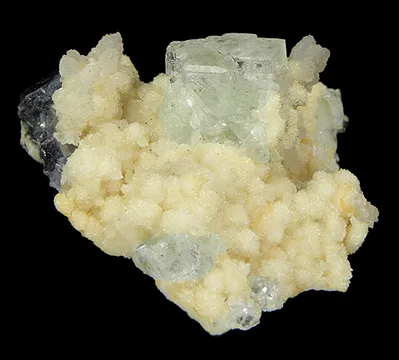
Calcite at Ahumada is usually collected not as a stand-alone species but as the essential stage on which the mine’s finest wulfenite performs. It forms white to cream, sugary, bubbly, drusy, bladed, or sparry crusts and masses in the oxidized manto, especially in the deeper wulfenite-bearing zone. The most desirable calcite matrix is clean, bright, and sculptural, giving strong contrast to orange wulfenite and to brown arsenic-bearing vanadinite; cabinet pieces with mound-like white calcite carrying evenly spaced wulfenite crystals are among the locality’s most recognizable styles. Some dealer-documented specimens note calcite fluorescence, especially under short-wave ultraviolet, but the collector value here remains mostly aesthetic: a calcite base that is sturdy, white, minimally bruised, and proportionate to the wulfenite crystals can elevate an Ahumada specimen from merely good to classic.
Vanadinite from Ahumada is most important in its arsenic-bearing form, historically and widely labeled “endlichite,” occurring as brown, olive-brown, root-beer, greenish, or dark sparkling microcrystals to small acicular or elongate hexagonal crystals on wulfenite, calcite, descloizite-rich crusts, and oxidized ore. In the upper part of the wulfenite zone, roughly between the 500- and 650-foot levels, vanadinite was abundant and commonly coated, overgrew, or pseudomorphed wulfenite; deeper, toward the 700-foot level, cleaner wulfenite became more common, though excellent combination specimens still show vanadinite dusting the matrix or selectively jacketed over wulfenite faces. The best vanadinite-bearing Ahumada pieces are not necessarily those with the largest vanadinite crystals, but those that show the paragenesis clearly: sparkling brown arsenic-bearing vanadinite draped over orange wulfenite and white calcite without smothering the composition.
Other documented minerals from the Erupción-Ahumada system include anglesite, baryte, brochantite, cerussite, chalcopyrite, chlorargyrite, descloizite, dolomite, galena, goethite, gypsum, hematite, hemimorphite, hydrozincite, limonite, native sulfur, plumbojarosite, pyrite, pyromorphite, quartz, sphalerite, and willemite. The upper Erupción mine is especially notable for anglesite and anglesite pseudomorphs after cerussite in gypsum and sulfur, while the lower Ahumada mine is the wulfenite-vanadinite-descloizite domain. Descloizite is the most important rarity for specimen collectors after wulfenite and vanadinite, especially where it coats or replaces wulfenite; willemite is also significant, both as a zinc oxidation product and because some specimens show strong short-wave ultraviolet response.
Ahumada wulfenite is common enough that a representative piece is attainable, but fine examples are much scarcer than the old abundance suggests. The mine produced many specimens over decades, and small to medium pieces still appear regularly from old collections. However, top pieces—thick, sharp, lustrous orange crystals on clean white calcite, transparent red-orange plates, large isolated “caramel” crystals, or old documented Los Baños-style material—trade as classic locality specimens rather than routine Mexican wulfenite.
Labeling is the main authenticity issue. Specimens may be labeled “Los Lamentos,” “Erupción Mine,” “Ahumada Mine,” “Erupción-Ahumada Mine,” or simply “Chihuahua.” For wulfenite, Ahumada Mine is generally the more precise collecting label; for upper-level anglesite, Erupción is often more accurate. Mislabeling also occurs between Ahumada/Los Lamentos and other Mexican or southwestern U.S. wulfenite localities. A true Ahumada piece commonly has thick orange to butterscotch crystals, white calcite or gossan matrix, and possible brown arsenic-bearing vanadinite or descloizite coatings. Thin yellow blades on mimetite-rich matrix, for example, should make a collector consider Ojuela or other Mexican localities instead.
Documented deliberate faking is not a major theme for this locality, but enhancement by cleaning, trimming, and selective removal of coatings does occur in the broader market. Some specimens have had vanadinite coatings partially removed to reveal orange wulfenite beneath; that may improve display but should be disclosed when obvious. Repairs are possible on larger wulfenite crystals, as the species is heavy, brittle, and easily nicked. Inspect crystal edges, attachment points, and any unusually isolated major crystals under magnification.
Condition is critical. Ahumada wulfenite is thicker and more robust than many wulfenites, but it is still soft enough and brittle enough to show bruised corners, cleaved edges, and contact marks. Edge wear around the perimeter of a plate may be acceptable when the central crystals are pristine; bruising on the dominant crystal dramatically reduces value. The white calcite matrix also bruises and stains easily, and old pieces may have dust embedded in the calcite or iron oxide in recesses.
Fluorescence can add interest but should not be assumed. Calcite and willemite from the system may fluoresce, especially under short-wave ultraviolet, but wulfenite itself is not normally the fluorescent feature. Handle specimens as lead-bearing minerals: do not lick or wet-clean casually, wash hands after handling, keep fragments and dust away from children and pets, and avoid acids because calcite matrix will react readily and may destabilize a specimen.
Los Lamentos has the kind of name collectors remember even before they know the minerals. The Sierra de Los Lamentos—“the lamentations”—was said to have earned its name from wind passing through cracks at the crest of the range above the mine, producing eerie shrieks and moans across the desert. The geology made the sound plausible: the same fractured, cavernous limestone that cried in the wind also guided ore fluids, later oxidation, air movement, and water through the mine.
The district was unusual for Mexico because it was not a colonial silver camp revived in modern times. The remoteness, lack of water, and relatively modest silver values kept it out of the Spanish mining tradition. José María de la Peña is credited in later accounts with the early ore discovery after a shallow prospect shaft reached rich cerussite. David Bruce Smith, a Scottish-born mining man, examined the ground before full development, and the mine’s early years unfolded against the instability of revolutionary northern Mexico. The old stories reduce the obstacles to two blunt necessities: water and protection.
The Pancho Villa episode is the most cinematic. Smith and E. F. Knotts worked the claims when they believed Villa’s forces were elsewhere, relying on desert rumor and distant dust clouds to judge danger. Villa eventually caught them at the mine in 1918 after repeated evasions. According to the collector-history retellings, he first threatened execution, then decided ransom was more profitable. The opening demand was $100,000 in gold coin. Smith bargained from desperation and practicality, and the sum eventually fell to $20,000. Even then Villa rejected paper money; the payment had to be gold, a heavy burden that had to be moved by a combination of automobile, horseback, and personal risk. Once paid, Villa reportedly left the mine alone, a rough protection arrangement born of the borderland logic of the time.
Water shaped the mine’s fate even more decisively than bandits did. In the dry camp years, water had to be hauled from a spring many miles away. Then, deep in the workings, the mine met the other extreme: water inflow near the lower levels became overwhelming. Pumping could not economically hold back the volume, and commercial mining ended while ore continued below. That is why Ahumada has always carried a sense of unfinished business. The richest wulfenite zone lay at the edge of the water problem, and every later dewatering or drought hinted at what might still be sealed below.
Collectors entered the story once wulfenite became treasure rather than ore. Earlier mining had sent enormous amounts of crystallized material toward the smelter, but by the 1940s specimen collectors understood what Los Lamentos could produce. Louis Vance’s 1949 collecting account with Earl Calvert and their guide Gómez is one of the locality’s classic field narratives. They drove from Villa Ahumada toward the mine with water and dynamite, crossed desert gullies and rough road, and slept in an abandoned adobe office where old mine papers and a heavy safe still marked the vanished company town.
The underground journey was long and physical: a horizontal adit, then thousands of feet down an incline into old stopes and lower levels where air still moved because the limestone was so fissured. At first there was wulfenite everywhere but little of it worth carrying—too small, stained, crowded, or ordinary. Then Gómez produced a specimen that looked unimpressive until turned over. The better side was excellent, and Gómez laughed; he knew the collectors had been tested.
The real pocket came after awkward crawling and close looking. A narrow fissure in limestone yielded good wulfenite, but blasting destroyed much of the first material. Later, while Calvert was wedged uncomfortably between rock and wall, Vance saw a narrow opening. They traded positions, removed a slab, and opened a cavity roughly a yard across and nearly as deep, lined with orange-yellow wulfenite on rubble in an old solution channel. Some pieces lifted free; others had to be separated from rubble where wulfenite had cemented fragments together. The reward was measured not in abstract “good specimens” but in large, three-dimensional plates heavy with lead molybdate.
The climb out was as memorable as the pocket. The incline steepened in the lower mine, and sacks of wulfenite, calcite, and oxidized lead ore made the ascent punishing. Vance compared it to climbing stairs where no stairs existed. Mexican miners could make the climb with loads in a fraction of the time; the collectors struggled upward until the miners came back to take part of the burden. When the men finally emerged, red iron oxide had colored hair, skin, and clothing. They were cut, bruised, filthy, exhausted, and already thinking about returning.
The caverns themselves became part of Ahumada lore. Strong natural ventilation reportedly helped miners locate openings; cigarette smoke could reveal which direction air was moving, and the strongest draft suggested open ground ahead. Stories also tell of a “breathing volcano” north of the mine, a sinkhole that seemed to inhale or exhale depending on pressure and wind. Underground chambers carried names—Cueva de Monte Blanco, Cueva de los Leones, Cueva del Coyote, Cueva del Nuevo Mundo, Long Tom Cave, Hojas de Plata, and Los Baños—turning the manto into a subterranean geography rather than a simple orebody.
Later specimen production came in bursts. In the late 1950s and 1960s, wulfenite was sufficiently abundant in the working stopes that mine people and local intermediaries sold quantities by weight. Collectors remembered material moving through Villa Ahumada, sometimes from unlikely places, including private homes and local shops. Benny Fenn’s collecting in 1969–1970 became legendary because of scale: accounts credit him with roughly 2,000 pounds—around 400 flats—of good wulfenite from a series of pockets. For months, his storage space reportedly looked like a Los Lamentos wulfenite warehouse.
The last great romance is Los Baños, the deep, wet wulfenite zone. In the early 1980s, renewed exploration and pumping briefly made the 700-foot level accessible after years of inaccessibility. Miners worked in waist-high water, and good wulfenite was still being produced when the water again became too great an obstacle. A mine owner reportedly left good specimens behind during the last collecting attempt, intending to return, but rising water prevented it. Drill logs from the same period indicated wulfenite-bearing cerussite between the 700- and 800-foot levels and below. For collectors, that is the enduring Ahumada dream: somewhere beyond water, collapse, and time, the orange crystals may continue down dip.