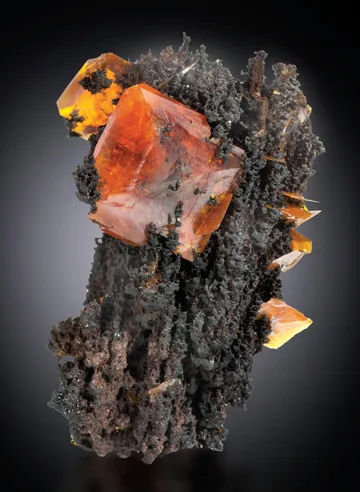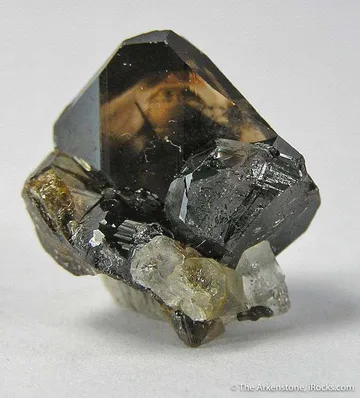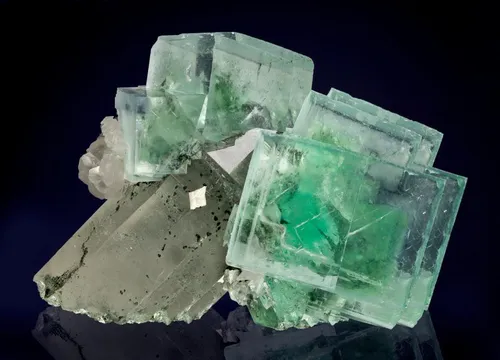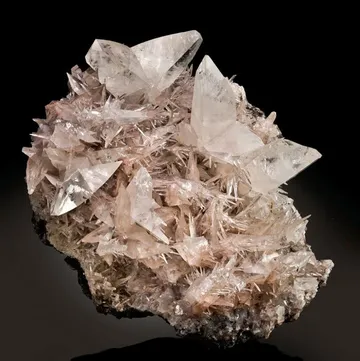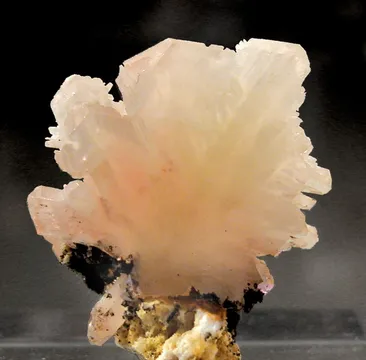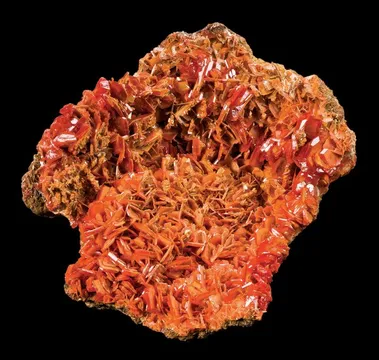
Xinjiang, China — a metallogenic province famed for deep purple fluorite cubes with dolomite base, chrome-green diopside crystals, and turquoise deposits.
Key facts
Xinjiang matters to mineral collectors less as a single mine than as a vast metallogenic province whose specimens often arrive with labels that compress an enormous landscape into one line. The autonomous region spans the Chinese Altai, Junggar, Tianshan, Tarim, Altyn Tagh, and Kunlun domains, and its collectable minerals reflect that scale: Li-Be-Ta-Nb-Cs pegmatites, alkaline rare-metal intrusions, marble-hosted gem diopside, fluorite veins and pockets, turquoise in ancient worked deposits, graphite in alkaline granite, and a long list of ore minerals from copper, molybdenum, gold, uranium, lead-zinc, nickel, and iron systems.
For today’s cabinet collector, the name “Xinjiang” most often appears on deep purple fluorite, commonly with white to cream dolomite, from recent Aksu-area production; on vivid green chromium-bearing diopside crystals from the Baxiyayike occurrence in Baicheng County, Akesu Prefecture; and, less often, on minerals from the world-famous Koktokay No. 3 pegmatite in the Altay pegmatite field. The best modern fluorites are architectural rather than merely colorful: intergrown cubic crystals, stepped or “staircase” growth, rich violet saturation, translucent to transparent interiors, and occasional pale dolomite that gives the purple cubes a snowy base. The better diopsides are bright chrome-green, transparent, prismatic to tabular-prismatic crystals from alkaline pegmatite veins in marble—small by cabinet-mineral standards, but gemmy and unusually lively.
Regional View
Country View
Xinjiang also has a deeper historical role than many modern specimen labels suggest. Turquoise from Tianhu East, about 180 km southeast of Hami, was worked in antiquity and later recognized as an archaeologically protected deposit. A fluorite bead from the Bronze Age Tianshanbeilu cemetery in Hami shows that fluorite was not only a modern display mineral here: in eastern Xinjiang, it was part of early exchange, ornament technology, and the movement of materials between the Eurasian interior, the Hexi Corridor, and the Central Plains.
Search for specimens: View all specimens from Xinjiang, China
“Xinjiang, China” is a regional label, and serious collectors should treat it as a starting point rather than a final locality. The province-scale geology is the reason the label covers such varied material. Northern Xinjiang includes the Chinese Altai and East Junggar domains, famous for granitic pegmatites and alkaline granites. Central and southern belts include the Tianshan and the northern margin of the Tarim Basin, where marble, carbonate, clastic, and intrusive rocks host gem, industrial, and ore mineralization. The region’s metallogenic history includes Paleozoic accretionary and post-collisional events, Mesozoic basin development, and younger basin-margin systems, producing a particularly broad suite of industrial and collector minerals.
The most famous hard-rock specimen locality within the broader Xinjiang collector world is Koktokay No. 3 in the Koktokay pegmatite field, Fuyun County, Altay Prefecture. It is a Li-Be-Ta-Nb-Cs rare-metal pegmatite, historically worked for pollucite, spodumene, lepidolite, beryl, and columbite-tantalite. Its internal structure is textbook-grade: from rim to core, studies recognize graphic and pseudo-graphic pegmatite, saccharoidal albite, blocky alkali feldspar, muscovite-quartz, cleavelandite-spodumene, quartz-spodumene, platy albite-muscovite, lepidolite-platy albite, and a blocky quartz-microcline core. That zonation is not just academic; it explains why Koktokay specimens may range from rare-metal phosphates and oxides to beryl, spodumene, mica, feldspar, quartz, and accessory fluorite.
The modern purple fluorite that has given the broad “Xinjiang” label renewed attention is generally marketed from the Aksu/Akesu region, with dealer labels including Aksu, Ke Ping, Baicheng County, and sometimes simply “Aksu Mine.” The best documented commercial material appeared in quantity from finds described as beginning around 2022 and was prominent in dealer updates and auction offerings in 2024–2025. These fluorites are cubic, purple, often multi-generation, and commonly show stepped surfaces or stacked cube architecture. Dolomite, when present, is typically white, cream, or pale beige and forms the contrasting carbonate matrix that elevates the best specimens from attractive purple fluorite clusters into display pieces.
The Baicheng County diopside occurrence at Baxiyayike is a different geological story. There, gem diopside occurs in alkaline pegmatite veins hosted by marble on the southern slopes of the South Tianshan range. The documented veins reach hundreds of meters in length, and the green color is attributed to a small chromium component. Transparent crystals are reported as prismatic to tabular-prismatic, commonly in the 1–3.5 cm long range and locally larger. Northern marble-hosted ore bodies also produce diopside, but much of that material is more fractured or cloudy and less desirable for specimens. The southern part of the deposit is noted for phlogopite and sodalite in the marbles, adding useful paragenetic context even when those species are not the market focus.
Industrial fluorite mineralization is also present elsewhere in Xinjiang, including the Kaerqiaer fluorite belt in Ruoqiang County, Bayin’gholin Autonomous Prefecture, where Kumutashi, Kaerqiaer, and Xiaobaihegou are recorded as fluorite deposits. These are important for understanding Xinjiang’s fluorine-rich metallogenic systems, but they are not the main source normally invoked by the recent purple Aksu-style cabinet specimens. Collectors should keep the distinction clear: a provincial label may be truthful while still concealing whether a piece is from an Aksu pocket, a Baicheng-area occurrence, Koktokay, a fluorite belt deposit, or another sublocality entirely.
Mining access today varies sharply by sublocality. Koktokay is a long-studied mining and geopark area, not an ordinary collecting ground. Tianhu East turquoise is protected because of its archaeological status. Baxiyayike and the Aksu fluorite finds are specimen sources known mainly through Chinese dealers, show supply, and secondary-market labels rather than through open collector access. In practical collecting terms, most specimens from Xinjiang should be acquired through established dealers with a clear chain of ownership, photographs, and—where possible—more specific locality information than “Xinjiang, China.”
Xinjiang fluorite in the current collector market is dominated by deep purple Aksu-area material, usually cubic, translucent to transparent, and frequently built from repeated growth episodes that make the faces look stepped, terraced, or stacked. Better pieces show rich violet saturation without becoming dead-black, bright luster on the cube faces, visible internal zoning or glow when backlit, and an aesthetic stance on matrix rather than a loose pile of cubes. Dolomite is the classic association: white, cream, or pale beige rhombs and crusts provide contrast at the base or between crystals. Sizes range from small miniatures through large cabinet specimens; the market has seen plenty of ordinary detached or chaotic growth pieces, while upright, sculptural matrix specimens with minimal bruising are much scarcer and command a premium. Some labels give Aksu, Ke Ping, or Baicheng County, but many still read only “Xinjiang,” so provenance matters.
Dolomite from the Xinjiang specimen trade is chiefly appreciated as the carbonate partner to the recent purple fluorites rather than as a stand-alone cabinet mineral. On the better Aksu-area specimens it appears as white to creamy, sometimes pale beige, crystallized coverage on matrix or as a contrasting base under violet fluorite cubes. The dolomite’s value here is compositional and aesthetic: it clarifies the architecture of the fluorite, softens the color contrast, and helps identify the best matrix pieces within a market otherwise full of loose or damaged fluorite clusters. Good examples show fresh, clean dolomite with crisp rhombic sparkle and no heavy iron staining or broken, powdery-looking patches; ordinary examples use dolomite merely as a thin druse or rubbley matrix with little visual impact.
Xinjiang diopside of greatest collector interest comes from the Baxiyayike diopside occurrence in Baicheng County, Akesu Prefecture, where alkaline pegmatite veins in marble produce chromium-bearing green crystals. The strongest pieces are transparent, saturated green, sharply prismatic to tabular-prismatic, and clean enough to read as gem crystal specimens rather than merely green pyroxene in rock. Documented average crystals are small—roughly centimeter-scale, with reported larger crystals reaching several centimeters—so quality is judged by color, transparency, termination, and freedom from fractures more than by size alone. Cloudy or heavily fractured diopside from marble-hosted ore bodies is much less desirable; the finest examples have a lively glassy brightness and enough form to show the pyroxene prism clearly, sometimes with marble, phlogopite, or sodalite-bearing context.
Other documented Xinjiang minerals make the region far richer than the three species above. Koktokay and the Altay pegmatite fields are associated with beryl, spodumene, lepidolite, pollucite, columbite-tantalite, tapiolite, mica, feldspar, quartz, and rare phosphates; qingheiite was described from a muscovite pegmatite in Qinghe County, Altay Prefecture. The Boziguoer rare-earth and rare-metal alkaline intrusion in Baicheng County has produced fluornatropyrochlore and a suite including pyrochlore-group minerals, zircon, monazite, bastnäsite-related REE mineralization, fluorite, astrophyllite, and other alkaline-intrusion accessories. Tianhu East turquoise is important mineralogically and archaeologically, with blue to bluish green veins and nodules in quartzite, plus associated quartz, apatite, goethite, hematite, jarosite, bonattite, muscovite, atacamite, svanbergite, and gypsum. Xinjiang also records important graphite, gold, copper-molybdenum, uranium, lead-zinc, nickel-copper, iron, evaporite, and salt-lake mineral systems, though many of these are ore-geology localities rather than sources of fine hand specimens.
The central collector problem with Xinjiang specimens is not that the material is inherently doubtful, but that the locality label is often too broad. Xinjiang is enormous, and a label that would be laughably imprecise in Europe or the United States is still common on Chinese export specimens. For purple fluorite, ask whether the dealer can support Aksu, Ke Ping, Baicheng County, or another more specific source, and be cautious when a specimen is described only with fashionable terms such as “new Xinjiang find” without any chain of provenance.
For the Aksu-style fluorites, the usual condition issue is bruising on cube edges and stepped growth faces. These pieces often look blocky and robust, but fluorite has perfect octahedral cleavage and a Mohs hardness of 4; edge dings, cleaved corners, repaired protruding cubes, and contact damage on the back or base are common. Backlighting is useful when evaluating them: the better purple pieces transmit light and show internal depth, while lesser examples are opaque, muddy, or visually flat. Matrix specimens are more desirable than loose clusters when the composition is balanced and the dolomite is clean, but matrix also increases the chance of hidden repairs or glued supports.
No well-documented, systematic fake industry specific to Xinjiang fluorite or diopside is established in the mineralogical literature, but mislabelling is common enough to matter. Some Chinese purple fluorites from other provinces can be confused with Xinjiang material if all one has is a color and a vague country label. Conversely, “Xinjiang” may be used when the seller simply lacks a sublocality. Treatments should be handled case by case: ask directly about repairs, stabilization, oiling, dyes, polishing, and acid cleaning. For turquoise from Tianhu East, archaeological protection and the brief modern market appearance of material make provenance particularly important; collectors should avoid material that appears to have been illicitly removed from protected sites.
Fluorescence claims deserve restraint. Fluorite may fluoresce, and some Aksu/Xinjiang specimens are promoted online with ultraviolet or “glow” language, but the locality is not defined by a single consistent fluorescent response. Evaluate the specimen in daylight first: form, luster, saturation, transparency, matrix, and condition are the serious value drivers. Diopside should be judged under neutral light for chromium-green color, transparency, and fractures; gemmy crystals are more vulnerable to chipping than massive pyroxene, so boxed storage and careful handling are recommended.
Rarity is tiered. Small to mid-sized purple Xinjiang fluorite clusters are available on the current market, but top matrix specimens with strong color, clean geometry, and minimal damage are far less common. Dolomite is common as an accessory but uncommon as a truly aesthetic supporting matrix. Fine Baxiyayike diopside crystals are specialized and much scarcer in general mineral circulation than the fluorites. Koktokay rare species, especially well-provenanced older material, belong to a separate collecting category and should be bought with species confirmation and locality documentation whenever possible.
One of Xinjiang’s most memorable fluorite stories does not begin in a mine pocket but in a grave. At the Tianshanbeilu cemetery in the Hami oasis, a translucent barrel-shaped bead from grave M099 had originally been marked as quartz and then mostly ignored. The cemetery itself is a key Bronze Age site: more than 700 graves, positioned at the eastern end of the Tianshan Mountains where routes from the Eurasian interior meet the Hexi Corridor. When researchers returned to the bead with micro-XRF and Raman spectroscopy, the old “quartz” label fell away. The object was fluorite, CaF2. Its diagnostic Raman signal and calcium-fluorine chemistry made the identification secure, and its date—approximately 1385–1256 BCE—placed it among the earliest known long barrel fluorite beads in China.
The bead is interesting not simply because it is fluorite, but because fluorite is a difficult material to work. It is soft enough to abrade, but it cleaves perfectly and breaks treacherously; long drilled holes are risky. The Tianshanbeilu bead showed circular marks at both ends of the drill hole, pointing to tubular drilling from two directions. In the same cultural world, copper and bronze objects were abundant, and at least 79 of 705 tombs contained copper-based tubes about 5 mm in outside diameter; one tomb of similar age, M125, contained seven bronze tubes. The bead therefore becomes a tiny, polished argument for craft technology: not a casual pebble ornament, but a worked mineral object made with enough control to survive drilling, shaping, burial, excavation, misidentification, and eventual scientific recognition.
Tianhu East tells a second Xinjiang story, this time in blue-green phosphate rather than purple fluoride. The deposit lies about 180 km southeast of Hami and was mined in antiquity as early as 1279–379 BCE. Modern activity resumed around 2015, and some turquoise appeared briefly on the Chinese jewelry market. Then the door closed: mining was prohibited because the locality is protected as an archaeological site. The geology is unusually instructive. Unlike many Chinese black-shale-related turquoise deposits where the turquoise sits mainly in shale, Tianhu East places blue to bluish green veins and nodules in quartzite, with the black shale acting as the source zone for aluminum, phosphorus, and copper. The turquoise fills fissures and shear zones, sometimes in veins up to 8 mm thick and nodules roughly 3–5 cm across. In a field of quartzite, black shale, limonite, pyrite, sericite, and weathering fractures, the mineral records the movement of supergene solutions through rock—an ancient gemstone born in the narrow spaces opened by tectonics and weathering.
The modern Aksu fluorite story has the flavor of a contemporary mineral rush. Dealers began describing a substantial new supply from Xinjiang, with finds said to date from about 2022. By late 2024 and 2025, these pieces were conspicuous enough that specialists were comparing them with other classic purple fluorite localities and noting the frustration of labels that said only “Xinjiang.” The best pieces were not just purple cubes; they were little cities of fluorite, towers and terraces of stepped cubic growth, some glowing from within when a light was placed behind them. One auction description called a 6.6 cm specimen a “cubist mansion in purple” and argued that truly sculptural matrix pieces were dramatically scarcer than the mass of loose, chaotic, or damaged clusters. Whether one accepts the market superlatives or not, the point is useful: the find produced quantity, but quantity did not make the top aesthetic pieces common.
Kuerban Reheman, Meiting Yan, Chunlei Qin, Xiaoguang Li, Mulati Simayi, and Zihua Tang, “A fluorite bead from Bronze Age Tianshanbeilu cemetery, Xinjiang, Northwest China,” Heritage Science, 12, article 256, 2024. This paper identifies a Bronze Age fluorite bead from Hami by micro-XRF and Raman spectroscopy and places it in the history of early Chinese fluorite ornament use. https://www.nature.com/articles/s40494-024-01379-y
Ling Liu, Mingxing Yang, Qiaoqiao Li, Yi Tang, Huilin Wen, Ye Yuan, Yan Li, and Jia Liu, “Mineralogy and Geochemistry of Turquoise from Tianhu East, Xinjiang, China,” Gems & Gemology, Vol. 60, No. 1, pp. 2–25, 2024. A detailed modern study of Tianhu East turquoise, its quartzite-hosted occurrence, associated minerals, geochemistry, and archaeological protection. https://www.gia.edu/doc/spring-2024-turquoise-tianhu-east.pdf
Zhu Jin-chu, Wu Chang-nian, Liu Chang-shi, Li Fu-chun, Huang Xiao-long, and Zhou Dong-shan, “Magmatic-Hydrothermal Evolution and Genesis of Koktokay No.3 Rare Metal Pegmatite Dyke, Altai, China,” Journal of Geology, 2000. A classic study of Koktokay No. 3’s Li-Be-Ta-Nb-Cs pegmatite, its nine internal zones, melt inclusions, and magmatic-hydrothermal evolution. https://geology.nju.edu.cn/EN/abstract/abstract9041.shtml
Zhou Qifeng, Qin Kezhang, Tang Dongmei, Wang Chunlong, Tian Ye, and Patrick Asamoah Sakyi, “Mineralogy of the Koktokay No. 3 pegmatite, Altai, NW China: Implications for evolution and melt–fluid processes of rare-metal pegmatites,” European Journal of Mineralogy, Vol. 27, No. 3, pp. 433–457, 2015. A major mineralogical treatment of one of Xinjiang’s most important rare-metal pegmatites. https://friendsofmineralogycolorado.org/wp-content/uploads/2016/07/2016_March_China_pegmatite_publication_references_Foord_symposium.pdf
Yin Jing-wu, Li Guo-wu, Yang Guang-ming, Ge Xiang-kun, Pan Bao-ming, Xu Hai-ming, and Wang Jun, “Fluornatropyrochlore, a New Pyrochlore Supergroup Mineral,” Acta Mineralogica Sinica, Vol. 36, No. 1, pp. 34–37, 2016. Description of fluornatropyrochlore from the Boziguoer rare-earth ore deposit, Baicheng County, Akesu Region, Xinjiang. https://english.gyig.cas.cn/pu/Papers_of_AMS/201602/t20160203_159492.html
Ma Zhesheng, Shi Nicheng, and Peng Zhizhong, “Crystal structure of a new phosphatic mineral—qingheiite,” Scientia Sinica, Series B, Vol. 26, pp. 876–884, 1983. The key crystallographic publication for qingheiite, a phosphate named for Qinghe County in Xinjiang’s Altay region. https://www.mindat.org/min-3333.html
Xinhao Sun, Yunsheng Ren, Zhenjun Sun, Jingmou Li, and Mengjia Huang, “Metallogenic age and hydrothermal evolution of the Huangyangshan graphite deposit in eastern Xinjiang, NW China: constraint from zircon geochronology and geochemistry,” Frontiers in Earth Science, 13:1709937, 2026. A modern study of the unusual Huangyangshan graphite deposit hosted in alkaline granite. https://www.frontiersin.org/journals/earth-science/articles/10.3389/feart.2025.1709937/full
Mindat: Baxiyayike diopside occurrence, Baicheng Co., Akesu Prefecture, Xinjiang — The key locality page for Xinjiang’s chromium-bearing gem diopside occurrence, including geology, crystal sizes, and associated minerals.
Mindat: Aksu Co., Akesu Prefecture, Xinjiang — Useful regional reference for Aksu-area minerals and the locality framework behind many recent Xinjiang fluorite labels.
Mindat: Koktokay No. 3 pegmatite, Altay Mine, Xinjiang — Essential reference for the famous Koktokay rare-metal pegmatite, its minerals, and its internal zonation.
The Mineralogical Record: “What’s New in the Mineral World,” Report 72 — Contemporary market commentary on the new purple “Xinjiang” fluorites and the problem of imprecise locality labels.
Mineral Auctions: Fluorite on matrix, Aksu Mine, Xinjiang — A detailed auction record documenting 2025 market response, specimen quality criteria, matrix rarity, and condition notes for recent Aksu fluorite.
The Khyber Mineral Company: Aksu fluorite dealer notes — Dealer descriptions of recent Aksu fluorites, including matrix examples, stepped growth, zoning, and linked specimen videos.
Barras Gautier Minéraux: Fluorite–Calcite, Baicheng Co., Akesu Prefecture — A European dealer archive illustrating the high-end Baicheng/Aksu-style purple fluorite market.
Heritage Science: A fluorite bead from Bronze Age Tianshanbeilu cemetery — Open-access archaeological and analytical study of the earliest known long barrel fluorite bead from China.
GIA: Mineralogy and Geochemistry of Turquoise from Tianhu East, Xinjiang — Detailed gemological and mineralogical treatment of Xinjiang turquoise, including ancient mining, modern protection, and associated minerals.
Chinese Academy of Sciences: Fluornatropyrochlore, a new pyrochlore supergroup mineral — Source for the Boziguoer fluornatropyrochlore description and its IMA context.
Nanjing University geology abstract: Koktokay No. 3 magmatic-hydrothermal evolution — Concise abstract summarizing Koktokay No. 3’s nine pegmatite zones and fluid/melt inclusion evidence.