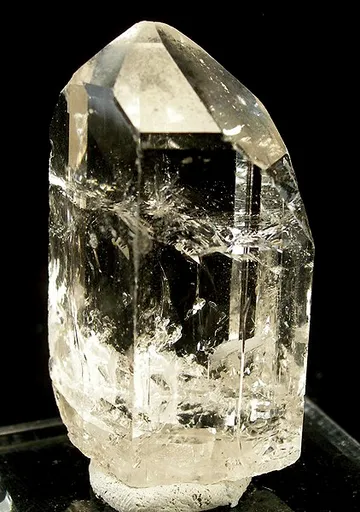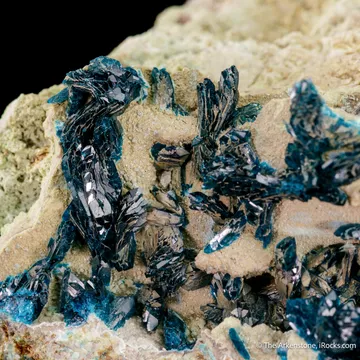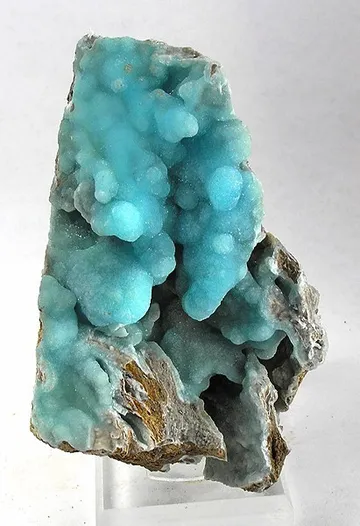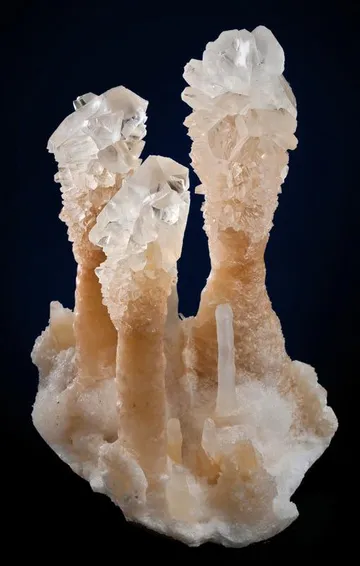
Amo Sn deposit, China — renowned for transparent, twinned cassiterite on quartz, with striking zoning, and the rare ximengite BiPO4 from this tin district.
Key facts
The Amo Sn deposit is one of the small but memorable Yunnan tin localities that crossed from ore geology into the specimen world because its cassiterite is not merely abundant enough to mine: at its best it is transparent, sharply twinned, dark honey-brown to reddish brown, and perched on pale quartz in a way that gives cabinet pieces real presence. The locality lies at Amo, in Ximeng County, Pu’er, western Yunnan, within the broader Lancangjiang tin metallogenic belt and the Changning-Menglian tectonic belt of the Sanjiang Tethys region. That setting matters to collectors because it places Amo among the granite-related tin systems of southwest China, where evolved magmatic-hydrothermal fluids produced cassiterite-bearing veins, greisen-style assemblages, quartz, mica, tourmaline-group minerals, sulfides, arsenates, phosphates, and bismuth minerals.
Amo is best known to collectors for cassiterite with quartz. Fine examples show lustrous, highly modified twinned cassiterite crystals, commonly transparent to translucent when backlit, with darker cores or color zoning and bright faces against white to colorless quartz. It is also mineralogically important as the locality now tied to ximengite, BiPO4, a rare bismuth phosphate first described from the Ximeng tin-mining district and later connected by published locality work to the Amo deposit. That combination—a serious ore deposit, a type-locality rarity, and attractive gemmy cassiterite specimens—gives Amo far more significance than its modest market footprint might suggest.
Regional View
Country View
The best Amo pieces are not the huge, opaque Chinese cassiterites familiar from some other districts. Their appeal is more refined: relatively isolated twins, aerial positioning, transparent brown interiors, and quartz matrix that frames the cassiterite rather than overwhelming it. Published dealer-reference specimens document crystals from about 1 cm to more than 3 cm, and one celebrated 2002 piece carries a main cassiterite crystal measuring 4.7 × 4.7 cm on an 11.8 cm matrix—exceptional for the locality and still one of the benchmark images collectors use when thinking of Amo.
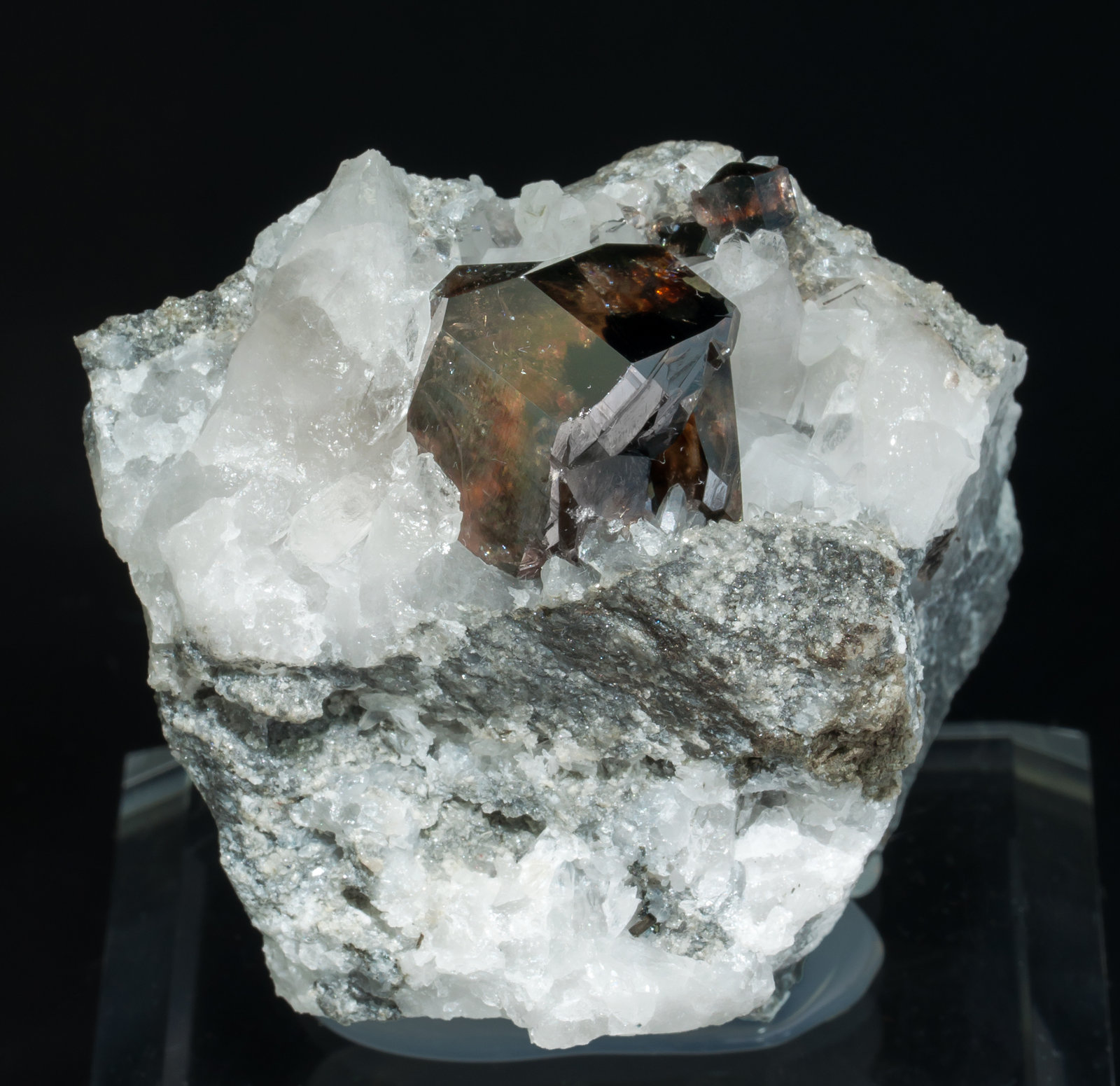
Photo: Fabre Minerals
Search for specimens: View all specimens from Amo Sn deposit, China
Amo is recorded as a hypothermal tin deposit in Ximeng County, Pu’er, Yunnan, and is part of the Lancangjiang tin metallogenic belt. Regionally, the deposit belongs to western Yunnan’s Sanjiang Tethys metallogenic province, near the Changning-Menglian belt, a major tectonic zone developed between the Baoshan and Simao blocks. Granite-related tin mineralization in this part of Yunnan is tied to evolved magmatic-hydrothermal systems, and published work on the Ximeng-Amo deposit specifically treats it as a high-temperature to hypothermal tin system related to granite intrusive activity.
The specimen assemblage is dominated, visually, by cassiterite and quartz. The mineral list documented for the deposit is broader and more revealing: albite, arsenopyrite, bismuthinite, bismutite, cassiterite, pyrite, quartz, scheelite, scorodite, sphalerite, tainiolite, tourmaline-group minerals, limonite after iron-bearing phases, and ximengite. This is a classic tin system with a bismuth-phosphate superprint: cassiterite and quartz form the collector-grade pieces, while bismuthinite alteration and phosphate mineralization account for ximengite’s presence.
The ore bodies and specific pocket names are not well exposed in the collector literature. What is clear is that Amo produced cassiterite crystals on quartz matrix from fissure- and vein-style mineralization rather than from large open cavities yielding abundant display specimens. The crystals that reached the mineral market tend to be discrete twins or compact groups on quartz, not dense ore masses. A Chinese collector-locality survey places the occurrence at Amo village, Xinchang township, Ximeng County, and describes the Ximeng cassiterite as usually reddish brown, with excellent luster and transparency, and crystals reported up to about 3 cm in that account. Fabre Minerals has documented several higher-end pieces with main crystals in the 1.8–3.4 cm range, plus the exceptional 4.7 cm benchmark crystal from 2002.
Mining history at Amo is less thoroughly published than the better-known Yunnan tin camps, but the deposit was already significant enough for geochemical and metallogenic study by the late 1980s and early 1990s. Ximeng-area cassiterite is reported from tin prospecting and mining activity beginning in the 1980s, and gem-quality cassiterite from the Ximeng-Amo area was sufficiently notable by 2021 to be discussed in gemological literature alongside the Yalian-Yunling material of Yongde County. A 2025 Yunnan provincial underground-mine responsibility notice lists a Ximeng Yuntian Mining Co. tin mine at Amo village, Xinchang town, with adit and inclined-shaft workings and a status of stopped production. That is useful for understanding the modern administrative picture, but it should not be read as an invitation to collect.
For collectors today, Amo is essentially a specimen-trade locality rather than a field-collecting destination. There is no documented public collecting access, and the realistic route to a specimen is through older Chinese trade material, established dealers, auction records, and collections. Matrix cassiterites from the 1990s, the documented 2002 find, specimens labeled 2011 and 2013, and more recent resale pieces form the core of what serious collectors encounter. Amo labels are sometimes shortened to “Ximeng” or “Yunnan,” so the most desirable specimens are those with older dealer documentation, publication history, or a precise Amo/Ximeng/Pu’er attribution.
Cassiterite from Amo is prized for qualities that are uncommon in tin-ore specimens: transparency, high luster, sharp twinning, and attractive placement on quartz. The typical collector crystal is brown to dark brown, commonly reddish or honey-toned where light passes through thinner edges, and many show twinned or cyclic-twinned forms with crisp faces and strong reflections. Published examples include miniature to small-cabinet specimens with main crystals around 1–2 cm, rarer crystals around 3 cm, and an exceptional 2002 specimen with a 4.7 × 4.7 cm main crystal on quartz matrix. The best pieces are not simply large; they are undamaged, glassy to subadamantine, visibly translucent, and isolated enough on the matrix to show the twin geometry. Ordinary Amo cassiterite is darker, more massive, more contacted, or crowded into ore matrix; the memorable pieces have the look of a gem crystal that happened to remain on matrix.
Quartz at Amo is important chiefly as the matrix and visual partner for cassiterite. On collector specimens it appears as white to colorless quartz crystals or drusy quartz lining the tin-bearing matrix, sometimes with mica or dark needle-like inclusions noted in both quartz and cassiterite on dealer-described pieces. The best quartz does not usually compete with the cassiterite for size; instead it supplies contrast, brightness, and context, making the brown cassiterite appear more transparent and more sculptural. Good Amo quartz associations show open space around the cassiterite, clean crystal surfaces, and stable matrix; lesser examples are quartz-rich but visually confused, iron-stained, or damaged in a way that leaves the cassiterite looking like an ore fragment rather than a display specimen.
Other documented minerals from Amo give the deposit much of its mineralogical interest beyond display cassiterite. Ximengite, BiPO4, is the standout rarity and type-locality mineral; it was described from the Ximeng tin-mining district and is linked in later locality data to the Amo deposit. It occurs as very small granular material, veinlets, and earthy aggregates, interpreted as an alteration product of bismuthinite in the tin deposit and associated with bismuthinite, waylandite, monazite, cassiterite, and tourmaline. Bismuthinite and bismutite mark the bismuth-bearing side of the system, while arsenopyrite, pyrite, sphalerite, scheelite, scorodite, tainiolite, albite, tourmaline-group minerals, and limonite round out the documented assemblage. The arsenopyrite association is especially interesting for collectors because a 2007 Chinese locality note records the first appearance of combination specimens showing about 2 cm arsenopyrite with bright transparent cassiterite crystals.
Amo cassiterite is a locality where accurate labeling matters. Specimens may be offered simply as “Ximeng,” “Yunnan,” or even broadly “China,” and some market descriptions use “Amo Tin deposit” while others use “Amo Sn deposit.” That is not necessarily mislabeling, but vague labels should be weighed carefully because Yunnan has more than one cassiterite-producing area, and China also produces very different cassiterite styles from Sichuan, Jiangxi, Inner Mongolia, and other regions. Amo pieces are generally smaller, more transparent, and more commonly shown with quartz matrix than the large, darker, blockier material often associated with other Chinese localities.
No well-documented, locality-specific fake or treatment problem is prominent in the sources consulted. The greater risks are misattribution, repaired crystals, glued-on matrix pieces, and undisclosed restoration of broken cassiterite tips or edges. Cassiterite is dense and brittle; a small crystal can feel surprisingly heavy, and sharp edges, terminations, and twin junctions may chip if the piece is handled casually. On quartz matrix, look closely for contact damage where the cassiterite rises from the matrix, and inspect around the base of aerial crystals for adhesive, fill, or suspicious iron-oxide staining hiding a join.
Color and transparency are central to value. Fine Amo cassiterite often looks nearly black under flat room light, then opens to brown, reddish brown, or toasted honey when a strong light is passed through an edge. This is not a treatment by itself; it is part of the appeal of gem-quality cassiterite from the locality. Published gemological work on Ximeng cassiterite recorded no fluorescence or phosphorescence under long-wave and short-wave ultraviolet radiation, so UV response is not a useful selling point for the cassiterite itself. Ximengite, by contrast, is a microscopic rarity rather than a display mineral, and should be treated as a species-confirmed analytical occurrence unless accompanied by serious documentation.
Availability is limited. Amo specimens do appear in the modern market, but good undamaged pieces are described by specialist dealers as scarce, and most high-quality examples are already in collections or circulate as resale material. A strong Amo specimen should ideally have a precise locality, a dated dealer label or collection history, visible translucency, sharp twinning, quartz association, and minimal damage. A specimen that combines all of those qualities is much more desirable than a larger but opaque or bruised cassiterite mass.
The specimen that made many collectors look twice at Amo was collected in 2002: an 11.8 × 9.7 × 7.5 cm cassiterite-with-quartz matrix carrying a main crystal 4.7 × 4.7 cm across. In photographs it has the drama that great cassiterites need—dark at first glance, but with transparent brown windows and mirror-bright faces when light catches the twin. Fabre Minerals later described it as one of the best pieces found at the locality, and in the Tucson Virtual 2021 chronicle it was singled out not only for crystal size and luster but also because it represented a hypothermal tin deposit whose best specimens could look like “natural works of art.” For Amo, that piece became a benchmark: if a dealer calls a cassiterite “good for the locality,” this is the visual standard lurking in the background.
Another small but memorable note comes from the Chinese specimen-locality literature. In spring 2007, the Ximeng tin mine reportedly produced combination specimens with arsenopyrite crystals around 2 cm associated with transparent cassiterite. The detail is easy to overlook, but it is exactly the sort of event collectors remember: not a new species, not a huge pocket with a trade name, but a fresh association that sharpened the locality’s identity. Amo was already known for reddish-brown gemmy cassiterite; the 2007 arsenopyrite-cassiterite combinations added a more mineralogical, sulfide-rich face to the locality.
The quieter story is ximengite. When Shi Jiaxin described the rare bismuth phosphate in 1989, the locality was given only as an undefined Ximeng County tin occurrence, about 420 km southwest of Kunming. Later locality work connected that tin-mining area to Amo. The result is a curious split personality: the mineral that gives Amo its type-locality distinction is not a showy cabinet mineral at all, but microscopic to granular BiPO4, colorless in the description and tied to bismuthinite alteration. Most collectors will never see a display-quality ximengite from Amo; nevertheless, its presence gives every cassiterite label from the deposit a deeper mineralogical context.