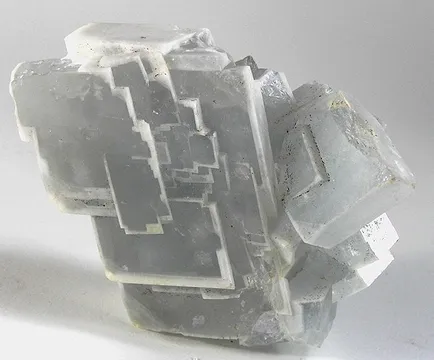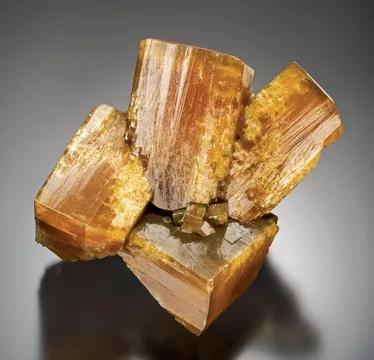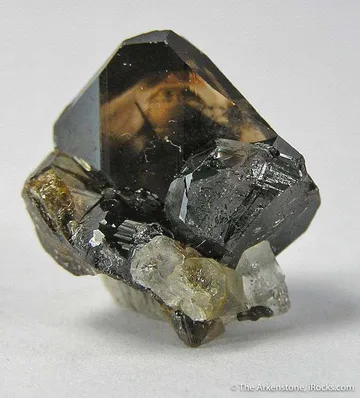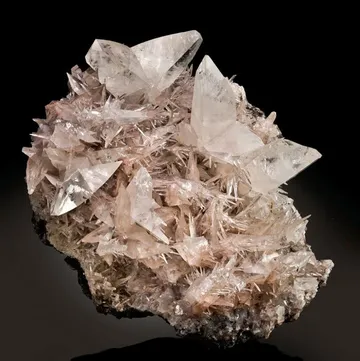
Xihuashan ore field, China — a historic tungsten–tin locality famed for Piaotang fluorite and quartz, with granitic-hydrothermal textures prized by collectors.
Key facts
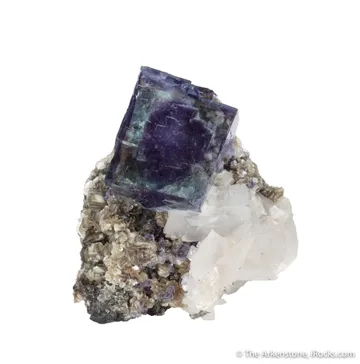
Xihuashan is one of the foundational names in Chinese tungsten: a classic South Jiangxi, Nanling Range ore field where wolframite-bearing quartz veins and F-rich granites created both an industrial landmark and a surprisingly refined collector locality. For the specimen world, the name is most often encountered on fluorite and quartz from the Piaotang side of the ore field—transparent to translucent fluorite cubes, octahedra, and stepped composite forms on lustrous quartz, muscovite, feldspar, calcite, sulfides, and, more rarely, scheelite. The best pieces have a look that is unmistakably granitic-hydrothermal: glassy colorless or pale green interiors, lavender to purple edge zoning, terraced cube growth, sharp quartz accents, mica-rich matrix, and the occasional brassy chalcopyrite or arsenopyrite note.
Geologically, the ore field belongs to the eastern Nanling tungsten–tin province of South China. The Xihuashan granite complex intruded low-grade Cambrian metasedimentary rocks and became the engine for a long-lived magmatic-hydrothermal system rich in W, Sn, Mo, Bi, F, Be, Y, and REE. At the mine scale, this is not a single picturesque cavity deposit but a vein field: thick and thin quartz veins, greisen alteration, feldspathized granite, hornfelsed country rock, and a paragenesis that grades from high-temperature silicates and oxides to sulfides, fluorite, carbonates, and late hydrothermal overprints. That geological complexity is why a “Piaotang fluorite” label can conceal a richer story: these are not isolated fluorite specimens from a fluorspar mine, but accessory-to-gangue minerals from a tungsten–tin system of national historical importance.
Regional View
Country View
The ore field’s collector reputation is strongest for Piaotang Mine specimens, especially those from the 2000s: fluorite with quartz, muscovite, chalcopyrite, calcite, arsenopyrite, and occasional unusual minerals such as euclase. Compared with the more famous Yaogangxian fluorites, Piaotang pieces tend to be scarcer on the market and are often subtler—pale, architectural, internally zoned, and dependent on good lighting. The finest examples are not just “Chinese purple fluorite,” but cabinet specimens that preserve the mine’s vein architecture in miniature: fluorite perched over quartz, mica and feldspar selvages, and sulfides marking the tungsten–tin plumbing system that made Xihuashan famous.

Photo: Wikimedia Commons
Search for specimens: View all specimens from Xihuashan ore field, China
The Xihuashan ore field lies in Dayu County, Ganzhou, southern Jiangxi, in the heart of China’s old tungsten country. Its principal localities include Xihuashan Mine, Dangping Mine, Piaotang Mine, Dalongshan W-Mo deposit, and Muzhiyuan/Muziyuan-related workings within the broader ore field. The historic Xihuashan Mine is centered roughly northwest of Dayu town; the ore field as a collector label is broader, and specimens sold simply as “Xihuashan ore field” may originate from one of several tungsten-related mines, with Piaotang especially important for modern fluorite specimens.
The deposit type is granite-related vein tungsten, with important W-Sn polymetallic mineralization. The Xihuashan Mine itself is a large-vein wolframite–quartz deposit developed mainly in Jurassic biotite granite near the top and marginal parts of the stock. The granitic complex is described as a multi-phase, highly evolved, peraluminous body; its exposed area is about 19 km2, and the ore field is tied to an F-rich magmatic-hydrothermal evolution. The first coarse to porphyritic biotite granite phase contains accessory monazite-(Ce), xenotime-(Y), zircon, and uranothorianite, while later medium- to fine-grained biotite granite records the magmatic-to-hydrothermal transition and carries Y-bearing accessory minerals, including gadolinite-(Y), fergusonite-(Y), xenotime-(Y), Y-rich garnet, yttrofluorite, and Y-rich fluorite.
At Xihuashan Mine, the veins are classically wolframite-bearing quartz veins, steeply dipping and arranged in swarms. Published descriptions record hundreds of economic veins, mainly E-W to ENE-WSW, commonly dipping steeply northward. The French and Chinese geological literature emphasizes the scale: the wolframite-dominant deposit occupies roughly 4.3 km2; 615 economic veins were recognized; average vein widths around 0.5–0.6 m were typical, but major veins could be far thicker, with the No. 299 vein reaching more than 1 km in length. Other summaries give vein lengths commonly in the 300–600 m range, widths from about 0.4 m to 3.6 m, and economic vertical extents generally near 200 m, rarely more than 300 m.
The paragenesis is broader than the commercial ore name suggests. Wolframite is dominant in the principal ore stage and is intergrown with quartz. Cassiterite, molybdenite, bismuthinite, scheelite, pyrite, arsenopyrite, chalcopyrite, sphalerite, pyrrhotite, bornite, and other sulfides or sulfosalts occur in the ore assemblage; quartz is the main gangue, joined by feldspar, mica, fluorite, beryl, topaz, calcite, dolomite, and other F- and Be-bearing minerals. Studies of inclusions in wolframite, quartz, cassiterite, beryl, pyrite, sphalerite, and fluorite show that the system began as a magmatic-hydrothermal transitional fluid and evolved into a hot aqueous hydrothermal system. Reported mineralization conditions are high for a vein deposit, with an overall temperature range of roughly 700–200 °C, pressures about 160–200 MPa, and gas-liquid inclusion salinities mostly around 5–10 wt.% NaCl equivalent.
A notable feature of Xihuashan is its “reverse” mineral zoning. In descriptions of the Xihuashan Mine, high-temperature minerals tend to occur in upper and marginal parts of veins, while lower-temperature minerals are concentrated toward vein centers and lower levels. In the No. 299 vein, mineral distribution from wall to center has been described as molybdenite, beryl, cassiterite, wolframite, then sulfides. Vertically, upper portions may contain fluorite, topaz, cassiterite, beryl, wolframite, and molybdenite; middle to upper levels are richer in wolframite and beryl; lower levels show decreasing wolframite and increasing sulfides and scheelite; still lower levels become more carbonate-rich.
Piaotang, within the same ore field, is geologically and historically important in its own right. It is a W-Sn deposit related to a hidden Jurassic granite pluton and is one of the classic birthplaces of the “five-floor” vertical zonation model for South China vein tungsten deposits. That model describes a vertical progression in vein morphology: barren or weak stringer/thread veins near the top; veinlet zones; mixed veinlet-thin vein zones; thicker, better-connected wolframite–quartz veins at depth; and a lower thinning-out zone. In Piaotang, studies from mining levels between 676 m and 328 m tied vein thickness, WO3 and Sn grade, fracture connectivity, and quartz growth generations together, showing how the deposit’s productive veins focused fluid downward into mechanically favorable host rocks.
Mining history is central to the locality’s identity. Tungsten ore was recognized at Xihuashan in 1907, and exploitation began in 1908, making it the first tungsten mine operated in China and a birthplace of the Chinese tungsten industry. Early extraction was first private and locally organized, later increasingly regulated. After 1949 the mine entered its major state-led development phase. During China’s first Five-Year Plan, Xihuashan was included among major national industrial projects and was rebuilt and expanded with Soviet assistance; it was essentially completed and commissioned around 1959–1960. One retrospective records pre-1949 production of 47,338 t tungsten concentrate, equivalent to 30,769.7 t WO3 metal, and 1949–2006 production of 97,288.7 t tungsten concentrate, equivalent to 63,237.7 t WO3 metal—nearly 150,000 t of concentrate over 99 years. Another modern geological summary gives cumulative output since exploitation began in 1908 as 142,040 t ore product, equivalent to 92,326 t metal, based on internal mine data.
Operators changed with Chinese industrial history. The name “Xihuashan Tungsten Mine” belongs to the long state-mining era. Later, after resource depletion became acute, Jiangxi Tungsten Group reorganized the mine’s effective assets in 2002 into Jiangxi Xihuashan Tungsten Industry Co., Ltd. Public company information describes that company as controlled by Jiangxi Tungsten Group and built from the assets of the old “world tungsten capital” mine. By the 2000s, the operation’s role had shifted from a great primary producer toward residual production, resource replacement, property and industrial functions, and eventually closure and ecological restoration. A 2022 field account states that mining at Xihuashan had closed in 2021 and that the remaining company employed 86 people, with principal work focused on ecological rehabilitation and preservation of century-old industrial heritage.
Collector material did not come from casual rockhounding in the way collectors might imagine from older Western mining districts. These are industrial tungsten mines and associated workings; access to workings, dumps, adits, and mine property requires permission from the owners or authorities, and underground access is a serious safety matter. Modern collector specimens reached the market through Chinese mineral-dealer networks, mine workers, and commercial channels, particularly during the 1990s through the 2000s. Piaotang fluorites from that period are now often seen as older Chinese material rather than current production. Several dealer records describe the better Piaotang fluorites as having come out before about 2010, with little comparable later production reaching the market.
Specific specimen finds can be tied to mine subdivisions and veins in the commercial record. Piaotang fluorite–quartz pieces have been listed from the No. 359 Vein at the 268 m level, including pastel-green fluorite cubes to about 2.5 cm on quartz with chalcopyrite; other specimens are attributed to the No. 3 Vein, 388 area, with stepped, glassy fluorites to about 3 cm showing light aqua and lavender centers with deeper purple rims. A dated specimen collected on March 21, 2009 was described as three intergrown, color-zoned fluorite cubes to 2.9 cm on quartz. Recent Mindat photo records also document Muziyuan-area Piaotang fluorite floaters, including pale grayish green to nearly colorless stepped cubes with violet edge zoning, quartz, feldspar-group minerals, and muscovite. These details matter because the ore field’s best fluorites are easy to misfile under the broader umbrella of “Chinese fluorite” unless the vein or mine provenance has been preserved.
Fluorite from the Xihuashan ore field is best known from Piaotang Mine and nearby Muziyuan-area production, where it occurs as sharp cubes, stepped cubic aggregates, octahedral to cuboctahedral forms, and complex terraced crystals on quartz, muscovite, feldspar, calcite, chalcopyrite, arsenopyrite, and occasionally other sulfides. Colors range from nearly colorless and pale gray-green to pastel green, aqua, lavender, and deep purple; the most distinctive pieces show clear to pale interiors with purple edge, corner, or phantom zoning. Good thumbnails may show transparent cubes on matrix, but the locality’s most desirable miniatures and cabinets have 2–3 cm fluorite crystals, crisp stepped growth, clean quartz contrast, and undisturbed mica or sulfide matrix; exceptional larger pieces include strongly sculptural stepped “Aztec pyramid” forms and fluorites more than 10 cm across, though these are rare. The best specimens separate themselves by locality character: transparent pale centers, saturated purple rims or corners, balanced quartz/mica association, and a less common, more nuanced appearance than the flood of more familiar Yaogangxian fluorites with which Piaotang material has often been confused.
Quartz is the structural mineral of the Xihuashan ore field: the tungsten, tin, beryllium, fluorine, and sulfide assemblages are fundamentally quartz-vein assemblages, and collector quartz occurs both as massive vein quartz with wolframite and as crystallized rock crystal in pockets and open spaces. At Xihuashan Mine, studies distinguish rock-forming quartz in granite, greisen quartz, massive vein quartz outside cavities, and miarolitic or vug quartz in cavities; the vug quartz contains primary fluid inclusions and belongs directly to the mineralizing system rather than to a late unrelated episode. Collectible quartz is typically colorless to milky, lustrous, and prismatic, commonly serving as matrix for fluorite, chalcopyrite, arsenopyrite, molybdenite, mica, calcite, and scheelite; on the better Piaotang pieces it is not merely background but an aesthetic anchor, with glassy crystals framing fluorite cubes or forming plates beneath them. For serious collectors, the best quartz-bearing pieces are those that show the granite-vein paragenesis clearly—sharp quartz with fluorite zoning, sulfide accents, mica selvage, or tungsten minerals—rather than plain vein quartz detached from its Xihuashan geological context.
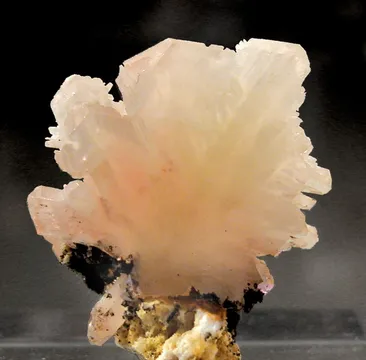
Beyond fluorite and quartz, Xihuashan is an unusually rich tungsten–tin–rare-element system. Ore minerals include wolframite, ferberite, cassiterite, molybdenite, scheelite, bismuthinite, chalcopyrite, arsenopyrite, pyrite, pyrrhotite, sphalerite, chalcocite, stannite, acanthite, and silver-bearing sulfosalts such as matildite and gustavite in parts of the ore field. The F-rich granite assemblage adds beryl, topaz, muscovite, zinnwaldite or lithium-bearing mica, tourmaline, feldspars, calcite, dolomite, apatite, triplite, and REE- or HFSE-bearing minerals including monazite-(Ce), xenotime-(Y), gadolinite-(Y), fergusonite-(Y), clinofergusonite-(Y), thorite, uraninite, uranothorite, bastnäsite-(Ce), synchysite-(Y), zircon including hafnian zircon, pyrochlore-group minerals, yttrofluorite, and Y-rich fluorite. Dangping adds mineralogical interest through reported tellurium-bearing canfieldite/tellurocanfieldite material, while Piaotang is notable to collectors for uncommon euclase specimens reported from a 2007 find, purple scheelite on quartz and chlorite-like matrix, and fluorite combinations that blur the line between ore mineral specimen and fine Chinese cabinet piece.
The chief authenticity problem for Xihuashan ore field specimens is locality accuracy, not widespread treatment. Piaotang fluorites can be confused with, or deliberately simplified into, “Yaogangxian” or generic “China” labels because both localities produced fluorite–quartz–mica–sulfide combinations and because Chinese specimen supply chains in the 1990s and 2000s often separated pieces from detailed mine data. A strong old label, a dealer record naming Piaotang Mine, a vein or level note such as No. 359 Vein / 268 m or No. 3 Vein / 388 area, or provenance to a well-documented collection adds real value.
Condition is especially important. Fluorite from Piaotang is commonly stepped, transparent, and edge-zoned, so small corner bruises are conspicuous and reduce the effect more than they would on massive or opaque fluorite. The purple color is often strongest at the corners and outer zones—the very parts most likely to chip. Examine cube edges, contact points, and high terraced faces under a strong light. Some old thumbnails and miniatures show minor nicks, frosty overgrowths, or contacted backs; those are acceptable on modest examples but become decisive on higher-priced cabinet pieces.
Good fluorite is not abundant. Older dealer records describe the main Piaotang fluorite material as having been produced before about 2010, with little similar production afterward. That scarcity explains why fine examples with 2–3 cm zoned cubes on quartz or mica can sell well above ordinary Chinese fluorite miniatures, while exceptional cabinets with dramatic composition, strong zoning, and historical provenance can command several thousand dollars. The most desirable pieces combine transparency, purple-edge zoning, matrix, and locality documentation.
Quartz-only specimens from the ore field need more scrutiny. Plain colorless or milky quartz from a major quartz-vein tungsten district is geologically legitimate but not always visually distinctive. A quartz specimen is more compelling when associated with fluorite, wolframite, molybdenite, cassiterite, scheelite, chalcopyrite, arsenopyrite, muscovite, or other paragenetic evidence. Wolframite-bearing quartz should be handled with care: heavy black blades can detach from older vein material, and sulfide-bearing specimens may be more vulnerable to oxidation if stored damp.
Scheelite from the ore field may fluoresce and should be checked under both longwave and shortwave UV, but avoid relying on fluorescence alone for identification. Some Xihuashan and Piaotang assemblages contain multiple white, pale, or massive minerals—quartz, feldspar, calcite, fluorite, scheelite, topaz, and beryl—and old labels may use broad group names. For rare species, especially REE minerals, yttrofluorite, clinofergusonite-(Y), pyrochlore-group material, tellurium-bearing canfieldite, or euclase, analytical confirmation or a well-documented published occurrence matters far more than a casual trade label.
The Xihuashan story begins not with a collector pocket but with a piece of heavy, dark ore leaving a mountain in Dayu. In 1908, a student studying at the Xijiang Youji School in Nanjing reportedly brought Xihuashan ore to the school laboratory for analysis; only then was it recognized as tungsten ore. The mountain had already yielded the mineral in 1907, but that laboratory identification turned a local curiosity into the opening chapter of China’s tungsten industry. From that point onward, Xihuashan was no longer just a hill northwest of Dayu—it became the place Chinese histories call the beginning of domestic tungsten mining.
Before 1949, the ore was valuable enough to attract both private and official mining, but the work was also fragmented and wasteful. Later retrospectives describe the pre-liberation period as one of disorderly digging and loss of resources. After 1949, the mine’s identity changed dramatically. During the First Five-Year Plan, Xihuashan was selected as one of the major industrial projects of the new state, rebuilt and expanded with Soviet assistance, and commissioned around the tenth anniversary of the People’s Republic in 1959–1960. The mine reached its designed capacity in its first year of operation and reportedly earned a profit of 800,000 yuan in 1960—a striking figure for a mine that only a few decades earlier had begun with hand-picked tungsten ore.
The numbers attached to Xihuashan are the kind that make industrial geologists pause. A century review records 47,338 t of tungsten concentrate before 1949 and 97,288.7 t from 1949 through 2006, nearly 150,000 t of concentrate in 99 years. Behind that total were hundreds of veins, thousands of workers, and a mountain that kept being reinterpreted by each generation of geologists. One account says that when the mine was planned from the reserves then available, it had a projected service life of fifteen years; from the start of production in 1960 onward, Xihuashan people were already searching for replacement resources.
The mine also entered China’s political and industrial memory. In November 1981, the first national science conference of the tungsten industry was held at Xihuashan Tungsten Mine in Dayu County. Fang Yi, then a vice-premier, attended and left an inscription urging the development of the tungsten industry. The choice of venue was symbolic: Xihuashan was not the newest or richest tungsten mine by then, but it was the right place to gather the industry because it carried the origin story.
The harder final chapters are just as specific. By 1989, one account says Xihuashan had 2.456 million t of recoverable ore remaining and only 2,465 t of retained tungsten metal reserves; at the same time the mine had 5,003 employees, 1,847 retirees, and more than 1,600 waiting-for-work young people, plus its own school, hospital, shops, communications facilities, theater, farm, hostel, and other social services. During the five years after 1985, more than 7,000 outside miners reportedly poured onto the mountain under a loose mining policy, causing chaotic extraction, theft, and damage to order at the mine; the same account says this shortened the mine’s service life by five years.
By 2002, resource exhaustion forced reorganization. Jiangxi Tungsten Group restructured the old mine’s remaining assets into a modern company, and by 2022 the former giant had become something quieter: a closed mine with 86 employees, tasked less with producing tungsten than with restoring the landscape and preserving a century of industrial heritage. For collectors, that ending matters. A bright little Piaotang fluorite cube on quartz is a cabinet mineral, but it is also a fragment of a much larger story—China’s first tungsten mine, a national industrial project, a vein field studied by generations of geologists, and a mountain now being asked to become green again after a hundred years of extraction.