A collector's guide to Kuruktag Mountains, China: its geology, mining history and notable minerals, illustrated with the 43 specimens documented from this locality on EarthWonders.
Key facts
Kuruktag Mountains wulfenite is one of the important modern Chinese entries in the world wulfenite canon: a desert-born lead molybdate occurrence from the eastern Xinjiang region, on the northern side of the Lop Nur–Tarim Basin country, where arid weathering and oxidized base-metal mineralization combined to produce bright orange to red crystals on pale calcite or dark, friable iron-manganese gossan. Its significance is partly mineralogical and partly historical. Before these finds reached the Western market in the mid-2000s, fine Chinese wulfenite was almost absent from serious collections; the Kuruktag/Jianshan material changed that almost overnight, introducing specimens whose color and habit could stand comparison with better-known wulfenite provinces in Arizona, Mexico, Namibia and the Congo.
Regional View
Country View
The collector should understand the locality name with care. Early literature and trade labels often treated “Kuruktag Mountains” broadly, and many specimens were attributed to the Jianshan iron-manganese deposit, “near Urumqi,” “Nonan,” or later to “Stone Crack.” More recent locality work separates at least part of the orange, bladed Kuruktag production from the famous Jianshan Mine proper. In practical collecting terms, the Kuruktag Mountains name now points to a small group of related Xinjiang wulfenite occurrences and labels, with the best pieces recognized by their intense red-orange to fiery red color, bright luster, thin tabular to bladed crystals, and dramatic contrast against white calcite or oxidized brown matrix.

Photo: Wikimedia Commons
At their best, these specimens have the snap that wulfenite collectors want: sharp edges, strong color saturation, glassy to resinous faces, and enough openness in the crystal field for individual tablets or blades to read clearly. Ordinary pieces can be crowded, dull, chipped, heavily coated, or mounted on crumbly matrix; exceptional ones combine multiple intact crystals, good relief, a clean display face, and a color that holds under normal room light rather than collapsing into brown.
Search for specimens: View all specimens from Kuruktag Mountains, China
The Kuruktag wulfenite occurrence belongs to the broad oxidized-lead-molybdenum setting that produces many of the world’s finest wulfenites: lead-bearing mineralization exposed to arid weathering, with molybdenum available from regional molybdenum-bearing systems and transported through groundwater until Pb and Mo could meet in oxidized fractures and vugs. The surrounding metallogenic province is part of eastern Xinjiang’s complicated Paleozoic belt, where iron, manganese, copper, molybdenum, gold, nickel, lead and zinc deposits are documented around the margins of the Tarim Block. In specimen terms, the relevant host is not a grand underground mine famous for diverse minerals, but a small oxidized Fe-Mn system in remote desert mountains.
The original 2007 description placed the discovery in a small iron-manganese deposit in the Kuruktag Mountains, in the vicinity of Lop Nur and the eastern Tarim Basin. That report associated the specimens with the Jianshan iron deposit and emphasized Paleozoic marine volcanic rocks in a region already known for manganese, copper, iron and gold mineralization. It also proposed the most plausible paragenetic mechanism: molybdenum derived from weathering molybdenum-bearing deposits or skarns could travel in oxidizing groundwater and precipitate as PbMoO4 where it encountered weathered lead mineralization. The arid climate matters; repeated wetting, evaporation and oxidation in desert country can preserve near-surface secondary minerals that might be destroyed or leached away in a humid climate.
The specimen-producing zones were pockety. The Mineralogical Record article described four or five pocket zones then known, with wulfenite habits varying from very thin tabular crystals to more robust plates and bipyramidal-looking crystals. More recent locality notes distinguish the exact Kuruktag Mountains occurrence from the Jianshan Mine, describing it as an uplifted ravine surrounded by Gobi desert. According to those notes, Jianshan had already produced wulfenite before the separate Kuruktag locality began; the Kuruktag Mountains production is reported as beginning in 2009 and running until about 2013. The distinction is important because much older material in Western collections may still carry the broader “Kuruktag Mountains” or “Jianshan Mine, Kuruktag Mountains” wording, while later orange bladed material is often sold as Kuruktag Mountains or “Stone Crack.”
There is no well-documented large corporate specimen-mining history for this locality. The early lot that made the occurrence famous was traced through a very narrow chain: one miner, a single dealer in Guilin, small lots to dealers in Changsha, and then a major October 2006 purchase arranged during Marcus Origlieri’s visit to Guilin on behalf of several American dealers, including Bill Larson, Rob Lavinsky and Wayne Thompson. Later market appearances show Chinese dealers and Western dealers continuing to handle the material under Kuruktag, Jianshan, “Stone Crack,” and occasionally incorrect or vague labels. Modern labels should be read critically, especially if they use “near Urumqi,” “Nonan,” “Tuokexun,” or other broad place names without more context.
Collecting access today should be assumed restricted or impractical. The locality is remote desert country in Xinjiang, not a casual field-collecting destination, and the known specimen supply has moved through miners and dealers rather than public collecting. Serious collectors should treat fresh “field collected” claims with caution unless the chain of custody is unusually clear. The practical collecting route is the specimen market: old 2006–2007 pieces, later Stone Crack/Kuruktag material, and more recent dealer stock released from accumulated lots.
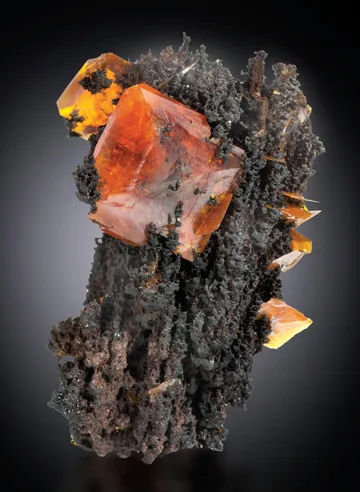
The notable finds are defined by wulfenite pocket style. Some pieces show dense blankets of red-orange crystals on dark Fe-Mn gossan; others carry thin “windowpane” plates; still others show more equant or pyramidal development. White calcite is an important part of the look on many specimens, appearing as a coating on one or both sides of wulfenite crystals or as contrasting matrix. Removal of that calcite has been specifically reported to leave pitted, dull crystal surfaces, so old aggressively cleaned examples can look lifeless compared with untreated or carefully prepared pieces.
Kuruktag Mountains wulfenite is prized for orange, red-orange, bright red, blood-red and brown-red crystals, most commonly as sharp tabular to bladed plates in dense clusters on friable iron-manganese gossan or contrasting white calcite; the first major market lots included crystals from microscopic size to roughly 4 cm on edge, though most good individual crystals are nearer 1–2 cm, and later Kuruktag material is especially associated with orange, bladed morphology rather than the predominantly red look of classic Jianshan-labeled pieces. The best specimens here separate themselves by undamaged crystal edges, bright luster, saturated color, clean relief, and attractive contrast with pale calcite or dark oxidized matrix; ordinary examples are crowded, chipped, partly dull, overcoated, acid-burned, or mounted on crumbly brown gossan that distracts from the crystal display.
For the exact Kuruktag Mountains locality, wulfenite is the documented collector mineral. The historic Jianshan/Kuruktag literature also notes dull white calcite coatings confirmed by X-ray diffraction and Raman spectroscopy, and mentions unidentified lustrous radiating needles resembling a manganese oxide. The nearby Jianshan Mine record includes calcite and cerussite in addition to wulfenite, but those should not automatically be transferred to every Kuruktag-labeled specimen. No IMA type-locality mineral is verified from this exact wulfenite occurrence; the rarity here is instead locality-specific: world-class Chinese wulfenite from a small, short-lived desert find.
Kuruktag wulfenite has an unusually important labeling problem. Older specimens may be labeled “Kuruktag Mountains,” “Jianshan Mine,” “Jianshan Mine, Kuruktag Mountains,” “near Urumqi,” “Nonan,” “Tuokexun,” or “Stone Crack.” Some of those names reflect historical uncertainty rather than deliberate deception, but the distinctions now matter. “Nonan” was reported not as the mine locality but as the miner’s residence. “Tuokexun” has been questioned in the literature as either a new wulfenite strike or a misattribution of the familiar Kuruktag material. “Stone Crack” appears on later trade labels and is widely associated with Kuruktag material, but the relationship between Stone Crack, Jianshan and the separate Kuruktag ravine locality has not always been consistently handled by dealers.
The most common condition problems are chipped crystal edges, broken plates, dull or pitted faces, and unstable matrix. Wulfenite is brittle, comparatively soft, and easily bruised along exposed edges; the thin blades and tabular crystals from this locality are especially vulnerable. The gossan matrix can be friable, and the original literature even noted that the dark brown to ochre rock could be stabilized by impregnation with a thin water-and-white-glue solution. Stabilization is not necessarily a fatal flaw on crumbly matrix, but it should be disclosed when obvious.
Cleaning history is important. Some crystals are naturally partly coated with dull white calcite, and that coating can be part of the specimen’s aesthetic value. Acid or aggressive mechanical removal may expose pitted, lusterless wulfenite beneath; pieces that look strangely matte, etched, or uniformly rough should be inspected with magnification. Conversely, do not assume that every calcite coating is damage or dirt. On many Kuruktag specimens, the white-on-red contrast is original and desirable.
No locality-specific fake epidemic is well documented, but mislabeling is common enough that provenance matters. Compare the specimen’s style with known Kuruktag and Jianshan examples: orange to red tabular or bladed wulfenite on white calcite or dark Fe-Mn gossan is credible; unusual associated species or elaborate parageneses should be questioned unless analytically supported. Avoid over-cleaned pieces marketed as “gemmy” if the faces lack luster, and be cautious with specimens whose locality is reduced to “China” or “near Urumqi” when priced as elite Kuruktag material.
Market availability is better than for many one-find classics. Small to miniature pieces continue to appear in dealer inventories, often at accessible prices when the crystals are modest or crowded. Better miniatures and cabinet specimens with sharp, saturated crystals command significantly higher prices, and top examples from the original 2006–2007 influx or the best Stone Crack/Kuruktag lots are treated as serious world-locality wulfenites rather than mere Chinese curiosities. Fine color, good luster, minimal damage and a precise old label remain the value drivers.
As with all lead minerals, wulfenite should be handled sensibly: do not lick, saw or grind it, wash hands after handling, and keep loose fragments away from children and pets. Display is usually straightforward, but the best Kuruktag pieces deserve vibration-free mounting and a dust-protected case, because cleaning dust from thin wulfenite plates is a good way to lose edges.
The Kuruktag story begins far from any mineral-show glamour, in the desert country around Lop Nur. The 2007 report placed the discovery about 300 km south of Hami and about 500 km south of the Mongolian border, near an ancient lakebed that had become one of the great salt playas of Central Asia. The same landscape held the ruins of Loulan, a Silk Road city founded in the second century BC and active for more than 800 years before it vanished after about 700 AD. When Marco Polo passed through in 1224, the old lake country had become so desolate that he saw “only tons of yellow sand.” That is the stage on which the first fine Chinese wulfenite appeared: not a famous mining district with generations of collectors, but a remote oxidized pocket in an austere desert range.
The specimen trail was nearly as improbable as the place itself. The first strong pieces were reportedly dug by one miner and sold to one dealer in Guilin. That dealer did not simply dump the lot onto the market; the best material was retained, and much of the low-grade rock was apparently discarded to keep the average quality high. Small lots reached Changsha dealers, and in 2005 the material began surfacing in the West under the misleading label “Nonan,” Xinjiang. The label sounded like a locality, but the investigation later found that Nonan was where the miner lived, not where the crystals grew.
The breakthrough came in October 2006, when Marcus Origlieri visited Guilin and arranged the purchase of the main lot for several American dealers, including Bill Larson, Rob Lavinsky and Wayne Thompson. Fine pieces were hand-carried back to Arizona, with the rest shipped afterward. For collectors watching the Chinese mineral boom of the early 2000s, this was a startling arrival: China had already given the market fluorite, stibnite, calcite, scheelite and other major specimens, but wulfenite had remained almost absent. Suddenly there were red crystals on gossan matrix from a remote Xinjiang Fe-Mn occurrence, and the old assumption that China had no serious wulfenite locality had to be rewritten.
Then came the label wars. The 2007 article cautiously deduced Jianshan as the likely mine name from secondhand location details, while later dealer reports and labels introduced “Stone Crack.” By 2015 and 2017, Mineralogical Record market reports were still wrestling with the terminology, noting that the material had appeared under vague or incorrect localities and that “Stone Crack” was showing up on labels without a fully explained relationship to Jianshan. More recent locality notes separate the Kuruktag Mountains occurrence from Jianshan and describe a 2009–2013 production window for the Kuruktag ravine locality. The result is a locality whose specimens are often easier to recognize by eye than to label with perfect historical neatness.
The best of the later Stone Crack/Kuruktag pieces earned genuine excitement. Dealers offered hundreds of specimens in a range of sizes, colors and habits: opaque butterscotch-orange, transparent medium orange, fiery red, and thicker tabular to nearly equant crystals. One report singled out very thin transparent “windowpanes,” thicker tablets, and compact crystals with basal and pyramid faces in near balance. In another market note, a 7.5 cm specimen was illustrated from “Stone Crack,” Kuruktag Mountains, with brilliant red-orange crystals on dark matrix and a price of $2,400. That price was not just for novelty; by then collectors had realized that the locality could produce wulfenite with true international standing.