A collector's guide to Jianshan Mine, China: its geology, mining history and notable minerals, illustrated with the 54 specimens documented from this locality on EarthWonders.
Key facts
Jianshan Mine entered the collecting world almost overnight as the source of the first truly fine Chinese wulfenite specimens: saturated red to red-orange PbMoO4 crystals from a remote iron-manganese occurrence in the Kuruktag Mountains of Xinjiang. The locality sits in one of those severe, mineralogically productive desert belts where oxidized base-metal mineralization, arid weathering, and nearby molybdenum sources can conspire to make wulfenite at specimen scale. Its best pieces have the immediate visual language of the great Sonoran wulfenite localities—thin glowing plates, bevelled square to octagonal tablets, and rich clusters on dark gossany matrix—yet the locality is wholly Chinese in its history: remote, poorly understood at first, and burdened with shifting labels as specimens moved from miner to dealer to Western market.
Regional View
Country View
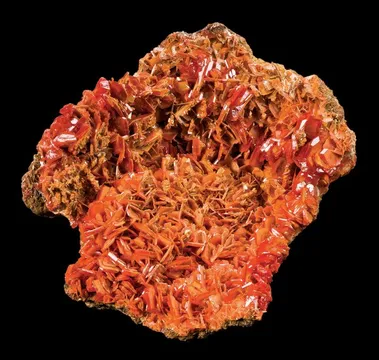
The specimens that made Jianshan famous are not merely “Chinese wulfenite”; they are a distinct collector class. Many are dense hedgehog-like groups of blades in red-orange, fiery red, blood-red, or brownish red, sometimes partly veiled by dull white calcite. Others show thicker tabular crystals, steep pyramid modifications, or nearly equant forms in which basal and pyramidal faces compete for dominance. The finest examples combine strong color, glassy luster, matrix contrast, three-dimensional architecture, and unusually low edge damage for a mineral that is notoriously easy to nick.

Photo: Wikimedia Commons
Search for specimens: View all specimens from Jianshan Mine, China
The collector locality known as Jianshan Mine is placed by current mineral-locality usage in Shanshan County, Turpan, Xinjiang Uyghur Autonomous Region, China, in the Kuruktag Mountains. Older specimen labels and early photographs frequently give Ruoqiang County and Bayingolin Autonomous Prefecture; some pieces were labelled simply “Kuruktag Mountains,” “Xinjiang,” or even “Nonan,” the last reportedly referring not to the mine but to the home locality of the miner who dug the material. The modern collector should therefore expect label variation on legitimate pieces.
Geologically, the wulfenite came from a small iron-manganese deposit in a region of Paleozoic marine volcanic rocks and late Paleozoic metallic mineralization around the northeastern Tarim Block. The broader district is part of the complex East Tianshan–Kuruktag metallogenic setting, where manganese, iron, gold, copper, molybdenum, nickel-cobalt, lead-zinc, and skarn-related deposits occur around the desert margin. The published interpretation for the wulfenite is a classic supergene one: molybdenum, probably liberated during weathering of porphyry or skarn-related molybdenite-bearing mineralization, moved through oxidizing ground waters until it encountered lead in the near-surface weathering zone, precipitating lead molybdate as wulfenite. The dark matrix on most pieces is a friable gossan dominated by iron and manganese oxides; the arid climate helped preserve open cavities and delicate oxidized minerals in a way familiar to collectors of Arizona and northern Mexico wulfenite.
The mine itself was not introduced to the Western collecting public through a formal mine operator’s specimen program. Published accounts describe the wulfenite as originating with a single miner, passing first to a dealer in Guilin, and then entering wider circulation through Chinese wholesalers and American dealers. The first red Kuruktag wulfenites were discovered in 2004, small lots reached the Western market by 2005 under imperfect locality names, and the important bulk purchase occurred in October 2006. The 2006–2007 appearance of the material was a genuine market event: before it, China had produced very little wulfenite of collector consequence.
The ore bodies exposed specimen cavities over a limited span and in more than one style. The literature describes four or five pocket zones mined over a couple of years, explaining the range from paper-thin tablets to thicker plates, red clusters on dark gossan, calcite-coated combinations, and compact groups of smaller sparkling crystals. Later market waves, especially material offered around the mid-2010s as “Stone Crack” or “Kuruktag Mountains,” created additional label complications. Those pieces resemble the Jianshan suite closely enough that many collectors and dealers treat them within the same Kuruktag/Jianshan collecting tradition, but careful labels should preserve exactly what was received rather than forcing all examples into one simplified name.
Collecting access should be considered closed to normal field collectors. The occurrence is remote, in a desert mountain region near Lop Nur and the Taklamakan margin, and the verified specimen supply has moved almost entirely through commercial channels. Any attempt to visit would require permission from the land and mineral-rights holders, local safety arrangements, and a sober understanding of remoteness, heat, unstable mine workings, and the legal realities of mining districts in Xinjiang.
Jianshan wulfenite is prized for red to red-orange PbMoO4 crystals on dark gossany iron-manganese matrix, with habits ranging from paper-thin tabular “windowpane” plates to thicker bevelled tablets, octagonal plates, bipyramidal or contact-twinned-looking forms, and dense clusters of blades. Published crystal sizes range from microscopic crystals to about 4 cm on edge, though the strongest collectible pieces more commonly show abundant 1–2 cm crystals, and many market specimens carry smaller, glittering plates in rich coverage. White, dull porcelaneous calcite is a common and locality-characteristic association, sometimes coating one or both sides of the wulfenite; on the best pieces it gives a striking red-and-white contrast, while on weaker pieces it can obscure luster. Fine specimens here are separated from ordinary ones by saturated red color rather than brownish or muddy orange, bright glassy luster, crisp beveled edges, three-dimensional architecture, and minimal edge bruising on the exposed plates.
The verified mineral list for Jianshan is surprisingly small for such a famous locality: wulfenite, calcite, and cerussite are the documented species, with manganese oxides and gossan recorded as matrix or associated material rather than fully characterized collectible species. No type-locality mineral is documented from Jianshan. Its importance rests almost entirely on a single world-class oxidized lead-molybdate occurrence, not on a broad suite of rare species.
The main authenticity concern with Jianshan material is locality labeling, not fabricated crystals. Legitimate specimens may carry older labels reading Ruoqiang County, Bayingolin Autonomous Prefecture, Kuruktag Mountains, “Nonan,” or “Stone Crack,” while current usage commonly places the Jianshan Mine in Shanshan County, Turpan. Preserve old labels and provenance carefully, because the shifting names are part of the specimen history rather than automatic evidence of fraud.
Condition is the decisive issue. Wulfenite is brittle, and Jianshan crystals are commonly thin plates with vulnerable corners and exposed edges. Even excellent pieces may show small peripheral chips, especially where blades rise above the matrix. Examine plate edges under magnification, look for rehealed-looking surfaces versus fresh breaks, and be wary of specimens photographed only from the most forgiving angle. The dark gossan matrix can also be crumbly; early published notes even mention stabilization of friable matrix with a dilute white-glue solution. Such stabilization is not automatically disqualifying if disclosed and confined to matrix, but it matters to value.
Calcite coatings deserve special caution. The white calcite crust is natural and often visually important. Removal can leave pitted, dull, lusterless wulfenite faces, so cleaned specimens are not always improved specimens. A red crystal with intact glassy faces and a partial white rim is usually preferable to an aggressively cleaned crystal with dead surfaces. As with all lead-bearing minerals, Jianshan wulfenite should be handled sensibly: wash hands after handling, avoid creating dust, and do not soak friable specimens unnecessarily.
Market availability is better than one might expect for a finite find. The first major Western wave was 2006–2007, followed by a lull and later reappearances from old stocks or related Kuruktag-labeled material. Representative miniatures and small cabinets still appear with regularity, while the best large, damage-minimal, strongly red, three-dimensional examples are much scarcer and command far stronger prices. Jianshan remains one of the few modern localities whose finest wulfenites can stand credibly beside classic Arizona, Mexico, Namibia, and Congo examples in a serious species collection.
The Jianshan story begins not in a collector-friendly mining district but in a hard, empty part of Xinjiang, roughly south of Hami and near the immense dry basin of Lop Nur. The surrounding geography carries a weight unusual for a mineral locality guide: Lake Luobupo, once a real lake and now a vast salt playa of about 3,000 square kilometers; the Taklamakan Desert; and the ancient city of Loulan, founded on the northwest side of the lake in the second century BC. Loulan prospered for centuries as a Silk Road stop and provincial capital, then vanished after about 700 AD. By the time Marco Polo passed through the region in 1224, the old city was buried in desert. That is the landscape from which the red wulfenite emerged: not a tidy mine camp, but a region where archaeology, salt, wind, ore, and distance overlap.
The specimens themselves followed a wonderfully indirect path. At first, attractive red crystals were sold as coming from “Nonan,” Xinjiang. That label turned out to be a false trail: “Nonan” was reportedly where the miner lived, not where the crystals grew. The wulfenites had come from an iron-manganese mine in the Kuruktag Mountains. One miner dug them, one dealer in Guilin acquired them, and other dealers in Changsha bought small lots. The best material was held back; lower-grade pieces may even have been discarded to keep the average quality high. Then, in October 2006, Marcus Origlieri visited Guilin and arranged the purchase of the main lot on behalf of several American dealers, including Bill Larson, Rob Lavinsky, and Wayne Thompson. Fine pieces were hand-carried back to Arizona, while the larger part of the lot followed by shipment. In the compressed little world of high-end minerals, that moment effectively introduced Jianshan to the West.
The pocket story explains why collectors see so many different “personalities” under the same locality name. The red wulfenites were not a monotonous run of identical crystals; they came from several pocket zones over a short span. Some were thin red plates in jumbled nests, some were thicker bevelled tablets, some looked bipyramidal, some were half-veiled by white calcite, and some carried the dark, crumbly iron-manganese matrix so vividly that they seemed almost Arizona-like. A few individual specimens became visual ambassadors for the locality: one miniature had a dominant composite crystal about 3 cm tall and was illustrated in the January–February 2007 China II issue of The Mineralogical Record; another large specimen, 17.4 x 9.5 x 7.6 cm, was described as one of the larger high-quality pieces preserved from several seasons of digging in the remote mountains.
The later “Stone Crack” label added a final twist. Around 2014–2017, Kuruktag red wulfenites became plentiful again on the market, some offered through Chinese sources under the name “Stone Crack mine.” Collectors recognized the look immediately—red-orange plates, dark matrix, occasional calcite, the same desert-supergene intensity—but the name was puzzling. Was it a literal translation, a neighboring working, a dealer’s phrase, or a separate ravine in the Kuruktag Mountains? The question matters because Jianshan is one of those Chinese localities where specimen identity and geography have never fit together cleanly. For collectors, the best practice is to keep every old label, every invoice, and every note. On a Jianshan wulfenite, provenance is not just paperwork; it is the map.