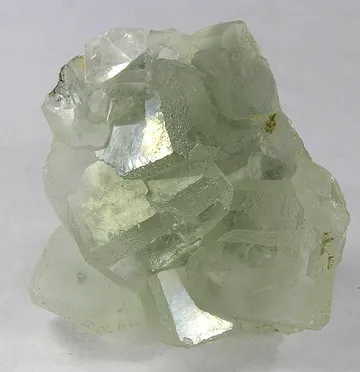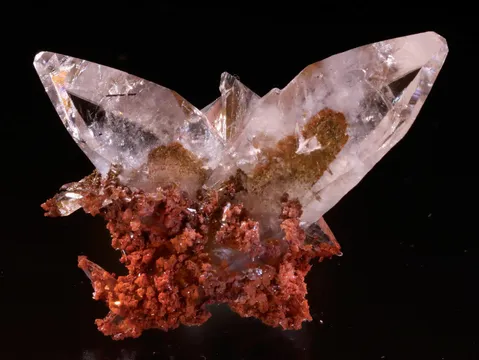
Mine No. 884, China — a Leiping-area locality famous for calcite with hematite, glassy V-shaped butterfly twins, and strong appeal to collectors worldwide.
Key facts
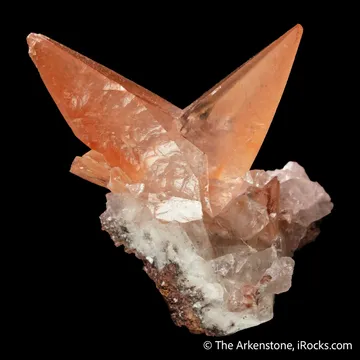
Mine No. 884 is one of the defining modern Chinese calcite localities: a Leiping-area working in Guiyang County, Chenzhou, Hunan, whose reputation rests on sharp V-shaped “butterfly” calcite twins and hematite-colored calcite sprays that reached the international specimen market around the turn of the millennium. In the strict mineralogical record the locality is a compact one—calcite and hematite are the documented species—but its collector impact is far larger than that short list suggests. The best pieces combine transparent to translucent calcite, crisp twinning, spiky scalenohedral growth, reddish-orange hematite inclusions or dusting, and enough sculptural balance to be recognized across a display case.
Geologically, Mine No. 884 belongs to the Leiping district of southern Hunan, a region better known economically for polymetallic mineralization than for a two-species collector assemblage. The locality lies within the broader southern Hunan mineral province, where the Nanling Range and Qin-Hang metallogenic systems overlap and where carbonate rocks, faulting, Jurassic granitic intrusions, skarn systems, Pb-Zn-Cu-Ag mineralization, and open-space hydrothermal vein growth are recurring themes. The calcites from Mine No. 884 are collector minerals rather than ore specimens in the usual sense: the important geological stage was the formation of cavities in an iron-bearing environment, followed by one or more generations of calcite growth that trapped, coated, or alternated with hematite.
Regional View
Country View
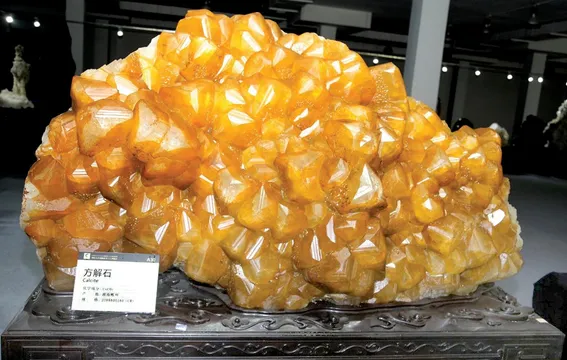
The historical significance of Mine No. 884 is tied to the late-1990s and early-2000s Chinese specimen boom, when localities in Hunan, Guangxi, Inner Mongolia, Fujian, and other provinces began producing minerals in quality and quantity that changed the international market. Mine No. 884 calcite was not merely another attractive red calcite. Its classic habit—a glassy, wing-like calcite twin, often perched on a matrix sprinkled with smaller crystals—became one of the signature Chinese calcite styles of the period. Larger pieces show hedgehog-like clusters of narrow scalenohedrons, brick-red hematite zones, triangular terminations, and, in some specimens, a small jewel-like twin rising from a forest of points.

Photo: Wikimedia Commons
The finest Mine No. 884 specimens are judged on architecture as much as color. A simple orange calcite is not enough. Good pieces have sharp, intact terminations; glassy luster; believable internal hematite color rather than flat surface stain; a balanced twin or spiky composition; and minimal bruising on the exposed points. The locality’s great attraction is the way hematite acts like a growth record: reddish internal brushes, phantoms, and warm iron tones make the calcite seem lit from within, while the trigonal geometry remains crisp and unmistakable.

Photo: Wikimedia Commons
Search for specimens: View all specimens from Mine No. 884, China
Mine No. 884 is recorded at Leiping, Guiyang County, Chenzhou, Hunan Province, China, with an estimated position near 26° N, 113° E. In collector usage, “Leiping” may appear broadly on labels for specimens from several nearby Leiping-area workings, while Mine No. 884 is the name most closely associated with the celebrated V-shaped calcite twins. This distinction matters: a specimen labeled simply “Leiping Mine” can be perfectly legitimate but less precise, whereas a Mine No. 884 label should be reserved for material confidently tied to that particular working.
The broader geological setting is southern Hunan’s polymetallic country. Regional studies describe the district as part of the overlap between the Nanling Range and Qin-Hang metallogenic belt, an area of Mesozoic magmatic-hydrothermal mineralization, Jurassic intrusions, carbonate host rocks, skarn systems, and Pb-Zn-Cu-Ag-W-Sn deposits. In nearby Guiyang and Chenzhou ore fields, mineralization is commonly controlled by combinations of stratigraphy, anticlines, faulting, intrusive contacts, and carbonate replacement or cavity filling. For Mine No. 884 specimens, the important collector-scale environment was open-space calcite growth in iron-bearing cavities or veins, with hematite present as inclusions, coatings, dusting, and internal color zoning.
The verified mineral list for Mine No. 884 is notably lean: calcite, CaCO3, and hematite, Fe2O3. That narrow assemblage is part of the locality’s character. It is not a locality famous for complex accessory species, colorful sulfides, or rare type minerals; it is a calcite locality in which one associate—hematite—does nearly all the visual work. In the best specimens, hematite gives color without obscuring the calcite’s transparency. It may tint scalenohedrons a warm orange, form rust-red internal clouds, or sit as fine reddish dust on particular growth surfaces.
The mining and specimen history is modern rather than nineteenth-century or early industrial. Collector records and dealer archives consistently place the important production of classic Mine No. 884 calcites in the late 1990s to early 2000s, with individual public records describing pieces from finds around 1998 and around 2000. The mine produced the majority of the V-shaped calcite twins long attributed in commerce to Leiping, and those twins became a reference style for Chinese calcite. By the 2010s and 2020s, the finest examples were no longer common fresh production items; they were moving through older dealer inventory, collection dispersals, auction archives, and named collections.
Publicly accessible records do not identify a named operating company for Mine No. 884 in the way one might expect for a large modern metal mine. The locality appears in mineralogical databases and collector literature primarily as a specimen locality, not as a fully documented industrial operation with published production tonnages, annual output figures, or formal ore-reserve statements attached to the Mine No. 884 name. For collectors, that means specimen provenance depends heavily on old labels, trustworthy dealers, photographic archives, and consistency of habit.
Notable specimen styles include thumbnail to miniature butterfly twins; small-cabinet matrix pieces with one or more V-twins surrounded by smaller crystals; spiky clusters of narrow scalenohedrons; larger scalenohedrons with red hematite inclusions and stepped faces; and unusual flattened or triangular rhombohedral crystals. Documented specimens range from thumbnails around 2–3 cm wide to cabinet plates over 20 cm. A Mine No. 884 specimen in the public image record measures 8.3 x 5.4 x 4.3 cm and carries a small, sharp twinned calcite among razor-like spiky crystals. Another documented butterfly twin measures 2.3 x 1.6 x 1.2 cm. A larger publicly illustrated Mine No. 884 butterfly-twin specimen measures 7.0 x 6.4 x 4.5 cm, with a 3.5 cm wide twin perched on sawed matrix. The Mineralogical Record’s China supplement also illustrates calcite twins on matrix from the 884 mine measuring 25.5 cm, recorded as found in 1998.
Collecting access today should be treated as closed, controlled, or permission-only. This is not a public pay-to-dig locality. It is an active or former mine locality in China, and access would require the permission of the landholder, mine authority, and any relevant local authorities, along with serious underground-mine safety precautions. For nearly all collectors outside China, Mine No. 884 is a market locality: specimens are acquired through established dealers, auctions, collection sales, and old-stock material rather than by field collecting.
Calcite from Mine No. 884 is prized above all for sharp V-twinned “butterfly” crystals and hematite-tinted scalenohedral clusters produced chiefly around the late 1990s and early 2000s. The twins are commonly thumbnail to miniature crystals, often about 2–4 cm across, perched on matrix or surrounded by smaller spiky calcites; larger cabinet pieces exist but are much scarcer in fine condition. Colors range from colorless and pale champagne to smoky, orange, reddish brown, and brick-red, with the warmth caused by hematite or iron-oxide inclusions rather than by a separate colorful calcite species. Associations are simple—hematite is the defining associate—and the best pieces show crisp terminations, glassy luster, transparency, internal reddish zoning, and a balanced wing-like form. Ordinary examples may be merely iron-stained or chipped, while top specimens have a clean, sculptural twin or a three-dimensional spray in which the hematite strengthens the composition without muddying the calcite.
The only other mineral securely documented from Mine No. 884 itself is hematite, Fe2O3. It is not normally collected here as separate lustrous iron-oxide crystals; its importance is as the coloring and inclusion agent that gives Mine No. 884 calcite its red-orange personality. Broader Leiping-area labels may introduce other species—quartz, smithsonite, pyrite, fluorite, galena, sphalerite, arsenopyrite, beudantite, and manganese-bearing calcite are recorded from nearby or related Leiping localities—but those should not be folded automatically into Mine No. 884 without specific evidence. Mine No. 884 is not documented as a type locality for any mineral; its fame rests instead on an exceptionally distinctive calcite habit.
Authentication starts with locality precision. Many labels say “Leiping Mine,” “Leiping,” or “884 Mine,” and those are not always interchangeable. Mine No. 884 material should have a style consistent with the classic V-twinned calcites or hematite-included scalenohedral/rhombohedral calcites of the Leiping district. The most convincing specimens carry old dealer labels, collection provenance, published photos, or records from reliable dealers. Color alone is insufficient: other Chinese localities also produce red, orange, brown, and iron-stained calcite.
No widespread, well-documented fake epidemic specific to Mine No. 884 is part of the published collector record, but the normal cautions for calcite apply. Inspect bright red-orange pieces under magnification for dye concentrated in cracks, unnatural surface films, glue at crystal bases, repaired twins, and color that sits only on broken or porous surfaces. Natural Mine No. 884 color is quite believable when it appears as internal hematite zoning, reddish phantoms, fine dusting on selected growth surfaces, or warm inclusions suspended within otherwise transparent calcite.
Condition is the main value limiter. Calcite is soft, cleaves perfectly, and Mine No. 884 crystals often stand exposed as points, wings, or thin matrix-mounted twins. Chipped tips, bruised terminations, cleaved side faces, scuffed luster, and contact marks are common. Some pieces have sawed or trimmed matrix backs, a feature seen in public specimen descriptions; that is not inherently deceptive when disclosed, but it affects how purist collectors evaluate the piece. On spiky clusters, check the tallest points first. On butterfly twins, check the wing tips, re-entrant angle, and lower attachment point. On large plates, look for repaired crystals and stabilized matrix.
Rarity is strongly quality-dependent. Small and moderately attractive examples still appear on the market, but sharp, balanced, undamaged butterfly twins from old finds are increasingly treated as modern classics. Large fine cabinet pieces are much scarcer than small twins, especially when they combine size, transparency, hematite zoning, and minimal damage. Recent market records show Mine No. 884 calcites ranging from a few hundred dollars for modest miniatures and small-cabinet pieces to well over a thousand dollars for stronger examples, with top cabinet specimens and named-collection pieces commanding premiums. The locality is available, but the best material is no longer casual stock.
Fluorescence should be regarded as specimen-specific rather than universal. Calcite can respond under ultraviolet light, and some Leiping-area calcites have been noted with an orange response, but Mine No. 884 should not be bought primarily as a fluorescent locality unless the exact specimen has been tested. Handling should be conservative: avoid acids, avoid prolonged soaking, keep the piece away from abrasion, and support matrix plates from below rather than by the exposed crystals.
Mine No. 884 entered collecting history in the direct, sudden way many modern Chinese localities did: a mine produced a distinctive form, dealers recognized it immediately, and within a few years the best examples had spread into major collections. The memorable detail is not a mine-shaft anecdote or a named pocket foreman, but the look of the find itself—small V-shaped calcite twins so sharp and symmetrical that they acquired the instant collector nicknames “butterfly” and “fishtail.”
One public specimen description preserves the tone of that moment. An 8.3 x 5.4 x 4.3 cm piece from the Dr. Stephen Smale Collection was described as coming from one of the most famous single calcite finds of modern China. On it, a pristine twinned calcite only 2 cm across sits among razor-sharp spikes, the whole specimen lightly warmed by hematite staining. The scale is part of the charm: the important crystal is not large, but it is placed like a jewel on a three-dimensional calcite thicket.
Another publicly documented Mine No. 884 specimen tells the butterfly story in purer form. It is only 2.3 x 1.6 x 1.2 cm, essentially a fine thumbnail, but it shows the textbook V-twinned calcite habit that made the locality famous. The description calls it a “classic and textbook” example of calcite twinning, a phrase that fits the best Mine No. 884 pieces perfectly. They are not merely pretty; they are educationally clear.
The larger end of the story is represented by the 25.5 cm calcite-twin-on-matrix specimen illustrated in the Mineralogical Record’s Crystalline Treasures supplement and recorded as found in 1998. That date anchors the locality in the first wave of great Chinese calcite finds that reached Western collectors around the turn of the millennium. It also reminds collectors that Mine No. 884 was not only a thumbnail locality. The mine produced serious display specimens—large enough to dominate a cabinet shelf—while retaining the delicate twinning that made the find famous.