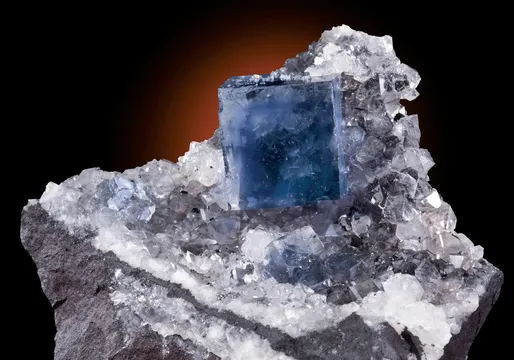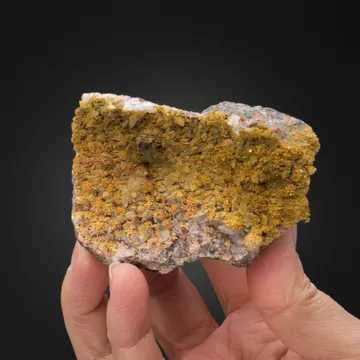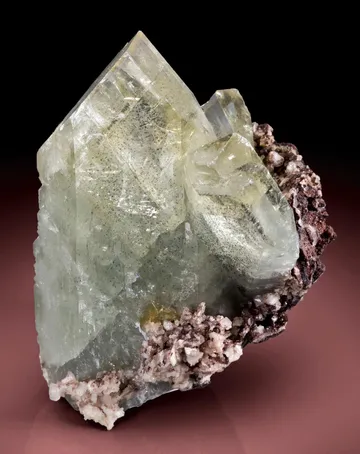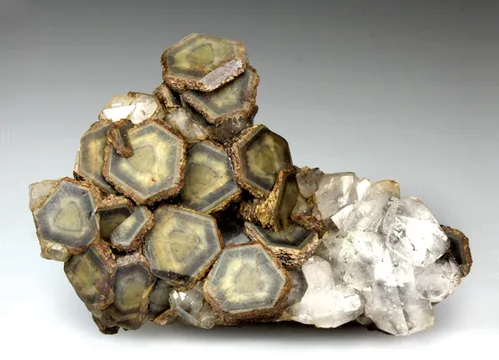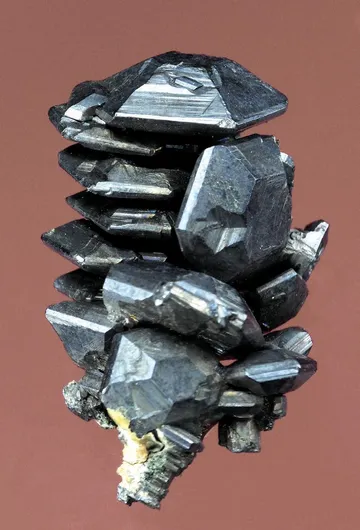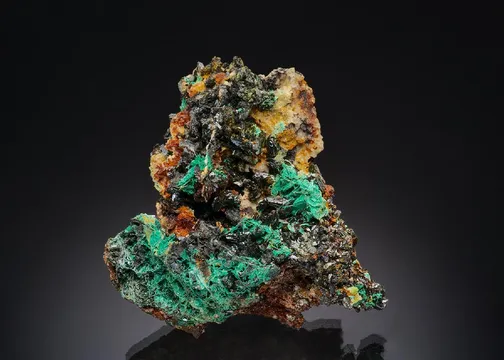
A collector's guide to Wheal Gorland, UK: its geology, mining history and notable minerals, illustrated with the 208 specimens documented from this locality on EarthWonders.
Key facts
Wheal Gorland is one of the defining mineral localities of the Cornish copper field: a small, now largely vanished mine near St Day whose collector reputation is out of all proportion to its surface footprint. Its fame rests on the oxidized zone of an arseniferous copper deposit developed on and close to the eastern contact of the Carn Marth granite, where lodes passed from granite into altered killas and where later kaolinization helped create the aluminium-rich conditions that made the mine uniquely fertile for copper arsenates. In the cabinets of serious collectors, “Gorland” means saturated blue liroconite, indigo clinoclase, olive acicular olivenite, green to blue-green chalcophyllite and cornwallite, red cuprite with native copper, cubic pharmacosiderite, and a supporting architecture of iron-stained quartz gossan.
Historically, Wheal Gorland belongs to the great age of Cornish copper mining. Its first recorded working was in 1792, but the lodes were almost certainly known earlier; production was erratic at first, with rich but discontinuous ore, then improved dramatically in the first decades of the nineteenth century. For mineral collectors, that same erratic supergene enrichment is the point. Gorland was not merely a copper mine that happened to yield specimens; it was a natural chemical laboratory in which arsenic, copper, iron, aluminium, phosphate, sulfate, chloride, silica, and fluctuating acidity produced a mineral suite that still anchors the historical study of secondary copper arsenates.
The finest specimens have the unmistakable look of old Cornish cabinet minerals: compact, weighty pieces of brown gossan and milky quartz, their cavities lined with vividly coloured crystals. The best liroconites are not large by ordinary cabinet standards, but they can be astonishingly commanding—sharp flattened blue bipyramids set like enamel in ochre matrix, sometimes with strashimirite or clinoclase. Gorland olivenite is typically more textural, forming satiny acicular linings and compact dark-green sprays. Clinoclase gives the mine its deepest blue-black accent, while cuprite and native copper preserve the mine’s original identity as a copper-ore locality rather than merely a rare-arsenate occurrence.
Regional View
Country View
Wheal Gorland is also a type-locality mine of exceptional importance. Chenevixite, clinoclase, cornwallite, kernowite, and liroconite are all tied to it as type-locality species. That list spans more than two centuries of mineralogy: from the early descriptive era of Rashleigh, Bournon, Mohs, Haidinger, and the nineteenth-century Cornish collectors, to the twenty-first-century recognition of kernowite on an old museum specimen formerly labelled as liroconite. Few localities better demonstrate why preserving old labels and old collections matters.

Photo: Wikimedia Commons
Search for specimens: View all specimens from Wheal Gorland, UK
Wheal Gorland lay just north-east of St Day in Cornwall’s Camborne–Redruth–St Day mining district. Older accounts place it in Gwennap parish, while modern administrative boundaries put it in St Day. The mine is part of the Cornubian polymetallic province, developed in and around Variscan granitic intrusions and their altered metasedimentary country rock. At Gorland, the lodes worked through both Carn Marth granite and killas, and the mineralization included copper, tin, arsenic, tungsten, fluorite, sulfides, and a famously deep oxidized zone. Modern work on liroconite formation emphasizes the unusual aluminium availability produced during pervasive kaolinization of the host rocks, coupled with oxidation of primary Cu-As ore.
The deposit was not a simple, continuous, predictable orebody. Early working exposed remarkably rich patches of secondary copper ore but no steady ore shoot; this explains both the mine’s early losses and its specimen richness. The upper and middle oxidation zone reached great depth for this district—reported in modern mineralogical literature as about 180 m—and developed a complex sequence of secondary minerals. Early acid conditions are represented by scorodite and pharmacosiderite; the main liroconite-forming stage followed under less acidic, aluminium-bearing conditions; later stages introduced or overgrew some specimens with olivenite, clinoclase, strashimirite, parnauite, cornwallite, cornubite, malachite, and azurite. This is why old Gorland specimens can look chemically layered: iron-stained quartz and gossan, relic sulfides, a dark or pale arsenate underlayer, then bright blue or green crystals in cavities.
Mining records begin in 1792. By 1795 an engine was erected after the lode had been developed to about 40 fathoms, and the shaft was then sunk deeper in search of more reliable ore. The venture lost money between 1792 and 1798, but from 1800 the mine’s fortunes improved. Production rose strongly through the early nineteenth century, with a peak around the late 1820s, before falling away in the 1830s. Records cited in standard locality summaries give estimated production of about 2,500 tonnes of copper ore from 1792 to 1798, 5,907 tonnes from 1800 to 1804, and 40,751 tonnes from 1815 to 1851. Contemporary mining statistics list the mine among the important Cornish copper producers of its time, and later summaries record 86 people working there in 1836: 53 men, 12 women, and 21 children.
The mine was taken into the St Day United group in 1852, apparently with little significant new production afterward, and by the mid-1860s it was idle or abandoned. A brief revival came from 1906 to 1909, when Edgar Allen and Company reworked stopes and dumps during demand for tungsten and tin. That phase produced tungsten ore and black tin rather than the classic copper-arsenate cabinet specimens. A final twentieth-century attempt to exploit the dumps for tin in 1976 is remembered by collectors for the wrong reason: the main specimen-producing dump was removed, reportedly for a very small black-tin content, destroying one of the last practical sources of classic Gorland secondary-mineral material.
Several names recur in specimen documentation. Bawden’s Shaft is especially important in collector labels and dealer records, particularly for olivenite, clinoclase, quartz veinstone, and mixed copper-arsenate material. Wheal Muttrall, closely associated with Wheal Gorland and often treated as a sublocality in mineral databases, appears on old labels and in locality descriptions; so do broader labels such as “St Day United Mines,” “Gwennap,” and occasionally “Poldice Mines” for the wider mining complex. This older label geography matters: a nineteenth-century “Wheal Gorland” label may refer to a more exact sub-shaft or neighbouring lode that was obvious to local collectors at the time but not recorded on the surviving label.
Collecting access today is essentially historical, not practical. The principal mine ground is built over, much of the old dump material has been removed or levelled, and surviving ground is private or protected. A small remnant dump has been preserved as part of the Wheal Gorland Site of Special Scientific Interest, designated for its mineralogical value. Collectors should treat Wheal Gorland as a closed classic locality: acquire specimens through old collections, reputable dealers, museum deaccession duplicates where legitimate, and carefully provenanced exchanges—not through attempts to dig on the remaining ground.
Liroconite is the emblem of Wheal Gorland and the mineral by which the mine is known worldwide: blue to blue-green Cu2Al(AsO4)(OH)4·4H2O occurring chiefly as flattened bipyramidal crystals in cavities in iron-stained quartz-gossan. Ordinary Gorland liroconite is often a micro to small-thumbnail feature, with sharp crystals of 1–4 mm already desirable; fine old pieces show multiple saturated blue crystals to about 6 mm; exceptional classics carry crystals approaching 1 cm, and the famous Rashleigh specimen records a much larger perfect crystal by historical standards. Associations include quartz, clinoclase, olivenite, strashimirite, azurite, ceruleite, pharmacosiderite, and related arsenates, with the best pieces distinguished by sharpness, translucency, saturated blue colour, freedom from bruising, and a balanced old-gossan matrix rather than by sheer size alone.
Quartz from Wheal Gorland is rarely collected as a standalone aesthetic species; its importance is as the vein and gossan framework that displays the mine’s arsenates. It occurs as milky, stubby, drusy, cellular, and iron-stained vein quartz, with smoky quartz also recorded, and it commonly forms the cavities in which liroconite, olivenite, clinoclase, pharmacosiderite, scorodite, cuprite, and native copper sit. The best Gorland quartz specimens are not the cleanest quartz crystals but the most informative ones: broken vein sections showing open vugs, relic sulfide or gossan texture, and crisp secondary minerals perched on quartz points or lining quartz-lined cavities, preserving the paragenetic setting of the mine.
Olivenite is one of the dominant Gorland copper arsenates, generally dark olive green to yellow-green and developed as acicular crystals, dense radial sprays, satiny fibrous coatings, crystalline cavity linings, and compact masses in quartz-gossan. It is especially characteristic with clinoclase and quartz, but it also occurs with liroconite, ceruleite, malachite, chenevixite, cornwallite, pharmacosiderite, scorodite, cassiterite, mixite, azurite, chrysocolla, and other secondary species recorded from the mine. Good Gorland olivenite is judged by luster and texture under magnification: tight, fresh needles or sparkling prismatic terminations in vugs are preferable to dull massive crusts, and the strongest collector pieces show dark olivenite contrasted against milky quartz or punctuated by blue clinoclase.
Clinoclase is another Wheal Gorland type-locality species and one of the mine’s great colour accents, occurring as deep blue to blue-black radiating spheres, sprays, aggregates, and curved-faced crystals in quartz-gossan cavities. It is most often seen with olivenite and quartz, and fine old specimens may show scintillating blue clinoclase sprays sitting on drusy dark-green olivenite over stubby milky quartz. Strong Gorland clinoclase is not merely “blue staining”; it should resolve into discrete crystals or radial aggregates, ideally lustrous and sharp, with enough contrast from olivenite, quartz, or pale malachite to make the blue visible without magnification.
Cuprite from Wheal Gorland links the rare-arsenate suite back to the mine’s copper-ore origin, occurring as red to deep maroon octahedral and cubo-octahedral crystals, crystalline masses, chalcotrichite, and tile-ore-style material in gossan and quartz veinstone. It is classically associated with native copper, quartz, chalcotrichite, tenorite, chrysocolla, and the arsenate suite including liroconite, clinoclase, olivenite, pharmacosiderite, and scorodite. The most desirable examples show lustrous, sharply formed red crystals—documented old specimens include crystals in the several-millimetre range—intergrown with metallic native copper rather than merely massive earthy red ore.
Pharmacosiderite at Wheal Gorland is a small-crystal mineral of real paragenetic importance, typically forming cubic to pseudocubic crystals in yellow-brown, honey, apple-green, leaf-green, blue-green, and darker green tones on iron-stained quartz-gossan. It is closely associated in documented specimens with scorodite, quartz, chalcophyllite, olivenite, goethite, arsenopyrite, and locally liroconite, and modern work places pharmacosiderite in an early acidic stage before the main liroconite crystallization. Fine pieces are judged under a loupe or microscope: sharp translucent cubes around 1 mm, sometimes to about 1.5 mm, lining vugs or richly coating folded gossan surfaces are far superior to powdery or indistinct green-brown crusts.
Chalcophyllite is a classic Gorland copper arsenate-sulfate, appearing as green to blue-green platy hexagonal crystals, rosettes, drusy crusts, and foliated aggregates in the oxidized lodes and dumps. At Wheal Gorland it is recorded with quartz, chrysocolla, connellite, pharmacosiderite, goethite, olivenite, scorodite, plumbogummite, cuprite, and related secondary phases, and the relationship with liroconite is notably uncommon and complex, with only a few documented direct associations. The best Gorland chalcophyllite is sharply crystalline and visibly platy, with individual hexagonal plates or tidy rosettes; dull granular green coatings are far less desirable unless supported by an old label or rare association.
Native copper from Wheal Gorland occurs as metallic, crystallized, crystalline, and hackly copper intergrown with cuprite and fragments of quartz veinstone, especially in rich supergene copper ore. The classic Gorland native-copper specimen is not the large sculptural Lake Superior style but a compact Cornish ore piece: maroon cuprite crystals and metallic copper embedded in or crossing milky quartz and brown gossan. Good examples retain bright or at least clearly metallic copper, visible crystal or hackly structure, and a convincing association with cuprite; pieces heavily altered to black tenorite or green secondary coatings may still be authentic but lose much of the visual force that collectors want from this locality.
Connellite is a delicate blue copper chloro-sulfate at Wheal Gorland, usually a micromineral forming acicular tufts, fine needles, or blue crystalline patches in cavities with other oxidized copper species. Documented Gorland associations include chalcophyllite, chrysocolla, quartz, goethite, cuprite, and related arsenates, with the best examples requiring magnification to appreciate the fibre-like crystal habit. Strong pieces are those in which connellite is more than a colour wash: discrete bright blue needles or tufts should be visible, preferably isolated on contrasting gossan or quartz and protected in a cavity from abrasion.
Scorodite from Wheal Gorland is part of the early acidic oxidation assemblage and is most often important in association rather than as large display crystals. It occurs in pale blue, sky-blue, greenish, yellow-brown, and honey-brown microcrystalline coatings or small crystals on quartz-gossan, commonly with pharmacosiderite and also with chalcophyllite, goethite, olivenite, arsenopyrite, and rarely in direct relationship with liroconite, where it is interpreted as older. The most collectible Gorland scorodite pieces show recognizable sparkle or crystal texture rather than earthy arsenate crusts, and combinations with green pharmacosiderite on quartz are especially appealing because they illustrate an early stage of the same oxidation system that later produced liroconite.
Beyond the headline species, Wheal Gorland is documented for a remarkable suite including chenevixite, cornwallite, kernowite, cornubite, ceruleite, strashimirite, parnauite, bayldonite, beudantite, brochantite, langite, libethenite, pseudomalachite, mixite, plumbogummite, azurite, malachite, chrysocolla, chalcocite, djurleite, bornite, chalcopyrite, arsenopyrite, sphalerite, pyrite, galena, fluorite, cassiterite, wolframite-group minerals, kaolinite, gibbsite, goethite, opal, torbernite, metazeunerite, uraninite, and zeunerite-type material. The type-locality list is especially important: chenevixite, clinoclase, cornwallite, kernowite, and liroconite make Gorland a key reference locality not just for collectors but for the nomenclatural history of copper arsenates.
Wheal Gorland specimens are classic-mining-era minerals, and the first authentication issue is the label. Genuine old pieces may carry a range of historically correct locality names: Wheal Gorland, Gorland Mine, St Day, Gwennap, St Day United, Wheal Muttrall, and occasionally broader district wording. That variability is normal, but it also creates room for optimistic relabelling. Mixed copper-arsenate specimens from the St Day, Gwennap, Carharrack, Poldice, Wheal Unity, and related districts can be difficult to separate without old provenance, and a bare “Cornwall” label should not be upgraded to Wheal Gorland without evidence.
No widely documented, locality-specific industry of fabricated Wheal Gorland fakes is known, but several practical hazards recur. Liroconite is soft and vulnerable to edge damage; old crystals may be repaired, consolidated, or reattached, and some cabinet pieces have complicated histories of trimming, mounting, or glue removal. Always inspect high-value liroconite under magnification for glossy glue in cracks, over-cleaned matrix, abraded crystal edges, and unnatural seating of crystals in vugs. A saturated blue, sharp, undamaged Gorland liroconite on original gossan is valuable enough that condition details matter greatly.
Kernowite has introduced a modern identification trap. Green or greenish liroconite from Wheal Gorland should not automatically be sold as kernowite. Most green liroconite remains within the liroconite compositional field, and kernowite requires analytical confirmation; colour alone is not reliable. For serious collectors, an unanalysed “kernowite” label should be treated as “iron-rich green liroconite group material” unless supported by Raman, microprobe, or published provenance.
Condition is often the limiting factor for Gorland pieces. The best minerals are commonly in brittle iron-stained quartz gossan, and the cavities are small. Acicular olivenite, connellite, chalcotrichite, and delicate chalcophyllite plates are easily bruised. Pharmacosiderite and scorodite crystals are usually tiny, so a piece that looks unimpressive to the unaided eye may be excellent under the microscope; conversely, a colourful hand specimen may resolve into indistinct crusts rather than true crystals. Handle arsenate-bearing specimens with ordinary mineral-collection hygiene: avoid dust generation, do not acid-clean, wash hands after handling, and keep friable material away from children and food-preparation areas.
Market availability is limited and uneven. Small olivenite, clinoclase, pharmacosiderite, cuprite, and mixed gossan specimens still appear periodically from old collections. Fine liroconite is scarce, expensive, and strongly competed for, especially if crystals are sharp, blue, aesthetic, and supported by old labels. Museum-quality Gorland pieces tend to remain in institutional or long-held private collections, and when they do reach the market, provenance, condition, and whether the specimen can be tied to a notable old collection can affect value almost as much as crystal size.
One of the great mineral stories from Wheal Gorland begins not underground but in a manuscript catalogue. In 1808, a remarkable liroconite crystal was found at the mine and later acquired by Philip Rashleigh, the Cornish gentleman-collector whose collection became one of the foundations of the Royal Cornwall Museum. Rashleigh described it with the eye of a collector who knew he had something extraordinary: “A crystal of copper ore in a double four sided pyramid of a transparent blue colour,” with its largest edge recorded as 9/10 of an inch. He added that it was “the largest yet seen perfect” and marked the entry “r r r,” his notation for extreme rarity. That specimen, now catalogued in the Royal Cornwall Museum collection, remains one of the touchstones by which all great Gorland liroconites are judged.
The mine itself could be both disappointing and suddenly astonishing. Early working in the 1790s found rich indications, enough to justify an engine in 1795, yet the shaft was sunk to 100 fathoms without finding regular ore shoots. The mine lost money in those first years because the lode would pass from richness to barrenness with frustrating abruptness. Then the same supergene irregularity that vexed the adventurers made Gorland famous: in places the copper enrichment was so rich that accounts describe guards being put on the ore wagons. For collectors, that image is irresistible—ore valuable enough to need protection, and within the same oxidation zone the rare arsenates that later became more valuable to mineralogy than the copper was to the smelter.
There is a second, quieter drama in the 1976 removal of the main specimen-producing dump. Before that, the dump was still being worked by amateur collectors for mineral specimens. Then it was taken away for tin recovery, reportedly on the expectation of about two pounds of black tin per tonne. In economic terms it was a marginal reworking of old mine waste; in mineralogical terms it destroyed one of the last significant sources of Wheal Gorland specimen material. The episode is still retold by collectors because it captures a recurring tragedy of classic localities: a dump that looked like waste to one generation was an archive of irreplaceable mineral history to the next.
Kernowite adds a modern twist to the old Gorland story. The mineral was recognized not from a new underground discovery but from an old museum specimen in the Sir Arthur Russell collection at the Natural History Museum, London, previously labelled as liroconite and linked through older provenance to Philip Rashleigh. The specimen’s exact early history is not perfectly recoverable, but its identity and its likely Gorland origin made it a new Cornish mineral more than two centuries after the mine’s classic collecting period. Its name comes from “Kernow,” the Cornish name for Cornwall, and the discovery is a reminder that old collections are not static relics: with modern analytical tools, they can still produce new minerals.
Wheal Gorland, St Day, Cornwall, England, UK — Mindat locality page — Principal online locality record with mineral list, type-locality status, history, production summaries, and specimen photo data.
Type Locality Report for Wheal Gorland — Mindat — Concise list of type-locality minerals attributed to Wheal Gorland, including chenevixite, clinoclase, cornwallite, kernowite, and liroconite.
Plumhoff, A. M., Plášil, J., Dachs, E., Benisek, A., Sejkora, J., Števko, M., Rumsey, M. S., and Majzlan, J. (2020), “Thermodynamic properties, crystal structure and phase relations of pushcharovskite, geminite and liroconite,” European Journal of Mineralogy, 32, 285–304 — Important modern study using Wheal Gorland liroconite and discussing the mine’s oxidation-zone paragenesis, host geology, kaolinization, and formation conditions.
Rumsey, M. S., Welch, M. D., Spratt, J., Kleppe, A. K., and Števko, M. (2021), “Kernowite, Cu2Fe(AsO4)(OH)4·4H2O, the Fe3+-analogue of liroconite from Cornwall, UK,” Mineralogical Magazine, 85, 283–290 — Formal description of kernowite from an old museum specimen linked to the Gorland/Rashleigh tradition.
Kernowite — Handbook of Mineralogy — One-page mineral summary with formula, optical data, occurrence, association, type material, and reference to the Natural History Museum specimen BM1964,R8908.
Liroconite — Virtual Microscope, Cornish Mineral Heritage — Royal Cornwall Museum / Open University digital record for the celebrated Rashleigh liroconite, including specimen number TRURI:1903.1.697 and the historic catalogue description.
Liroconite from Wheal Gorland — Mindat occurrence page — Species-specific locality entry documenting type-locality status, habit, colour, associations, and photo-based data.
Olivenite from Wheal Gorland — Mindat occurrence page — Species-specific locality entry with formula, association data, and photo documentation.
Pharmacosiderite from Wheal Gorland — Mindat occurrence page — Species-specific locality entry with formula, associated minerals, and historical references.
Cuprite from Wheal Gorland — Mindat occurrence page — Species-specific locality entry documenting red octahedral and cubo-octahedral cuprite, associated native copper, and world-class locality rating.
Lemon, Charles (1838), “The Statistics of the Copper Mines of Cornwall,” Journal of the Statistical Society of London, 1(2), 65–84 — Contemporary statistical source for the Cornish copper-mining context in which Wheal Gorland operated.
Collins, J. H. (1871), A Handbook to the Mineralogy of Cornwall and Devon — Classic nineteenth-century locality handbook listing minerals known from Gorland and neighbouring Cornish mines.
“ESR3478 PHARMACOSIDERITE, Wheal Gorland, Cornwall, UK” — Crystal Classics — Short specimen video showing a Wheal Gorland pharmacosiderite example from a specialist mineral dealer.
“Liroconite” — Virtual Microscope, Cornish Mineral Heritage — Interactive digital object and fact sheet for the Royal Cornwall Museum’s famous Rashleigh liroconite specimen from Wheal Gorland.
Wheal Gorland — Mindat — Best single starting point for mineral list, locality hierarchy, historical notes, and specimen-photo associations.
Wheal Gorland Type Locality Report — Mindat — Quick reference for Gorland’s type-locality minerals.
Wheal Gorland — Buddlepit Mine Database — Mine-history summary with grid reference, working dates, publications, and nearby mine relationships.
Liroconite — Virtual Microscope — Essential digital record for the famous Rashleigh/Royal Cornwall Museum liroconite.
European Journal of Mineralogy — Plumhoff et al. 2020 liroconite study — Modern geochemical and thermodynamic context for Wheal Gorland liroconite formation.
Kernowite — Handbook of Mineralogy — Compact authoritative summary of the newly recognized Fe3+ analogue of liroconite.
Kernowite formal-description record — ResearchGate — Accessible page for the Mineralogical Magazine paper describing kernowite.
Liroconite and strashimirite from Wheal Gorland — Wikimedia Commons — Freely licensed image of an old miniature with sharp blue liroconite crystals and strashimirite.
Clinoclase, olivenite and quartz from Wheal Gorland — Wikimedia Commons — Freely licensed image illustrating the classic blue-green Gorland clinoclase/olivenite/quartz association.
The Statistics of the Copper Mines of Cornwall — JSTOR — Nineteenth-century statistical source for the copper-mining economy around Wheal Gorland’s productive period.
A Handbook to the Mineralogy of Cornwall and Devon — Wikimedia Commons PDF — Period reference valuable for old mineral names, locality spellings, and nineteenth-century Cornish collecting context.
Project Gorland — Northern Mine Research Society PDF — Mine-history and field context document focused on Wheal Gorland and its setting.