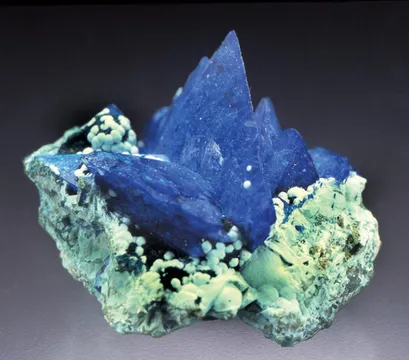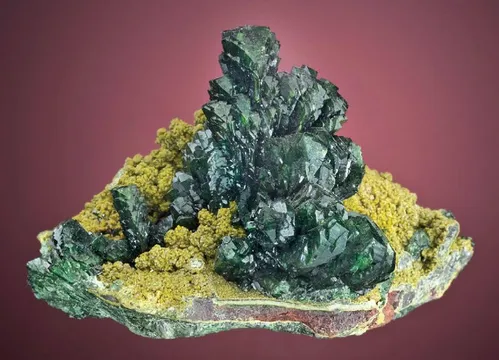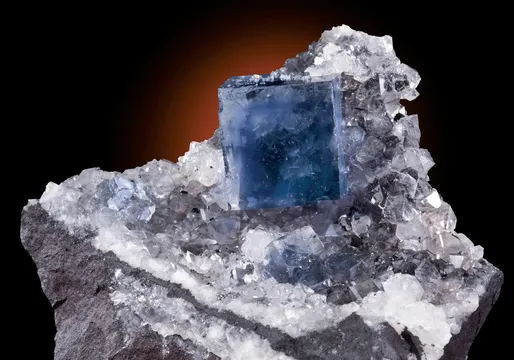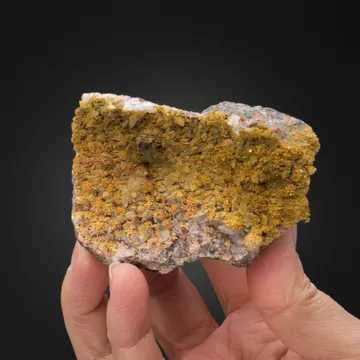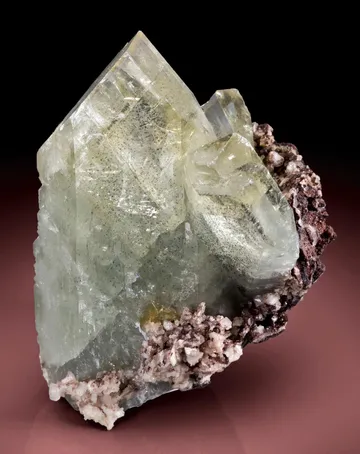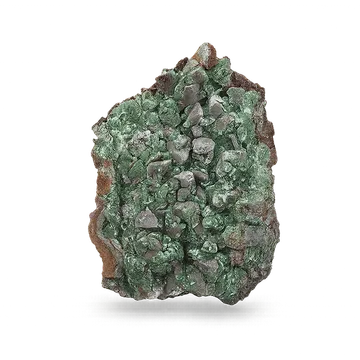
Olivenite - olive-green, acicular and botryoidal crystals from Wheal Gorland, Cornwall; a classic Cornish collector's mineral with copper-ore associations.
Key facts
Olivenite from Wheal Gorland is a classic Cornish collector’s mineral in the old sense of the word: dark, lustrous, compact, historically important, and almost always carrying the quiet authority of a nineteenth-century copper mine rather than the brash perfection of a modern open-pit find. Its best pieces are not large-crystal showstoppers. They are dense coatings, sprays, vugs, and rounded crusts of olive-green to dark forest-green Cu2(AsO4)(OH), typically sparkling over quartz, limonite-rich gossan, or malachite-stained matrix. The appeal is in the texture: acicular crystals packed into satiny radial aggregates, botryoidal-looking surfaces that resolve under magnification into needles or small prismatic terminations, and the unmistakable old Cornish palette of olive green, blue-green clinoclase, paler malachite, white quartz, and iron-brown gossan.
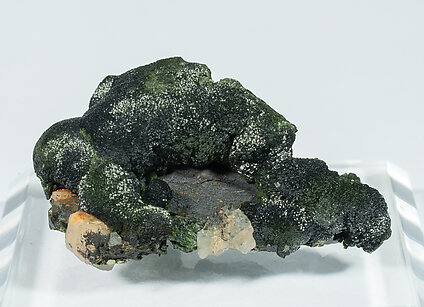
Photo: Fabre Minerals
Wheal Gorland sits in the St Day area of the Camborne–Redruth–St Day mining district, one of the great copper-mining districts of Cornwall. The mine worked a system of polymetallic lodes at and near the granite–country-rock setting, with primary copper, tin, arsenic, and tungsten mineralization later transformed in the upper oxidized zones into an extraordinary secondary assemblage. Olivenite belongs to that supergene copper-arsenate suite, and at Wheal Gorland it occurs in the company of some of the most historically resonant Cornish minerals: clinoclase, cornwallite, chenevixite, liroconite, malachite, pharmacosiderite, chalcophyllite, ceruleite, and quartz.
Wheal Gorland is not the type locality for olivenite; that honor belongs to the nearby Carharrack area. But Gorland is one of the defining old localities for the species. The mine’s fame rests not only on olivenite but on the richness of its entire secondary copper assemblage. It is the type locality for several valid species, including chenevixite, clinoclase, cornwallite, kernowite, and liroconite, making it one of the most important named localities in European mineralogy. For olivenite collectors, a Wheal Gorland specimen offers both species quality and locality prestige: a piece of the St Day copper-arsenate story rather than merely another green arsenate on matrix.
The finest examples collectors seek are rich, three-dimensional, and visibly crystallized: sharply acicular sprays in open vugs, lustrous deep-green crusts that remain lively under a hand lens, or old pieces with olivenite associated with clinoclase, malachite, quartz, or the famous blue minerals of the locality. Provenance matters heavily. Many desirable specimens are old collection pieces, sometimes carrying nineteenth- or early twentieth-century labels, because the mine is long closed, much of the specimen-producing ground has been lost, and fresh material of comparable quality is not a dependable modern supply.
Search for specimens: View all olivenite specimens from Wheal Gorland, Cornwall, UK
Wheal Gorland lies just north-east of St Day, in west Cornwall, at about 50° 14′ 30″ N, 5° 11′ 2″ W, with the UK National Grid reference SW730429. Historically it was in Gwennap parish; modern locality treatments place it within St Day, in the Camborne–Redruth–St Day district. The mine is now classed as built over, and the former Bawdens Shaft and Old Engine Shaft area has been developed as housing. It should be treated as a historic and protected mineral locality, not as an open collecting ground.
The deposit was a Cornish polymetallic lode system developed in Devonian country rock and spatially related to the Cornubian granite system. The lodes carried copper, tin, arsenic, and tungsten minerals, with tin and tungsten reported especially around the granite–country-rock contact during the early twentieth-century reworking. The primary assemblage and hydrothermal gangue were subsequently oxidized near surface, producing the copper arsenates that made Wheal Gorland famous to mineralogists. Olivenite is part of that oxidized-zone chemistry: copper from the primary ores, arsenic from arsenide and arsenopyrite-bearing mineralization, and oxygenated groundwater working through fractured quartz-gossan.
The first recorded working at Wheal Gorland was in 1792, though the lodes were probably known earlier. An engine was erected in 1795, when the lode had already been developed to 40 fathoms; the shaft was then sunk deeper, ultimately to 100 fathoms, yet regular ore shoots remained elusive. The mine was notoriously “bunchy”: at times extremely rich, then abruptly poor. Between 1792 and 1798 it lost money, but from 1800 onward conditions improved dramatically. Copper ore production reached a high point in 1827, and nineteenth-century records place the mine among the significant Cornish copper producers of its day.
Recorded production figures give a sense of the scale. Estimates list about 2,500 tons of copper ore for 1792–1798, 5,907 tons for 1800–1804, and 40,751 tons for 1815–1851. A later reworking in 1906–1909 produced tungsten, tin, and arsenic, including 164 tons of tungsten ore, 15 tons of tin ore, and 18 tons of arsenic in one commonly cited summary. The mine was taken into the St Day United group in 1852, but little substantial work followed under that ownership. By the later nineteenth century it was essentially a historic mine rather than an active copper producer.
Wheal Gorland’s mineral-specimen history is as important as its mining history. The upper workings and dumps yielded the secondary copper minerals that entered classic collections across Britain and Europe. Olivenite, clinoclase, cornwallite, liroconite, chenevixite, pharmacosiderite, chalcophyllite, malachite, quartz, and related arsenates occur in the specimen record, and the locality is repeatedly cited in nineteenth- and twentieth-century mineralogical literature. Some of the most interesting post-mining material came from dumps rather than deep underground collecting.
The major collecting tragedy was the removal of the main specimen-producing dump in 1976 for tin extraction. The tin content has been reported as only about 2 lb of black tin per ton, a pitiful return when set against the scientific and collector value of the discarded secondary-mineral material. Before that removal, amateur collectors had actively worked the dump for specimens. Afterward, collectors and dealers attempted, unsuccessfully, to gain access to the Muttrell lode through Davies Shaft. During the period when Wheal Jane pumping lowered the local water table, access could reportedly be made down to the County Adit, but not to the fabled Muttrell lode itself.
Collecting access today is severely constrained. The old mine area is built over or on private land, and the remaining protected mineral ground is associated with the Wheal Gorland Site of Special Scientific Interest. SSSI status does not create a public right of access; it adds legal protection for the site’s geological interest. Any scientific collecting, ground disturbance, or excavation would require appropriate landowner permission and, where relevant, Natural England consent. For most collectors, legitimate acquisition means old collections, reputable dealers, and documented specimens already in circulation.
Wheal Gorland olivenite is typically an olive-green to dark forest-green mineral, with the best examples showing bright, satiny, or sparkling luster. The crystal habit most associated with the locality is acicular to slender prismatic, commonly in dense radial sprays or compact aggregates. In hand specimen these growths may look botryoidal, mammillary, or almost velvety; under magnification they reveal packed needles and small terminations. Some pieces show elongated crystals with curved faces, doubly terminated individuals, or flattened prismatic forms, though the locality is better known for rich aggregate texture than for large isolated crystals.
Crystal size is generally small. Many display pieces are built from sub-millimetric to millimetric crystals, and a 0.5 mm crystal size is entirely normal for dense crusts. More open vugs may show acicular sprays several millimetres long, and dealer-documented examples include main crystals around 0.3 × 0.1 cm on miniature-size specimens. A vug 2.3 cm wide filled with olive-green acicular olivenite has been documented in an old Wheal Gorland specimen, which is a strong size for the style. The important measurement is often not a single crystal but the extent and richness of the crystallized area: a miniature or small cabinet specimen completely covered by sparkling olivenite can be much more desirable than a larger but patchy matrix piece.
The most typical matrices are quartz-rich veinstone, limonitic gossan, and copper-stained material with malachite or other secondary minerals. White quartz provides the strongest visual contrast, while brown gossan gives the most “Cornish” look. Malachite may appear as light to medium green banding or coatings, sometimes surrounding vugs lined with darker olivenite needles. Quartz, clinoclase, ceruleite, liroconite, malachite, chenevixite, cornwallite, limonite, pharmacosiderite, scorodite, cassiterite, mixite, cerussite, azurite, and chrysocolla are all recorded in association with olivenite from the locality or in photo-documented assemblages.
One historically important form is “wood copper,” an old variety name applied to fibrous or wood-like olivenite. At Wheal Gorland this material appears in the locality record and may also be encountered in older labels or dealer descriptions. Collectors should read such labels carefully: “wood copper” can refer to fibrous olivenite habit, and some old specimens described in that orbit may involve later replacement or association with clinoclase. The best pieces retain enough visible crystallization to be appreciated as olivenite rather than a dull green mass.
Quality factors are straightforward but unforgiving. Richness comes first: continuous coverage, lined cavities, or multiple sprays across the display face. Luster is second; dull green arsenate crusts are much less desirable than satiny or sparkling aggregates. Color should be recognizably olive to dark green, ideally deep and uniform, though lighter radial cross-sections can be attractive. Matrix matters when it adds contrast: white quartz, banded malachite, or blue-green clinoclase can elevate a specimen. Finally, provenance has unusual weight at Wheal Gorland. A small old piece with a credible nineteenth-century or early collection label may outrank a larger but undocumented fragment.
Authentic Wheal Gorland olivenite is scarce in the modern market and appears mainly through old collections. The mine is closed, the principal specimen dump was removed decades ago, and the developed site is not a realistic source for steady new collecting. When fresh-looking specimens appear, they should be assessed cautiously: not necessarily because they are fake, but because locality precision in the St Day district can be messy. Nearby Carharrack, Ting Tang, Wheal Unity, Wheal Muttrall, and other Gwennap–St Day localities also produced copper arsenates, and old labels may use broader names such as “Gwennap,” “St Day,” or “United Mines.”
No well-documented, locality-specific treatment problem is associated with Wheal Gorland olivenite in the standard collector literature and dealer records reviewed for this guide. The more realistic concerns are misattribution, over-broad locality naming, and species confusion in mixed copper-arsenate assemblages. Olivenite can occur with clinoclase and cornwallite, and old labels may emphasize the more famous species or use obsolete variety names. Dense dark-green crusts should be examined under magnification; a specimen sold as olivenite should show the expected acicular or prismatic habit, not simply an undifferentiated green coating.
Condition is an important issue. Wheal Gorland olivenite often consists of tiny needles or fine radial sprays, so bruising may show as flattened, greyed, or dull patches where the sparkle has been crushed. Edges of vugs are especially vulnerable. Matrix pieces can be friable where limonitic gossan is soft or powdery, and older specimens may have been trimmed heavily, glued to old bases, or stabilized in ways that are not always disclosed. Good pieces should be inspected for rubbed high points, broken spray tips, repaired matrix, and old glue residues.
The arsenate chemistry also deserves ordinary collector caution. Olivenite contains arsenic as part of its crystal structure; it is not a specimen to grind, acid-clean casually, or handle while eating. Normal display and careful handling are not a problem, but dust generation should be avoided. Historic labels should be preserved separately or protected from abrasion, as provenance is a meaningful part of value.
Current market availability is thin but real. Small cabinet and miniature specimens have appeared in recent dealer and auction records, including a 39 mm miniature listed around the mid-hundreds of dollars, a 5.8 cm old classic sold at auction for $450 in 2021, a 6.1 cm old classic sold for $249 in 2024, and a 6.3 cm ex Kurt Hefendehl small cabinet specimen sold for $836 in 2024. A more complex clinoclase-on-olivenite-on-quartz Wheal Gorland piece sold for $4,150 in 2025, illustrating how strong associated-species aesthetics and old-locality significance can push prices well beyond ordinary olivenite-only pieces. As always with classic Cornish material, the market rewards old labels, undamaged crystallized coverage, and unmistakable locality character.
In the early years of Wheal Gorland, the mine did not behave like a tidy orebody on a surveyor’s plan. It was erratic, rich in one place and barren in the next. The first recorded working was in 1792, and by 1795 the mine had enough promise to justify an engine. The lode had been opened to 40 fathoms, then the decision was made to sink deeper. Even at 100 fathoms, regular ore shoots had not been found. Between 1792 and 1798 the venture lost money. Then, around 1800, the ground changed character. The same mine that had frustrated its adventurers began yielding rich copper ore, and by 1827 production reached a peak recorded as 2,959 tons of copper ore.
The most memorable detail from the early working is the guard placed on the ore wagons. At times the supergene copper ore was so rich that it had to be watched in transit. For mineral collectors, that one image explains Wheal Gorland better than a production table: wagons of oxidized copper ore moving from the mine under guard, carrying not just smelting value but the same copper-arsenate chemistry that later made the place legendary. The green olivenite, blue liroconite, blue-green clinoclase, and related minerals were not decorative accidents; they were visible expressions of an ore zone rich enough to worry the mine’s owners.
By 1833 George Abbot could write of Wheal Gorland as a mine of serious economic rank, credited with profits of more than £300,000 and an annual production of 1,400 tons of ore. It was placed third in profitability behind Dolcoath and Consolidated Mines, two names that tower over Cornish mining history. Yet the glory did not last. Output declined after the late 1820s, and by 1838 production had fallen sharply. In 1852 Wheal Gorland passed into the St Day United group, but little work followed. The mine that had once put guards on ore wagons became, in practical terms, a classic locality preserved increasingly in cabinets rather than in active stopes.
The 1976 dump removal is the episode collectors still wince over. The main specimen-producing dump—one of the last practical sources of Wheal Gorland secondary minerals—was removed for tin extraction. The reported black tin content was only about 2 lb per ton. In exchange for that meagre value, the collecting world lost a dump that had been actively producing specimens for amateurs. It is hard to imagine a more Cornish mineral-collector tragedy: a heap rich in historic copper arsenates, removed in pursuit of a residue of tin so small that the number itself has become part of the story.
After the dump was gone, attention turned to the underground possibilities. Collectors and dealers tried to gain access to the Muttrell lode through Davies Shaft, but the attempt failed. When Wheal Jane was still pumping and lowering the local water table, access could be made down as far as the County Adit. Even then, the coveted Muttrell lode remained out of reach. Local collectors later judged that a successful breakthrough might not reward the risk anyway: the ground from Davies Shaft toward the Muttrell lode was described as “like a not-quite-soft cheese,” with stopes probably collapsed. It is a wonderfully Cornish phrase—half geology, half warning—and it closes the romantic idea of reopening Wheal Gorland with a dose of underground reality.
A quieter modern story comes from the museum drawer rather than the mine. Kernowite, the dark-green Fe3+ analogue of liroconite, was formally described from material attributed to Wheal Gorland, including a specimen in the Natural History Museum, London, with a lineage through Sir Arthur Russell and, earlier, Philip Rashleigh. That specimen had been labelled as liroconite, and the new identity emerged only through modern analytical work. The episode is a reminder that Wheal Gorland is not exhausted scientifically just because the mine is closed. Its old specimens still contain unanswered questions, especially in the complicated green-to-blue copper arsenates that eighteenth- and nineteenth-century collectors saved long before electron microprobes and single-crystal refinements could read them properly.