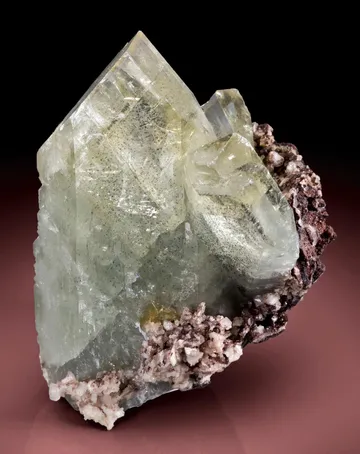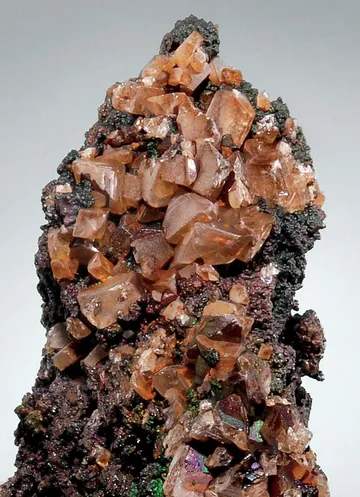
Wales, UK — a compact mineral province with diverse localities, classic type specimens like brookite and anglesite, and historic mines prized by collectors.
Key facts
Wales is not a single specimen locality so much as a compact mineral province whose best pieces come from several sharply different geological worlds: Lower Palaeozoic volcanic and sedimentary rocks of Eryri and Anglesey, the Devonian-to-Permian quartz-sulphide vein systems of the Central Wales Orefield, Mississippi Valley-type lead-zinc-barite-fluorite veins in North-east and South Wales, Carboniferous coalfield ironstone nodules, and the great quarry cavities of dolomitized limestone around Cardiff. That variety is why Welsh cabinets can look almost like a miniature survey of British mineralogy: grass-green pyromorphite on quartz from Bwlch Glas; reddish-brown brookite on altered dolerite from Prenteg; golden sprays of millerite in siderite-lined coal-measure nodules; huge red-dusted calcite scalenohedra from South Wales limestone quarries; and sharp albite-quartz-anatase-brookite associations from alpine-type fissures in North Wales.
The historical weight is just as strong as the mineralogy. Wales gave mineralogy several species first described from Welsh material, including brookite, anglesite, dickite, brammallite, banalsite, cymrite, pennantite, namuwite, lanthanite-(Ce), brinrobertsite, and steverustite. Parys Mountain was one of Europe’s great copper producers in the late eighteenth century and is the type locality of anglesite; Prenteg is the classic type locality for brookite; the South Wales Coalfield produced millerite specimens of international standing; and the Central Wales lead-zinc mines preserve one of Britain’s most intensively studied polyphase vein systems. The finest Welsh specimens tend to be compact rather than enormous, but they have character: bright colour against old quartz, crisp titanium-oxide crystals on pale feldspar, rich sulphide textures in breccia, and the unmistakable contrast between industrial mining history and elegant crystallography.
Regional View
Country View
For collectors, the name “Wales” on a label must always be narrowed if possible. A Welsh pyromorphite without a mine name is not the same collecting proposition as a Bwlch Glas or Frongoch specimen; a Welsh brookite may be world-class if it is genuinely Prenteg material, but many other Welsh brookites are micromount occurrences; and “South Wales millerite” can mean anything from a superb classic coalfield nodule to a modest later find from a reclaimed tip. Provenance is part of the specimen here, because many important Welsh finds were short-lived, historically collected, or came from localities now inaccessible, overgrown, landscaped, protected, or active industrial sites.

Search for specimens: View all specimens from Wales, UK
Welsh mineral specimens come from several deposit types rather than one mine or one orebody. The Central Wales Orefield is the most important specimen-producing lead-zinc province for quartz, pyromorphite, sphalerite, galena, chalcopyrite, calcite, and a suite of unusual secondary species. Its lodes cut Lower Palaeozoic mudstones and sandstones, especially in Ceredigion and adjoining Powys, and are famous for mineralized breccias in which angular wall-rock fragments and earlier vein material were repeatedly shattered and recemented by quartz, carbonates, and sulphides. Modern work on the orefield divides much of the primary mineralization into an early, more complex A1 group and a later, coarser A2 group. The A1 assemblages are generally compact, tough, milky quartz-rich breccias with fine intergrowths of chalcopyrite, sphalerite, galena, pyrite, marcasite, cobalt-nickel minerals, and ferroan carbonates; the A2 assemblages are more open, vuggy, crustiform, and specimen-friendly, with coarser quartz, galena, sphalerite, chalcopyrite, and calcite.
Cwmystwyth is the classic teaching locality for the Central Wales Orefield. Its lodes occupy a belt more than 1.5 km long and cut folded Llandovery mudstones and sandstones of the Cwmystwyth Grits Group. The Comet and Kingside lodes, with Mitchell’s Lode and associated fractures, show both early and late mineralizing episodes. Most of the lead and zinc ore mined there belonged to the later A2-style mineralization, and the site also produced secondary pyromorphite, cerussite, hemimorphite, hydrozincite, malachite, linarite, brochantite, and posnjakite. Specimen-grade material from Cwmystwyth is usually weathered because the surface workings have been exposed for centuries, but the locality remains one of the most instructive places for understanding the textures of Welsh quartz-sulphide vein breccias.
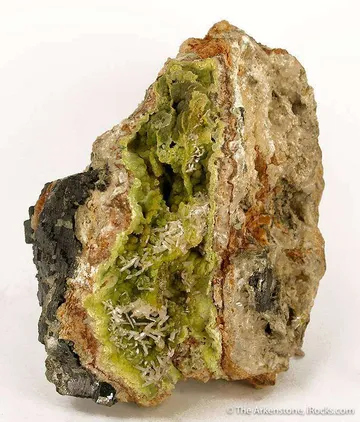
Bwlch Glas Mine, near Tal-y-bont in Ceredigion, is the locality behind many of the best Welsh pyromorphites. The celebrated specimens came from underground and from vein material in which green pyromorphite coats or lines vugs in quartz breccia. The most recognizable Bwlch Glas pieces show vivid apple- to grass-green crystals over white to grey quartz, often with cerussite, bindheimite-group material, galena, and locally wulfenite. Early dealer labels often obscured the exact source with “near Plynlimon,” and many specimens later acquired the erroneous label “Plynlimon Mine,” a persistent collecting problem because Plynlimon Mine is not the source of these classic pieces.
Frongoch, another major Central Wales mine, is equally important but visually different. It was one of the great nineteenth-century lead-zinc producers of the orefield and worked mineralization on the Frongoch Fault. Its primary ores were galena and sphalerite with quartz and carbonates, but its specimen fame rests heavily on secondary mineralization. Brown to pale mauve pyromorphite, cerussite, bindheimite-group minerals, wulfenite, and rare post-mining species occur there; the brown pyromorphite is especially significant because Frongoch is the Welsh locality where that colour is best developed in more than trace quantities. The mine is also prominent in modern environmental and conservation work because its sulphide-rich spoil has generated metal-bearing drainage.
North Wales adds a very different specimen style. The alpine-type fissure veins of Snowdonia and adjacent areas cut Lower Palaeozoic igneous and sedimentary rocks and yield quartz, albite, anatase, brookite, rutile, apatite, chlorite-group minerals, synchysite, xenotime, and monazite. Prenteg, near Tremadog, is the classic brookite locality: reddish-brown striated tabular crystals on altered dolerite with quartz and albite, historically collected from what became one of the world’s benchmark brookite occurrences. Other localities such as Hendre Quarry, Manod Quarry, Cwmorthin, Gloddfa Ganol, and Tanygrisiau produced smaller but important alpine-type associations. The best of these are cabinet-quality or fine micromount specimens with sharp contrast between white albite, clear quartz, chloritic coatings, and lustrous titanium oxides.
Anglesey’s Parys Mountain represents another Welsh classic: a volcanic-related massive sulphide system with copper, lead, zinc, iron, silica, and silver mineralization associated with submarine volcanic rocks. Its Great Lode was a giant eighteenth-century copper producer, and the oxidized gossan yielded the type material for anglesite. The landscape of red, orange, yellow, and purple spoil is not merely picturesque; it reflects intense oxidation of sulphides and the formation of copper- and iron-bearing secondary minerals. Parys specimens are usually more historically and scientifically important than pretty, though old anglesite, chalcopyrite, sphalerite, pyrite, galena, quartz, malachite, and mine-salt assemblages are all represented in collections.
South Wales contributes two of the most distinctive Welsh specimen environments. In the Coal Measures, septarian clay-ironstone nodules from collieries and coal tips produced pearly to brown siderite crystals, doubly terminated quartz “diamonds,” barite, sphalerite, galena, siegenite, and the golden acicular millerite sprays that made the region famous. Many such localities were temporary because productive nodules were exposed during coal extraction, opencast work, or tip reclamation, then lost again. Separately, the Carboniferous Limestone and associated Mesozoic strata around Cardiff, Llantrisant, Taff’s Well, Machen, Mwyndy, Ton Mawr, Wenvoe, and related quarries produced large cavity minerals: calcite, barite, quartz, goethite, hematite, sphalerite, smithsonite, hemimorphite, malachite, and barytocalcite in limestone-hosted iron and MVT-style lead-zinc-barium systems. Access to active quarries is controlled, and most collecting depends on historic material, dealer stock, old quarry finds, or permission-based visits.
Collecting access in Wales is highly variable and generally more restricted than older collecting literature implies. Some classic sites are protected or inaccessible, many mine tips are private land or scheduled heritage sites, underground workings are unstable and hazardous, and active quarries require formal permission. Prenteg is not an open collecting locality. Working quarries such as Taff’s Well, Machen, Dolyhir, and similar sites should be treated as no-access without prior permission. Old mine dumps may carry environmental hazards as well as heritage restrictions, and weathered lead-, arsenic-, cadmium-, copper-, and zinc-bearing minerals should be handled with normal mineral-collector hygiene: avoid dust, do not trim indoors without controls, wash hands after handling, and store crumbly secondary mineral specimens securely.
Welsh quartz ranges from ordinary vein-stone to genuine classics, and the best pieces are strongly locality-dependent: clear early tourist “Snowdon Diamonds” from North Wales; long, bright prismatic crystals from alpine-type fissures and slate-quarry settings such as Votty and Bowydd; water-clear to milky crystals on prehnite at St David’s Head; doubly terminated “Merthyr diamond” crystals in South Wales Coalfield ironstone cavities; and coarser grey-white or milky quartz from the Central Wales Orefield, where it is the principal gangue of both A1 and A2 lead-zinc vein assemblages. In Central Wales, the collector-grade material is seldom just “quartz”—good specimens carry context, such as smoky crystals in rare breccia vugs at Bog Mine, quartz beds interlayered with marcasite and sulphides at Brynyrafr, or 2–3 cm pyramidal quartz overgrowing calcite rhombs from Cefngwyn. The better Welsh quartz specimens are bright, undamaged, and three-dimensional, with clear terminations or a meaningful association; ordinary milky lode quartz without crystals, sulphides, or a classic label is abundant and far less desirable.
Pyromorphite is one of the signature collector minerals of Wales, especially from the Central Wales Orefield, where oxidation of lead-bearing lodes produced green, yellow-green, brown, mauve-brown, and rarely nearly colourless material on quartz, galena, cerussite, goethitic gossan, and barite. Bwlch Glas Mine is the Welsh classic: specimens collected mainly in the late 1960s and early 1970s show grass- to apple-green prismatic or acicular pyromorphite richly covering quartz breccia, sometimes on both sides of the matrix and locally associated with cerussite, bindheimite-group minerals, galena, susannite, and wulfenite. Frongoch is famous for a different look—pale mauve to brown prisms, locally to exceptional size for Wales, and green microcrystalline crusts near the Wemyss boundary—while Llechweddhelyg produced superb olive-green curved barrel-shaped crystals in dark vuggy goethitic gossan. The best Welsh pyromorphites combine saturated colour, visible crystal form, bright coverage, and a correct mine label; mediocre examples are dull green crusts on quartz, and mislabelled “Plynlimon Mine” specimens should be corrected to Bwlch Glas when the appearance and provenance support it.
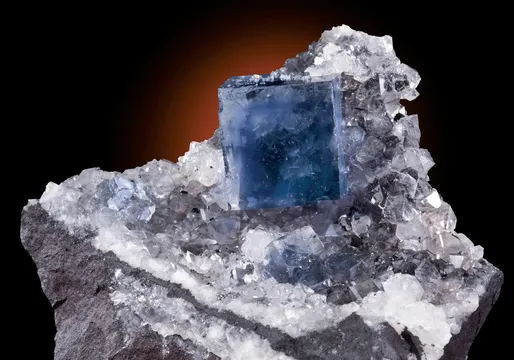
Calcite occurs almost everywhere in Wales, but collector pieces fall into several recognizable families: rhombs and platy “schiefer-spar” from the Llanrwst lead-zinc veins, weathered stalactitic and tabular forms from the late A2-c assemblage of the Central Wales Orefield, luminescence-distinguished supergene calcite enclosing copper minerals at Great Orme, and the big South Wales limestone-quarry crystals that made Taff’s Well and neighbouring workings famous. Around Cardiff, large cavities in dolomitized Carboniferous Limestone produced scalenohedra exceeding 30 cm, crystal groups exceeding 1 m across, nailheads, rhombic aggregates, and reddish hematite-dusted pieces associated with barite, quartz, and iron oxides. Display-quality Welsh calcite is judged less by rarity than by form, lustre, and damage: a clean smaller scalenohedron, sharp nailhead group, or red-dusted cluster is usually preferable to a huge overgrown and bruised quarry crystal, while Central Wales pieces gain value when they show attractive quartz, galena, pyrite, or unusual pseudotabular habits tied to a documented mine.
Brookite is a Welsh type-locality mineral and one of the country’s great world-class species: the classic material is from Prenteg near Tremadog, where lustrous reddish-brown, striated, tabular crystals commonly in the 15–30 mm range occur on altered dolerite with quartz, albite, anatase, apatite, and clinochlore. Historic Prenteg specimens are prized because they combine size, crystal sharpness, lustre, matrix, and provenance; no other Welsh occurrence is known to surpass them. Smaller brookites occur in alpine-type fissure associations at Hendre Quarry, where reddish-brown crystals to about 2.5 mm accompany quartz, albite, apatite, anatase, xenotime, and monazite and may require careful removal of calcite coatings; at Manod, where crystals are often deformed or broken in clinochlore with quartz and albite; and at Cwmorthin and Tanygrisiau, where the species is generally a micromount mineral. A good Welsh brookite is therefore not simply any brown TiO2 crystal—it is a sharp, lustrous, well-striated tabular crystal, ideally Prenteg, with intact edges and credible old provenance.
Millerite is one of Wales’s most internationally important minerals because the South Wales Coalfield produced superb sprays of bright golden needles in septarian clay-ironstone nodules, typically rising from pearly to brown siderite linings and associated with quartz, sphalerite, galena, chalcopyrite, and Co-Ni sulphides such as siegenite. The classic coalfield specimens come from collieries and tips including Treharris, Powell Duffryn at Bargoed, Gelli, Wyndham, Coed Ely, and other workings, with sprays commonly measured in millimetres to a few centimetres and exceptional radiating groups reported around 25–40 mm across or long. Central Wales also produced millerite in hydrothermal vein settings, especially Brynyrafr Mine near Ponterwyd, where tangled and often twisted needles generally 5–10 mm, exceptionally to about 20 mm, span quartz cavities with chalcopyrite and occasional sphalerite; attractive though these are, they do not match the finest coalfield nodules. Top Welsh millerite must be protected from vibration and abrasion: unbent, bright, separated needles in an open siderite-lined vug are far better than tarnished, crushed, or clay-filled sprays.
Barite, historically “baryte” or “heavy spar” in Welsh mining literature, is widespread in Welsh hydrothermal systems but only locally produces good crystals. It was mined in quantity in the Llanengan district, at Pennant near St Asaph, in the Middletown border area, on the Van Lode near Llanidloes, and at the Vale of Towy and Cystanog mines, yet much of that output was massive rather than specimen-grade. The best Welsh barite specimens come from selected South Wales cavity-fill iron and limestone deposits, where Mwyndy produced yellow crystals up to about 5 cm, Taff’s Well and Ton Mawr produced pink bladed aggregates, and Dolyhir yielded translucent yellow to bluish prismatic crystals to about 20 mm and white tabular blades to about 15 mm in veins with calcite, harmotome, barytocalcite, and witherite. Septarian ironstone nodules of the South Wales Coalfield also produced tabular crystals up to about 10 mm from collieries such as Bedwas, Deep Navigation, Lewis Merthyr, and Windsor. Good Welsh barite is unusually clean, glassy, coloured, or bladed with matrix and locality; massive white heavy spar from old dumps is historically interesting but common.
Siderite is widespread in Wales but its best collectible development is in the South Wales Coalfield, where Carboniferous clay-ironstone nodules contain septarian cavities lined with pearly white to cream siderite that weathers through lustrous golden brown to darker brown. These siderite linings are the essential matrix for many classic Welsh millerite specimens and also host quartz, sphalerite, galena, and other sulphides. Small rhombic crystals, commonly only a few millimetres across, can be very attractive when fresh and lustrous, and the Wyndham Colliery reclamation of the 1980s produced rare stellate twinned siderite crystals around 0.5–1 mm across with sphalerite and millerite. In the Central Wales Orefield, siderite is recorded as gangue at mines such as Ystrad Einion, Geufron, and Siglenlas, but these are not the aesthetic classics. For collectors, the condition issue is oxidation: fresh lustrous siderite-lined cavities are desirable, while dull, crumbly, limonite-replaced nodules quickly lose the elegance that makes the association worthwhile.
Albite in Wales is important less as a large display mineral than as a key component of North Welsh alpine-type fissure assemblages, where white, colourless, buff, or pinkish tabular crystals occur with quartz, anatase, brookite, rutile, apatite, chlorite-group minerals, synchysite, xenotime, and monazite. Prenteg produced rich hand specimens of 5–10 mm white tabular albite aggregates on dolerite in the same classic environment as brookite, though the locality is now protected and inaccessible to collectors. Manod Quarry produced some of the best Welsh albite specimens, with colourless to white tabular crystals up to about 10 mm coating fractured quartz-latite in association with quartz, anatase, brookite, apatite, synchysite, and clinochlore; Gloddfa Ganol yielded complex crystals up to about 2 mm in brecciated slate; Tanygrisiau Station produced coatings of small twinned tabular crystals; and Brynyrafr offers an unusual Central Wales occurrence of sub-millimetre euhedral albite with apatite, rutile, and quartz in tiny cavities within quartz-cemented breccia. The best pieces show sharp, untarnished feldspar crystals as part of a balanced alpine assemblage, not merely pale feldspar veinlets.
Malachite is common in Welsh copper-bearing oxidation zones, but attractive specimens are selective. The Great Orme copper mines are historically famous for malachite on dolomite and for malachite pseudomorphs after chalcopyrite, the green copper carbonate being one of the ores exploited by early miners and even staining bone tools found in the ancient workings. In the Central Wales Orefield, Llechweddhelyg produced Wales’s most attractive malachite: bright green fibrous and banded sprays up to about 4.5 cm, fibrous masses up to about 6 cm, deep green masses in galena-goethite matrix, and rarer botryoidal coatings, particularly on the Eastern Engine-shaft dump. Nearby Lletty Evan-Hen produced smaller spherical sprays, generally under 6 mm, in quartz veinstone cavities, while Lodge Park yielded post-mining spheroidal coatings with brochantite. South Wales localities such as Machen, Wenvoe, Penarth, and Lavernock generally produced coatings, spheroids, or copper-stained associations rather than major display crystals. Good Welsh malachite is velvety, saturated, fibrous, and three-dimensional, with Llechweddhelyg provenance carrying special weight.
Sphalerite was an important Welsh zinc ore in the Central Wales, Halkyn-Minera, Llanrwst, Parys Mountain, South Wales, and Dolgellau districts, but handsome crystals are less common than its abundance might suggest. In the Central Wales Orefield it occurs in several paragenetic generations, from dark brown through reddish to yellow “honey-blende,” commonly with quartz, ferroan dolomite, galena, and chalcopyrite; polished sections often show “chalcopyrite disease,” tiny oriented blebs of chalcopyrite included in sphalerite. Frongoch sold more than 50,000 tonnes of sphalerite concentrates in the nineteenth century, and other major sphalerite-bearing mines included Van, Brynyrafr, Nantycreiau, and Cwmystwyth, though well-formed crystals from Central Wales are rare. The better aesthetic Welsh sphalerites are more likely from Halkyn-Minera, where lustrous reddish-brown crystals over 1 cm occur with quartz and calcite, from Moel-y-Crio with galena and calcite, or from South Wales Coalfield nodules where sphalerite accompanies millerite, siderite, quartz, galena, and siegenite. Collectors should beware weathered Central Wales sphalerite because cadmium can be present and bright yellow cadmium sulphide films may appear on broken altered material.
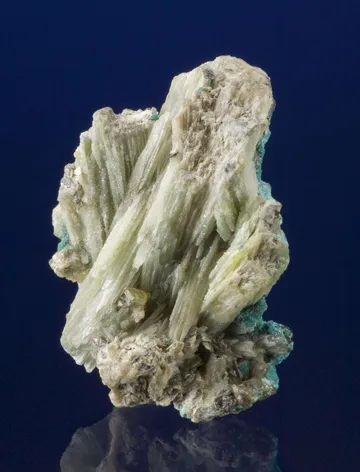
Beyond these ten species, Wales is unusually rich in type-locality and rare minerals. Anglesite was first recognized from the gossan of Parys Mountain; brookite from Prenteg is both type-locality material and a world standard for the species; dickite is tied to Trwyn-Bychan on Anglesey; brammallite to Llandebie in Carmarthenshire; banalsite, cymrite, and pennantite to the Benallt manganese mine on the Llŷn Peninsula; namuwite to Aberllyn near Betws-y-coed; lanthanite-(Ce) to Britannia Mine on Snowdon; brinrobertsite to material near Bangor; and steverustite to Central Wales post-mining lead thiosulphate assemblages. Other collector or research minerals documented from Wales include wulfenite from Bwlch Glas and Central Wales occurrences, barytocalcite from Mwyndy and Dolyhir, witherite from barite-rich systems, siegenite in coalfield and Central Wales associations, tucekite as a rare Central Wales ore mineral, and a broad suite of copper, lead, zinc, barium, manganese, and rare-earth secondary species that make Welsh micromineralogy far deeper than the size of the country would suggest.
Welsh labels deserve scrutiny. The best-known locality problem is Bwlch Glas pyromorphite sold as “near Plynlimon” and later relabelled as “Plynlimon Mine.” That mislabelling is not a harmless simplification: Bwlch Glas is the true classic source of the coarse green pyromorphite, while Plynlimon Mine is not known for specimen-quality pyromorphite. Old “Anglesey” pyromorphite specimens in some collections are also problematic, because several resemble material from Roughton Gill in Cumbria and lack convincing modern confirmation. For brookite, vague old labels such as “Tremadoc” or “near Snowdon” may refer to the Prenteg type locality, but the value difference between Prenteg and a generic North Wales alpine occurrence is large enough that provenance should be preserved exactly as received, not improved.
Condition issues vary by species. Bwlch Glas pyromorphite is commonly on quartz breccia and may have exposed delicate acicular or prismatic crystals; avoid ultrasonic cleaning and aggressive brushing. Brown Frongoch pyromorphite and cerussite-rich material can be easily bruised and should be stored away from harder quartz specimens. Millerite from South Wales nodules is fragile: the needles bend, snap, and detach, and clay-ironstone matrices can shed if repeatedly dried and wetted. Siderite-lined nodules may continue to weather, especially if damp or already oxidized. Calcite from Taff’s Well, Machen, and related limestone quarries is often cleaved, contacted, or bruised on exposed points, and very large crystals are not automatically high quality. Barite is heavy but not tough; bladed groups chip along edges. Albite-brookite-anatase specimens from North Wales are usually small and should be cleaned under magnification, particularly where calcite coatings obscure titanium oxides.
Fluorescence is locality-specific rather than a general Welsh selling point. Calcite from the Great Orme copper mines has been studied in multiple supergene generations distinguished partly by luminescent properties, and some South Wales calcites may respond, but fluorescence should not be assumed without testing. Handling precautions are sensible for all Welsh mine material: many old dumps contain lead, zinc, copper, arsenic, barium, cadmium, and acidic alteration products; do not inhale dust from trimming; wash hands after handling; and keep friable secondary minerals away from children and pets. Specimens containing suspected soluble sulphates from mine environments should be kept dry and boxed.
Market availability is uneven. Bwlch Glas pyromorphite appears regularly enough that patient collectors can obtain a representative miniature or small cabinet piece, but rich, bright, well-crystallized examples with old provenance are British classics and command stronger prices. Prenteg brookite is much scarcer and should be treated as a historic specimen; modern collecting at the locality is not an option. South Wales millerite is available from old collections, but excellent open sprays in undamaged nodules are much harder to buy than small or tarnished examples. South Wales calcite is available in large sizes, yet truly aesthetic, undamaged examples are selective. Welsh microminerals—especially Central Wales secondary species and North Wales alpine-type assemblages—remain an active specialist field, but reliable identification and locality precision matter more than dramatic size.
The Bwlch Glas pyromorphite story has the flavor of old-school collecting secrecy. Fine green specimens began appearing on the market in the 1970s labelled only as “near Plynlimon,” the high ground that dominates the district. That vagueness was deliberate enough to leave a long afterlife in collections: labels hardened into “Plynlimon,” then into the erroneous “Plynlimon Mine.” The irony is that the concealment failed. The real source, Bwlch Glas Mine near Tal-y-bont, became famous anyway, while the false label became a problem every later collector has had to unpick. A good Bwlch Glas specimen still tells that story visually: white quartz breccia, bright apple-green pyromorphite, and the unmistakable look of a pocket found in a small Welsh lead mine rather than a large commercial source.
Cwmystwyth carries a much older drama. High on Copper Hill, archaeological excavation of ancient opencast workings produced charcoal, deer-antler implements, and wood dated to the Early Bronze Age, making the site one of Europe’s important early mining landscapes. Centuries later the same valley was being read through medieval and Tudor eyes. The Cistercian abbey of Strata Florida, completed in 1201 nearby, is thought to have been connected with mining administration in the district, and John Leland described the approach to the workings in his 1536–39 itinerary through Wales. For the mineral collector standing before Cwmystwyth material, that time-depth matters: pyromorphite and quartz breccia from the upper workings are not simply chemical products of oxidized galena, but pieces of a landscape mined, re-mined, weathered, studied, and argued over for thousands of years.
Parys Mountain is the Welsh locality where geology and industrial theatre most visibly collide. The hill near Amlwch rises only modestly, but the mine landscape is a furnace-coloured scar of red, orange, purple, and yellow waste. In the eighteenth century the discovery of the Great Lode transformed it into one of Europe’s dominant copper producers. Ore was not just dug; it was roasted on site, leached in precipitation pits, and turned into copper by throwing scrap iron into metal-bearing waters. The gossan that once capped the orebody yielded abundant lead sulphate, recognized from Anglesey material before the name anglesite was formalized. Today the old pits show the collector why many Parys specimens are more mineralogical documents than pretty cabinet pieces: the colours are the specimen, spread across a landscape of oxidized sulphides.
At the Great Orme, the most vivid mineral story is not a crystal pocket but a prehistoric mine. Bronze Age miners followed copper mineralization through constricted limestone workings, exploiting malachite and related copper ores long before modern geology could describe the deposit. Later aragonite flowstone sealed many archaeological features and helped preserve evidence of the ancient work. The scale is startling: the mines are internationally known because the surviving prehistoric workings form one of Europe’s largest Bronze Age copper-mining complexes, and research has linked Great Orme copper to bronze objects distributed far beyond North Wales. For collectors, the green of Great Orme malachite is therefore not just colour—it is ore, pigment, tool metal, and archaeology in the same specimen.
The South Wales millerite story is more modern and more fleeting. The finest specimens were not mined from tidy museum pockets; they came from clay-ironstone nodules exposed by coal mining, opencast work, and tip reclamation. A productive reclamation could briefly reveal nodules lined with siderite and hairlike golden millerite, then the opportunity was gone. Wyndham Colliery is remembered among specialists for rare stellate twinned siderites collected during 1980s reclamation, while other collieries became known for millerite sprays only because collectors were there during the short window when the nodules were accessible. That temporary nature explains why even small South Wales nodules with sharp, undamaged millerite sprays carry a charge absent from more abundant world localities: many came from industrial moments that cannot be repeated.