A collector's guide to Susanna Mine, UK: its geology, mining history and notable minerals, illustrated with the 21 specimens documented from this locality on EarthWonders.
Key facts
The Susanna Mine at Leadhills, South Lanarkshire, is one of the great small places in British mineralogy: a lead-zinc-silver vein that became disproportionately famous not for tonnes of ore, but for the chemistry of its oxidised zone. The mine worked the Susanna Vein—also called the Clay-bed—on Lady Manner’s Scar, north-west of Leadhills village, within the Leadhills–Wanlockhead ore field of the Lowther Hills. The country rocks are Ordovician greywackes, shales, cherts and associated volcanic rocks, cut by a dense swarm of fissure veins. In the Susanna Vein, galena with subordinate sphalerite, pyrite and chalcopyrite weathered into a compact, chemically varied suite of lead sulphates, carbonates, phosphates and copper-lead sulphates: lanarkite, leadhillite, susannite, caledonite, linarite, pyromorphite, mimetite, cerussite, anglesite and rarer species that later proved important to mineral classification.
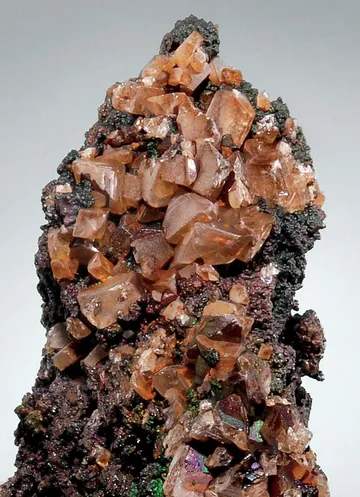
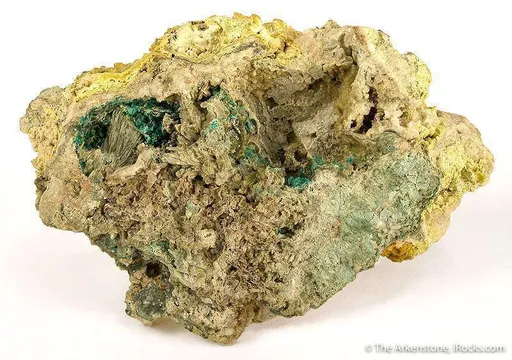
For collectors, Susanna is above all a type-locality name. Lanarkite, leadhillite and susannite are historically tied to the Leadhills/Susanna suite, and later re-study of old specimens revealed still more rare phases, including scotlandite, macphersonite and chenite-bearing associations. The best cabinet appeal comes from contrast rather than size: pale straw to colourless blades and plates of lanarkite and leadhillite set in vugs of green or yellow pyromorphite, with powdery to crystalline blue-green caledonite or linarite and dull grey galena beneath. A fine Susanna piece is rarely loud; it is an old Scottish miniature with a great label, a complicated paragenesis, and crystals large enough to make a rare species visible without needing to be merely a micromount.
Regional View
Country View
The locality’s classic specimens are overwhelmingly old-time pieces. The Susanna workings themselves are abandoned, the richest oxidised ground was exploited long ago, and the visible scar and dumps now sit in a historic mining landscape rather than an active collecting ground. This matters on the market: a specimen labelled “Susanna Mine” is often valued as much for its provenance and diagnostic associations as for crystal size alone.

Photo: Wikimedia Commons
Search for specimens: View all specimens from Susanna Mine, UK
The Susanna Mine belongs to the Leadhills–Wanlockhead lead-zinc-silver vein field, the most productive historic lead mining district in Scotland. The ore field lies in strongly faulted Lower Palaeozoic rocks of the Southern Uplands, where fissure veins cut greywacke, shale and chert. The broader field contained roughly seventy worked lead-zinc veins, many of them banded fissure-fillings or breccia veins in which fragments of greywacke were cemented by calcite or dolomite and locally by galena. The richer shoots tended to be controlled by fracture zones, clay gouges and shattered wall rock, creating both large ore pockets and smaller oxidised cavities.
The Susanna Vein itself was an abandoned vein on Lady Manner’s Scar, north-west of Leadhills. It was also known as the Clay-bed, an apt old mining name for a lode whose wall movement and clayey decomposed material helped concentrate both ore and secondary minerals. The vein trends a few degrees north of west and hades north at about 45–50 degrees. Old descriptions record broken country rock with interspersed “self-pieces” of galena and, in places, exceptionally rich widths said to have reached 18 ft of solid ore. Its workings extended for more than 260 fathoms along strike and to about 140 fathoms in depth, but the mine was ultimately abandoned because water could not be controlled.
Primary ore at Susanna was galena, with lesser sphalerite, pyrite and chalcopyrite. The collector interest sits in the oxidised upper lode, where the slow alteration of galena and the presence of subordinate copper minerals produced an unusually full secondary suite. Cerussite was not only present but was worked as “grey lead ore” in the upper levels. Anglesite, pyromorphite and mimetite formed with the carbonate minerals; where copper entered the system, linarite and caledonite appeared; and under unusually low-carbonate conditions, the rare basic lead sulphate lanarkite crystallised. That mixture of sulphate, carbonate, phosphate and copper-lead chemistry is the hallmark of the best Susanna specimens.
Historically, Leadhills mining goes back at least to medieval records of lead working in the district, followed by significant gold extraction in the sixteenth century and large-scale lead exploitation thereafter. The Leadhills mines later passed into the Hopetoun interest, and nineteenth- and early twentieth-century accounts list the Marquis of Linlithgow as proprietor and The Leadhills Co. Ltd. as lessee for the Susanna Vein. Historic Environment Scotland records the visible Leadhills mining remains as mainly mid- to late-eighteenth- and nineteenth-century, with a final operational phase between 1917 and 1928 before closure in 1929. The district as a whole yielded about 0.4 million tonnes of metallic lead, 10,000 tonnes of zinc and 25 tonnes of silver between 1700 and 1958, but Susanna’s mineralogical fame rests on small oxidised pockets rather than late industrial production.
The Susanna Vein was probably among the early veins worked at Leadhills. Old accounts describe a great open-cast gash up the hillside marking its course. The Foullis family worked it extensively, and a vivid mining anecdote survives from the period of litigation between Anne and Douglas Foullis: Douglas had trialled from his Glendorch lands in search of the vein without success, only for later miners, while exploiting a rich ore pocket, to break accidentally into his old workings and reveal that he had stopped within a few feet of the prize. That is exactly the kind of geological near-miss that defines old vein mining: the difference between failure and a rich pocket could be only a few feet of uncut ground.
Collecting access today should be treated conservatively. The Susanna workings are part of a historically sensitive mining landscape around Leadhills, with scheduled-monument protection applying to extensive lead-mining remains in the area. Geological field guides advise seeking permission from Hopetoun Estates for Leadhills ground, avoiding the grouse-shooting season, and never entering old adits, many of which are unsafe. Surface dumps in the district have been picked for generations, and the Lady Manner’s Scar opencast workings are specifically described in excursion literature as no longer as fruitful as several other Leadhills–Wanlockhead collecting stops. For collectors, serious Susanna material is therefore usually acquired through old collections, dealer stock and museum deaccession history rather than fresh field recovery.
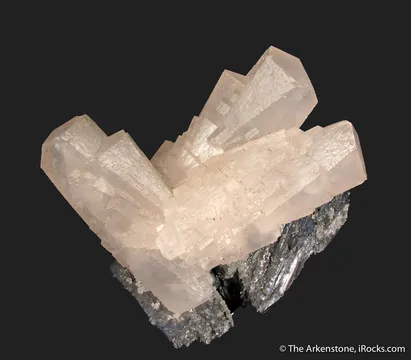
Lanarkite is the signature species of Susanna: colourless, white to pale yellow or faintly greenish blades and elongated prisms in small oxidised vugs, commonly on or near pyromorphite, anglesite, cerussite, leadhillite, susannite, caledonite and linarite. Most crystals are only a few millimetres, but notable old specimens show sharp blades around 6 mm, 1 cm, and in exceptional documented vugs up to about 1.5 cm; those larger, lustrous, translucent sprays are world-class for the species. Ordinary Susanna lanarkite may be a pale, cleaved lining or a sparse white crust, while the desirable pieces show distinct bladed crystal groups rising free in cavities, preferably with green or yellow pyromorphite providing contrast and with an old Susanna or Leadhills label that anchors the specimen to the type-locality suite.
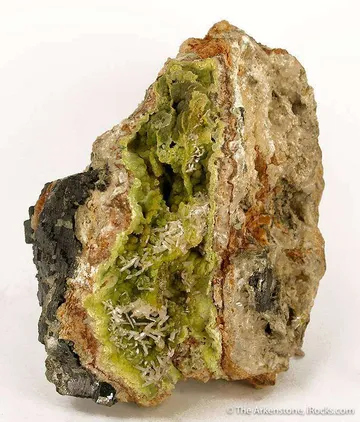
Pyromorphite from the Susanna Mine is a classic accessory rather than the world’s largest expression of the species, but it is crucial to the locality’s visual character and paragenesis. It occurs as green, yellow, olive, orange and rarely red coatings, druses and small hexagonal crystals on galena-rich matrix, cerussite, quartz and the lead sulphate-carbonate suite; documented specimen descriptions include smooth, melted-looking coatings and distinct hexagonal crystals around 1 mm, with old labels noting both light green crystalline material and darker gemmy green pyromorphite. The most attractive Susanna pyromorphite specimens are those where the phosphate forms a rich, colourful carpet around lanarkite, leadhillite, linarite or caledonite, while the historically important red-orange material is prized because nineteenth- and twentieth-century authors singled out Susanna as the Leadhills source for unusual orange and red pyromorphite.
Other documented Susanna minerals make the mine far more than a two-species locality. Leadhillite and susannite are central to the old Leadhills suite, and macphersonite, the third polymorph of Pb4(SO4)(CO3)2(OH)2, was described from Leadhills material associated with leadhillite, susannite, cerussite, caledonite, pyromorphite, scotlandite and galena. Scotlandite, PbSO3, was recognised on a specimen labelled from the Susanna Vein and became famous as the first naturally occurring sulphite; its associated cavity contained anglesite, lanarkite, leadhillite and susannite. Chenite, Pb4Cu(SO4)2(OH)6, was also identified from a Susanna-labelled specimen as minute sky-blue crystals with caledonite, linarite, leadhillite and altered galena. The broader Susanna list also includes cerussite, anglesite, mimetite, linarite, caledonite, chrysocolla, malachite, azurite, galena, sphalerite, pyrite, chalcopyrite, quartz, calcite and baryte, with vanadinite recorded historically as exceedingly rare from Susanna and Belton Grain.
Susanna Mine specimens reward caution and close looking. The principal authenticity issue is not a well-known treatment or artificial enhancement tradition, but locality and species precision. Many old pieces are labelled simply “Leadhills,” “Susanna Vein,” “Scar Vein,” or by older spellings such as “Suzannah,” and several minerals in the suite can be visually deceptive: leadhillite, susannite and macphersonite are polymorphs and may be confused on habit alone; pale lanarkite can be mistaken for anglesite, cerussite or leadhillite fragments; and small yellow phases in mixed vugs may need analytical confirmation rather than confident naked-eye naming. For valuable pieces, an old label is important but not sufficient—look for the full Susanna association, crystal habit, matrix and, where rarity is claimed, analytical support.
Condition is often the limiting factor. Lanarkite, leadhillite, susannite and macphersonite are soft lead minerals with excellent cleavage tendencies, so sharp edges are easily bruised and old specimens commonly show broken blades, cleaved plates, rubbed vug mouths or sugary decomposition crusts. Caledonite and linarite add colour but are small and can be friable on oxidised galena. Pyromorphite coatings may be more robust, yet the best visual pieces depend on tiny crystals sitting intact on uneven vug surfaces; repeated handling quickly dulls their appeal. Store Susanna specimens in a dry, stable cabinet, avoid ultrasonic cleaning, and use only minimal mechanical dust removal.
Several Susanna-associated phases can fluoresce, most notably some lanarkite and macphersonite reported from Leadhills material, but fluorescence should be treated as a supporting observation rather than an identification. The locality’s lead-rich minerals also warrant ordinary sensible handling: do not abrade or powder them, keep them away from children, and wash hands after handling. From a market standpoint, unquestionable Susanna Mine lanarkite is scarce; attractive pyromorphite-only pieces are more available, but those with convincing old-time Susanna provenance and associated rare lead sulphates rise sharply in desirability. Miniatures and small cabinets with visible lanarkite, leadhillite or susannite in a vug are the sweet spot for most serious collectors; analysed micromounts of chenite, scotlandite or macphersonite occupy a more specialist tier.
The Susanna Vein’s oldest story is a tale of a miss measured in feet. During the Foullis family’s long involvement at Leadhills, Anne and Douglas Foullis became entangled in litigation over the ground. Douglas trialled from his lands at Glendorch, searching for the Susanna Vein, but failed to cut it. Much later, miners working an exceptionally rich pocket of ore broke unexpectedly into his abandoned trial workings. The accident proved that Douglas had been almost there: his old work had stopped within only a few feet of the rich vein. In an ore field where veins pinched, shifted and vanished into shattered greywacke and clay gouge, the episode has the bitter geometry of underground mining—wealth on one side of the wall, disappointment on the other.
Another Susanna story belongs to the afterlife of specimens rather than to the mine itself. In 1978, W. H. Paar acquired a specimen from Dr D. H. Garske of Elmhurst, Illinois, labelled “Lanarkite, Anglesite, Leadhillite/Susannite; Susanna Vein, Leadhills, Lanarkshire, Scotland.” Its paper trail led through Howard Belsky of Brooklyn and Richard Barstow, and the authors judged it likely to be an old collection specimen rather than recent field material. Careful examination found tiny crystals and aggregates that matched none of the labelled species. Microprobe work found lead and sulphur; infrared spectroscopy revealed sulphite; secondary ion mass spectrometry confirmed the chemistry. The unknown phase became scotlandite, PbSO3, the first naturally occurring sulphite. The whole discovery came not from a fresh blast or a new shaft, but from looking harder at an old vug.
The scotlandite specimen itself was modest in hand—about 5 x 5 x 3 cm—but mineralogically rich. It consisted of massive baryte with a large cavity carrying anglesite, lanarkite, leadhillite, susannite and scotlandite. Lanarkite occurred as elongated, mostly cleaved prisms up to 1.5 cm; leadhillite formed tiny thin pseudohexagonal tablets less than 1 mm; susannite appeared as 2–3 mm rhombohedral crystals; and the scotlandite sat in vuggy anglesite as yellowish crystals up to about 1 mm, sometimes arranged in fan-shaped aggregates. The yellow tint was not fundamental to scotlandite itself, but came from minute pyromorphite inclusions—an elegant example of how the Susanna suite records multiple stages of alteration in the same small cavity.
Chenite has an equally collector-like origin story. In 1981, Paar obtained from D. Möhler, a mineral dealer in Graz, a small Susanna-labelled specimen with tiny blue crystals that proved to be new. The label read “Caledonit auf Bleiglanz; Susanna Mine, Leadhills, Schottland,” and the specimen carried two older labels, one linked to the Viennese dealer J. Böhm and another indicating the world-famous Karabaczek collection. The specimen, roughly 3 x 3 x 2.5 cm, was mostly coarse galena with minor chalcopyrite. On its attractive side, greenish-blue to bluish-green millimetre caledonite crystals were partly overgrown by less than 1 mm linarite; on the reverse, only small amounts of pearly leadhillite were visible.
The chenite itself occupied a tiny cavity between weathered galena with micro-anglesite and a roof of densely intergrown caledonite. In that cavity were only twelve chenite crystals, each less than 1 x 0.5 x 0.2 mm, plus a twinned crystal about 1.5 mm long at the deepest point. The total preserved chenite on the specimen was estimated at only 8–12 mg. The authors noted that the chenite twin could not be removed without destroying it, nor could the specimen be used for mounting to resolve the twin law. For collectors, that is a remarkable sentence: the best crystallographic answer was physically present, but the specimen was too rare and too delicate to sacrifice.
A second chenite specimen from Susanna later entered the study with even more context. It carried a label from Mr M. Wright, FRGS, Great Russell Street, London, reading “Suzannite, Suzannah mine, Lead-hills,” and another from the collection of Docteur Latteux. This piece contained chenite crystals to over 1 mm along with susannite, green elongated prismatic leadhillite, caledonite, hydrocerussite, linarite, lanarkite and a white phase of elongated six-sided crystals capped by hexagonal-looking terminations. The specimen reads like a miniature archive of the Susanna oxidised zone: old label, old spelling, miscalled main species, and hidden new mineralogy visible only to the patient mineralogist.