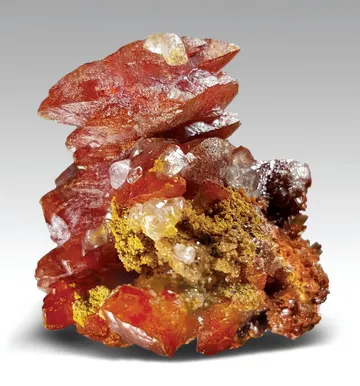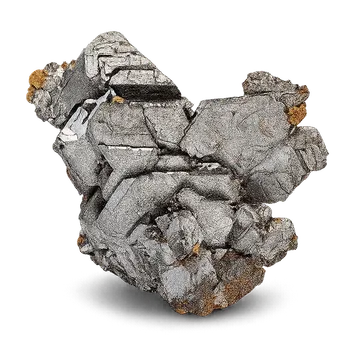
Galena from Viburnum Trend, Missouri - a world-class MVT district prized for crisp metallic cubes, rich luster, and associations with dolomite and sulfides.
Key facts
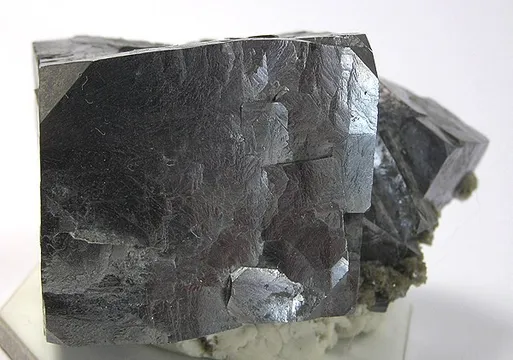
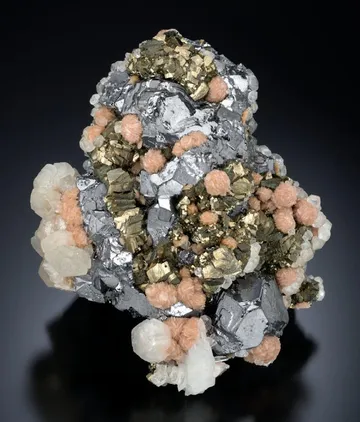
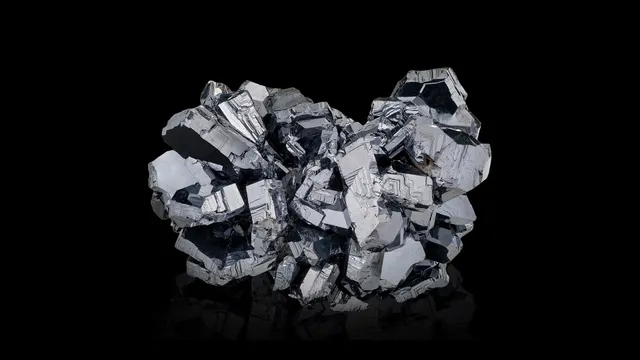
Galena from the Viburnum Trend is one of the modern American classics: heavy, metallic, sharply geometric, and unmistakably Midwestern. The best pieces have a gunmetal to lead-gray sheen, cubes with slightly modified corners, cuboctahedrons, octahedrons, complex parallel-growth groups, and—in a handful of celebrated finds—flat spinel-twinned plates that look almost too thin and architectural for ordinary galena. Collectors often recognize the locality by the combination of bright galena on dolomite, chalcopyrite, marcasite, calcite, sphalerite, and the cobalt-nickel sulfide siegenite.

Photo: Wikimedia Commons
The district is not a small collector locality that happened to produce a few attractive specimens. It is a world-class Mississippi Valley-type lead-zinc-copper district hosted chiefly by the Cambrian Bonneterre Formation, part of the Southeast Missouri Lead District, and it has been central to U.S. lead production since the decline of the Old Lead Belt. The ore is unusually lead-rich for an MVT district, and galena is not an accessory curiosity here: it is the principal ore mineral, occurring as disseminations and replacements in dolomite, as breccia cement, and as open-space crystals in vugs and fractures.
For the collector, the essential Viburnum look is crisp metallic galena against a textured sulfide-carbonate ground. Buick Mine pieces are especially well represented in classic collections, while Sweetwater, Brushy Creek, Fletcher, West Fork, Magmont, Casteel, and the Viburnum-numbered mines each have their own history and specimen flavor. The most desirable examples balance luster, crystal definition, minimal bruising, and a well-composed matrix; large single cubes are impressive, but a lively cabinet specimen with sharp cuboctahedrons, dolomite rhombs, brassy marcasite, or pale calcite can be far more engaging.

Photo: Wikimedia Commons
Search for specimens: View all galena specimens from Viburnum Trend, Missouri, USA
The Viburnum Trend, historically called the New Lead Belt, is a north-south belt of lead-zinc-copper-silver mineralization in southeastern Missouri. It lies within the Southeast Missouri Lead District and includes mines in the general Viburnum–Bixby–Boss–Ellington region of Crawford, Washington, Iron, Dent, Reynolds, and Shannon counties. Important mines and mine groups include Viburnum No. 27, No. 28, No. 29, Casteel, Buick, Brushy Creek, Fletcher, West Fork, Sweetwater, Magmont, and Magmont West.
The deposit type is Mississippi Valley-type base-metal mineralization. The ores are hosted principally in Cambrian carbonate rocks, especially the Bonneterre Formation, where mineralizing basinal brines moved through favorable dolomite, reef, grainstone, collapse-breccia, and permeable facies. Galena, sphalerite, and chalcopyrite are the main economic sulfides, with pyrite, marcasite, siegenite, bravoite, millerite, bornite, and other sulfides present locally. Gangue and open-space minerals include dolomite, calcite, quartz, and locally barite-group mineralization in the broader Southeast Missouri setting.
St. Joe drilled the discovery hole for the Viburnum Trend in 1955, and the first ore from the new district was shipped from the Number 27 mine in Crawford County in mid-1960. Mining expanded rapidly as the Old Lead Belt declined; the last Old Lead Belt mine closed in 1972, by which time the Viburnum Trend had become the modern center of Missouri lead production. Ore bodies are generally tabular to sinuous and north-south trending, with an average ore depth commonly given around 1,200 feet. Missouri Department of Natural Resources summaries describe individual Viburnum Trend mines as ranging from 20 to more than 50 million tons and containing as much as 8% galena with several percent sphalerite.
Mining is by underground methods, chiefly room-and-pillar operations following the ore. The modern district has been operated by major mining companies rather than as a casual prospecting field. That matters for collectors: the finest specimens did not come from weathered dump picking in the old sense, but from mine operations, mine geologists, miners, and the specimen trade. Access to active and recently active mines is controlled, and collectors should not expect open public collecting at the mine sites. Surface rockhounding in the surrounding Ozarks is a different matter, but the collector-grade Viburnum galenas of interest here are overwhelmingly mine-derived specimens with labels, old dealer stock, or documented collection history.
Notable finds include large Buick galena cubes on chalcopyrite, clusters of sharp cuboctahedrons, parallel-growth and spinel-twinned galena from 1990s Buick finds, rare galena stalactitic forms, Sweetwater galena associated with calcite and chalcopyrite, and the scientifically described platy galena occurrences from Magmont, Buick, Fletcher, Brushy Creek, and Sweetwater. West Fork has also received special attention in the economic-geology literature for its mineral zoning, with galena-rich outer zones overprinting earlier iron-zinc sulfide zones.
Viburnum Trend galena is PbS and usually presents as metallic gray to gunmetal-gray crystals with high specific gravity and the familiar cubic cleavage of the species. The most common collectible forms are cubes, cuboctahedrons, modified cubes, octahedrons, and complex intergrowths. Octahedral galena formed early in the district’s paragenesis, while cubic galena is later; studies of the district note repeated deposition of octahedral galena before the later cubic generations.
Crystal size ranges widely. Many attractive small-cabinet and cabinet pieces carry galena crystals from a few millimeters to roughly 2 cm. Better Buick examples include cuboctahedrons around 1.5–2.4 cm, large modified cubes around 4–5 cm across, and sharp cabinet specimens in the 7–11 cm overall range. Sweetwater and other mines can produce chunky crystal groups, modified crystals, and matrix pieces where galena is visually integrated with dolomite, calcite, chalcopyrite, or sphalerite rather than isolated as a single crystal.
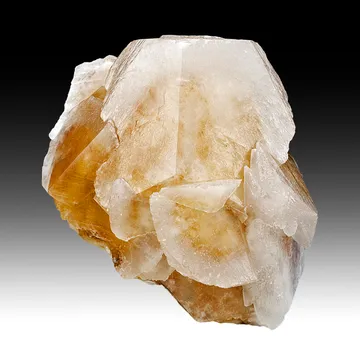
The matrix associations are a major part of the locality’s appeal. Dolomite commonly appears as pale, pinkish, cream, or tan rhombs; chalcopyrite adds brassy yellow to iridescent color; marcasite and pyrite add sparkle; calcite contributes pale scalenohedrons, rhombs, or doubly terminated crystals; sphalerite may appear as dark brown to honey-brown crystals or masses. Siegenite, a cobalt-nickel sulfide, is a distinctive Viburnum Trend association, and Buick and Sweetwater pieces with siegenite are particularly prized by systematic collectors.
The unusual platy galenas are a special Viburnum chapter. These are not ordinary flattened cubes; they have been interpreted as spinel-twinned octahedral galena. They are extremely rare, known only in small quantities from Magmont, Buick, Fletcher, Brushy Creek, and Sweetwater, and not reported from Casteel, West Fork, No. 27, No. 28, or No. 29 in the study that focused on them. The plates can be around 1 cm and show twinned portions, penetration-twin character, and marginal indentations typical of spinel-twinned forms. Their trace-element contents are low, so their form is not attributed to unusual silver, bismuth, antimony, or arsenic enrichment; rapid crystallization from oversaturated hydrothermal fluids is the favored explanation.
Quality in Viburnum galena is judged on geometry first. Sharp, complete cubes and cuboctahedrons with crisp edges, flat reflective faces, and minimal bruising command attention. Luster is next: the best pieces are bright metallic rather than dull or granular. Matrix composition matters greatly—a galena cube perched on knobby chalcopyrite, or a field of cuboctahedrons on dolomite and marcasite, is more desirable than a broken mass of lead ore. Balance also matters because galena is heavy; a specimen that displays upright without strain and has crystals distributed over the show face is more satisfying than a top-heavy chunk with one hidden good face.
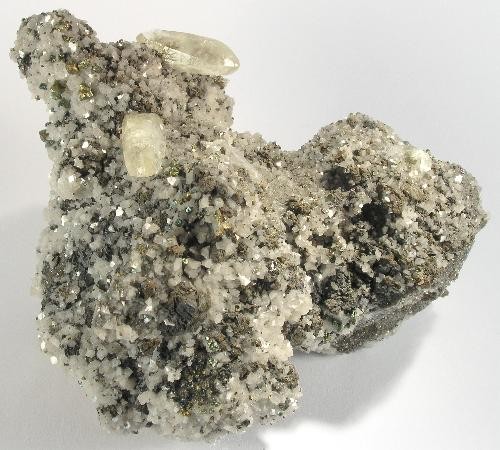
Photo: Wikimedia Commons
Viburnum Trend galena is abundant enough in the marketplace that a collector can be selective, but the best pieces are not common. Ordinary massive ore, bruised cubes, and small sulfide-on-dolomite pieces are widely encountered. Fine older Buick, Sweetwater, West Fork, Brushy Creek, and Magmont specimens with sharp crystals, documented provenance, and strong display quality are much scarcer. Brushy Creek galenas, in particular, have been described by dealers as less common than Sweetwater galenas, although individual finds and old collections can change what appears on the market at any given time.
As of 2026, Viburnum Trend galena remains available through mineral marketplaces, regional dealers, old collection dispersals, and show stock, including pieces collected in the 1970s–1990s as well as material attributed more broadly to ongoing mine production. The range is wide: inexpensive association pieces with calcite, dolomite, chalcopyrite, and scattered galena can be modestly priced, while large, sharp, lustrous, aesthetic Buick or Sweetwater galenas with old labels can move into serious cabinet-specimen territory.
Condition is the main issue. Galena is soft, heavy, and has perfect cubic cleavage, so corners bruise, edges chip, and large crystals may show cleavage breaks or rubs even when the overall specimen looks intact. Check the high points with side lighting. On cubes, look for crushed corners, repaired-looking cleavage seams, and flat scars that interrupt otherwise reflective faces. On matrix pieces, inspect where the galena contacts chalcopyrite or dolomite; those junctions often hide impact damage or old trimming.
Iridescence deserves scrutiny. Chalcopyrite from the district may show natural iridescent colors, but artificial enhancement of chalcopyrite—often marketed broadly as “peacock ore”—is common in the mineral trade. A documented Mindat discussion specifically notes that much Viburnum Trend chalcopyrite material has been treated, while natural iridescent chalcopyrite also occurs in the mines. This concern is mainly about associated chalcopyrite rather than the galena itself, but it affects the appearance and value of combination specimens. Be cautious with unusually vivid rainbow coatings, especially if the color is uniform over broken surfaces or looks chemically “washed” rather than localized on natural crystal faces.
For locality authenticity, labels matter. Many Midwestern galenas can look superficially similar, and unlabeled cubic galena on dolomite or sulfide matrix may be casually assigned to “Missouri” or “Viburnum Trend” without proof. Pieces with mine-specific labels—Buick, Sweetwater, Brushy Creek, West Fork, Fletcher, Magmont, Casteel, No. 27, No. 29—are preferable to vague district labels when the specimen style supports the attribution. The best documentation includes an old collection label, dealer record, or a chain of provenance from a known Missouri dealer or collector.
Handle and store specimens with respect. Galena is a lead sulfide; intact specimens are safe to collect when handled sensibly, but wash hands after handling, keep away from children and pets, avoid inhaling dust from broken or trimmed material, and do not use galena in water bottles, elixirs, or lapidary work without proper industrial precautions.
The Viburnum Trend began as a search forced by decline. By the early 1950s, the Old Lead Belt—the historic engine of southeastern Missouri lead mining—was running down. Exploration pushed outward along the margins of the St. Francois Mountains, and in 1955 St. Joe drilled the discovery hole that opened the new district near Viburnum. Five years later, in mid-1960, the No. 27 mine shipped the first ore. From that point the center of gravity of Missouri lead mining shifted westward and southward into the New Lead Belt.
The scale of the new district quickly became apparent. At Buick, the ore body was discovered in 1960 and the mine went into production in 1969. In its first six years, to March 1975, Buick produced more than 7.5 million tons of ore averaging about 9% lead and 3.5% zinc. In 1973 and 1974 alone, Buick accounted for 28% of the lead and 12% of the zinc mined in the United States. One of the more telling technical details is almost poetic to a galena collector: the ore grade had originally been underestimated because small amounts of galena were lost by “grinding” during core drilling. In other words, the very mineral that gives Viburnum specimens their bright cubic authority was soft and heavy enough to disappear into the drilling process and make the ore body look leaner than it was.
Magmont has its own origin story in a name. Cominco American, operating as Montana Phosphate Products Company, and Dresser Industries, operating as Magnet Cove Barium, began exploration in Missouri in 1960. “Magmont” joined the first syllables of Magnet Cove and Montana. The first drill intersection came in September 1962. To prove the ore body, the companies drilled more than 200 holes and recovered 23 miles of core from a deposit lying about 1,200 feet below the surface. Production began in 1968, and the mine-mill complex was built around a million-ton-per-year scale. The ore was primarily galena, with zinc, copper, and silver values—industrial facts that translated, occasionally and fortunately, into collector specimens.
The most mineralogically intimate story is the recognition of the platy galenas. Galena is an isometric mineral; collectors expect cubes, octahedrons, and cuboctahedrons. Flat plates look wrong at first glance, which is precisely why they matter. Richard Hagni’s 2018 study began after he acquired a Magmont specimen carrying unusually flat crystals. Close photographs showed six or seven roughly 1 cm platy galena crystals, each appearing to consist of two portions. Some showed indentations along the margins—exactly the kind of clue one expects from spinel twinning. Hagni concluded that these Viburnum plates were spinel-twinned octahedral galena, deposited early, before later quartz and cubic galena covered them.
The rarity of those plates is part of the story. Hagni consulted present and former Viburnum mine geologists—Larry Nuelle, Bill Clendenin, Bob Dunn, Bruce Ahler, Rick Dingess, Andy Childers, and George Moellering—to determine where they had actually been seen. Their collective experience narrowed the occurrence to about half the mines: Magmont, Buick, Fletcher, Brushy Creek, and Sweetwater. Casteel, West Fork, No. 27, No. 28, and No. 29 did not produce such plates in their observations. Clendenin added an especially useful Sweetwater detail: there, platy galena was found throughout the mine rather than in just one zone or ore type.
There is also a tiny drama in the chemistry. Some lead districts produce unusual galena forms because trace elements interfere with growth. Viburnum’s plates seemed a good candidate for that explanation—until the analyses came back. The platy galena had only 3.1 ppm Ag, less than 2 ppm Bi, less than 2 ppm Sb, and less than 2 ppm As. That shifted the explanation away from exotic chemistry and toward kinetics: a local rush of lead cations and sulfur anions in oversaturated ore fluid, crystallizing so quickly that a twin form was captured in the growth.