A collector's guide to Urucum claim, Brazil: its geology, mining history and notable minerals, illustrated with the 133 specimens documented from this locality on EarthWonders.
Key facts
Urucum claim is one of the defining gem-pegmatite localities of eastern Minas Gerais: a large, zoned granitic pegmatite known on labels as Lavra do Urucum, Córrego do Urucum pegmatite, Tim claim, Tim mine, and Urucum Mine. For collectors its name is inseparable from pink beryl and spodumene. The locality produced some of the most admired morganite crystals in the world—thick, tabular to short-prismatic, salmon-pink to rose-lavender beryls, often perched on white cleavelandite and dramatically accented by black tourmaline. It also yielded important kunzite, including transparent lilac spodumene crystals and cleaved crystal sections from a major 1968 find.
Geologically, Urucum belongs to the rare-element pegmatite province of the Rio Doce region of Minas Gerais, in the broader Eastern Brazilian Pegmatite Province. The principal worked body is a broad lenticular pegmatite associated with the Urucum granite near the São Tomé schists, and it shows the classic large-crystal architecture collectors expect from productive LCT-style systems: schorl-rich border material, feldspathic zones with huge crystals and replacement bodies, quartz cores, and miarolitic pockets capable of producing cabinet-scale gems. The mineral suite is not limited to showy gem species; Urucum is also a serious rare-mineral locality, with documented stokesite, coutinhoite, uranium secondary minerals, cassiterite, microlite-group minerals, and rare arsenates.
Regional View
Country View
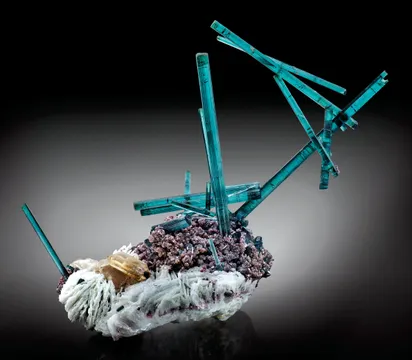
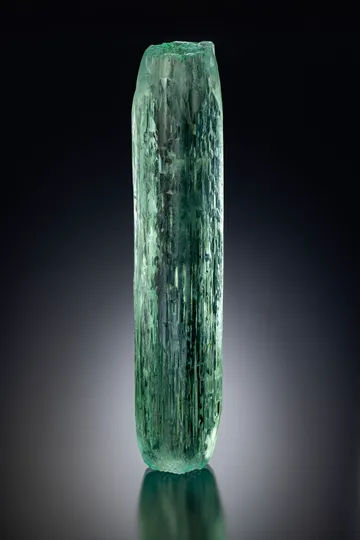
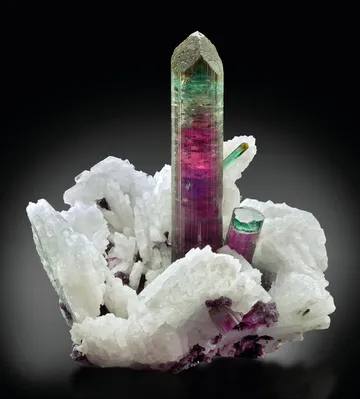
The best Urucum specimens are instantly recognizable. Morganite tends to be thick and architectural rather than delicate: lustrous pink blocks and plates, commonly with etched or modified faces, sometimes showing internal zoning and dark tourmaline inclusions. On matrix, the finest pieces combine three strong visual elements—pink beryl, white bladed albite, and black or green tourmaline—without the tourmaline overwhelming the transparency of the beryl. Urucum kunzite is more fragile in presentation but can be spectacularly gemmy, with a pale lilac glow, longitudinal striation, and the glassy broken-looking surface texture typical of spodumene.

Photo: Wikimedia Commons

Photo: Wikimedia Commons
Search for specimens: View all specimens from Urucum claim, Brazil
Urucum is a granitic pegmatite worked historically for both industrial and specimen minerals. It is indexed by collectors under several overlapping geographic labels: older and gemological sources commonly cite Urucum Mine near Galiléia in the Doce valley of Minas Gerais, while modern locality databases also place the claim in the Barra do Cuieté area of Conselheiro Pena. Both label styles are encountered on specimens, and the historical names Tim Mine, Tim claim, Córrego do Urucum pegmatite, and Lavra do Urucum are all part of the same collector vocabulary.
The principal Urucum-GEOMETA workings lie in the Serra do Urucum pegmatite cluster, where pegmatites are closely associated with the Urucum granite and occur near the contact zone with São Tomé schists. Published geological work describes Urucum-GEOMETA as a wide, lenticular body striking northwest and dipping steeply southwest. Its zonation is especially important for collectors: a narrow schorl-rich zone sits abruptly against the granitic wall rock, followed inward by coarse granitic pegmatite, then by a feldspar-rich zone containing giant feldspar crystals and numerous replacement bodies. That inner feldspathic zone yielded feldspar, masses of spodumene, large books of muscovite, schorl crystals reportedly up to about a meter, and fine beryl crystals.
Industrial production focused on feldspar, mica, beryl, and related pegmatite products. The mine was worked from the early 1960s, and underground galleries with connecting chambers were developed as miners followed productive parts of the body downward. GEOMETA and COMIG appear in the literature as important concession names for the two larger Urucum workings in the Serra do Urucum area, with Urucum-GEOMETA described in detail and Urucum-COMIG discussed for its economic aspects.
The 1968 spodumene zone is the first great collector episode at the locality. A clay-rich pocket or pocket system contained discontinuous masses of pink gem spodumene, many crystals broken but still abundant enough to produce roughly 3,000 kg of kunzite, including about 500 kg of excellent gem-quality material; the largest crystal was reported at about 2 kg. Green and yellow spodumene were also reported with the find, though these are much less familiar to specimen collectors than the lilac-pink kunzite.
The 1973 morganite discovery is the locality’s signature event. Sources describe an intensely mineralized cylindrical pocket roughly 2 m in diameter and 10 m high, lined with bladed albite var. cleavelandite and producing fine morganite crystals, some in association with green elbaite. A separate gemological account describes approximately 300 morganite crystals from the Corrego do Urucum mine, with some individual crystals reaching about 10 kg. This is the find that established Urucum’s world reputation for large, lustrous, pink beryl specimens.
Later mineralogical interest shifted strongly toward rarities. Urucum became known for superb stokesite, typically as spherical or hemispherical crystalline aggregates from millimetric size to about 3 cm across, commonly associated with cleavelandite, cassiterite, and microlite-group minerals. The locality also became the type locality for coutinhoite, a rare thorium-bearing uranyl silicate hydrate found as a secondary hydrothermal mineral in the pegmatite. These late-stage uranium and tin associations make Urucum as important to systematic micromount and rare-species collectors as it is to gem-crystal collectors.
Collecting access should be treated as private-mine access, not casual public rockhounding. Most collector specimens encountered today are old-stock pieces from the 1960s–1970s gem finds, later dealer-circulated rare-mineral specimens, or specimens released through Brazilian dealers and international inventories. Good morganite remains available but expensive in fine quality; good kunzite is much less common in undamaged display form; matrix stokesite and verified rare uranium species are specialized and best sought from dealers with strong provenance and analytical confidence.
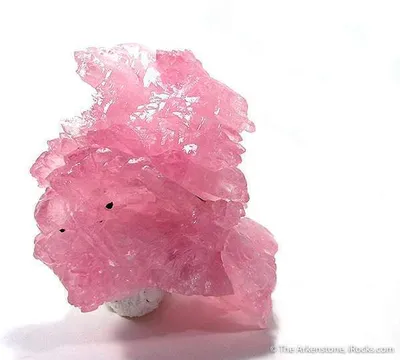
Urucum morganite is the locality’s glory: thick tabular to short-prismatic beryl crystals in salmon-pink, peach-pink, rose, and lavender-pink tones, commonly lustrous and partly gemmy, with etched or dissolved faces, modified edges, and internal black tourmaline inclusions in many pieces. The classic specimens came from the famous cylindrical pocket discovered in 1973, whose cleavelandite-lined walls yielded large pink beryl crystals, some associated with green elbaite; the best examples balance size, color saturation, transparency, and contrast, especially where pink beryl sits on white cleavelandite with just enough black schorl or elbaite to frame the crystal without muddying it. Ordinary Urucum morganite can be chunky, bruised, overly included, or visually flat; the great pieces have a distinct architectural presence, glassy luster, strong pink body color, visible gem zones, and complete or near-complete all-around form.
Beyond the gem-variety name, Urucum beryl occurs as robust pegmatitic crystals in albite-, feldspar-, quartz-, mica-, and tourmaline-rich zones, with the collector emphasis overwhelmingly on pink morganite but with non-morganite beryl also documented from the pegmatite. The habits are typically stout rather than needle-like: hexagonal prisms and thick plates with etched faces, dissolution channels, frosted-to-glassy surfaces, and locally strong transparency. Good Urucum beryl specimens are judged not only by crystal size but by how well the beryl reads as a freestanding crystal in the pegmatite assemblage—clean faces, good terminations or sculptural dissolution, and meaningful association with cleavelandite, schorl, elbaite, or lepidolite make the difference between a geological sample and a cabinet specimen.
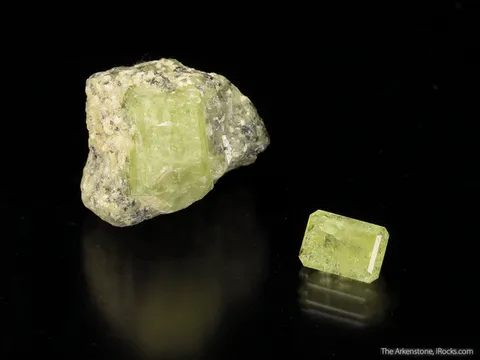
Spodumene from Urucum is tied chiefly to the 1968 gem-spodumene discovery, in which pink kunzite occurred in discontinuous clay-pocket masses within the pegmatite and was accompanied by lesser green and yellow spodumene. Collector pieces range from cleaved or etched crystal sections to transparent lilac floaters, often with strong longitudinal striation, splintery-looking surfaces, and the delicate, glassy translucency that makes spodumene both alluring and vulnerable. The finest Urucum spodumene is visibly gemmy, clean enough to transmit light, and attractive in color without being too pale; ordinary pieces tend to be cleavage fragments, bruised crystals, or nearly colorless sections whose locality interest outweighs their aesthetics.
Urucum kunzite is pink to lilac spodumene from one of Brazil’s major kunzite occurrences, produced in quantity from the 1968 clay-rich pocket zone but only rarely preserved as fine, undamaged specimen crystals. Typical collector examples show flattened to bladed spodumene form, strong vertical striations, transparent to translucent interiors, and a pastel lilac-pink color that can be subtle until backlit; some fine examples are complete floaters, but many historic pieces are cleaved, repaired, contacted, or chipped because spodumene’s perfect cleavage and brittleness made extraction punishing. The best Urucum kunzites combine transparency, recognizable crystal form, pleasing lilac color, and minimal edge damage; large size alone is not enough here, because many larger fragments lack display integrity.

Photo: Wikimedia Commons
Albite is fundamental to the look of Urucum specimens, most memorably as cleavelandite: white to creamy, bladed, pearly aggregates that line pockets and provide the matrix for morganite, elbaite, stokesite, microlite-group minerals, and other late-stage species. In the 1973 morganite pocket, cleavelandite reportedly carpeted the walls of the cylindrical cavity, giving collectors the classic pink-on-white Urucum aesthetic. Good albite specimens from Urucum are not merely background matrix; they show clean, sharp, layered cleavelandite blades with enough openness to display the associated mineral clearly, whereas ordinary pieces are massive, iron-stained, crushed, or visually crowded.
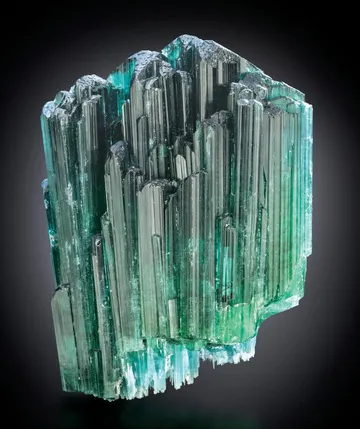
Tourmaline at Urucum appears in several collector roles: black schorl in the border and wall zones, dark tourmaline inclusions in morganite, and colored elbaite—especially green elbaite associated with the 1973 morganite pocket. Scientific study of black tourmaline from Córrego do Urucum showed that at least some “black” material is iron- and manganese-colored elbaite with blue, green, and pink internal regions, a reminder that visual color alone is not reliable for species-level tourmaline identification here. The most attractive Urucum tourmaline-bearing specimens use tourmaline as contrast: green elbaite sprays or black prisms against white cleavelandite and pink beryl; pieces in which tourmaline inclusions make the morganite gray or opaque are much less desirable.
Cleavelandite is the collector’s matrix mineral at Urucum, forming the bladed albite crusts and pearly parallel-growth aggregates that make the locality’s morganite, elbaite, and stokesite specimens immediately recognizable. It was especially important in the 1973 cylindrical morganite pocket, where the walls were described as carpeted with cleavelandite; it also hosts the rare stokesite assemblage with cassiterite and microlite-group minerals. Good Urucum cleavelandite is crisp, bright, and dimensional, with separated blades and clean white contrast; poorer material is clay-coated, iron-stained, massive, or damaged from extraction in the feldspar-rich zones.
Schorl is a defining structural and visual mineral of the Urucum pegmatite, forming a narrow schorl-rich zone at the wall contact and occurring as black prismatic crystals, radiating aggregates, and inclusions or attached crystals on morganite and albite. The literature records schorl crystals from the feldspathic zone reaching very large size, and in specimen terms the black tourmaline gives Urucum morganite much of its visual drama. The best schorl-bearing pieces preserve sharp black contrast without overwhelming the gem mineral; if schorl is too abundant or deeply included, the beryl can appear smoky gray, cloudy, or visually dead.
Spessartine is a subordinate but documented member of the Urucum collector assemblage, best understood as part of the manganese-rich rare-element pegmatite environment rather than as the locality’s showpiece mineral. It occurs in the broader gem-pocket association cited historically with the Urucum morganite-kunzite finds, alongside quartz, tourmaline, lepidolite, and columbite-group minerals. Desirable Urucum spessartine specimens are locality pieces: small, sharp, orange to reddish-brown garnets with clean placement on albite or pegmatite matrix; they are collected for association and provenance more than for competition with the great spessartines of better-known garnet localities.
Other documented minerals from Urucum broaden the locality far beyond morganite and kunzite. Coutinhoite, a thorium-bearing uranyl silicate hydrate, is the type-locality mineral and occurs in late secondary uranium assemblages with microcline, muscovite, weeksite, phosphuranylite, metauranocircite, and uranocircite. Stokesite is one of the locality’s great rare-species attractions, occurring as radial, spherical, or hemispherical aggregates with albite, cassiterite, and microlite-group minerals; Urucum material is widely regarded as among the best for the species. The pegmatite also has records of fluorapatite, wölsendorfite, saleeite, uraninite, löllingite, quartz including smoky quartz, microcline, muscovite, lepidolite, cookeite, biotite-group mica, bismuthinite, cassiterite, columbite-group minerals, plumbomicrolite or related microlite-group minerals, karibibite, schneiderhöhnite, scorodite, and nontronite.
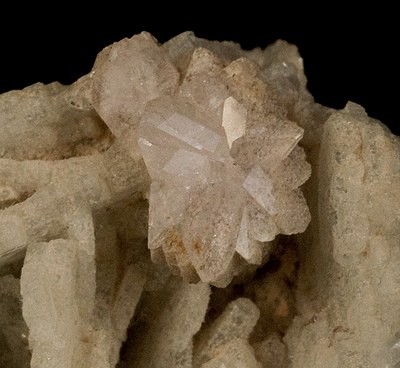
Photo: Wikimedia Commons
The first challenge with Urucum specimens is locality labeling. Specimens may be labeled Urucum claim, Córrego do Urucum pegmatite, Urucum Mine, Tim Mine, Tim claim, Lavra do Tim, Lavra do Urucum, Galiléia, Barra do Cuieté, or Conselheiro Pena. These labels are not automatically contradictory, but they should be read carefully. A morganite sold simply as “Brazil” or “Minas Gerais” needs more support before being accepted as Urucum; conversely, a known Urucum specimen may carry older Galiléia labeling even when modern databases place the claim under Barra do Cuieté, Conselheiro Pena. At least one recently sold Urucum morganite was noted as having once been erroneously labeled as Golconda, a plausible confusion because both are famous Minas Gerais pegmatite names.
Condition is central to value. Urucum morganite is often thick and durable-looking, but large crystals commonly show edge bruises, pocket contacts, internal fractures, etched surfaces, and repairs. Some large display pieces have documented gap-fill epoxy in minor rough areas, and collectors should inspect broad pink faces with side lighting for fills, oil, glue, or polished damage. Etching and dissolution are normal for the locality and can be attractive; fresh conchoidal chips, filled pits, or unnatural glossy patches are a different matter. On matrix pieces, check whether the beryl is naturally attached or trimmed into a prepared base of albite and schorl.
Kunzite demands even more caution. Urucum spodumene commonly cleaves, splinters, and bruises, so a transparent floater with intact edges is considerably scarcer than a sizable fragment. Repairs are possible and should be expected in larger spodumene specimens unless proven otherwise. Like kunzite from other localities, Urucum material should be protected from strong sunlight and display lighting because pink spodumene can fade. Several Urucum kunzite specimens are reported as fluorescent under longwave and shortwave ultraviolet light, but fluorescence should be treated as a supporting observation rather than a definitive locality test.
Tourmaline identification is another subtle issue. Urucum “black tourmaline” may be visually described as schorl on labels, but published work on black material from Córrego do Urucum showed elbaite colored by iron and manganese, with blue, green, and pink regions. When species-level accuracy matters, especially for black tourmaline associated with beryl or cleavelandite, analytical confirmation is preferable.
Rare-species specimens require the highest documentation. Coutinhoite, wölsendorfite, saleeite, phosphuranylite, uranocircite, metauranocircite, and uraninite are uranium-bearing minerals; they should be stored sensibly, kept out of children’s reach, handled to avoid dust, and not cleaned aggressively. Stokesite from Urucum is usually small but important, and the best pieces show spherical to hemispherical radial aggregates on cleavelandite rather than loose unattributed grains. Microlite-group names on older labels may not survive modern pyrochlore-supergroup nomenclature without analysis, so visual names such as “stannomicrolite” or “plumbomicrolite” should be treated cautiously.
Market availability is uneven. Urucum morganite appears regularly enough that patient collectors can choose, but fine color, high transparency, intact crystal form, and natural matrix dramatically raise the price. Small but aesthetic old-find morganites are often harder to buy than large damaged ones. Kunzite is much scarcer as a top-quality display specimen, despite the tonnage historically produced. Stokesite and coutinhoite are specialist items: less costly than great morganite in many cases, but much more dependent on provenance, analytical reliability, and whether the specimen carries the distinctive Urucum habit.
The Urucum story begins like many great Minas Gerais pegmatite stories: as an industrial operation that unexpectedly became a treasure chamber. In the early 1960s, the old Lavra do Tim was being worked for the practical minerals of pegmatite—feldspar, mica, beryl, and lepidolite. Galleries and chambers followed the broad lenticular body underground. The mine was not merely a single open cut but a connected system, deep enough that later authors could refer to a “level 335,” where smoky quartz occurred with uraninite and löllingite, and where the quartz core exposed milky crystals up to about a meter long, some weighing several tons.
Then came 1968. Miners broke into a clay-rich zone full of gem spodumene, not as a single neat crystal pocket but as abundant discontinuous masses, each roughly 1.5 m across. Many of the crystals were already broken—the normal fate of spodumene in a rough pegmatite pocket—but the volume was extraordinary. About 3,000 kg of kunzite were recovered, with approximately 500 kg good enough to be described as excellent gem material. The largest crystal was around 2 kg. The same zone also produced smaller amounts of green and yellow spodumene, tantalizing hints of hiddenite-like and yellow spodumene color in a locality remembered almost entirely for lilac-pink kunzite.
The morganite discovery that made Urucum famous followed in 1973. The pocket was not an ordinary vug. It was described as a cylindrical “caldeirão,” roughly 2 m wide and 10 m high, its walls carpeted with bladed cleavelandite. Kunzite was absent from this particular chamber, but the walls yielded the pink beryl that would define the mine. Gemological accounts describe approximately 300 crystals from the find, with some individual morganites reaching about 10 kg. The best pieces had the combination collectors still prize today: big pink beryl, white cleavelandite, and green or black tourmaline.
Even the rare-mineral chapter at Urucum has a visual punch. Stokesite, a calcium tin silicate so rare that most collectors never see a good one, appeared not as anonymous crusts but as radial balls and hemispheres, many with nearly perfect symmetry, ranging from tiny aggregates to about 3 cm across. On the best matrix pieces, pale glassy stokesite sits on cleavelandite blades with tiny yellow microlite-group crystals and cassiterite nearby—the miniature, late-stage echo of the larger gem pockets that had made the pegmatite famous decades earlier.