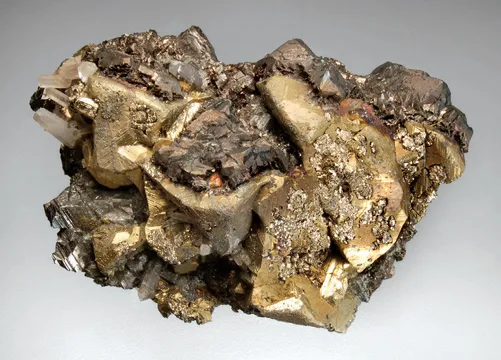
A collector's guide to Uchucchacua Mine, Peru: its geology, mining history and notable minerals, illustrated with the 262 specimens documented from this locality on EarthWonders.
Key facts
Uchucchacua is one of the great modern silver localities of the central Andes: a high-altitude, carbonate-hosted Ag-Mn-Pb-Zn system in the Oyón district of Lima, Peru, where commercial mining and collector mineralogy are unusually intertwined. To an ore geologist it is a structurally controlled vein, replacement, and skarn district developed in Cretaceous Jumasha Formation limestones near Miocene dacitic intrusions. To a collector, it is the Peruvian source that can place cherry-red rhodochrosite, black metallic alabandite, dark silver sulfides and sulfosalts, native silver, quartz, calcite, and occasional fluorite on the same label.
The mine’s fame rests first on its rhodochrosite: transparent to translucent red and pink crystals, commonly sharp scalenohedra or stepped rhombs, perched on black manganese oxides, sulfides, quartz, and calcite. The best pieces have the same visual punch collectors prize from classic rhodochrosite localities worldwide, but with a distinct Uchucchacua look: smaller, glassier, often brighter isolated crystals rising from dark, rugged silver-manganese ore. The second pillar is silver mineralogy. Native silver wires, acanthite, proustite, pyrargyrite, pearceite-group minerals, polybasite, and a remarkable suite of rare Ag-Mn-Pb-Sb-As-Sn sulfosalts make the district far more than a pretty rhodochrosite source. Uchucchacua is also a type locality for a cluster of rare minerals, several described from modern analytical work on the mine’s Ag-Mn-rich alabandite zones.
Regional View
Country View
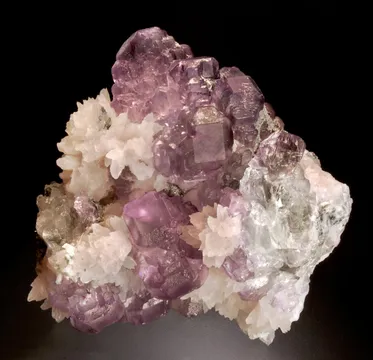
Uchucchacua specimens are usually miniatures to small-cabinet pieces rather than giant showpieces. Their power is in contrast and precision: red rhodochrosite against black manganese oxide, black octahedral alabandite partially dusted with pink carbonate, silver wires rising from quartz-rhodochrosite vugs, and small but gemmy proustite crystals glowing deep red when properly lit. Many fine pieces show evidence of having come from active underground mining rather than leisurely pocket collecting: edge contacts, cleaved carbonates, narrow vugs, and rugged ore matrix are normal. The finest examples overcome that by having sharp, isolated crystals, clean contrast, and strong color.

Photo: Rob Lavinsky, iRocks.com, Wikimedia Commons

Search for specimens: View all specimens from Uchucchacua Mine, Peru
Uchucchacua lies in the District and Province of Oyón, Lima Region, Peru, high in the western slope of the central Andes. Buenaventura describes the operation as an underground silver, lead, and zinc mine at roughly 4,500 meters above sea level, discovered by Buenaventura and in production since 1975. Corporate technical reporting places the mine about 265 kilometers northeast of Lima, accessed by the Lima–Huacho–Sayán–Churín–Oyón–Uchucchacua route. The present operation is wholly owned and operated by Compañía de Minas Buenaventura S.A.A.
The deposit is best understood as a polymetallic Ag-Mn-Pb-Zn system hosted by carbonate rocks of the Upper Cretaceous Jumasha Formation and related to Miocene intrusive activity. Published economic-geology work describes the district as a vein, replacement, and skarn mineral district in folded Turonian shelf limestones. The limestones are cut by steep wrench faults and fracture systems, and mineralization occupies both open-space veins and metasomatic replacement bodies in carbonate wall rock. Later technical summaries recognize three principal styles: fracture filling, replacement of limestones by sulfides and silicates carrying silver and zinc, and contact metasomatic skarn with endoskarn and exoskarn assemblages.
Structure is the skeleton of the mine. Important named faults include Uchucchacua, Socorro-Cachipampa, Rosa, and Sandra, with vein systems trending NE-SW, E-W, and NW-SE. The productive sectors commonly cited in mining and technical sources are Socorro, Carmen, Casualidad, and Huantajalla; Buenaventura has also referred to work in Socorro, Carmen-Casualidad, and Huantajalla. The vein names and ore bodies most often encountered in geological descriptions include Luz, Socorro, Camucha, Rosa, Casualidad, Plomopampa, Huantajalla, Mercedes, and Candelaria, along with replacement bodies adjacent to the veins, including Rosa Norte, Viviana, and Irma. A 2022 SRK technical summary divided the deposit into four systems—Carmen, Casualidad, Huantajalla, and Socorro—and described Socorro Alto and Socorro Bajo as especially important reserve contributors at that time.
Mineralogically the district is rich because silver, manganese, lead, zinc, antimony, arsenic, copper, and tin all participated in the hydrothermal system. The ore minerals include silver in sulfides and sulfosalts, abundant alabandite, galena, sphalerite, pyrite, pyrrhotite, arsenopyrite, and many Ag-bearing sulfosalts. The gangue is not incidental: calcite, kutnohorite, rhodochrosite, quartz, and manganese-calcium silicates are fundamental to the look of both ore and specimens. Lead and zinc increase toward intrusive centers, while the famous collector pieces generally reflect the Ag-Mn-rich carbonate and sulfide assemblages that create black matrix, pink to red rhodochrosite, silver minerals, and local quartz-lined cavities.
The mine has been a major silver producer for decades. Buenaventura reported 10,640,913 ounces of silver from Uchucchacua in 2019 and 5,000,312 ounces in 2020, with zinc and lead as significant by-products. The operation was temporarily closed from October 2021 after operational problems worsened by the COVID-19 pandemic, including delays in mine preparation and exploration. Buenaventura completed steps toward restart in 2023, with maintenance and start-up beginning September 1, 2023, and corporate filings later reporting resumed operations in September 2023. Current public descriptions list a treatment capacity of 3,910 metric tonnes per day and describe lead-silver, zinc-silver, and pyrite concentrate circuits; manganese-rich concentrates from Uchucchacua are treated at the Río Seco leaching plant.
Collecting access today should be regarded as closed industrial access, not a recreational collecting locality. Specimens enter the collector market through mine-related recovery, dealer networks, older collections, and sporadic releases from past pockets. The mine is active and mechanized, using bench-and-fill and cut-and-fill variants underground, with production areas reached by ramps, shafts, and haulage infrastructure. Loose assumptions about visiting, dumping, or collecting underground are not appropriate here; serious provenance is part of a specimen’s value.
The most identifiable collecting episodes are tied to particular mine levels and find dates recorded by dealers and specimen databases. Fine alabandite specimens from the 300 level, approximately 895 meters deep, were reported from finds around September 2009 and September 2010; these typically show sharp black octahedra, some partly coated by pink rhodochrosite and accompanied by quartz or calcite. Native silver with rhodochrosite, acanthite, quartz, and calcite is also documented from about 2009, and older silver-wire specimens are known from quartz-rhodochrosite vugs. The best rhodochrosite pockets have produced isolated, gemmy, cherry-red scalenohedra and rhombs generally in the centimeter range, with occasional crystals approaching or exceeding 2 cm on attractive matrix. Uchucchacua also produced gem rhodochrosite suitable for faceting; published gemological sources document cut stones near 13.9 carats from the mine.
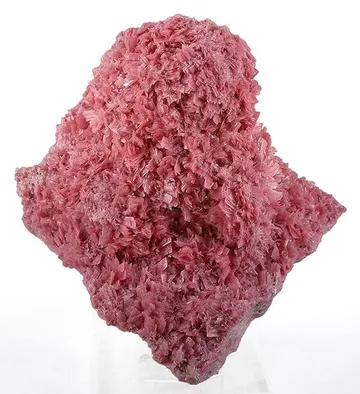
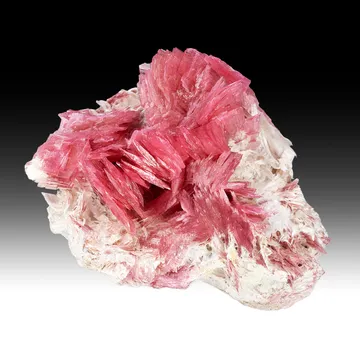
Rhodochrosite is the signature collector mineral from Uchucchacua, occurring as transparent to translucent pink, rose-red, raspberry-red, and cherry-red crystals on black manganese oxide or sulfide-rich matrix, commonly with quartz, calcite, fluorite, alabandite, acanthite, proustite, or native silver. The locality is especially known for sharp scalenohedra, stepped rhombs, and doubly terminated crystals, usually around thumbnail to miniature scale; documented specimen crystals commonly fall near 0.7–1.3 cm, with outstanding examples around 1.9–2.2 cm, and gemological literature records faceted rhodochrosite near 13.9 carats from Uchucchacua material. Good pieces here are not simply “red Peruvian rhodochrosite”: they have saturated color, glassy luster, transparent edges, distinct free-standing crystals, dark contrasting matrix, and minimal bruising to sharp terminations, while ordinary pieces tend to be paler, crowded, cleaved, or visually lost in massive carbonate.
Native silver from Uchucchacua is a much scarcer collector commodity than rhodochrosite but is central to the mine’s identity, occurring as wires, curled growths, dendritic aggregates, and crystallized masses in quartz, calcite, acanthite, and rhodochrosite-bearing vugs. Documented specimens include silver with rhodochrosite, acanthite, quartz, and calcite from about 2009, as well as older miniatures with thick complex wires over 2 cm long rising from quartz-rhodochrosite cavities; some polished ore-vein slices show native silver enclosed in light pink banded rhodochrosite and white quartz. The best silver specimens from Uchucchacua have three things at once: recognizable wire or crystal form, attractive contrast against pale quartz or pink carbonate, and enough integrity that the wires are not flattened, broken, heavily blackened, or buried in massive acanthite.
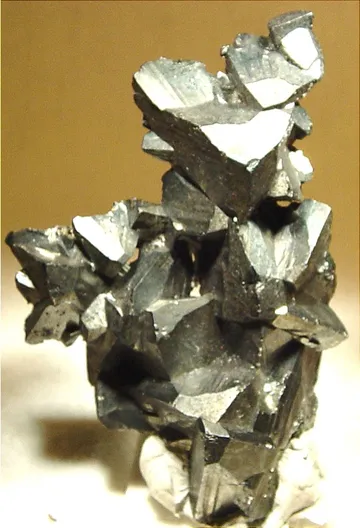
Alabandite from Uchucchacua is among the locality’s most distinctive serious-collector minerals: black, bright metallic to submetallic MnS crystals, typically sharp octahedra, commonly on matrix and often partly coated or accented by pale to pink rhodochrosite, quartz, or calcite. Notable specimens from the 300 level, about 895 meters deep, were recorded from September 2009 and September 2010 finds, with individual alabandite crystals around 1.2–1.3 cm on miniatures and small-cabinet pieces; another documented piece from Uchucchacua showed octahedral crystals to roughly 2.5 cm. Fine alabandite here is judged by crisp octahedral form, metallic luster, intact points, and the presence of contrasting pink rhodochrosite or white quartz, while dull black massive sulfide without clean crystal geometry is mostly an ore sample rather than a display specimen.
Fluorite is a supporting but attractive Uchucchacua species, most often seen by collectors as small colorless to very pale crystals associated with rhodochrosite, quartz, calcite, and dark manganese-rich matrix. Its importance is less as a stand-alone fluorite locality than as an accent mineral in rhodochrosite pockets: verified specimens show gemmy cherry-red rhodochrosite with fluorite and scattered clear quartz, and dealer descriptions note clear fluorite crystals tucked into vugs lined with manganese oxides or paired with pink rhodochrosite “petals.” Good Uchucchacua fluorite combinations depend on transparency, clean placement, and visual contribution to the rhodochrosite composition; isolated, tiny, colorless fluorite grains have little impact unless they sharpen the paragenetic story of a specimen.
Acanthite at Uchucchacua occurs in the silver-sulfide part of the assemblage, commonly with native silver, calcite, quartz, rhodochrosite, proustite, pearceite-group minerals, polybasite, and pyrite. Good collector pieces show black lustrous cubo-octahedral or complex crystals rather than massive silver sulfide; one documented 2009 Uchucchacua specimen had cubo-octahedral acanthite crystals with additional forms and hooked native silver growths, and silver thumbnails from the mine may pair curled silver wire with a sharp acanthite crystal on massive acanthite. The value is in form and association: sharp acanthite plus native silver on a clean carbonate-quartz matrix is far more desirable than a heavy, dull black ore lump with uncertain crystal outlines.
Quartz is one of the essential matrix and pocket minerals at Uchucchacua, occurring as sparkling colorless crusts, transparent points, and small double-terminated crystals intergrown with rhodochrosite, native silver, acanthite, calcite, proustite, alabandite, and other sulfides and sulfosalts. It gives many Uchucchacua specimens their brightness: red rhodochrosite may sit on crystallized quartz, native silver can rise from quartz-rhodochrosite vugs, and some rhodochrosite specimens show transparent, facet-like quartz points interspersed between the carbonate crystals. Collectors should value quartz here when it clarifies the composition—clean, glassy, undamaged, and framing the silver or rhodochrosite—rather than when it is simply massive white gangue.
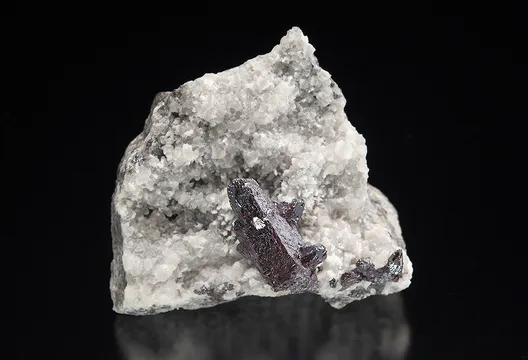
Proustite from Uchucchacua is prized in small, high-quality examples: deep red to dark red trigonal crystals and clusters on rhodochrosite, quartz, calcite, pyrite, alabandite, acanthite, polybasite, pearceite-group minerals, and mixed sulfide matrix. Verified specimens include bright red proustite crystals on pale pink rhodochrosite matrix, a 2003 piece with two visually distinct generations of red crystals with rhodochrosite and quartz, and pearceite-proustite-calcite combinations where the proustite is small but important. The best pieces are sharp, lustrous, translucent enough to transmit red light, and well isolated on a pale or pink matrix; damaged, opaque, or light-darkened crystals lose much of the visual appeal even if the species identification is correct.
Goethite is part of the oxidized iron-manganese visual vocabulary of Uchucchacua specimens, appearing as brown to black coatings, crusts, and matrix material in association with rhodochrosite and other vein minerals. It is not the mineral that made the mine famous, but it can be important aesthetically when it provides the dark, earthy or lustrous backdrop that intensifies red rhodochrosite or pale carbonate. Good Uchucchacua goethite specimens are therefore usually judged as combinations: the goethite should be stable, attractive, and textural, not just powdery iron staining, and it should frame sharper rhodochrosite or quartz rather than obscuring them.
Calcite is a principal gangue mineral at Uchucchacua and appears throughout the collector assemblage as white to colorless rhombohedra, drusy linings, Mn-bearing carbonate matrix, and vein fill with quartz, rhodochrosite, proustite, acanthite, native silver, pearceite-group minerals, chalcopyrite, galena, and pyrite. It is especially valuable on silver-sulfosalt specimens because white calcite sets off red proustite, dark pearceite or acanthite, and silver wires with strong contrast; dealer-documented Uchucchacua pearceite-proustite specimens also record calcite fluorescence under both longwave and shortwave ultraviolet light. The best calcite-bearing specimens have clean, sharp, undamaged calcite that acts as a display matrix, while massive cleaved calcite with little crystal definition is common gangue.
Beyond the major collector species, Uchucchacua is mineralogically exceptional for rare silver and manganese-bearing sulfides and sulfosalts. Documented type-locality minerals include agmantinite, benavidesite, hyršlite, keutschite, manganoquadratite, menchettiite, oyonite, ramosite, spryite, and uchucchacuaite. Other notable species reported from the mine include pearceite, pearceite-T2ac, polybasite, pyrargyrite, miargyrite, freieslebenite, diaphorite, canfieldite, argyrodite, billingsleyite, ferdowsiite, pirquitasite, smithite, trechmannite, galena, sphalerite, pyrite, pyrrhotite, arsenopyrite, chalcopyrite, realgar, orpiment, kutnohorite, rhodonite, bustamite, johannsenite, axinite-(Mn), tephroite, grossular, andradite, wollastonite, tremolite, and neotocite. Many of these are microscopic, analytical, or ore-petrology minerals rather than conventional display pieces, but they are precisely why Uchucchacua remains important to mineralogists long after a rhodochrosite pocket is dispersed.
Uchucchacua labels deserve close reading. “Uchucchacua Mine, Oyón Province, Lima, Peru” is the usual collector shorthand, but older labels may use variant spellings, omit the district, or refer to Uchuc-Chacua. Specimens from related mine sectors, the broader Uchucchacua area, Pozo Rico exploration work, or nearby Yumpag material should not be casually merged without supporting provenance. For marketplace purposes, exact mine attribution matters most on high-value rhodochrosite, silver, proustite, and rare sulfosalt specimens.
The most common misidentification issue is not deliberate fakery but overconfident naming. Red Uchucchacua rhodochrosite can be confused in photographs with South African N’Chwaning rhodochrosite, Sweet Home Mine material, or even bright synthetic crystals when locality data are weak. Proustite can be confused with pyrargyrite, darkened “ruby silver,” or other silver sulfosalts, and Uchucchacua contains enough pearceite-group, polybasite, and related phases that a dark metallic silver sulfosalt should not be assigned by appearance alone. Pearceite labels are especially sensitive because older “pearceite” specimens from Uchucchacua may correspond more specifically to pearceite-T2ac under modern nomenclature. Type-locality sulfosalts such as menchettiite, oyonite, ramosite, spryite, and keutschite are not visual-identification minerals; credible examples should have analytical support or strong institutional provenance.
Rhodochrosite condition is the key value divider. Uchucchacua rhodochrosite crystals are often small, sharp, and perched in narrow vugs, so exposed tips and edges are easily bruised. Cleavage chips along crystal faces, broken terminations, rubs on high points, and matrix trimming scars are common. The best specimens look clean under magnification: no obvious fresh cleaves on the main crystals, no glue-darkened pocket debris, and no crushed black matrix pressed into pink crystal faces. Rhodochrosite is a carbonate, so avoid acids and harsh chemical cleaning.
Silver and acanthite pieces should be handled as fragile metallic specimens. Native silver wires can bend, detach, or fatigue if touched; acanthite and dark silver sulfosalts can be brittle, and their luster is easily dulled by dirt, oils, or careless cleaning. Tarnish is normal for silver-bearing specimens, but aggressive polishing is destructive and usually obvious. On proustite, light exposure is a real concern: store fine pieces away from strong sunlight and display them under low, controlled light if long-term color matters. Proustite that appears black under normal lighting may still show red at thin edges or under backlighting, but bright, transparent red crystals command a substantial premium.
Alabandite is far rarer on the market than casual viewers expect. Because it is black and ore-like, fine crystals depend on being recognized and saved during mining. Sharp octahedral crystals with rhodochrosite coatings or matrix are legitimate locality classics; massive black MnS without form is not comparable. Alabandite may also tarnish or dull, so stable luster and unabraded crystal points are important.
Calcite from the mine may fluoresce, and ultraviolet response can add interest to pearceite-proustite-calcite combinations, but fluorescence should be treated as a bonus rather than the basis for identification. Fluorite is usually an accent species on Uchucchacua specimens, not a major value driver unless the association with rhodochrosite is especially aesthetic. Quartz is best when it is clean and transparent enough to provide contrast, not simply present as massive gangue.
Market availability is uneven. Rhodochrosite from Uchucchacua remains visible in dealer inventories, auction archives, and older collections, but fresh, top-quality pieces with intense red color and undamaged crystals are much less common than small or contacted examples. Native silver, acanthite, proustite, and alabandite appear sporadically and are more dependent on old collections, labeled find dates, and dealer curation. The type-locality rarities are essentially analytical and specialist material rather than mainstream cabinet minerals.
Bussell, M. Andrew, Alpers, Charles N., Petersen, Ulrich, Shepherd, Thomas J., Bermudez, Carlos, and Baxter, Alistair N. (1990), “The Ag-Mn-Pb-Zn vein, replacement, and skarn deposits of Uchucchacua, Peru: studies of structure, mineralogy, metal zoning, Sr isotopes, and fluid inclusions,” Economic Geology, 85(7), 1348–1383. The foundational modern economic-geology paper on Uchucchacua’s structure, mineralization styles, gangue mineralogy, fluid inclusions, and ore-fluid interpretation.
Oudin, Elisabeth, Picot, Paul, Pillard, François, Moëlo, Yves, Burke, Ernest A. J., and Zakrzewski, Marek A. (1982), “La bénavidésite, Pb4(Mn, Fe)Sb6S14, un nouveau minéral de la série de la jamesonite,” Bulletin de Minéralogie, 105(2), 166–169. The description of benavidesite, a type-locality sulfosalt tied to Uchucchacua.
Moëlo, Yves, Oudin, Elisabeth, Picot, Paul, and Caye, René (1984), “L’uchucchacuaïte, AgMnPb3Sb5S12, une nouvelle espèce minérale de la série de l’andorite,” Bulletin de Minéralogie, 107, 597–604. The original description of uchucchacuaite, the mineral named for the mine.
Bindi, Luca, Keutsch, Frank N., and Bonazzi, Paola (2012), “Menchettiite, AgPb2.40Mn1.60Sb3As2S12, a new sulfosalt belonging to the lillianite series from the Uchucchacua polymetallic deposit, Lima Department, Peru,” American Mineralogist, 97, 440–446. Description of menchettiite, including its occurrence as black microscopic grains in the Uchucchacua sulfosalt assemblage.
Bindi, Luca, Biagioni, Cristian, and Keutsch, Frank N. (2018), “Oyonite, Ag3Mn2Pb4Sb7As4S24, a New Member of the Lillianite Homologous Series from the Uchucchacua Base-Metal Deposit, Oyon District, Peru,” Minerals, 8(5), 192. Description of oyonite from Uchucchacua, a rare black metallic microscopic sulfosalt in calcite matrix.
Keutsch, Frank N., Topa, Dan, Fredrickson, Rie Takagi, Makovicky, Emil, and Paar, Werner H. (2019), “Agmantinite, Ag2MnSnS4, a new mineral with a wurtzite derivative structure from the Uchucchacua polymetallic deposit, Lima Department, Peru,” Mineralogical Magazine, 83(2), 233–238. Description and reference summary for agmantinite, another Uchucchacua type-locality mineral.
Topa, Dan, Takagi Fredrickson, Rie, Stanley, Chris, and Dincă, George (2026), “Keutschite, Cu2AgAsS4, a new mineral with a stannite structure from the Uchucchacua polymetallic deposit, Lima Department, Peru,” European Journal of Mineralogy, 38, 1–7. The formal description of keutschite, discovered in a sample from the alabandite zone of the Uchucchacua Ag-Pb-Zn deposit; the paper also summarizes the mine’s importance as a type locality for multiple Mn-bearing and Ag-bearing minerals.
Mindat locality entry for Uchucchacua Mine, Uchucchacua area, Oyón District, Oyón Province, Lima, Peru. The most useful consolidated mineral list for the mine, including type-locality status, species references, and specimen-photo associations.
Gemdat entry for Uchucchacua Mine, Oyón District, Lima, Peru. Useful for gemological notes, including rhodochrosite and rhodonite references and the documentation of significant faceted rhodochrosite.
Hyršlite mineral information, Mindat. Reference entry for hyršlite, a rare sartorite-series mineral with Uchucchacua as its type locality.
Spryite mineral information, Mindat. Reference entry for spryite, an Ag-As sulfide type-locality mineral from Uchucchacua.
Agmantinite mineral information, Mindat. Reference entry for agmantinite and its Uchucchacua type-locality citation.
Keutschite mineral information, Mindat. Reference entry for keutschite and its 2026 European Journal of Mineralogy description.
“#17777 - RHODOCHROSITE, Uchucchacua Mine, Peru,” QUEBUL FINE MINERALS. Dealer specimen video showing gem red scalenohedral rhodochrosite crystals to about 13 mm on dark matrix.
“#18495 - RHODOCHROSITE, Uchucchacua Mine, Peru,” QUEBUL FINE MINERALS. Dealer specimen video of an exceptional Uchucchacua rhodochrosite with transparent cherry-red crystals reportedly to 22 mm, some doubly terminated, on black botryoidal manganese matrix.
“Rhodochrosite. Uchucchacua mine, Oyon Province, Lima, Perú,” MChMinerals, fine minerals. Vimeo specimen video focused on Uchucchacua rhodochrosite.
“BFH0118 RHODOCHROSITE, Uchucchacua mine, Peru,” Crystal Classics. Dealer video illustrating a Crystal Classics rhodochrosite specimen from the mine.
Buenaventura: Uchucchacua operation page — Official operator summary with location, ownership, mining method, geology, treatment capacity, and current mine description.
Buenaventura 2025 Integrated Annual Report — Current corporate reporting for Uchucchacua/Yumpag ownership, production context, and operating status.
Buenaventura 2025 Form 20-F — Detailed public filing that documents the temporary October 2021 closure and September 2023 restart.
USGS publication page for Bussell et al. (1990), Economic Geology — Essential abstract and bibliographic record for the definitive geological study of Uchucchacua.
SRK / SEC Technical Report Summary for Uchucchacua — Technical mine-reporting source for geological model, mining areas, reserve distribution, and mining methods.
Mindat: Uchucchacua Mine locality page — Broad mineral list, type-locality notations, references, and hundreds of specimen photographs.
Mindat: Rhodochrosite from Uchucchacua Mine — Species-specific photo associations and collector examples for the mine’s best-known mineral.
Mindat: Native Silver from Uchucchacua Mine — Useful reference for native silver associations and specimen-photo records.
Mindat: Proustite from Uchucchacua Mine — Species-specific reference for proustite associations at Uchucchacua.
Wikimedia Commons: Uchucchacua Mine category — Freely licensed specimen photographs, especially rhodochrosite, proustite, alabandite, acanthite, and pearceite-group material.
Wikimedia Commons: Rhodochrosite-Fluorite-166920.jpg — Documented rhodochrosite-fluorite specimen from the mine, photographed by Rob Lavinsky.
Wikimedia Commons: Proustite-Rhodochrosite-253924.jpg — Documented proustite on rhodochrosite from Uchucchacua, photographed by Rob Lavinsky.
Fabre Minerals: South America reference specimens, Uchucchacua section — Dealer archive with valuable details on rhodochrosite, proustite, pearceite-group minerals, alabandite, acanthite, and find dates.
Fabre Minerals: Silver with Rhodochrosite and Acanthite, Quartz, Calcite — Documented Uchucchacua silver combination specimen from about 2009.
Gemdat: Uchucchacua Mine — Gem-focused locality entry noting rhodochrosite crystal character and faceted material.
European Journal of Mineralogy: Keutschite description — Open-access modern mineralogical paper documenting keutschite and summarizing Uchucchacua’s rare Ag-Mn sulfosalt significance.
Handbook of Mineralogy: Agmantinite — Concise mineral reference for an Uchucchacua type-locality species.
Handbook of Mineralogy: Oyonite — Concise mineral reference for another Uchucchacua type-locality sulfosalt.