






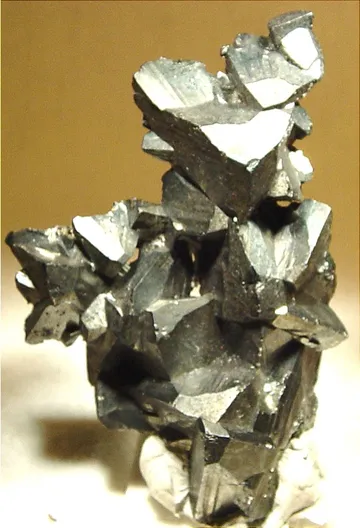
Casapalca, Peru — a classic high-Andean locality for Ag-Pb-Zn-Cu sulfides, famed for sharp tetrahedrite crystals and historical significance to collectors.
Key facts
Casapalca is one of the classic high-Andean polymetallic localities of Peru, a name that belongs as much to economic geology as to mineral collecting. The district lies high on the western flank of the Central Andes in Huarochirí Province, Lima Region, where steep valleys cut a thick pile of red-bed sedimentary rocks and Tertiary volcanic units. Its ores are the familiar but immensely variable Andean Ag-Pb-Zn-Cu suite: sphalerite, galena, tetrahedrite-group minerals, tennantite, chalcopyrite and pyrite in quartz-carbonate gangue, with rhodochrosite, calcite, dolomite, sericite and manganiferous carbonates contributing much of the texture and color of the veins.
For collectors, Casapalca is above all a tetrahedrite locality. The best specimens carry sharp, dark metallic tetrahedra and modified tetrahedra, commonly perched on quartz, pyrite, sphalerite or chalcopyrite. A good Casapalca tetrahedrite is not merely “black sulfosalt on matrix”: it has a steely, mirrorlike luster, crisp triangular faces, striated edges, and the heavy architectural presence of a true vein specimen. Some pieces are lightly dusted or coated by chalcopyrite, giving the crystals a brassy skin over the dark sulfosalt, while others show jet-black to gunmetal crystals rising from pale quartz druse or sparkling pyrite.
Historically, Casapalca is important because it was studied early and deeply. By the 1930s, H. E. McKinstry and J. A. Noble had already recognized the district as an unusually clear example of zoned vein mineralization, opened through large vertical and horizontal ranges. Later studies of fluid inclusions, stable isotopes and tetrahedrite chemistry made Casapalca a textbook locality for Cordilleran polymetallic veins. The district is also a practical mining camp, not a romantic abandoned occurrence: modern Casapalca comprises active underground operations, historically divided between the Yauliyacu and Casapalca/Americana mine areas, with both vein and replacement-style “cuerpo” mineralization.
Regional View
Country View
The locality has been labelled in several ways over the years: Casapalca, Casapalca Mine, Yauliyacu Mine, Americana, Chicla District, Huarochirí Province, Lima Department, and on older labels sometimes “Junín,” reflecting older mining-district usage rather than the modern political locality. Serious collectors should read old labels with sympathy but verify the intended mine area and mineral species carefully, especially for tetrahedrite-group specimens.

Photo: Wikimedia Commons
Search for specimens: View all specimens from Casapalca, Peru
Casapalca is a hydrothermal polymetallic vein and replacement district carrying silver, lead, zinc and copper. The mine area is reached by the Central Highway east of Lima, near the high pass country of the Western Cordillera, and the principal modern mine workings lie around 4,200–4,600 m above sea level. The district sits in rugged glacial and fluvial-glacial topography, with the Rímac River cutting through the area and exposing the stratigraphy that controls the ore.
The host succession is dominated by the Casapalca Formation and overlying volcanic rocks. The red beds of the Casapalca Formation include shales and calcareous sandstones, with their red color caused by finely disseminated hematite. Above them lies the Carmen Member, a package of conglomerates, limestone units, sandstones, shales, tuffs and volcanic conglomerates. This unit is particularly important in the mine because coarse sandstones and conglomerates supplied permeable and reactive horizons where mineralizing fluids could replace limestone clasts and calcareous matrix. Overlying volcanic units include the Tablachaca, Carlos Francisco and Yauliyacu members of the Carlos Francisco Formation, with tuffs, breccias, agglomerates and andesitic flows.
Structurally, Casapalca is governed by Andean-scale folding and faulting. The Casapalca anticlinorium trends roughly parallel to the Andes, and the ore veins cut across the stratigraphic sequence rather than respecting it. Principal vein systems have been described as long, steeply dipping, fault-controlled structures with splays, offshoots and duplex-like arrangements. Older mine descriptions emphasized the Carlos Francisco–Aguas Calientes system, Bella Unión, Carmen and Rayo veins; later technical work describes major L, M, N and N3 vein systems in the central mine area. These structures supplied open-space sites for quartz-carbonate-sulfide deposition and also acted as conduits feeding replacement bodies.
Two styles of ore matter to collectors and geologists alike. The first is the vein mineralization: typically narrow to moderate-width quartz-carbonate-sulfide veins carrying sphalerite, galena, tetrahedrite-group minerals, tennantite and chalcopyrite, with pyrite, quartz, calcite, rhodochrosite, dolomite, sericite and manganiferous calcite as gangue or associated minerals. The second is the disseminated and replacement ore known in the mine as “cuerpos.” These cuerpos include stockworks and disseminations in the hanging wall and footwall of major veins, sigmoidal bodies formed at strong vein bends, and stratiform replacements in the Carmen Member where porous conglomerates and coarse sandstones allowed sulfides to spread away from the feeder fractures.
The district is famously zoned. Early work described a central, more pyritic and intensely altered part of the system, grading outward into richer tetrahedrite-bearing assemblages and then into cooler carbonate, stibnite and barite-bearing mineralization. Modern mine descriptions also recognize vertical zoning, with higher silver values nearer the upper levels and stronger zinc values at depth. Hydrothermal alteration follows the same logic: silicification, pyritization and sericitization are strongest close to the veins, while more distal rocks show propylitic alteration with epidote, chlorite and calcite.
Mining in the Casapalca district reaches back to the early Spanish colonial period, when work was concentrated on outcropping or near-surface veins and oxidized zones rich enough to yield native silver and silver ores. Modern mining began in the late nineteenth century. In 1887, Cía. de Minas Los Andes, associated with Backus and Johnston, worked the Rayo vein and developed mineralized structures such as Carlos Francisco, Carmen, Bella Unión and Aguas Calientes. Cerro de Pasco Corporation acquired the Casapalca mine and most of the permits in 1921 and later built the Graton Tunnel, a major drainage and ventilation tunnel extending for many kilometers beneath the mine workings. In 1974 the district passed to Centromín Perú. In 1997, the district was divided into the Yauliyacu and Casapalca mine areas; Yauliyacu passed to Empresa Minera Yauliyacu / Los Quenuales, while the Casapalca side continued under Cía. Minera Casapalca, later Alpayana.
Today the Casapalca name encompasses active underground mining rather than casual surface collecting. Alpayana operates both the Americana unit, rooted in the former Casapalca operation, and the Yauliyacu unit, acquired through its purchase of Empresa Minera Los Quenuales. Americana is described by the operator as an underground Zn-Cu-Pb-Ag operation with vein systems several kilometers long and deep, while Yauliyacu is an underground Zn-Cu-Pb-Ag operation east of Lima with upper-zone ore moved by gravity through ore passes and lower-zone ore hoisted through the central shaft. Access to underground workings, dumps and operational areas is controlled by the operator; specimens available to collectors generally come through mine employees, historic lots, Peruvian dealers, older European and North American collections, and modern specimen dealers with established supply chains.
The notable specimen production is strongly weighted toward sulfide and sulfosalt pockets rather than oxidized showpieces. Classic pockets produced tetrahedrite-group crystals with quartz, pyrite, sphalerite, chalcopyrite, galena and calcite. The most desirable pieces show isolated, complete crystals on contrasting matrix; ordinary pieces tend to be massive tetrahedrite, broken sulfosalt cleavage fragments, or dense ore with little crystal definition. Casapalca also produced attractive sphalerite assemblages, pyrite-rich quartz-carbonate pieces, bournonite, geocronite and minor silver sulfosalts, but in the collector market the locality’s identity remains centered on tetrahedrite.
Casapalca tetrahedrite is the district’s signature collector mineral, usually appearing as lustrous steel-gray to black tetrahedral and modified tetrahedral crystals in quartz-carbonate-sulfide vein matrix. The best specimens show sharp, freestanding crystals from about thumbnail scale to several centimeters, with exceptional historic pieces reported with crystals approaching cabinet-specimen size; many are associated with quartz, pyrite, sphalerite and chalcopyrite, and some carry a natural brassy chalcopyrite coating that can brighten the faces without obscuring the form. Published work on the deposit shows that tetrahedrite chemistry varies across the zoned vein system, and modern labels may more precisely read tetrahedrite-(Fe), tetrahedrite-(Zn), tennantite-(Zn), or “tetrahedrite subgroup” rather than undifferentiated tetrahedrite. The strongest collector pieces are those with complete, mirror-bright, undamaged crystals standing proud on contrasting quartz or pyrite; massive ore, rubbed crystals, and specimens where the sulfosalt is mostly hidden under chalcopyrite are far more common.
Other documented minerals from Casapalca form a compact but interesting Andean polymetallic suite. Sphalerite, galena, chalcopyrite and pyrite are the main ore companions, with rhodochrosite, manganese-bearing calcite, calcite, dolomite, quartz and sericite as typical gangue. Sulfosalt collectors should note bournonite, boulangerite, geocronite, jamesonite, diaphorite, miargyrite, polybasite and pyrargyrite, while realgar, orpiment, stibnite, enargite, hübnerite, native copper, acanthite, baryte, anhydrite including the blue “angelite” variety, and willemite are also recorded from the locality or its sublocalities. Casapalca is not celebrated for type-locality species; its importance lies instead in classic, well-studied zoned sulfide-sulfosalt mineralization and in the quality of its tetrahedrite-group crystals.
The main authenticity issue with Casapalca specimens is not widespread fabrication but precision. “Tetrahedrite” is often used in the old collector sense, while modern mineral nomenclature divides the material into named tetrahedrite-group species depending on dominant constituents. A specimen sold as tetrahedrite from Casapalca may need analytical confirmation before it can honestly be labelled tetrahedrite-(Fe), tetrahedrite-(Zn), tennantite-(Zn), or another subgroup member. For most aesthetic collecting this distinction may not affect value, but for systematic sulfosalt collections it matters.
Locality wording also deserves attention. Old labels may say Casapalca, Yauliyacu, Casapalca Mine, Casapalca District, Lima, Huarochirí, or even Junín. This is common for older Peruvian mining labels and does not automatically make a specimen suspicious, but high-value pieces should be evaluated with the age and style of the label, dealer history, and specimen appearance in mind. “Casapalca” can refer broadly to the mining district or more narrowly to the mine area now associated with Americana; Yauliyacu is adjacent and historically connected underground, so older specimens may be difficult to assign to one side of the divided district without original mine documentation.
Condition is critical. Tetrahedrite has sharp but vulnerable edges, and the best Casapalca crystals tend to show prominent corners that bruise easily. Look for flat spots, rubbed high points, chipped tetrahedral apices and impact marks along striated faces. A little edge wear is common on older pieces, but a top specimen should retain the crisp geometry that makes the locality famous. Quartz and calcite associations add contrast but also create more points of possible damage, especially where quartz crystals project from pockets around heavy sulfide crystals.
Chalcopyrite coatings should be judged carefully. A thin brassy film or dusting on tetrahedrite is a known natural habit at Casapalca, but heavy coatings can obscure the sulfosalt and make mediocre pieces look flashier than they are. Conversely, bright chalcopyrite skin is sometimes part of the locality’s charm when the underlying tetrahedrite crystal form remains sharp. Avoid confusing brassy chalcopyrite-coated tetrahedrite with altered pyrite or with unrelated “peacock ore” style treatments from other localities.
The locality is not a standard fluorescence locality in the way Franklin, Tsumeb or some zinc silicate deposits are, though willemite is recorded and may be of analytical interest. Most Casapalca display specimens are best evaluated under strong white light, where luster, contrast and crystal definition are obvious. If realgar or orpiment is present on a labelled Casapalca piece, treat it as light-sensitive and toxic in the usual arsenic-sulfide sense: avoid prolonged direct sunlight, dust generation and unnecessary handling.
Market availability is steady but uneven. Small to miniature tetrahedrite specimens from Casapalca appear with some regularity, while large, sharp, highly lustrous cabinet pieces with complete crystals are much less common and command a premium. Historic pieces with old labels, clean quartz contrast, strong crystal isolation and minimal bruising remain the most desirable. Massive ore chunks and dark, visually indistinct sulfide pieces should be priced as locality examples rather than fine display specimens.
Casapalca’s first great story is geographical. The old camp sat in the canyon of the Rímac River, below the Continental Divide, with the Carlos Francisco peak rising east of town to roughly 17,000 feet. McKinstry and Noble described a mine system that could be followed from a long tunnel low in the valley upward through connected workings for about 3,500 vertical feet toward the outcrop below the summit. That is the kind of exposure economic geologists dream about: not a single hand specimen, not a single stope, but a whole mineralizing system cut open through enough elevation to watch its zoning unfold.
The Aguas Calientes part of the district carried its own warning in the name. It was “so-called because flows of hot water” were encountered underground, a detail that makes Casapalca feel less like an extinct geological diagram and more like a living hydrothermal system with warmth still leaking through its fractures. In the old interpretation, the deep and central parts of the mine lay close to the channels that once brought the hottest ore fluids upward. The later discovery of hot water in workings gave that model a visceral reality for miners: the veins were not just mineralized cracks, but the fossil plumbing of an active mountain.
One of the most memorable structural observations from the early work was the local “shingle structure” in the Carlos Francisco mine. In the porphyry, the veins did not simply run as single flat sheets; they overlapped in en echelon fashion, like roof shingles. Where one shingle died downward, a vertical connecting vein could link it to the next, and those junctions were often where the veins became particularly wide and rich. It is easy to see why this mattered underground. A miner following a narrowing vein could either lose the ore or, if the geometry was favorable, find the connecting shoot where the deposit opened again.
Casapalca also gave geologists a lesson in wall-rock behavior. In shale, veins could pinch to narrow slips. In brittle conglomerate of the Carmen Member, fracturing could widen and multiply. In porphyry, stress produced intricate branching veinlets. The same hydrothermal fluid, moving through different rocks, created different ore shapes. For collectors this helps explain why Casapalca specimens vary so much: some are dense, massive sulfide vein chunks; others are vuggy, crystalline pieces with quartz and tetrahedrite; still others belong to replacement-style mineralization where sulfides spread through favorable sedimentary horizons.
The zonal pattern became the district’s scientific signature. McKinstry and Noble saw coarse pyritic ore near the inferred center of mineralization, richer tetrahedrite-bearing assemblages outward, and still farther out carbonate, stibnite and barite-bearing zones. They recognized that the zoning was more conspicuous laterally than vertically. In plain collector language, this means Casapalca was not a single pocket repeated endlessly; it was a broad hydrothermal gradient, and the mineral character changed depending on where the vein was intercepted.
Modern mining added another scale to the story. The Graton Tunnel, built by Cerro de Pasco Corporation, runs for about 11.5 km beneath the Yauliyacu mine area to aid drainage and ventilation. Later production history saw the district pass from private ownership to Centromín Perú in 1974, then into the modern split between Yauliyacu and Casapalca in 1997. The two mine areas remained physically connected underground but operated through separate accesses. For collectors, that explains both the abundance of old “Casapalca” labels and the difficulty of pinning every historic specimen to a precise modern operating unit.
H. E. McKinstry and J. A. Noble, “The Veins of Casapalca, Peru,” Economic Geology, vol. 27, no. 6, 1932, pp. 501–522. A foundational structural and mineralogical study of the Casapalca vein system, including the Carlos Francisco and Aguas Calientes workings, shingle structures, wall-rock alteration and lateral zoning.
R. O. Rye and F. J. Sawkins, “Fluid Inclusion and Stable Isotope Studies on the Casapalca Ag-Pb-Zn-Cu Deposits, Central Andes, Peru,” Economic Geology, vol. 69, no. 2, 1974, pp. 181–205. A major genetic study of Casapalca ore fluids, widely cited in later work on Andean polymetallic vein deposits.
Ishiung Wu and Ulrich Petersen, “Geochemistry of Tetrahedrite and Mineral Zoning at Casapalca, Peru,” Economic Geology, vol. 72, no. 6, 1977, pp. 993–1016. The key publication for tetrahedrite chemistry and zoning at Casapalca, especially relevant to modern tetrahedrite-group identifications.
Tetrahedrite-(Fe) occurrence record, Mindat. Summarizes the documented tetrahedrite-(Fe) occurrence at the Casapalca Mine and cites Wu and Petersen’s 1977 work.
Tetrahedrite subgroup occurrence record, Mindat. Useful for collector associations, specimen-photo data and references, including Jaroslav Hyršl’s 1999 note on a new tetrahedrite find and Hyršl and Rosales’ 2003 Mineralogical Record update on Peruvian minerals.
Neil R. Burns and Samuel Mah, “2010 Resource and Reserve Update, Yauliyacu Mine, Peru,” Silver Wheaton Corp., 2011. A technical report with detailed summaries of location, access, mining history, regional geology, vein and cuerpo mineralization, paragenesis and zoning.
Mario Hernán Basilio Pérez and Manolo Damián Dávalos, “Mineralización en la zona de cuerpos de la mina Casapalca,” Universidad Nacional de San Antonio Abad del Cusco, 2015. A thesis abstract focused on the cuerpo-style mineralization, reserves and underground mapping of the Casapalca mine area.
Adolfo Lopez Matencio, “Comportamiento geológico, alteraciones hidrotermales y mineralización de la veta Esperanza y asociados, en los niveles inferiores 15, 16, 17 y 18, Compañía Minera Casapalca S.A.,” Universidad Nacional de San Antonio Abad del Cusco, 2016. A mine-scale study of the Esperanza vein and lower-level alteration/mineralization.
Javier Chayña Herencia, “Interpretación geológica-estructural de la veta Chira y su relación con las estructuras M en la formación de cuerpos polimetálicos de las zonas intermedia y baja de la mina Casapalca,” Universidad Nacional de San Antonio Abad del Cusco, 2017. A structural study of the Chira vein, M structures and cuerpo formation in the Americana/Casapalca mine setting.
Mindat: Casapalca Mine, Casapalca, Chicla District, Huarochirí Province, Lima, Peru — The main locality database page for the Casapalca Mine, with mineral list, sublocalities, references and specimen photographs.
Mindat: Casapalca, Chicla District, Huarochirí Province, Lima, Peru — Broader locality page useful for reconciling mine, town and district-level records.
Mindat: Yauliyacu Mine, Casapalca, Chicla District, Huarochirí Province, Lima, Peru — Important for distinguishing Yauliyacu from the adjacent Casapalca/Americana mine area.
Wikimedia Commons: Minerals of Casapalca — Freely licensed specimen photographs, including tetrahedrite, sphalerite, quartz, pyrite and calcite assemblages.
Alpayana: Unidad Minera Americana — Operator information on the modern Americana operation in the Casapalca mining area.
Alpayana: Unidad Minera Yauliyacu — Operator information on the modern Yauliyacu unit, including underground extraction details.
Alpayana: Nosotros — Company history, including the transition from Minera Casapalca to Alpayana and the 2022 acquisition of Empresa Minera Los Quenuales.
Silver Wheaton: 2010 Resource and Reserve Update, Yauliyacu Mine, Peru — Detailed technical background on Yauliyacu/Casapalca geology, history, mineralization and mine infrastructure.
INGEMMET library record: Geochemistry of Tetrahedrite and Mineral Zoning at Casapalca, Peru — Bibliographic record for the key Wu and Petersen tetrahedrite-zoning paper.
_2012-07-20.jpg)