






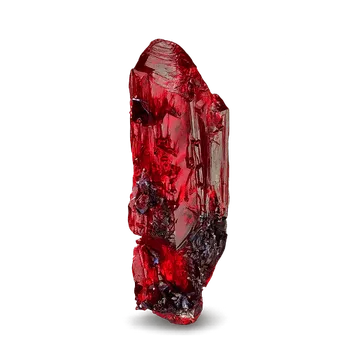
Proustite from the Uchucchacua Mine occupies a special place among modern “ruby silver” specimens: it is not usually the biggest proustite in the world, but the best pieces have a unmistakable Uchucchacua look—steel-gray to mirror-bright trigonal crystals that suddenly flash cherry- to blood-red when a strong light enters the crystal. That contrast is the appeal. In normal cabinet lighting the crystals may look metallic, almost blackened silver; under backlighting they reveal the saturated internal red that makes proustite one of the great optical pleasures of silver mineral collecting.
Key facts
Proustite from the Uchucchacua Mine occupies a special place among modern “ruby silver” specimens: it is not usually the biggest proustite in the world, but the best pieces have a unmistakable Uchucchacua look—steel-gray to mirror-bright trigonal crystals that suddenly flash cherry- to blood-red when a strong light enters the crystal. That contrast is the appeal. In normal cabinet lighting the crystals may look metallic, almost blackened silver; under backlighting they reveal the saturated internal red that makes proustite one of the great optical pleasures of silver mineral collecting.

Photo: Géry Parent, Wikimedia Commons
The geological setting explains the richness of the associations. Uchucchacua is a high-altitude, carbonate-hosted Ag-Mn-Pb-Zn system in the central Peruvian Andes, developed in Jumasha Formation limestones and controlled by major structural zones. It is not a simple silver vein in the old European sense; it is a structurally complex district of veins, replacement bodies, and skarn-related mineralization, with a strong manganese signature. That chemistry produced the famous black alabandite, pink rhodochrosite and Mn-calcite, rhodonite, silver sulfosalts, and a long list of rare Mn- and Ag-bearing species.
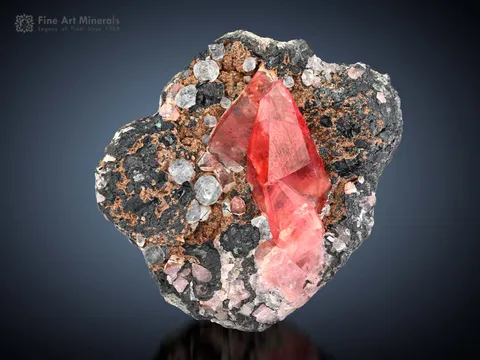
For collectors, Uchucchacua proustite is most desirable when the crystals are sharp, trigonal, lustrous, and translucent enough to show a vivid red body color. The classic presentation is a small red crystal or cluster on pale rhodochrosite, white calcite, quartz, or a mixed sulfide matrix. Fine thumbnail and miniature specimens can be far more compelling than larger, bruised pieces because proustite’s value is concentrated in perfection: unabraded terminations, clean faces, good isolation, and strong internal color under light.

Photo: Rob Lavinsky, iRocks.com, Wikimedia Commons
The mine is historically important beyond proustite. Uchucchacua has been one of Peru’s major modern silver operations and a remarkably productive mineralogical locality. It is the type locality for multiple rare minerals, and recent work on its Ag-Mn sulfosalt assemblages continues to add new species and new structural information. Proustite, Ag3AsS3, is only one member of that silver-sulfosalt story, but for specimen collectors it is the most visually immediate: the red, the luster, and the delicate Peruvian matrix combinations make the best examples instantly recognizable.
Search for specimens: View all proustite specimens from Uchucchacua Mine, Peru
The Uchucchacua Mine is in the Oyón district and province of Lima, Peru, at roughly 4,500 meters elevation in the central Andes. It is an underground silver-lead-zinc operation owned by Buenaventura, and its mineralogical identity is tied to the carbonate rocks of the Jumasha Formation, the mine’s manganese-rich chemistry, and a dense network of mineralized structures.
The deposit is best understood as a polymetallic Ag-Mn-Pb-Zn district with veins, replacement bodies, and skarn-related mineralization. Ore and specimen pockets occur in a structural environment of faults and fractures cutting folded Cretaceous limestones, with mineralization influenced by Miocene intrusions. In practical specimen terms, this means that proustite is part of a late silver-sulfosalt stage rather than a stand-alone species: it appears in a setting already prepared by carbonate replacement, manganese gangue, sulfides, and repeated hydrothermal events.
Modern exploration by Buenaventura began in the 1960s, and the mine commenced production in 1975. The operation developed into a major underground silver producer, working areas such as Socorro, Carmen, and Huantajalla. Buenaventura’s current description of the mine emphasizes mechanized underground mining, cut-and-fill and bench-and-fill methods, shaft haulage, rail transport underground, and mine drainage through the Patón tunnel system. These are not casual collecting conditions; Uchucchacua is an active industrial mine, and specimen recovery has depended on mine production, miners, dealers, and later circulation of older collection material rather than public collecting access.
For mineral collectors, the important production periods are not always the same as the ore-production timeline. Proustite specimens appearing in the collector market are often described as older finds, with several dealer records pointing to material from around the mid-1990s to early 2000s and specimens entering notable private collections such as those of Brian Kosnar, Frank Keutsch, Dr. William S. Logan, Colin Manlove, Thomas P. Moore, and others. This is consistent with what collectors see in the market: Uchucchacua proustite is available, but it tends to appear as scattered older pieces rather than as a steady stream of freshly mined cabinet specimens.
The mine was temporarily suspended in 2021 after operational and social challenges, then moved through updated mine planning and resumed its role as a producing operation in the Uchucchacua–Yumpag complex. From a specimen standpoint, that does not mean regular access to new proustite pockets. Active mines can be major specimen sources when pockets are encountered and specimens are preserved, but they can also operate for long intervals with little collector-grade recovery. Uchucchacua should therefore be treated as a classic modern locality with intermittent specimen availability, not as an open collecting locality.
Uchucchacua proustite most often appears as sharp trigonal crystals, small crystal clusters, or scattered crystals on matrix. The best crystals show the classic proustite morphology: compact trigonal prisms, blocky crystals, rhombohedral or scalenohedral terminations, and bright lustrous faces. Individual crystals documented in dealer and photo records commonly range from a few millimeters to about 1 cm, with exceptional examples reaching roughly 1.1 to 1.5 cm as significant crystals for this locality. Matrix specimens may be miniature to small-cabinet size, but the proustite itself is usually the accent mineral rather than a large freestanding crystal mass.
Color is one of the key locality traits. In ordinary room light, many Uchucchacua crystals look metallic gray, silvery, or nearly black because of surface luster and the way proustite darkens under light exposure. The collector’s test is backlighting: fine examples glow cherry red to blood red from within. Pieces that look merely black and opaque under a strong light have much less appeal, although some old or light-exposed crystals may still show red along edges, contacts, or broken areas.

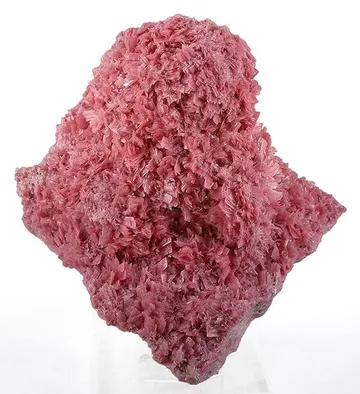
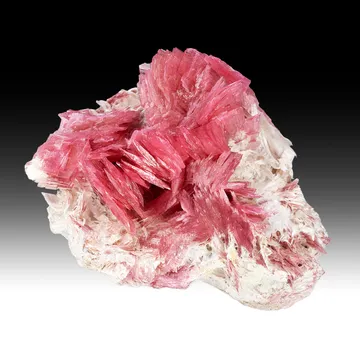
The finest associations are a major part of the locality’s charm. Proustite is documented with rhodochrosite, calcite, quartz, pyrite, alabandite, polybasite, pearceite and pearceite-T2ac, acanthite, tennantite-group minerals, galena, chalcopyrite, fluorite, pyrargyrite, native silver, and rarer Ag-Mn sulfosalts. Rhodochrosite is especially prized because the pale to pink carbonate matrix sets off the dark red proustite so well. White calcite and quartz matrices also work beautifully, giving the red crystals a clean visual stage.
Quality factors are straightforward but unforgiving. Look for:
A large matrix with many damaged or opaque crystals can be less desirable than a thumbnail with one perfect, transparent red crystal. Conversely, a specimen with proustite, rhodochrosite, and rare Uchucchacua silver sulfosalts can be important even when the proustite crystals are small, because the locality’s mineralogical richness is part of the specimen’s value.
The chief authenticity issue is not a known epidemic of fabricated Uchucchacua proustites, but identification and condition. Proustite is the arsenic analogue of pyrargyrite, Ag3SbS3, and the two “ruby silver” species can be visually similar. Uchucchacua also contains multiple dark silver sulfosalts, including polybasite and pearceite-group minerals, so a red or gray metallic crystal on a Peruvian silver matrix should not be assumed to be proustite without supporting context. High-value specimens deserve analytical confirmation or a strong chain of provenance from a knowledgeable dealer or collection.
Proustite is light sensitive. This matters more than almost any other care issue. Bright, prolonged illumination can darken the mineral and reduce the red transparency that makes the specimen desirable. Fine Uchucchacua examples should be stored in the dark and displayed only briefly under controlled light. Avoid sunny cabinets, hot display lamps, and photography sessions that expose the crystal to intense light for longer than necessary. LED lighting used briefly is preferable to hot or high-UV sources, but conservative handling is still the rule.
Condition problems are common because proustite is soft and brittle. Edge wear, contacted terminations, cleaved tips, and bruised lustrous faces all affect value. Some Uchucchacua pieces show contacts where crystals grew against pocket walls or against other crystals; these can be acceptable when they are part of the natural growth geometry, but they should be distinguished from later breakage. A crystal with one contacted face and brilliant red transparency may still be very collectible; a specimen with multiple crushed terminations and no internal color is a different category.
Cleaning should be minimal. The matrix may include delicate rhodochrosite, calcite, quartz needles, soft sulfides, and friable manganese-rich material. Avoid acids, ultrasonic cleaning, aggressive brushing, and prolonged soaking. Dust removal with a hand blower or a very soft brush is usually safer than trying to “improve” the surface. Do not attempt to polish or oil proustite; the collector value lies in natural crystal faces and natural luster.
Market availability is intermittent. Uchucchacua is a famous silver mine, but fine proustite specimens from it are not abundant in proportion to the mine’s scale. Dealer and auction records show thumbnails, miniatures, and small-cabinet specimens ranging from modestly priced pieces with scattered red crystallization to much stronger association specimens priced in the hundreds to low thousands of dollars. Especially desirable are pieces with sharp red crystals on rhodochrosite, well-documented older collection provenance, analyzed associations with rare silver sulfosalts, or unusually large individual crystals for the locality.
_1.JPG)


