






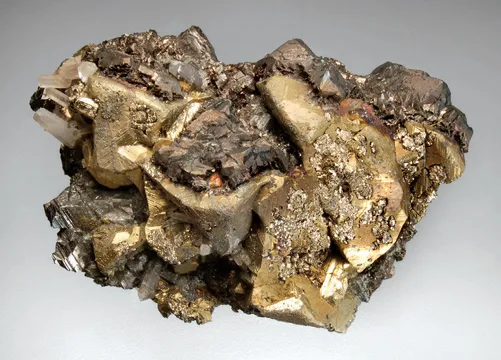
Casapalca Mine, Peru — Andean polymetallic vein locality known for tetrahedrite and sphalerite in quartz, offering dramatic contrast and pocket specimens.
Key facts
Casapalca is one of the great central Andean polymetallic vein localities, a high, hard-rock mine camp in the Rímac valley east of Lima where silver-lead-zinc-copper ore veins cut Tertiary red beds and volcanic rocks near the continental divide. For collectors, its name belongs above all to classic steel-gray tetrahedrite, commonly perched in quartz or associated with jet-black sphalerite, brassy pyrite, galena, calcite, and occasional chalcopyrite films. The best specimens have a distinctly Peruvian severity: dark, architectural sulfide crystals set against snow-white to glassy quartz, with the metallic species often sharp enough to read the growth history of the pocket.
Regional View
Country View
The mineralogy is not merely attractive; it has been scientifically important for nearly a century. Hugh E. McKinstry’s 1927 account of the minerals of Casapalca and the later 1932 study by McKinstry and J. A. Noble made the district a textbook example of open-space vein filling, paragenesis, and mineral zoning. Later fluid-inclusion, stable-isotope, and microprobe work treated Casapalca as a model Cordilleran polymetallic vein system, especially for the behavior of tetrahedrite-tennantite, silver zoning, and the changing character of ore fluids with depth and distance from the center of mineralization.

Photo: DerHexer, Wikimedia Commons
The finest Casapalca pieces are usually combination specimens rather than single-species cabinet trophies. Tetrahedrite may show as sharp tetrahedra, modified and complex but still strongly geometric, with bright gunmetal luster. Sphalerite is typically black to very dark brown and lustrous, often sharply twinned. Quartz ranges from short, sparkling druse to slender, transparent needles and larger milky-to-satiny crystals. Pyrite can occur as highly lustrous pyritohedra, while calcite—especially manganese-bearing calcite—adds pale pink or white sprays and scalenohedra. Good specimens succeed by contrast: black sphalerite, gray tetrahedrite, yellow pyrite or chalcopyrite, white quartz, and pinkish carbonate all placed cleanly on a three-dimensional sulfide matrix.
Search for specimens: View all specimens from Casapalca Mine, Peru
Casapalca lies in the Chicla District of Huarochirí Province, Lima Region, Peru, high in the central Andes along the Rímac River corridor between Lima and the Oroya side of the range. Older literature describes the camp as just below the railway summit, about 13,700 feet above sea level, with mine workings rising in the mountains to the east. Modern technical descriptions of the adjacent Yauliyacu-Casapalca system place the main mine infrastructure at roughly 4,120 to 4,510 m above sea level, emphasizing how much of the deposit is a high-altitude underground operation rather than an accessible surface collecting locality.
Geologically, Casapalca belongs to the central Peruvian belt of Cordilleran polymetallic veins and replacement bodies. The local section is dominated by Tertiary sedimentary and volcanic rocks: red sandstones and shales of the Casapalca Formation, the Carmen conglomeratic and carbonate-bearing member, overlying volcanic rocks of the Carlos Francisco sequence, and younger sedimentary-volcanic units. These rocks are folded into the Casapalca Anticlinorium and cut by steep hydrothermal vein structures. The deposit is best described as a hydrothermal polymetallic vein system with disseminated and replacement-style “cuerpos” where mineralization spread into favorable wall rocks, especially coarse clastic and carbonate-rich horizons.
The principal ore minerals are sphalerite, galena, tetrahedrite-tennantite, and chalcopyrite, with pyrite, quartz, calcite, dolomite, rhodochrosite, sericite, and manganiferous calcite as major gangue and accessory phases. Fluid-inclusion and paragenetic studies documented a multistage vein history, with early higher-temperature mineralization giving way to later lower-temperature carbonate- and sulfosalt-rich assemblages. In collector terms, this means that Casapalca is not a one-look locality: deeper or hotter parts are more sulfide-dominant, while cooler and more distal parts introduce abundant carbonates, barite in outlying veins, realgar, stibnite, and delicate vug linings.
The old studies made a crucial point that collectors can still see in specimens: wall rock mattered. In the red beds, carbonate gangue is much more prominent; in porphyry-hosted sections, quartz is the dominant nonmetallic mineral. In some pockets the sequence is readable by eye—massive ore or early quartz and pyrite first, then sphalerite, then galena and tetrahedrite, then later bournonite or quartz overgrowths, and finally calcite sprays perched on the earlier sulfides. This is why some Casapalca specimens have a dense, dark, “ore specimen” feel while others are almost airy, with quartz points and calcite rising from metallic crystals.
The district’s mining history is long. Spanish colonial work focused on rich, near-surface veins, probably including native silver and oxidized silver ores. Modern mining began in the late nineteenth century; one technical history gives 1887 as the beginning of modern-style work by Cía. de Minas Los Andes, associated with Backus and Johnston, on the Rayo vein and nearby structures such as Carlos Francisco, Carmen, Bella Unión, and Aguas Calientes. Cerro de Pasco Corporation acquired the Casapalca mine area in 1921, Centromin Perú took ownership in 1974, and the district was divided in 1997 into Yauliyacu and the eastern Casapalca mine area, with underground connections remaining between them. Today the historic Casapalca name overlaps with modern operating names and ownership history; collectors should be alert to whether an old label refers broadly to the pre-1997 Casapalca district, the present Casapalca/Americana side, or the neighboring Yauliyacu workings.
The modern corporate successor to the Casapalca mining tradition is Alpayana, a Peruvian underground polymetallic mining group that grew from Minera Casapalca and now operates several units, including Americana and Yauliyacu. The old collector locality “Casapalca Mine” remains meaningful because it is the label under which generations of tetrahedrite, sphalerite, quartz, pyrite, calcite, and galena specimens entered collections, especially from the 1970s through early 1990s and from occasional later recoveries. On present access, this is an active industrial underground mine district, not a recreational collecting ground. Specimens reach the market through historical collections, old dealer stock, deaccessions, and occasional material saved from ore rather than through casual field collecting.
Several specimen-producing episodes are well documented. McKinstry recorded that in the summer of 1923 a large vug was opened, lined with quartz, sphalerite, calcite, and bournonite, and that many fine specimens were removed. Later collector-market pieces, many described as from the 1970s, 1980s, or early 1990s, produced the now-classic tetrahedrite-on-quartz and tetrahedrite-sphalerite-quartz combinations. High-end examples include tetrahedrite crystals to several centimeters on edge, black twinned sphalerite to roughly 3 cm, quartz druses and sprays, and, more rarely, large pyrite, galena, calcite, or chalcopyrite-rich associations.
Casapalca tetrahedrite is the locality’s calling card: dark silvery-gray to gunmetal, lustrous, sharply tetrahedral to complexly modified, and most valued when individual crystals stand cleanly from a quartz, sphalerite, pyrite, galena, or calcite matrix. Ordinary pieces show small scattered tetrahedra in massive sulfide or quartz; good pieces have bright, crisp crystals from about 1 cm upward; and the exceptional cabinet specimens carry crystals of 3 cm or more on edge, with some recorded Casapalca plates showing still larger crystals. Many historic labels simply say “tetrahedrite,” but modern nomenclature and analyzed material indicate that much of the Casapalca material belongs in tetrahedrite-(Fe) or the tetrahedrite subgroup, and older literature notes that the tetrahedrite here can be silver-bearing. The best examples have sharp faces, minimal edge bruising, strong metallic luster, and attractive contrast with white quartz or black sphalerite; some show a thin chalcopyrite film, a feature that can be beautiful but should be recognized as a natural coating rather than mistaken for a separate dominant species.
Quartz at Casapalca is rarely the headline species by itself, but it is the essential stage on which the sulfides perform. It occurs as glassy to milky prismatic crystals, short sparkling druse, slender needle-like sprays, ribbony white aggregates, and larger satiny crystals associated with sphalerite, pyrite, galena, calcite, bournonite, and tetrahedrite. McKinstry’s paragenetic work placed quartz early in the main sequence but also noted quartz and calcite veining at several later points, which matches the range seen in specimens: some quartz is partly engulfed or overgrown by sphalerite and galena, while other quartz forms late sprays around earlier sulfosalts. Good Casapalca quartz specimens are judged less by absolute crystal size than by placement and condition—clear needles rising through black sphalerite, bright druse outlining tetrahedrite crystals, or undamaged milky-white contrast on heavy metallic ore.
Casapalca sphalerite is typically dark gray, brown-black, to jet black, lustrous, and commonly twinned, with sharp crystals that can be visually confused with other dark sulfides until the resinous-to-submetallic luster and form are inspected closely. McKinstry described vugs in which sphalerite lined the cavity before bournonite, quartz, and calcite were added, and modern collector specimens confirm sphalerite as both a matrix-former and a display species. Fine examples show striated, well-formed crystals from centimeter size up to several centimeters, sometimes with white quartz needles, pyrite, chalcopyrite, galena, or tetrahedrite. The most desirable pieces have isolated, glossy sphalerite crystals rather than massive black ore, and they benefit greatly from contrast—especially clear quartz, brassy chalcopyrite, or silver-gray tetrahedrite set against the dark sphalerite surface.
Chalcopyrite from Casapalca is part of the primary ore assemblage but is most collectible when it appears as bright brassy crystals or as a distinctive coating on tetrahedrite and associated sulfides. In the higher-temperature, more central portions of the vein system chalcopyrite was common, while in more carbonate- and tetrahedrite-rich outer zones it became much rarer; this zoning explains why many classic tetrahedrite specimens show only traces or films of chalcopyrite rather than large crystals. Collector examples include brassy crystals on black sphalerite with quartz, chalcopyrite with siderite and tetrahedrite, and tetrahedrite faces dusted or skinned with golden chalcopyrite. Good Casapalca chalcopyrite pieces are those in which the chalcopyrite is crystallized, lustrous, and compositionally clear in the association; ordinary pieces are simply sulfide masses where chalcopyrite is present but not visually dominant.
Calcite at Casapalca is a late and visually important gangue mineral, especially in specimens from carbonate-rich wall-rock environments and cooler phases of the vein system. It occurs as colorless, white, cream, and pale pink manganese-bearing crystals, commonly scalenohedral, tufted, feathery, or spray-like, and is frequently perched on earlier pyrite, sphalerite, tetrahedrite, quartz, and galena. McKinstry described tufts of calcite scalenohedra sitting on the earlier vug minerals, and modern specimens preserve exactly that look: delicate calcite sprays partly blanketing bright sulfides. The best calcites from Casapalca are not necessarily large; they are valued for freshness, pale pink color, undamaged terminations, and their ability to soften the otherwise dark metallic assemblage. Ordinary examples are cleavable carbonate masses or damaged druses on ore.
Casapalca pyrite is important both as a major vein mineral and as a specimen species in its own right. McKinstry noted that open vugs commonly produced nearly perfect pyritohedrons, while pyrite replacing wall rock more often formed cubes; he also stated that octahedral pyrite was not known to him from the locality, though later collector descriptions include modified and edge-sharpened forms that may invite casual misdescription. Fine specimens show mirror-bright, brass-yellow pyritohedra, often well striated, associated with clear quartz needles, galena, sphalerite, calcite, or tetrahedrite. The best pieces are bright, crisp, and three-dimensional, with stable surfaces and little oxidation; ordinary examples are massive pyrite-rich ore or dull pyrite scattered through quartz and sulfide matrix.
Galena at Casapalca is a major ore mineral and a supporting actor in many classic combination specimens, most often appearing as dull to bright gray crystals intergrown with sphalerite, quartz, tetrahedrite, pyrite, and calcite. McKinstry observed that galena was usually not as well crystallized as the showier bournonite and sphalerite in some vugs, but he also described intergrowths with bournonite that suggest simultaneous growth from competing crystal centers. Collector pieces include galena crystals around centimeter size on tetrahedrite-quartz associations and larger cubo-octahedral crystals with calcite from older collections. Good Casapalca galena specimens have sharp faces, recognizable cubo-octahedral geometry, and pleasing placement among quartz or pyrite; ordinary pieces are heavy, cleaved, lead-gray matrix with little crystal definition.
Beyond these staples, Casapalca has a remarkably rich polymetallic suite. Bournonite is historically one of the great species from the mine, with McKinstry calling it the most spectacular crystallized mineral in the early material and documenting nearly centimeter-size brilliant crystals from the 1923 vug. Rhodochrosite, rhodonite, dolomite, and manganese-bearing calcite mark the manganese-carbonate side of the system, while bournonite, geocronite, boulangerite, jamesonite, diaphorite, miargyrite, polybasite, pyrargyrite, acanthite, tennantite-(Zn), arsenopyrite, enargite, stibnite, realgar, and orpiment testify to the district’s antimony-, arsenic-, and silver-rich character. Reported secondary and accessory species include anhydrite, the blue anhydrite variety angelite, baryte, bornite, gypsum, hübnerite, native copper, siderite, sericite, willemite, and near-surface alteration products such as limonite, psilomelane, malachite, azurite, chrysocolla, smithsonite, kaolin, allophane, chalcanthite, melanterite, chalcocite, and covellite.
Casapalca specimens deserve careful labeling. Older labels may say simply “Casapalca,” “Casapalca Mine,” “Casapalca District,” “Casapalca, Junin,” “Casapalca, Lima,” “Centromin,” or even refer broadly to the mine before the 1997 split between Yauliyacu and the eastern Casapalca mine. The locality is in present-day Lima Region, Huarochirí Province, but older collector and dealer geography can be inconsistent. A conservative label should preserve the old wording and add a modern interpretation rather than silently replacing the provenance.
The most common identification problem is distinguishing dark tetrahedrite, sphalerite, and galena in mixed sulfide specimens. Tetrahedrite should show tetrahedral or modified tetrahedral forms and a metallic gray luster; sphalerite is darker, more resinous to submetallic, often striated or twinned; galena is heavier-looking and tends toward cubic or cubo-octahedral forms and cleavage. Chalcopyrite films on tetrahedrite are known from Casapalca and can create misleading golden patches. Some specimens have also been sold or relabeled under other Peruvian localities; one documented market note described a specimen labeled as tennantite from Huanzala that was instead recognized as tetrahedrite from Casapalca. Because Peru has several mines producing dark sulfide-quartz associations, provenance quality matters.
Condition is a serious issue. Tetrahedrite edges bruise, quartz points chip, calcite sprays break, and galena corners abrade easily. The best Casapalca pieces were often saved from working ore pockets, not collected gently from a hobby dig, so contacts, sawn bases, repaired matrix edges, and small pocket-removal breaks are normal. Evaluate the display face first: a specimen with a contacted back but pristine tetrahedrite faces and undamaged quartz can be much better than a “complete” piece with battered front crystals.
Treatments are not especially associated with Casapalca, but cleaning can change the character of specimens. Sulfides may be acid-sensitive in association with calcite, and manganese-bearing calcite or delicate quartz druses can be dulled by aggressive cleaning. Pyrite should be checked for stability, though fine Casapalca pyrite is generally collected as bright, solid crystals rather than decomposing marcasite-rich material. Arsenic and antimony sulfosalts are not a handling hazard in normal display use, but specimens containing realgar or orpiment should be kept away from prolonged strong light, dust should not be inhaled, and all sulfide specimens should be handled with normal mineral-collection hygiene.
Market availability is moderate for small to cabinet tetrahedrite-quartz-sphalerite combinations and much lower for top material. Miniatures and small cabinets with 5–15 mm tetrahedrite crystals appear periodically; larger, sharp tetrahedrite crystals of 3 cm or more, aesthetic pyrite-quartz-galena plates, good manganese-bearing calcite associations, and well-crystallized bournonite are much scarcer. Many of the best pieces on the market today are old-collection specimens from the 1970s through early 1990s rather than fresh production.
The old approach to Casapalca must have been one of the most dramatic commutes in mining geology. McKinstry described the Central Railway of Peru climbing nearly 16,000 feet in an eight-hour journey from Callao on the Pacific coast to the continental divide. Just below the summit lay Casapalca, deep in the valley of the Rímac River, with the mines rising in the mountains to the east. For a visiting geologist or mineralogist in the 1920s, the district was not an abstract locality name on a label; it was a hard ascent from sea level into treeless Andean country where ore veins, railways, camp life, and scientific fieldwork met at altitude.
The 1923 pocket is the great early collector episode. McKinstry recorded that during the summer of that year “a great vug” was opened, lined with crystals of quartz, sphalerite, calcite, and bournonite. The sequence he described is the kind collectors still reconstruct from surviving specimens: massive ore and earlier quartz-pyrite at the cavity wall; sphalerite crystals first lining the vug; bournonite growing on the sphalerite; quartz prisms radiating around and sometimes upon the bournonite; and tufts of calcite scalenohedra perched last on the whole assemblage. The most spectacular mineral to McKinstry was not tetrahedrite but bournonite, brilliant and nearly a centimeter across, with basal and prism forms dominating the crystals.
The district also became a natural laboratory for zoning. In one part of the system, coarse sulfides and chalcopyrite marked the hotter and more intense mineralizing conditions, with little carbonate. Away from that center, tetrahedrite and carbonates increased, chalcopyrite became rare, and the cooler phases introduced botryoidal carbonates, stibnite, realgar, and barite in outlying mines. In a collector’s drawer, that zonation becomes visible as a progression from dark, dense sulfide ore to quartz-lined vugs with bright tetrahedrite, pink calcite, and late red arsenic sulfides against white quartz.
One of the most striking engineering stories is the Graton Tunnel, driven below the mining district during the Cerro de Pasco era. Technical reports describe it as an 11.5 km tunnel beginning near the Rímac River at about 3,240 m elevation and extending beneath the Yauliyacu-Casapalca workings. It was built in part to supply water to Lima and later served mine drainage and ventilation. In practical terms, it changed the hydrology of an immense vertical vein system—workings, water, ore, and air all connected through a tunnel long enough to make the old specimen labels feel suddenly small.
_2012-07-20.jpg)
