A collector's guide to Pachapaqui, Peru: its geology, mining history and notable minerals, illustrated with the 27 specimens documented from this locality on EarthWonders.
Key facts
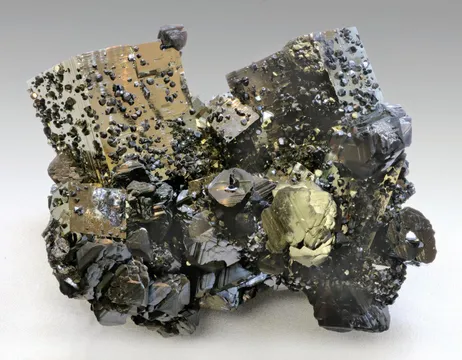
Pachapaqui is one of the great underappreciated Peruvian polymetallic districts: a high Andean zinc-lead-silver-copper camp in Ancash where ore geology and specimen mineralogy meet unusually well. Collectors know the name less for a single “Pachapaqui Mine” than for a district of veins, mantos, breccias, prospects, and old workings grouped around the village of Pachapaqui in Aquia District, Bolognesi Province. The specimens that made the locality famous are classic central-Andean combinations: pink manganese-bearing calcite on quartz and pyrite, sharp dark sphalerite, galena, chalcopyrite, bournonite, rhodochrosite, rhodonite, fluorite, helvine, and tetrahedrite-group crystals that modern analyses place on the tennantite side.
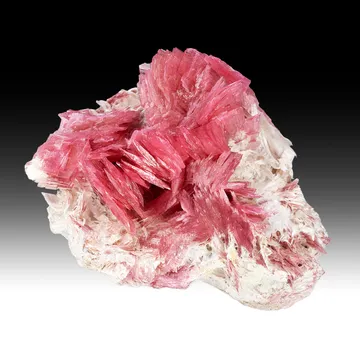
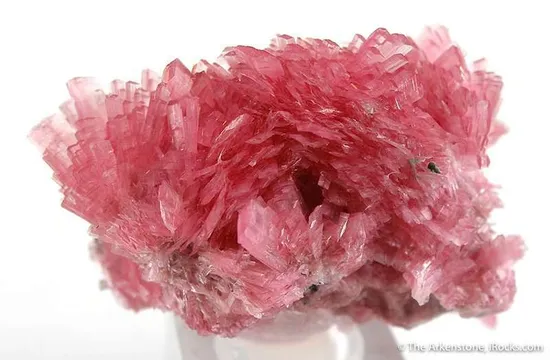
The best Pachapaqui pieces have a very distinctive look. The calcites are often soft pink to peach, frosted to translucent, in rhombohedra, lenticular aggregates, elongated parallel growths, or spiky clusters over bright pyrite and colorless quartz. Many are manganese-bearing and can show vivid red fluorescence under ultraviolet light. Quartz occurs as colorless to white prismatic crystals, sometimes slender and needlelike, lining vugs and forming sparkling crusts beneath calcite, sulfides, or tetrahedrite-group minerals. The most desirable pieces have balance: clean calcite form, bright pyrite contrast, dark sphalerite or galena anchoring the matrix, and minimal bruising on the exposed calcite edges.
Regional View
Country View
Geologically, Pachapaqui sits in the central Peruvian Andes at roughly 3,800 to 4,800 meters elevation, in a belt where carbonate strata, compressive Andean structure, intrusive activity, skarn alteration, replacement bodies, and later fault-controlled veins combine. That complexity is why the locality is more than a pretty calcite source. It is a mineral district in the old sense: ore shoots, replacement mantos, steep veins, breccia bodies, prospect adits, and surface workings scattered over difficult mountain ground, each able to produce a different balance of sulfides and gangue.
The district’s mineralogical literature spans practical mid-20th-century economic geology, Andean stratabound-deposit studies, Peruvian mineral-specimen reports, and modern tetrahedrite-group chemistry. For collectors, Pachapaqui’s historical importance rests in three overlapping reputations: a lead-zinc-silver-copper mining camp, a source of classic fluorescent pink manganese-bearing calcite, and a locality whose old “tetrahedrite” labels deserve careful modern interpretation.
Search for specimens: View all specimens from Pachapaqui, Peru
Pachapaqui is best understood as a mining district, not a single mine. Older and commercial labels often say “Pachapaqui Mine,” but the district includes multiple named areas and workings, among them Arabia, San Antonio, Riqueza, Julmar, Mantos, Santa Benita, Rascacielo, Socorro, and others. That distinction matters for serious collectors because some minerals are much more locality-sensitive than the broad label suggests. The classic tetrahedrite-group crystals, for example, are tied in the literature to the Santa Benita Prospect northeast of the town rather than to every working in the district.
The deposit is polymetallic and structurally complex. Modern mining-project summaries describe the ore as occurring in veins, mantles, and irregular bodies in polymetallic skarns. Older USGS work emphasized fissure-filling veins and replacement bodies, with common ore minerals galena, sphalerite, pyrite, chalcopyrite, tetrahedrite-tennantite, arsenopyrite, and stibnite in the broader Cordillera Blanca and northern Cordillera Huayhuash districts, and with quartz and carbonate gangue dominant in many deposits. At Pachapaqui, later mine descriptions divide the mineralization into areas such as San Antonio, Arabia, Riqueza/Julmar, Mantos, and Brecha, controlled by host rock, structures, and proximity to intrusive or metasomatic zones.
The local host rocks include limestone, skarnized limestone, calcareous breccia, volcanic breccia, quartzite, phyllite, sandstone, and related sedimentary units. Mine-scale descriptions emphasize faulted gray and black limestones, mineralized faults and mantos, sericitization, chloritization, argillization, oxidation, and skarn alteration. Economic zones appear strongly influenced by carbonate host rocks and by intersections of mineralized faults, where vein, pipe, breccia, and replacement geometries develop.
The ore assemblage is a collector’s dream because the same hydrothermal system that deposited saleable zinc, lead, silver, and copper ores also left open spaces and late gangue growth. A typical Pachapaqui assemblage is galena, sphalerite, silver-bearing minerals, tetrahedrite-group sulfosalts, chalcopyrite, quartz, calcite, rhodochrosite, rhodonite, pyrite, pyrrhotite, and marcasite. Barite, fluorite, sericite, helvine, axinite-(Mn), alabandite, spessartine, kutnohorite, siderite, bournonite, arsenopyrite, and wurtzite round out the collector suite.
The Arabia area is one of the historically important sources. USGS descriptions place the Arabia mine on the west side of Quebrada Burro, northeast of the Pachapaqui concentrator, with main workings at high elevation. The vein material there was described as vuggy white quartz with rhodonite and pods, lenses, veinlets, and disseminated grains of pyrite, chalcopyrite, sphalerite, galena, and tetrahedrite. Local people told the USGS geologists that Arabia had been worked in Colonial times, and the size of the old pits, shafts, drifts, and stopes suggested that several thousand tons of vein material had been removed.
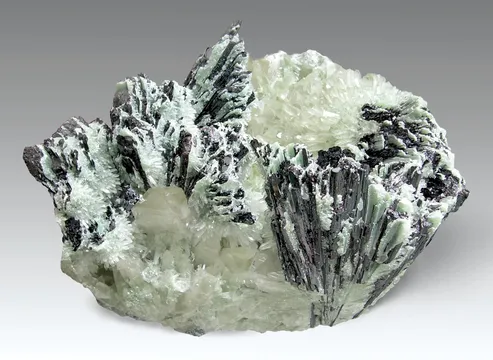
Santa Benita is small but important to collectors. It lies near the head of Quebrada Burro, southeast of Laguna Burro, with an adit at about 4,320 meters. The mineralized zone consists of closely spaced parallel fractures and breccia along a fault zone in recrystallized and silicified limestone. The vuggy veinlets are mainly pyrite and quartz with minor galena, sphalerite, chalcopyrite, and tetrahedrite-group minerals; many vugs are lined with quartz and tetrahedrite-group crystals. The USGS judged the zone too low grade for mining, but for collectors that very vugginess is exactly what made it important.
The modern mining story centers on ICM Pachapaqui S.A.C., with the Pachapaqui Expansion treated in Peru’s mining investment portfolio as a brownfield underground expansion project. The 2024 portfolio lists Korea Zinc Company, Ltd. as the 100% investor, ICM Pachapaqui S.A.C. as operator, zinc as the main product, and a planned plant expansion from 800 to 3,300 tons per day. The same source reports proven and probable ore reserves of 9.1 Mt at 3.40% Zn, 1.42% Pb, 55.58 g/t Ag, and 0.44% Cu, with an 11-year mine life in the project plan.
Collecting access today should be treated as industrial-mine access, not casual field collecting. The district includes active, inactive, and historically worked components; modern concessions, environmental approvals, water management, old waste dumps, and underground workings are all part of the area. Specimens reaching collectors generally come through mine-related recovery, older dealer stock, and collection recycling rather than from legal public rockhounding. Any field visit would require permission from the operator and respect for Peruvian mining, community, safety, and environmental rules.
The best specimen finds appear to have come from vugs and late-stage openings in the polymetallic system rather than from massive ore. Around the turn of the 21st century the district produced attractive collector-quality rhodochrosite, calcite, helvine, fluorite, sulfides, and tetrahedrite-group specimens. Dealer and collection records show cabinet to large-cabinet calcite-quartz-pyrite pieces, small cabinet manganese-bearing calcite plates, sharp sphalerite-pyrite-arsenopyrite combinations, and tetrahedrite/tennantite-group specimens on quartz, galena, sphalerite, bournonite, chalcopyrite, and pyrite.
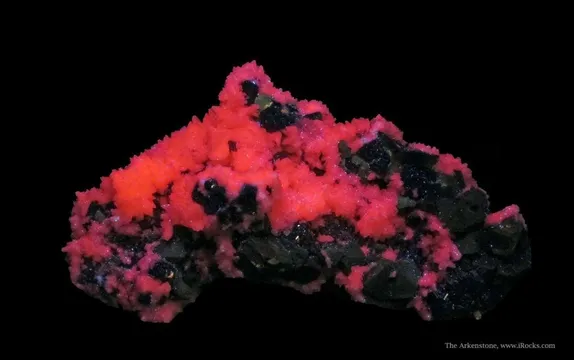
Calcite from Pachapaqui is the locality’s signature display mineral, especially in manganese-bearing pink forms on quartz, pyrite, sphalerite, and galena. Collector specimens range from small plates with spiky pink calcites under 1 cm to dramatic cabinet pieces with elongated, lenticular, or parallel polycrystalline calcite growths more than 6 cm long; some examples show frosted rhombohedra to about 2.5 cm on the diagonal, and large matrix pieces are known. The color is usually pale rose, peach, tan, or white, with the best pieces showing clean pastel color, strong contrast against brassy pyrite or black sphalerite, and minimal bruising on exposed rhombohedral edges. Many Pachapaqui calcites are manganese-bearing and fluoresce red, sometimes very strongly, under ultraviolet light, making good undamaged examples especially desirable to both Peruvian-mineral specialists and fluorescent-mineral collectors.
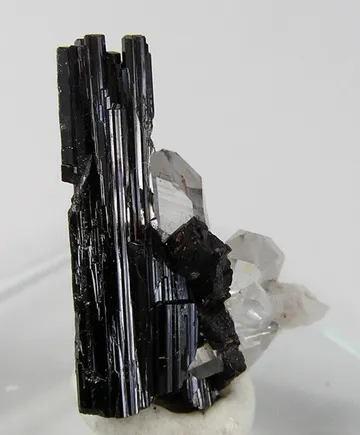
Quartz from Pachapaqui is rarely the headline species by itself, but it is essential to the district’s best specimens: colorless to white, prismatic, sometimes needlelike or barrel-shaped, and commonly forming crystallized matrices, vug linings, or sparkling crusts with pyrite, sphalerite, galena, chalcopyrite, calcite, rhodochrosite, and tetrahedrite-group minerals. USGS descriptions of the Santa Benita Prospect noted vugs lined with quartz and tetrahedrite-group crystals, and specimen records show slender quartz crystals over sphalerite bases, quartz matrices carrying pink calcite and pyrite, and quartz accompanying dark tennantite-(Fe) crystals. Superior Pachapaqui quartz pieces are judged less by isolated crystal size than by association and architecture: bright, undamaged prismatic quartz providing lift and sparkle to sulfides or pink manganese-bearing calcite.
Beyond calcite and quartz, Pachapaqui is documented for an unusually rich Peruvian polymetallic suite. Sphalerite can occur as sharp, highly lustrous brown to black crystals, sometimes with pyrite and arsenopyrite; bournonite is an important collector species in the district; chalcopyrite, galena, pyrite, arsenopyrite, pyrrhotite, and marcasite reflect the ore assemblage; and rhodochrosite, rhodonite, fluorite, helvine, axinite-(Mn), alabandite, spessartine, kutnohorite, siderite, ankerite, barite, sericite, and wurtzite add mineralogical depth. The district is not known in the verified sources as a mineral type locality; its rarity value instead lies in species such as helvine, axinite-(Mn), alabandite from the Arabia area, and especially tetrahedrite-group material now analytically placed in part as tennantite-(Fe).
The most important label issue at Pachapaqui is locality precision. “Pachapaqui Mine” is common on older labels, but the locality is a district, and sublocality matters. If a specimen is simply labeled Pachapaqui, that may be the best recoverable information, but a label specifying Santa Benita, Arabia, Riqueza, Mantos, or another named zone is more valuable when credible. Tetrahedrite-group pieces are particularly sensitive: old labels often say “tetrahedrite,” while modern work on Peruvian tetrahedrite-group minerals has identified Pachapaqui material as tennantite-(Fe). Unless a piece has analysis, cautious labeling as “tetrahedrite-group mineral” or “tennantite-tetrahedrite group” is preferable.
No well-documented Pachapaqui-specific fake industry emerged in the verified sources, and the locality’s calcite-quartz-pyrite-sphalerite combinations are not obvious candidates for routine fabrication. The greater risks are mislabeling, over-specific labeling, and overconfident species names in the tetrahedrite-tennantite group. Pachapaqui material can resemble other central-Andean polymetallic specimens, especially from Huanzalá, Casapalca, Huarón, Quiruvilca, Raura, and related Peruvian camps. Pink manganese-bearing calcite on sulfides is not enough on its own to prove Pachapaqui.
Condition is the usual challenge. Calcite has perfect rhombohedral cleavage and many Pachapaqui pieces expose projecting edges, thin elongated aggregates, or spiky crystal tips. Minor cleaving, bruised calcite edges, and broken quartz needles are common; they should be evaluated in proportion to the specimen’s overall aesthetics. Heavy sulfide matrices can make pieces deceptively dense, and cabinet specimens should be mounted or stored so that calcite points do not carry weight. Pyrite and marcasite-bearing material should be kept dry and away from temperature swings; although Pachapaqui is not notorious for pyrite disease, any polymetallic sulfide specimen deserves stable storage.
Fluorescence is a real value point. Many manganese-bearing calcites from Pachapaqui respond red under longwave and/or shortwave ultraviolet light, with some dealer and collection records describing extreme or intense fluorescence. Buyers should ask whether the response is longwave, shortwave, or both, because different specimens vary. The strongest pieces can appeal beyond Peruvian specialists to fluorescent-mineral collectors, but fluorescence should not be used as a sole locality test.
Market availability is moderate but uneven. Small to medium Pachapaqui calcite-quartz-pyrite combinations appear with some regularity from dealer inventories and recycled collections, while top cabinet pieces, sharp pink manganese-bearing calcite plates, and strong tetrahedrite/tennantite-group specimens are much less common. Because the classic collector finds are no longer a routine flood of fresh material, the best examples increasingly move through older collections and established dealers. Provenance to a respected dealer, collection, or older label is a meaningful premium.
The old USGS description of Arabia reads like the remains of a mountain camp that had already lived several lives by 1949. The mine lay high above Pachapaqui on the west side of Quebrada Burro, with the principal workings between about 4,310 and 4,430 meters. The trail distance back to Pachapaqui was eight to ten kilometers, and the hillside was littered with signs of earlier effort: surface pits, shafts, drifts, and open stopes. Local inhabitants told Alfred J. Bodenlos and George E. Ericksen that Arabia had been worked in Colonial times. The geologists could find no production record, but they did not need one to understand the scale of the vanished work. The main adit alone ran more than 300 meters, and the old excavations suggested that several thousand tons of vein material had been removed before the modern surveyors arrived.
Santa Benita tells the opposite kind of story: not a big mine, but a small vuggy prospect that became disproportionately important to collectors. Near Laguna Burro, at about 4,320 meters, the richest part of the zone was only explored by a four-meter adit. Economically it disappointed; the mineralized zone averaged only about 20 centimeters in width, with more than 20 meters of horizontal and vertical extent, and the USGS considered it too low grade to mine. But mineral specimens do not obey ore-reserve logic. In those narrow vuggy veinlets, quartz and pyrite were joined by galena, sphalerite, chalcopyrite, and tetrahedrite-group minerals, and many vugs were lined with quartz and dark tetrahedral crystals. What was too small for ore became just right for specimens.
A later chapter opened in 2006, when ICM took control of Pachapaqui. By September 1, 2008, ICM’s president Marvin Pelley was speaking publicly about restarting production from the polymetallic mine. The plan then described a staged return: an initial investment of US$15 million, an 800-ton-capacity concentrator intended to produce three concentrate types, a second stage planned for 2010, and a much larger third stage aimed at total processing capacity of 8,200 tons per day. Credit Suisse was named as adviser in the search for a strategic partner, and the company began listing in the venture-capital segment of the Lima Stock Exchange. The modern expansion path has shifted over time, but that 2008 announcement captures Pachapaqui’s recurring pattern: an old, difficult, high-Andean district repeatedly re-examined because the rock still has metal in it.
Even the miners’ own presentation language hints at how remote Pachapaqui feels. One Spanish-language mine presentation repeated the saying, “A la minera se le culpa porque trabajamos donde el diablo perdió el poncho” — mining gets blamed because miners work where the devil lost his poncho. It is a rough, memorable line, and it fits the place: steep country, high elevations, broken limestone, old adits, breccias, mantos, and veins scattered across a landscape where the same structures that made mining difficult also made the specimens worth saving.
Alfred J. Bodenlos and George E. Ericksen, “Lead-zinc deposits of Cordillera Blanca and northern Cordillera Huayhuash, Peru,” U.S. Geological Survey Bulletin 1017, 1955, 166 pp., 12 plates. This is the foundational English-language economic-geology source for Pachapaqui, including the Pachapaqui concentration plant, Arabia mine, Santa Benita Prospect, Rascacielo mine, and district-scale vein and replacement mineralization. (alicia.concytec.gob.pe)
R. Carrascal and J. Sáez, “Stratabound Polymetallic Ore Deposits of the Santa Metallotect in the Huanzalá and Pachapaqui Mining Areas in Central Peru,” in L. Fontboté, G. C. Amstutz, M. Cardozo, E. Cedillo, and J. Frutos, eds., Stratabound Ore Deposits in the Andes, Springer, 1990, pp. 555–568. A key Andean metallogenic treatment placing Pachapaqui with Huanzalá in the Santa metallotect discussion. (zh.mindat.org)
Jaroslav Hyršl and Zolina Rosales, “Neue Mineralienfunde aus Peru [New mineral discoveries from Peru],” Mineralien-Welt, 11(5), 2000, pp. 23–31. Cited for Pachapaqui minerals including calcite and Arabia-area axinite-(Mn). (zh.mindat.org)
Jaroslav Hyršl and Zolina Rosales, “Peruvian Minerals: An Update,” The Mineralogical Record, 34(3), 2003, pp. 241–254. Documents Pachapaqui species including arsenopyrite, bournonite, chalcopyrite, fluorite, helvine, manganese-bearing calcite, pyrite, quartz, rhodonite, sphalerite, and tetrahedrite-group minerals; also records Arabia-area alabandite, axinite-(Mn), rhodonite, and spessartine. (mindat.org)
A. Gomi, “Alabandite from the Pachapaqui mine, Ancash Department, Peru,” Chigaku Kenkyu, 58(2), 2009, pp. 115–120. A locality-specific note on alabandite from Pachapaqui. (mindat.org)
Jaroslav Hyršl, Jack A. Crowley, Rock H. Currier, and Terry Szenics, Peru — Paradise of Minerals, Asociación Andrés del Castillo, 2011, 544 pp. A major modern reference on Peruvian collector minerals, cited in locality databases for Pachapaqui. (mindat.org)
Dalibor Velebil, Jaroslav Hyršl, Jiří Sejkora, and Zdeněk Dolníček, “Chemistry and classification of minerals of tetrahedrite group from deposits of Peru,” Bulletin Mineralogie Petrologie, 29(2), 2021, pp. 321–336. Modern electron-microprobe work identifying Pachapaqui material among Peruvian tennantite-(Fe) occurrences. (bullmineral.cz)
Ministerio de Energía y Minas, “Portfolio of Mining Investment Projects 2024,” Government of Peru, 2024. Lists the Pachapaqui Expansion as an ICM Pachapaqui S.A.C. brownfield underground zinc project backed by Korea Zinc Company, Ltd., with 9.1 Mt proven and probable reserves and planned treatment capacity expansion to 3,300 tons per day. (cdn.www.gob.pe)
Mindat.org, “Pachapaqui mining district, Aquia District, Bolognesi Province, Ancash, Peru.” Useful for locality hierarchy, synonym warnings, mineral list, and occurrence references, including the caution that “Pachapaqui Mine” is a common misnomer for a district. (mindat.org)