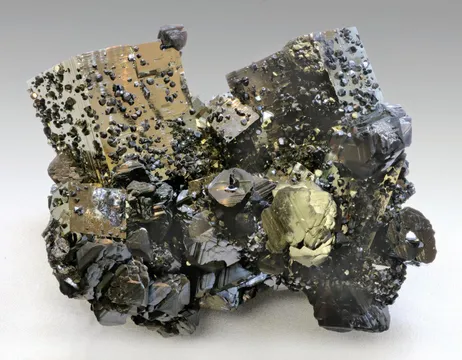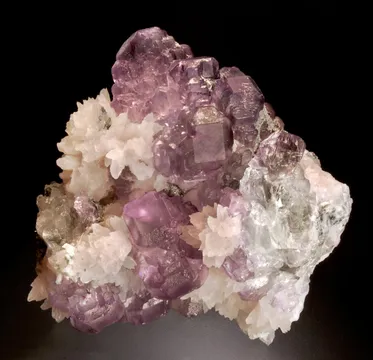
San Martín Mine, Peru: famed for rose-pink rhodonite blades set in calcite and quartz, in a high Andean skarn belt; a modern classic for collectors.
Key facts
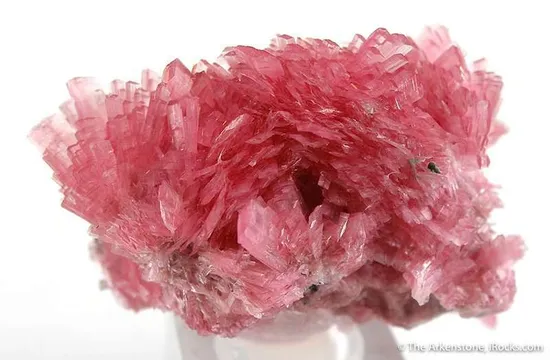
San Martín Mine is one of the deceptively small Peruvian localities whose importance is far larger than its footprint. Collectors know it above all for rhodonite: sharp, flattened, rose-pink to raspberry-red blades in delicate sprays, sheaves, and flower-like rosettes, commonly set against white calcite, colorless quartz, brassy pyrite, dark sphalerite, and, more rarely, bronze pyrrhotite. In the best pieces the blades are translucent to transparent at the edges, intensely colored without looking heavy or opaque, and separated enough that light can enter between the crystals. Those are the specimens that made the mine a modern classic.
The mine lies in the Chiurucu area of Huallanca District, Bolognesi Province, Ancash, on the high Andean skarn belt around the Hilarión system. This is Zn-Pb-Ag-(Cu) country: carbonate formations cut by intrusive rocks, altered to calc-silicate skarn and marble, then mineralized by sulfides. Rhodonite here is not a casual accessory; it belongs to the manganese-rich part of the metasomatic assemblage and appears in cavities and vein zones associated with the ore. That geological setting explains the characteristic San Martín look: pink Mn-silicate crystals partnered with sulfides rather than the massive ornamental rhodonite familiar from many other localities.
Regional View
Country View
San Martín specimens also carry a label story. Older pieces may be labelled “Chiurucu Mine,” “Chiuruco,” “San Martin,” “St. Martin,” Huánuco Department, Dos de Mayo Province, or Ancash/Bolognesi/Huallanca. The modern collector label generally uses San Martín Mine, Chiurucu or Chiuruco, Huallanca District, Bolognesi Province, Ancash, Peru. The confusion is understandable: the mine sits in a rugged borderland of high Andean mining districts, and the locality was marketed before the name San Martín became the dominant collector usage.

Photo: Wikimedia Commons / CarlesMillan
Search for specimens: View all specimens from San Martín Mine, Peru
San Martín is best understood as a small but specimen-important prospect or mine within the broader Huallanca–Hilarión mineralized belt. The surrounding district is dominated by Cretaceous carbonate rocks and intrusive bodies that produced skarn and carbonate-replacement style Zn-Pb-Ag-(Cu) mineralization. In the Hilarión system, the ore minerals are mainly sphalerite to marmatite and silver-bearing galena, with pyrrhotite, pyrite, magnetite, arsenopyrite, and locally chalcopyrite in the gangue. Alteration is zoned from hotter calc-silicate minerals near intrusive contacts into marble and more distal carbonate alteration. Rhodonite belongs to the manganese-rich calc-silicate side of this story.
The San Martín target has been described in the Hilarión exploration literature as a quartz-feldspar porphyry intruding the Jumasha Formation, with IP chargeability, mineralization in exploration tunnels and channel samples, and evidence of historical artisanal workings. Specimen literature narrows the collecting horizon still further: the rhodonite pockets were reported from veins along a contact between sphalerite ore and surrounding skarn. That is why so many specimens carry dark sphalerite or pyrite on the back, or show quartz and calcite perched among the pink blades.
Production information for San Martín as a standalone ore mine is sparse in collector sources, and it should not be confused with the large Hilarión resource itself. The broader property has a modern exploration history involving Mitsubishi in the late 1970s and Minera Hilarión, Compañía Minera Milpo, and Nexa Peru from the 1980s onward. Technical reports for the Hilarión project describe extensive exploration drilling and a proposed underground mining concept, while also noting that the Hilarión project property itself had no past production as of the 2020 technical report. San Martín’s mineral-specimen fame therefore rests not on tonnage, but on a few exceptional rhodonite-bearing openings in a skarn system otherwise explored for base metals.
For collectors, the key find history is compact. Deep pink bladed rhodonite from Chiurucu was known by 1989, enough to place Peruvian rhodonite in the serious collector conversation. Additional material appeared in 1998, but both early episodes were limited. The modern flood—if “flood” can be used for such fragile and finite material—came from pockets discovered in October 2006 and marketed heavily in 2007. Reports from the period describe several hundred specimens, from loose rosettes and thumbnails to a small number of large, elite pieces with transparent pink-red blades rising from matrix. Later dealer inventories and museum-style entries often date individual specimens to January, March, July, August, or September 2007, suggesting that the 2006 discovery and its immediate aftermath supplied much of the material collectors now see.
Collecting access today should be treated as closed in practical terms. San Martín is not a public fee-collecting locality; it is within an active Peruvian mining and exploration landscape, high in the Andes, on titled mining ground and community land. Any field collecting would require formal permission from the claim holder and local authorities, and the best known rhodonite pockets are long exhausted. Most available specimens today come from old dealer stocks, collection dispersals, and recycled material from the 2006–2007 finds.
San Martín rhodonite is prized for free-standing flattened blades rather than massive pink material: crystals commonly form sprays, subparallel sheaves, divergent rosettes, and compact “rose” aggregates, with individual blades often around millimetres to 2 cm and exceptional cabinet specimens reaching much larger overall size. The color ranges from medium rose-pink to vivid raspberry or red-pink, and the finest 2006–2007 pieces show transparent terminations and enough separation between blades to give a bright, airy architecture. Common associations are quartz, calcite, pyrite, and sphalerite, with pyrrhotite as a scarcer and highly desirable metallic accent; the best pieces combine strong saturated color, undamaged blade tips, clean contrast on white calcite or colorless quartz, and a stable matrix, while ordinary examples tend to be tighter, paler, more massive, or visibly bruised along the fragile edges.
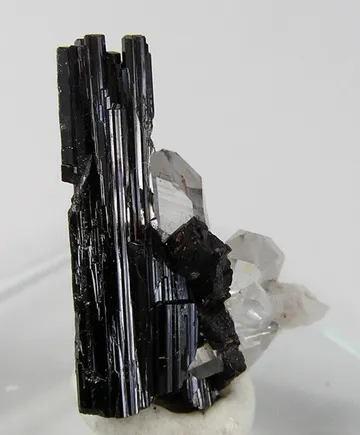
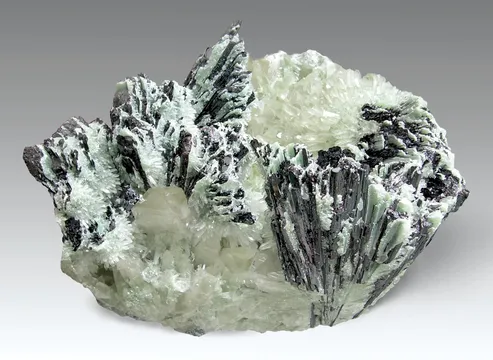
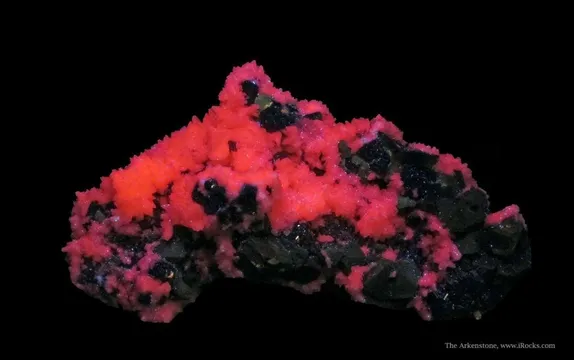
Other documented minerals from San Martín include alabandite, calcite, chalcopyrite, galena, pyrite, pyrrhotite, quartz, rhodochrosite, and sphalerite. There is no well-established type-locality mineral tied to San Martín in the collector record, but alabandite is an important rarity for the locality and fits the same manganese-rich chemistry that made the rhodonite famous. Sphalerite and galena represent the base-metal ore association; pyrite, pyrrhotite, quartz, and calcite are the minerals most often seen on rhodonite specimens. Rhodochrosite is recorded but is not the identity of the classic pink bladed material from San Martín—those collector specimens are rhodonite, not rhodochrosite.
The main authenticity issue is not a flood of documented fakes, but labelling. San Martín rhodonite has moved through the market under several names: Chiurucu Mine, Chiuruco Mine, San Martin Mine, St. Martin Mine, Huallanca, Huánuco, Dos de Mayo, Bolognesi, and Ancash. Some of this reflects real historical usage and boundary confusion rather than bad faith. A good label should preserve older provenance while also adding the current standardized locality: San Martín Mine, Chiurucu or Chiuruco, Huallanca District, Bolognesi Province, Ancash, Peru.
Condition is crucial. The crystals are thin, bladed, and commonly perched in open sprays, so even fine specimens often have tiny edge bruises, missing blade tips, or contact areas where the rosette separated from pocket wall or matrix. Use magnification to check whether the best crystals are complete at the terminations and whether a “loose rose” has been glued to matrix. Repairs are possible on delicate rhodonite, especially where crystals stand upright from calcite or quartz; they are not automatically disqualifying on a rare high-end piece, but they should be disclosed.
Color should be judged in hand and under neutral light. San Martín rhodonite is famous for an unusually vivid pink to red-pink, but the thin blades transmit light strongly and can look different under LED, fluorescent, halogen, sunlight, and dealer photography. Oversaturated photos can make mediocre specimens look better than they are. The strongest pieces hold good color even without backlighting and still show transparency at the tips or edges.
There are no widely documented treatments specific to San Martín rhodonite. Still, avoid ultrasonic cleaning, acids, or aggressive soaking: the rhodonite is cleavable and fragile, calcite matrix is acid-sensitive, and sulfide associations can be destabilized or tarnished by careless cleaning. Store specimens away from vibration and crowding; the best pieces should be mounted or boxed so no blade bears weight.
Market availability is steady but finite. Small thumbnails and miniatures from old stock still appear, sometimes at accessible prices, while sharp, saturated, matrix specimens with isolated blades and minimal damage are much less common. Large, open, aesthetic pieces from the 2006–2007 find are now modern classics and are usually seen through established dealers, auctions, and collection dispersals rather than fresh mining.
The most repeated San Martín story begins not in the Andes but in Tucson. In 2007, Luis Burillo’s room reportedly held a showcase glowing rose-pink with roughly 100 pieces from the new Peruvian find. A mine manager travelling with him explained that the old Chiurucu mine was now being called San Martín, a small sentence that forced collectors to revise labels already sitting in drawers and cabinets. The material had a history: the first deep pink bladed rhodonites had appeared in 1989, more had surfaced in 1998, and both times the supply vanished quickly. Then, in October 2006, several pockets opened in veins at the contact between sphalerite ore and skarn. About 400 specimens were said to have emerged, including around 40 large, superb pieces.
The ordinary pieces from that find were anything but dull. Many were loose, delicate rosettes—thumbsized to small miniature “roses” of pale to medium pink rhodonite, fragile enough that one could imagine them plucked from a stem. The best specimens were different: wide, flat, transparent pink to red blades to about 2 cm standing from matrix. A very small number carried sharp, lustrous, metallic-bronze pyrrhotite crystals to about 1 cm resting on the pink rosettes. By the time the Tucson reports circulated, the locality that had seemed exhausted was suddenly alive again, and the 2007 San Martín rhodonites were being spoken of as one of the show’s major mineral surprises.
A second story is quieter but just as important for collectors: the label problem. Hartmut Hensel raised the issue publicly in 2007 after buying a rhodonite from the “recent finds at San Martin Mine, Chiurucu.” He had assumed it was the same Chiurucu locality described earlier in print, only to find locality records pointing to different provinces and even different departments. Other collectors tried to untangle the geography: Ancash versus Huánuco, Bolognesi versus Dos de Mayo, Chiurucu versus Chiuruco, prospect versus mine. One participant finally reduced the matter to a collector’s truth: “A fine mineral deserves a correct label!” That line still applies. San Martín rhodonite is distinctive enough to recognize, but its historical labels need to be read with care rather than silently “corrected” into oblivion.
Mindat locality page: San Martín Mine, Chiurucu, Huallanca District, Bolognesi Province, Ancash, Peru — The most useful current locality summary, including the standardized modern locality, alternate Chiurucu name, mineral list, and photo gallery.
Mindat occurrence page: Rhodonite from San Martín Mine — Species-specific entry documenting San Martín rhodonite as a world-class occurrence, with associations based on the photo record.
Hyršl, Jaroslav and Rosales, Zolina. “Peruvian Minerals: An Update.” The Mineralogical Record, 34(3), 241–254, 2003. Listed in the Mindat reference record for Peruvian rhodonite and related Peruvian mineral discoveries.
Hyršl, Jaroslav and Rosales, Zolina. “Neue Mineralienfunde aus Peru” [New mineral discoveries from Peru]. Mineralien-Welt, 11(5), 23–31, 2000. Listed in the Mindat reference record for Peruvian rhodonite.
“Mines and Minerals of Peru.” The Mineralogical Record, 28(4), 1997. The Mineralogical Record index notes Chiurucu rhodonite as large groups of deep pink bladed crystals found in 1989, with coverage on pages P56–P57.
Moore, Thomas P. “What’s New in the Mineral World” — July 2007, The Mineralogical Record — Contemporary report on the 2006 San Martín rhodonite find and its impact on the 2007 market.
Moore, Thomas P. “What’s New in the Mineral World” — January 2008, The Mineralogical Record — Notes the San Martín, formerly Chiurucu, rhodonites among the “modern classics” circulating soon after the 2007 Tucson appearance.
Moore, Thomas P. “What’s New in the Mineral World,” Report 55, The Mineralogical Record — Discusses saved-up San Martín/Chiurucu rhodonite specimens, including associations with quartz, calcite, pyrite, and sphalerite.
Garay, E.; Guzmán, J. P.; Díaz, J.; and Mota-e-Silva, J. “Proyecto tipo CRD de Zn-Pb-Ag-(Cu) Hilarión, Ancash, Perú” — Geological summary of the Hilarión CRD/skarn system, including carbonate host formations, intrusive control, sulfide assemblage, and rhodonite in the high-temperature alteration suite.
Taco, Juan Carlos; Guzmán, Jean Paul; and Mota-e-Silva, Jonas. “Proyecto Hilarión, yacimiento tipo skarn de Zn-Pb-Ag-(Cu) en la franja Mesozoica de la cordillera Chaupijanca…” — Nexa Resources technical paper placing Hilarión, El Padrino, and nearby targets including San Martín within the Chaupijanca mineralized belt.
RPA / Nexa Resources S.A. “Hilarión Project, Project #3138 Technical Report NI 43-101,” February 14, 2020 — Technical report with ownership, exploration history, resource context, skarn model discussion, and specific notes on the San Martin target.
CarlesMillan, “Rhodonite with quartz, sphalerite and pyrite,” Wikimedia Commons — Well-documented specimen photograph with dimensions, associations, mass, and notes on the 2007 Chiurucu find.
“IRB1866 RHODONITE with PYRITE, San Martín Mine, Peru” — Crystal Classics — Short specimen video of San Martín rhodonite with pyrite, useful for seeing luster and color in motion.
“Rhodonite - Minerals For Sale - #9505512” — Weinrich Minerals — Dealer page with a specimen video link for a thumbnail of deep pink bladed rhodonite with minor quartz.
“RHODONITE - San Martin Mine, Chiurucu, Huallanca District, Bolognesi, Ancash, Peru” — Exposants Confines — Archived dealer media page for a 3.60 cm San Martín rhodonite specimen with video tab.
Mindat: San Martín Mine, Chiurucu, Huallanca District, Bolognesi Province, Ancash, Peru — Best starting point for the locality name, alternate names, mineral list, and gallery.
Mindat: Rhodonite from San Martín Mine — Species-focused page for the mine’s signature mineral and its documented associations.
The Mineralogical Record: July 2007 “What’s New” report — Contemporary collector-market account of the 2006 find and 2007 Tucson impact.
The Mineralogical Record: January 2008 “What’s New” report — Follow-up market note recognizing San Martín rhodonite as a modern classic.
The Mineralogical Record: Report 55 PDF — Later discussion of saved-up Chiurucu/San Martín specimens and their typical mineral combinations.
Nexa / RPA Hilarión Project NI 43-101 Technical Report, 2020 — Deep technical background on the surrounding Hilarión skarn system, ownership, exploration, and San Martin target.
INGEMMET PDF: “Proyecto tipo CRD de Zn-Pb-Ag-(Cu) Hilarión, Ancash, Perú” — Concise geological paper describing the Hilarión carbonate-replacement/skarn model and alteration assemblage.
INGEMMET PDF: “Proyecto Hilarión, yacimiento tipo skarn de Zn-Pb-Ag-(Cu)…” — Exploration-focused technical note placing San Martín among the targets of the Chaupijanca belt.
Wikimedia Commons: Rhodonite with quartz, sphalerite and pyrite from San Martín Mine — Freely licensed specimen photo with useful mineral associations and measurements.
Fabre Minerals rhodonite search results — Dealer archive showing multiple dated 2007 San Martín specimens and detailed descriptions of habit, color, associations, and size.