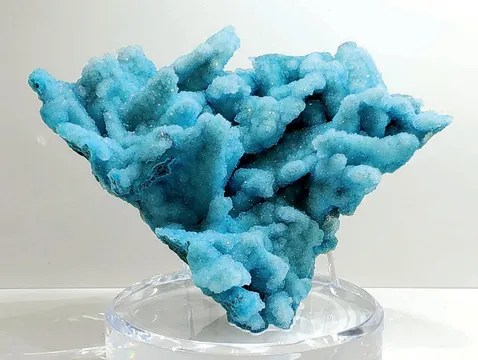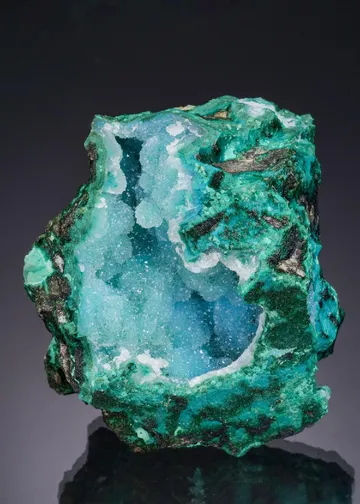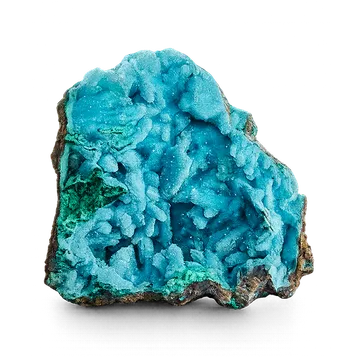
Chrysocolla from the Tenke-Fungurume area belongs to one of the most important modern copper-cobalt districts on Earth, and the best collector pieces show that pedigree immediately: saturated sky-blue to turquoise chrysocolla, commonly draped with glittering microcrystalline quartz, set against remnants of malachite-green, dark copper oxides, or pale carbonate matrix. The finest specimens are not simply color pieces; they are paragenetic puzzles, preserving earlier copper-carbonate forms as pseudomorphs and epimorphs. In the best-known modern style, bladed or tabular forms—usually interpreted as azurite at the start of the sequence, though barite or gypsum has also been suggested for some habits—were replaced first by malachite and then partly or wholly by chrysocolla, before a late silica event added a sparkling quartz skin.
Key facts
Chrysocolla from the Tenke-Fungurume area belongs to one of the most important modern copper-cobalt districts on Earth, and the best collector pieces show that pedigree immediately: saturated sky-blue to turquoise chrysocolla, commonly draped with glittering microcrystalline quartz, set against remnants of malachite-green, dark copper oxides, or pale carbonate matrix. The finest specimens are not simply color pieces; they are paragenetic puzzles, preserving earlier copper-carbonate forms as pseudomorphs and epimorphs. In the best-known modern style, bladed or tabular forms—usually interpreted as azurite at the start of the sequence, though barite or gypsum has also been suggested for some habits—were replaced first by malachite and then partly or wholly by chrysocolla, before a late silica event added a sparkling quartz skin.
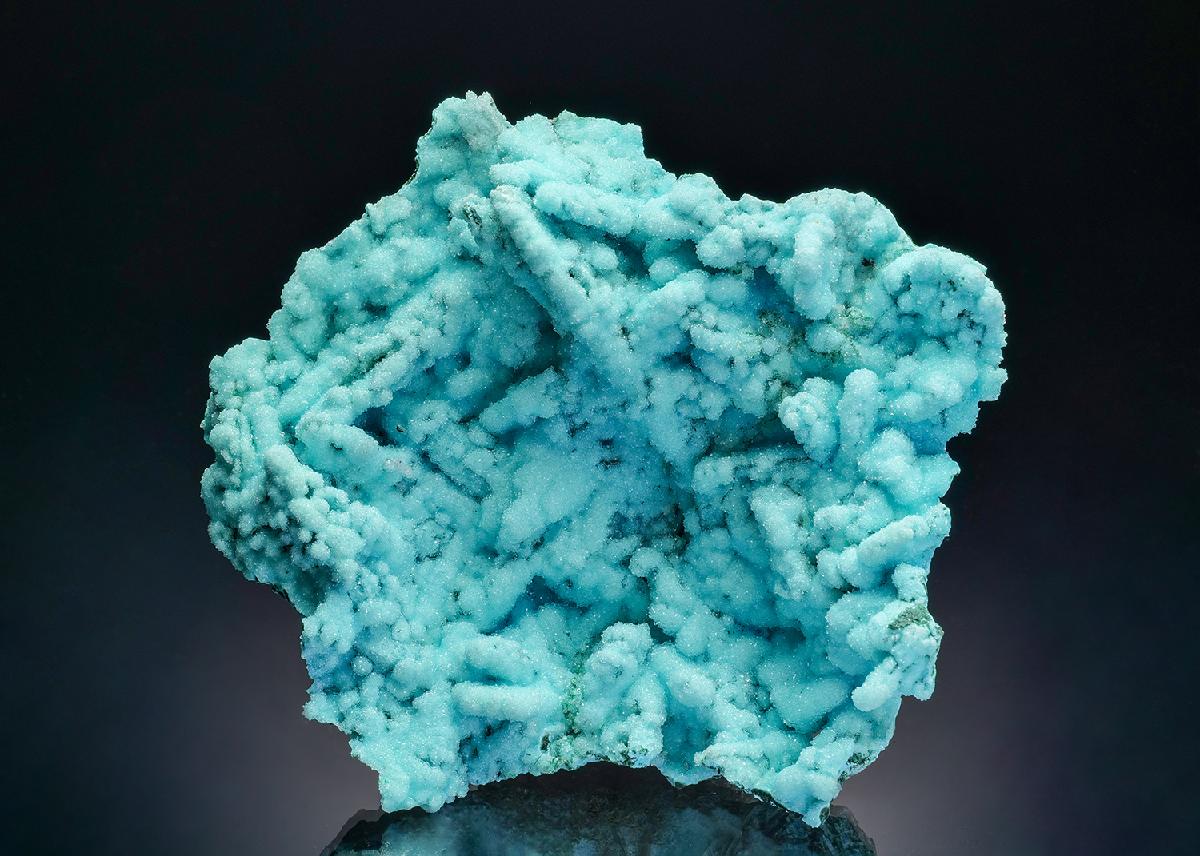
Photo: Crystal Classics
The district is part of the Central African Copperbelt, where copper-cobalt mineralization is hosted in Neoproterozoic sedimentary rocks of the Katanga Supergroup. At Tenke-Fungurume, the productive rocks are chiefly dolomitic shale, silicified dolomite, and related Mines Series units. Primary copper and cobalt sulfides—especially chalcocite, bornite, chalcopyrite, and carrollite—are overprinted near the surface by a supergene suite in which malachite, heterogenite, chrysocolla, brochantite, pseudomalachite, and related secondary copper minerals are important. Chrysocolla’s collector significance here comes from that oxidized and mixed-zone chemistry: copper released during weathering met silica-rich, variably leached host rocks, producing blue copper silicate as coatings, replacements, seams, and pseudomorphs.
For collectors, Tenke-Fungurume chrysocolla is at its best when the color is clean and luminous, the quartz druse is continuous and lively, and the specimen retains architectural form rather than collapsing into an amorphous blue crust. Cabinet-size examples can be dramatic, but small cabinet and miniature specimens with complete bladed groups, undamaged quartz “sugar,” and visible green malachite relics often carry more mineralogical interest than larger, less coherent pieces.
Search for specimens: View all chrysocolla specimens from Tenke-Fungurume Area, DR Congo
The Tenke-Fungurume area lies in Lualaba Province in the southern Democratic Republic of the Congo, within the Katanga Copper Crescent. Mindat treats it as a broad mining area rather than a single pit, with deposits and sublocalities including Tenke, Fungurume, Kansalawile, Mambilima, Kyaundji, and others. The area is commonly described as extending between Tenke hill and Fungurume hill, roughly a 30 km mineralized zone in the Kolwezi mining district.
Geologically, this is a sediment-hosted, stratabound copper-cobalt district in the Central African Copperbelt. The principal ore occurs in the Mines Series of the Roan Group, especially in dolomitic shale and silicified carbonate units. Two important ore-bearing horizons, commonly described in mine terminology as RSF and SDB, are separated by cellular silicified dolomite known as RSC. The district is structurally complicated: mineralized Mines Series blocks occur as fault-bounded tectonic slices or “écailles,” which can be richly mineralized, weakly mineralized, or barren over short distances.
The mineral zoning is strongly depth controlled. Near surface, leaching can produce a depleted cap; below that, the oxide zone is dominated by secondary minerals such as malachite, heterogenite, and chrysocolla, with accessory brochantite, pseudomalachite, libethenite, plancheite, cornetite, and others. At greater depth, mixed ores contain combinations such as chrysocolla, cuprite, native copper, cobaltoan dolomite, sphaerocobaltite, chalcocite, and relict oxide minerals. Deeper sulfide ore is dominated by chalcocite, bornite, chalcopyrite, and carrollite.
Large-scale modern production began in 2009, when the Tenke Fungurume project produced its first copper cathode. The mine has since become one of the world’s major copper-cobalt operations. It is an active industrial open-pit mining complex, not a public collecting locality. Collector specimens reach the market through Congolese mineral networks and international dealers, and precise pocket information is often absent or deliberately vague. That matters: “Tenke-Fungurume” is now widely used in the trade for attractive Congolese chrysocolla pseudomorphs, but the exact sublocality may be uncertain unless supported by strong provenance.
Notable specimen styles include quartz-coated chrysocolla after malachite after azurite, chrysocolla after malachite on earlier bladed forms of uncertain identity, and botryoidal to elongated chrysocolla growths with quartz and malachite. Dealer and collector records document waves of attractive material around 2020–2021, including large cabinet specimens with bladed forms to several centimeters, smaller miniatures with complete blue pseudomorphs, and quartz-drused pieces with intense, uniform blue color.
Tenke-Fungurume chrysocolla is typically non-crystalline in the strict mineralogical sense; its collector “crystal” forms are inherited. The most desirable specimens show chrysocolla replacing earlier minerals, preserving bladed, tabular, ridged, or cockscomb-like habits. Where the original precursor was azurite, the sequence is commonly described as azurite to malachite to chrysocolla, sometimes with green malachite visible in broken tips or recessed areas. Other specimens have been described as chrysocolla after malachite after barite, gypsum, or anhydrite, particularly where the forms are broader, more rounded, or evaporite-like rather than convincing azurite blades.
Color is the locality’s chief attraction. Fine examples range from pale robin’s-egg blue through vivid sky blue to turquoise. Green malachite remnants can create attractive contrast, especially where exposed along edges or in the core of pseudomorphs. Quartz druse is a major quality factor: a continuous coating of colorless microcrystals gives a sparkling, frosted luster that both enhances the blue and protects the softer chrysocolla underneath. Some specimens also show tan to brown iron-stained quartz selectively coating one side, adding natural zoning and pocket orientation clues.
Common forms include:
Documented specimen sizes range from miniatures around 3 cm across to cabinet pieces over 13 cm, with some large cabinet examples exceeding 17 cm. Individual pseudomorphed blades on recorded specimens reach several centimeters; one Mindat minID specimen notes replaced bladed crystals to at least 5.0 cm, while auction and dealer examples describe tabular forms and blades around 2–3.5 cm.
Associated minerals include malachite, azurite, quartz, cuprite, heterogenite, pseudomalachite, brochantite, cobalt-bearing calcite, cobalt-bearing dolomite, dolomite, calcite, chalcocite, bornite, chalcopyrite, carrollite, gerhardtite, paramelaconite, tenorite, and baryte. At the specimen scale, the most market-relevant associations are chrysocolla with malachite and quartz; at the deposit scale, chrysocolla belongs to the broader oxide and mixed-zone copper-cobalt assemblage.
Quality is judged by color saturation, completeness of form, sparkle, and paragenetic clarity. The strongest pieces have bright, even blue chrysocolla; crisp inherited morphology; intact drusy quartz without bruised tips; and enough green malachite or matrix contrast to make the replacement history readable. Dull, chalky, powdery, or abraded chrysocolla is much less desirable, even when the color is strong.
The chief authenticity issue for Tenke-Fungurume chrysocolla is locality precision. Because the area is broad and because Congolese specimen supply chains often protect exact sources, many pieces are labeled simply “Tenke-Fungurume area” or even “Tenke-Fungurume Mine.” That label may be accurate at the district level but still imprecise at the pocket or sublocality level. Serious collectors should preserve dealer labels, invoices, minID records, auction descriptions, and any earlier provenance.
The second issue is interpretation of the pseudomorph. Chrysocolla itself does not form sharp blades, so bladed “chrysocolla crystals” should be understood as replacements or coatings. Azurite is a plausible precursor for many tabular copper-carbonate forms, particularly where malachite is present as an intermediate replacement. But not every bladed or cockscomb habit can be assigned confidently to azurite; barite, gypsum, and anhydrite have all been proposed for some Tenke-style pieces. Descriptions that confidently name a three-stage pseudomorph should be weighed against the specimen’s morphology and any analytical or provenance support.
Condition matters greatly. Quartz-coated pieces are more durable than earthy chrysocolla, but they still chip along exposed ridges and tips. Micro-chipping is common on the projecting blades and on the highest points of the druse. Fresh chips may reveal green malachite cores, pale blue chrysocolla, or less attractive dark matrix. Look carefully for reattached blades, filled fractures, and mismatched quartz sparkle along repaired edges.
Treatments are a broader chrysocolla concern rather than a Tenke-only problem. Porous chrysocolla can be stabilized with resin, and very soft pieces may shed or dull if handled carelessly. A suspiciously plastic luster, darkened seams, chemical odor, or glossy pooling in recesses can indicate impregnation. Dyeing is less likely on quartz-drused pseudomorphs with complex natural zoning than on massive chalcedony or lapidary material, but unnaturally uniform electric blue in fractures should always be examined under magnification.
Market availability has been unusually good compared with many classic localities because modern Congolese finds have supplied miniatures, small cabinets, and cabinets over the last several years. That availability should not be mistaken for abundance of top quality. The best specimens—complete, architectural, richly blue, quartz-sparkled, and convincingly pseudomorphic—are selectively retained by collectors and can command strong prices, especially in larger cabinet sizes or with no recorded repairs.
The modern collector story of Tenke-Fungurume chrysocolla is partly a story of beauty and partly a story of uncertainty. The specimens arrived with the kind of visual drama that makes a market take notice: pale to electric blue blades, glittering quartz, malachite-green ghosts, and sculptural forms that looked crystalline but could not be chrysocolla crystals. The explanation became the hook. The blue forms were not original crystals at all, but replacements—sometimes described as chrysocolla after malachite after azurite, sometimes as chrysocolla after malachite after barite or gypsum. On the best pieces, the specimen itself tells part of the story: green malachite peeks through at broken tips, quartz sparkles over every ridge, and the blue skin preserves forms older than the mineral now visible on the surface.
One documented large cabinet specimen recorded through Mindat’s minID system captures the uncertainty perfectly. It measured 170 mm x 140 mm x 65 mm and was described as a late-2020 Congo find with sparkling blue chrysocolla replacing previous bladed crystals “of what were likely azurite or barite, even possibly gypsum.” The blades reached at least 5.0 cm. The same note observed that slight micro-chipping was present and typical of almost all such specimens. That is the sort of field-market detail collectors should remember: these are not abstract blue sculptures, but delicate replacement pieces whose highest ridges have often survived a rough journey from pocket to dealer tray.
The locality story is equally complicated. In a Mindat discussion about chrysocolla after gypsum, anhydrite, or barite from the DRC, Sue Marcus raised the central question collectors still ask: dealers were offering such material as “usually the Tenke area,” but could the locality be identified more precisely? The replies reflected a reality familiar to anyone who follows Congolese secondary copper minerals. Exact sources can be guarded closely by diggers, both to protect productive pockets and to preserve commercial advantage. One participant cautioned that “almost everything coming out of the Congo these days” was being labeled Tenke-Fungurume. The point is not that every label is wrong; it is that Tenke-Fungurume has become both a real district name and a convenient trade shorthand.
A Heritage Auctions lot from August 9, 2023 shows how this material crossed into the broader auction market. The specimen, labeled Tenke Mine, Tenke-Fungurume area, measured 7.8 x 6.6 x 3.7 cm and sold for $239. Its description emphasized three mineral generations: tabular azurite first, malachite replacement second, and chrysocolla third. The largest tabular crystal reached 2.2 cm. Minor bruising exposed green malachite cores in some tips, turning condition notes into paragenetic evidence.
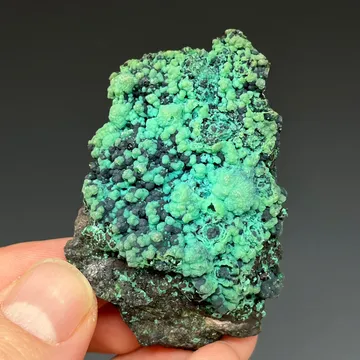
A Fabre Minerals video specimen from 2021 presented a different but related style: elongated botryoidal chrysocolla growths, intensely and uniformly blue, entirely covered by quartz microcrystals, on a matrix where quartz covered deep green-blue malachite microcrystals. The specimen measured 7.2 x 6.8 x 4.2 cm. That piece illustrates why the locality appeals beyond pseudomorph specialists. Even when the forms are botryoidal rather than bladed, the Tenke-Fungurume combination of blue copper silicate, green malachite, and sparkling silica has the cabinet presence collectors want from the best Katangan secondary copper minerals.