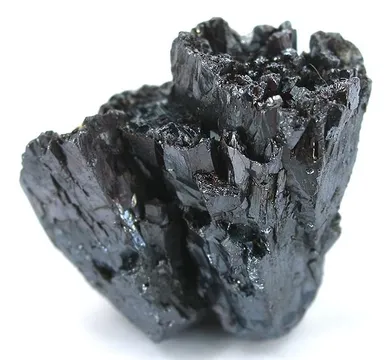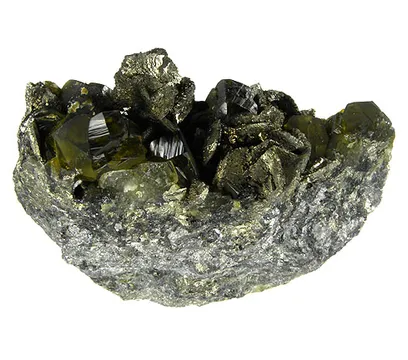
Tazna Mine, Bolivia - renowned locality for sharp ferberite and bismuthinite crystals, with arsenopyrite and quartz associations and a dramatic Andean setting.
Key facts
Tazna is one of the great Bolivian names for collectors who like their specimens sharp, heavy, metallic, and unmistakably Andean. The mine, more properly the Tazna or Tasna-Rosario mine on Cerro Tazna in Potosí Department, is a tungsten-bismuth-tin system in the southern Bolivian metallogenic belt, where hydrothermal veins cut hornfelsed sedimentary rocks around Tertiary intrusive and subvolcanic activity. In ore-deposit terms it is a compact but complex Sn-W-Bi district; in specimen terms it is a locality of jet-black ferberite twins, bright prismatic bismuthinite, marcasite-coated bismuth sulfides, greenish-brown siderite, sparkling arsenopyrite, and occasional phosphate and bismuth-arsenate rarities.
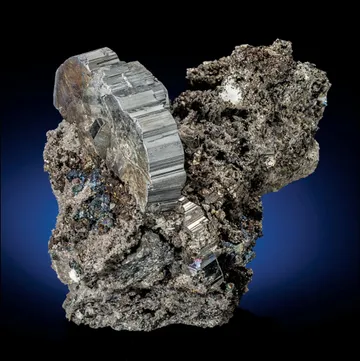
Collectors usually meet Tazna first through ferberite. The classic crystals are lustrous black blades and tabular twins, commonly on arsenopyrite or quartz, with a sculptural “butterfly” look that is quite unlike the quartz-rich ferberites of Panasqueira or many Chinese tungsten mines. The best Tazna pieces have three things at once: a complete, lustrous main twin; a matrix that proves the Bolivian association rather than a loose black blade; and enough openness to show the crystal form. Bismuthinite gives the locality its second personality: grey-white to darker metallic prismatic crystals, commonly with yellow-grey marcasite or pyrite-marcasite films, from a mine famous historically as a primary bismuth producer as well as a tungsten source.
Regional View
Country View
The setting is visually dramatic even before one looks underground. Cerro Tazna rises from the high country of southern Bolivia as a broad, glaciated hill in the Cordillera de Chichas, and older geological descriptions famously compare its form to a sleeping elephant. The productive veins and related workings are part of a district-scale system that includes named sectors such as Rosario, Farallón Viejo, Farallón Nuevo, Matilde, and others; for specimen labels, these names matter because some of the finest bismuthinite and augelite material is tied to particular veins and episodes of small-scale recovery.

Photo: Wikimedia Commons

Photo: Wikimedia Commons
Search for specimens: View all specimens from Tazna Mine, Bolivia
The Tazna Mine is located at Tasna Rosario on Cerro Tazna, in Cotagaita Municipality, Nor Chichas Province, Potosí Department, Bolivia. The modern Mindat locality position is near 20° 37′ 15″ S, 66° 11′ 35″ W, and the mine is part of the broader Atocha-Quechisla mineral region of southern Potosí. Labels may use Tazna, Tasna, Tasna-Rosario, Tazna-Rosario, Cerro Tazna, or Rosario section; all can be legitimate, but they are not always equally precise.
Geologically, Tazna belongs to Bolivia’s tin-tungsten-bismuth metallogenic province. The country’s classic tin belt is not simply a “tin” belt in specimen terms: tungsten, bismuth, silver, copper, gold, arsenic, antimony, lead, zinc, and a rich suite of sulfosalts and secondary bismuth minerals are all part of the story. At Tazna the principal collector minerals formed in hydrothermal veins that traverse hornfelsed rocks, especially altered Ordovician slates and related sedimentary units affected by intrusive or subvolcanic activity. The geological literature describes the system as vein-type tungsten mineralization in hornfels, with the Tazna district tied to a contact aureole around a probable Miocene-Pliocene granite intrusion. Bismuth-specialist literature further treats Tasna as one of the few historical primary bismuth-producing districts, with Sn-W-Bi-Ag-Pb-Zn and Bi-Cu-Sn veins over several square kilometres.
The mineral zoning is one reason Tazna specimens are so varied. Older descriptions distinguish zones and named workings with different metal emphases: Farallón Nuevo and Rosario WO2 for tungsten; Farallón Viejo and Banda Huasi for tin-bismuth; Rosario Ratoneria and Matilde for bismuth-tungsten; Colorada, Mariana, Eduarda, and Mary for tin; and Triunfo, Chita, and Alluta for antimony. Copper-gold values are noted especially around Rosario, while silver-lead values appear in other mine sectors. For a collector, that translates into sharply different hand specimens from the same mountain: black ferberite on arsenopyrite and quartz from the tungsten-rich portions; bismuthinite, native bismuth, and bismuth alteration minerals from the Bi-rich portions; and siderite, pyrite, quartz, cassiterite, and phosphate assemblages in the more complex vein pockets.
Mining at Tasna was already important before the modern specimen trade, but the most clearly documented recent history is tied to Bolivia’s state and cooperative mining system. COMIBOL, the Corporación Minera de Bolivia, was created in 1952 during the nationalization of the mines formerly controlled by the great tin groups. A 1992 Bolivian decree records that the Tasna mining center in Nor Chichas had been productively paralyzed for more than ten years despite being considered potentially rich in bismuth, wolfram, silver, gold, and copper, and approved a joint-risk agreement between COMIBOL and Compañía de Minerales Especializados S.A. for exploration, development, exploitation, beneficiation, and smelting. Cooperative mining then became central to the locality’s later story: the Cooperativa Minera Locatarios Tasna Ltda. was founded at “La Florida” in the Tasna Rosario mining section on April 3, 1986, with 36 miner members and one palliri member recorded at its first assembly. Later cooperative data list Locatarios Tasna as a producer of bismuth, wolfram, and tin.
Access today should be understood as mining access, not casual collecting access. Tazna is an active or intermittently active mining district, with cooperative workings, old adits, unstable underground openings, and mine waste affected by sulfide oxidation. Specimens reaching the market generally come through miners, local buyers, Bolivian dealers, or established international specimen channels rather than through recreational collecting. The most reliable pieces are those with old collection labels, dealer histories, or a vein/section name such as Rosario or Farallón Viejo when known.
Several specimen-producing episodes stand out. Ferberite specimens from a famous 1999 find produced display-quality groups with black crystals to around 4 cm on arsenopyrite and quartz. Another documented ferberite discovery in 2008 produced larger matrix pieces with sharp, lustrous tabular crystals to roughly 3.7 cm. Around the early 2000s, Tazna also released notable augelite with siderite, pyrite, and micro quartz, material regarded by dealers at the time as some of the first Bolivian augelite to appear in a long while. The great bismuthinite episode is tied to Farallón Viejo in 2001, when local searchers reportedly encountered a remarkable geode in a non-producing working; the best specimens from that pocket showed unusually large, well-formed bismuthinite crystals, many coated or partly coated by marcasite.
Tazna ferberite is the locality’s signature display mineral: metallic jet-black, heavy, bladed to tabular FeWO4 crystals, commonly twinned on the a face into “butterfly” or V-shaped forms and set on arsenopyrite, quartz, or marcasite-bearing matrix. Documented specimens from the famous 1999 find show lustrous crystals to about 4.0 cm on arsenopyrite with small gem quartz, while later 2008 material produced sharp tabular crystals to about 3.7 cm on crystallized arsenopyrite; other cabinet pieces show “flower”-like groups with ferberite crystals over 4 cm across. The very best Tazna ferberites are not merely black blades: they have crisp terminations, high metallic luster, balanced twinning, minimal bruising on edges, and enough matrix to show the classic Bolivian association rather than an isolated wolframite-group shard.
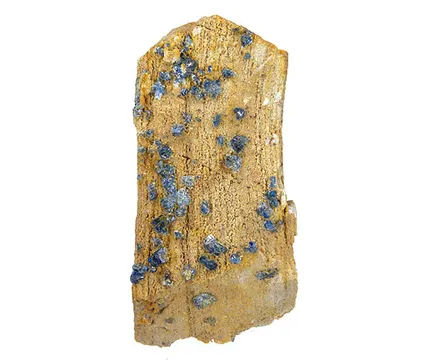
At Tazna, marcasite is most prized as the late metallic skin on bismuthinite rather than as free-standing cockscomb crystals: it commonly appears as yellow-grey, brassy, or subdued metallic botryoidal crusts and thin coatings on prismatic bismuthinite, especially in Farallón Viejo material from the 2001 bismuthinite find. Fine pieces can show a sharp grey-white bismuthinite core with marcasite concentrated on the top, rear, or prism edges, giving contrast without hiding the crystal; ordinary pieces are those in which the marcasite-pyrite film dulls or blankets the bismuthinite so thoroughly that form and terminations are lost. Because marcasite may be intergrown with pyrite here and both can form surface patinas, good labels and, for high-value specimens, analytical confidence matter.
Tazna bismuthinite is among the great crystallized bismuthinite occurrences, and its best specimens are unusually three-dimensional for a species more often seen as needles, felted masses, or embedded blades. The 2001 Farallón Viejo discovery produced brilliant to grey metallic, prismatic, commonly terminated Bi2S3 crystals, many partly or wholly coated by marcasite; published market records describe cabinet specimens with numerous well-defined crystals, main crystals around 2 cm in some matrix pieces, and other Tazna examples with crystals several centimetres long. The most desirable examples retain bright metallic bismuthinite faces, complete terminations, and individual crystals standing clear of the matrix or each other; a light marcasite patina can be attractive, but thick coating, dull oxidation, or broken peripheral needles quickly lowers the specimen’s grade.
Quartz at Tazna is the essential gangue and display partner rather than the headline species: it occurs as vein quartz, small gemmy crystals with ferberite and arsenopyrite, micro quartz with siderite-augelite-pyrite assemblages, and occasional smoky quartz associations. In the best ferberite specimens, small clear quartz crystals brighten the black metallic twins and confirm the hydrothermal pocket environment; in the augelite-siderite assemblage, micro quartz forms a sparkling base for greenish-brown siderite rhombs and pale augelite. The collector value of Tazna quartz lies in placement and association, so clean, undamaged, well-positioned crystals accompanying ferberite, siderite, augelite, or sulfides are far more significant than massive white vein quartz without crystallized ore minerals.
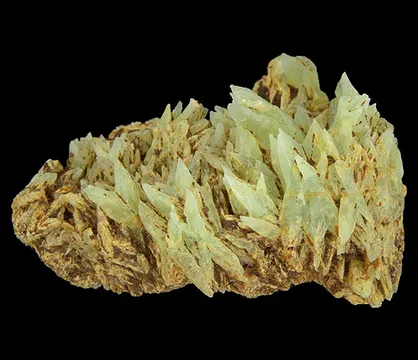
Tazna siderite is best known from the augelite-bearing assemblage, where it forms greenish-brown to brown compressed rhombohedra, sometimes layered, associated with gemmy augelite, pyrite, and micro quartz. Documented specimens show siderite rhombs to about 2.2 cm across, and the finest pieces are those where the siderite is sharp, lustrous, and arranged as a real matrix for the smaller augelite crystals rather than as a dull carbonate mass. Good Tazna siderite has a flattened, stacked, almost compressed look that contrasts well with tiny bright pyrite and pale augelite; mediocre pieces tend to be lumpy, iron-stained, or lacking the phosphate association that makes this material locality-specific.
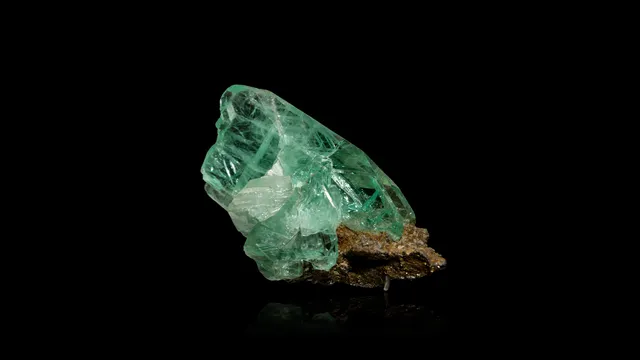
Tazna augelite appears as small but choice pale to colourless or faintly greenish, lustrous, gemmy crystals on siderite-rich matrix with pyrite and micro quartz, and it is one of the locality’s most attractive secondary collector assemblages. Early-2000s material brought Bolivian augelite back to the market after a long quiet interval, with documented Tazna specimens showing sharp crystals to about 8.5 mm associated with greenish-brown compressed siderite rhombohedra. The best examples are not large by species standards, but they are bright, clean, isolated enough to see, and aesthetically set on contrasting siderite; ordinary pieces carry only scattered microscopic augelite on a carbonate-pyrite matrix.
Beyond the headline species, Tazna is a rich locality for sulfides, sulfosalts, oxides, phosphates, and secondary bismuth minerals. Documented minerals include arsenopyrite, cassiterite, chalcopyrite, chalcocite, cosalite, jamesonite, pyrite, pyrrhotite, sphalerite, stannite, native bismuth, native gold, bismite, bismoclite, bismutite, atelestite, preisingerite, rooseveltite, russellite, ikunolite, Joséite-B, zunyite, topaz, woodhouseite, wavellite, vivianite, and reported metavauxite. The broader Cerro Tazna district is also mineralogically historic: daubréeite, BiO(OH), has its type locality at the Constancia mine on Cerro Tazna, and the old “taznite” material described from the same area is now regarded as an uncertain or impure bismuth arsenate rather than a secure modern species. Farallonite, named from the Farallón Mine on Cerro Tazna, is not an IMA-approved species and is best treated with caution on labels.
Tazna has one unusually specific authenticity warning: magnetite from Cerro Huañaquino has been deliberately sold with the wrong locality attribution “Tazna mine.” That matters because Tazna labels carry a premium, especially for classic Bolivian black metallic species. A black, lustrous, heavy specimen labelled “Tazna” should not automatically be accepted as ferberite; ferberite has a bladed to tabular wolframite-group habit and brownish-black streak, while magnetite has a different crystal habit and strong magnetism. For older tungsten labels, “wolframite” is also common; many Tazna collector specimens are properly ferberite-rich wolframite-group material, and good modern labels should say ferberite when the composition and habit justify it.
The most common honest labelling problem is geographic precision. Tazna, Tasna, Tasna-Rosario, Cerro Tazna, Rosario section, Farallón Mine, and Farallón Viejo vein may appear on different labels for related but not identical material. Preserve old labels exactly, but do not casually upgrade a general “Cerro Tazna” piece to “Tazna Mine, Rosario section” unless the chain of custody supports it. Bismuthinite from Farallón Viejo, augelite-siderite from Tazna, and ferberite from Rosario-style material each have distinct collector identities.
Condition is critical. Ferberite is heavy and brittle, with edges and terminations that chip easily; many otherwise fine twins have bruised blade edges or contacted backs. Bismuthinite crystals are softer-looking but fragile in practice, especially as slender prisms or divergent clusters; broken peripheral crystals are common. Marcasite coatings require dry storage. Any Tazna specimen with marcasite or pyrite-marcasite should be kept away from humidity, acidic boxes, and damp wooden cabinets; watch for powdering, sulfurous odor, orange-brown staining, white sulfate efflorescence, or loosening grains. Siderite can be cleaved or bruised, and augelite crystals are small enough that poor trimming, heavy cleaning, or careless brushing can remove much of the value.
No reliable, locality-specific fluorescence trait is important for Tazna collector specimens. The handling rule is instead chemical and mechanical: keep sulfide-rich pieces dry, do not wash marcasite-bearing bismuthinite, avoid ultrasonic cleaning, and be conservative with any powdery yellow, cream, or white bismuth oxidation minerals, since several are rare or analytically tricky. For rare bismuth tellurides, bismuth arsenates, phosphates, and secondary species such as zaïrite, atelestite, preisingerite, rooseveltite, and Joséite-B, visual identification alone is not enough for high-value transactions.
Market availability is uneven. Ferberite from Tazna appears regularly enough that patient collectors can choose for form and condition, but the best large matrix twins are not common. Bismuthinite is scarcer and more episode-driven, with excellent Farallón Viejo pieces prized because so many crystals are coated, broken, or dull. Augelite with siderite is genuinely limited and tends to move through the market as older-stock or collection pieces rather than continuous production. The best Tazna specimens are therefore bought as classics: they reward provenance, old labels, precise section names, and restraint in cleaning.
Cerro Tazna’s old geological portrait is hard to improve on: a high, bulky hill rising from the Altiplano, its northwest-southeast body shaped like a “sleeping elephant,” with abrupt flanks polished by glaciation. That image is more than picturesque. It explains why the mine feels like a mountain-scale object rather than a single adit. The ore is not one neat vein in one tidy wall rock; it is a district wrapped around a hornfelsed, folded, faulted hill, with the better tungsten, bismuth, and tin zones expressing themselves in different parts of the elephant’s body.
The bismuthinite story from Farallón Viejo has the feel of a classic Bolivian specimen find. The mine was not in normal production when local searchers encountered a remarkable geode in August 2001. From it came unusually large, well-formed bismuthinite crystals, many with marcasite coatings. Dealers who followed the find noted that most crystals were partly or totally covered by marcasite, making clean, bright bismuthinite faces the exception rather than the rule. That is why a specimen with intense luster, good terminal faces, and only limited marcasite is so memorable: it is not just a bismuthinite specimen, but a survivor from a pocket where nature mostly chose to varnish the prize.
The cooperative history adds another layer. On April 3, 1986, at 7:00 p.m., in the Tasna Rosario mining section at a place called La Florida, the Cooperativa Minera Locatarios Tasna Ltda. was founded. The first assembly recorded 36 miner members and one palliri, a woman ore sorter. That small founding scene sits behind many later Tazna specimens. Pieces that reach cabinets in Tucson, Munich, Sainte-Marie, or online marketplaces often began not as a specimen-mining project but as selective survival from hard, manual, cooperative extraction of wolfram, bismuth, and tin.
There is also a specimen-trade chapter connected with Bolivia’s opening to the international mineral market. Rock Currier collection material from Tazna, including bismuthinite with marcasite, is tied to Currier’s repeated travels in Bolivia and his role in helping bring Bolivian specimens into wider collector circulation. Those labels matter. A Tazna bismuthinite in an old Perky box, or a ferberite with a Currier, Bancroft, Noble, Lavinsky, Petrov, or other traceable history, is not merely an attractive mineral; it is part of the chain by which this difficult high-Andean district became a classic locality in modern cabinets.
I. Domeyko, “Sur une nouvelle espèce minérale,” Comptes Rendus de l’Académie des Sciences, Paris, vol. 82, p. 922, 1876. Original description associated with daubréeite from Cerro de Tazna; later work clarified the identity and distinction of the bismuth oxychloride/hydroxide material. URL: https://www.mindat.org/min-1229.html
I. Domeyko, “Sur un arséniate-antimoniate de bismuth de Tazna,” Comptes Rendus de l’Académie des Sciences, Paris, vol. 85, p. 955, 1877. Source of the old “taznite” name, now treated as uncertain and probably impure compact atelestite-like bismuth arsenate material. URL: https://www.rruff.net/doclib/MinMag/Volume_24/24-149-49.pdf
L. J. Spencer, “Notes on some Bolivian minerals (Jamesonite, Andorite, Cassiterite, Tourmaline, &c.),” Mineralogical Magazine and Journal of the Mineralogical Society, vol. 14, no. 67, pp. 308–344, 1907. Includes early documentation of minerals from Cerro de Tasna and other Bolivian localities. URL: https://rruff.geo.arizona.edu/doclib/MinMag/Volume_14/14-67-308.pdf
F. A. Bannister, “The crystal-structure of the bismuth oxyhalides,” Mineralogical Magazine, vol. 24, pp. 49–58, 1935. Discusses specimens labelled daubréeite from Cerro de Tazna in the Muséum National d’Histoire Naturelle, Paris, and the confusion among powdery bismuth minerals. URL: https://www.rruff.net/doclib/MinMag/Volume_24/24-149-49.pdf
N. N. Kohanowski, “Mines Magazine,” Colorado School of Mines, vol. 43, no. 2, pp. 17–24, 1953. Cited for farallonite from the Farallón Mine on Cerro Tazna; farallonite remains non-IMA-approved and should be treated cautiously. URL: https://zh.mindat.org/reference.php?id=15934980
A. Sugaki and coauthors, “Study on the ore minerals from the Bolivian tin deposits (II): Cassiterite and wolframite from the mines in the Potosí and Quechisla districts,” Science Reports of Tohoku University, 1980s. Includes Tasna among Quechisla district mines studied for cassiterite and wolframite chemistry, occurrence, assemblages, and X-ray data. URL: https://www.researchgate.net/publication/321825162_STUDY_ON_THE_ORE_MINERALS_FROM_THE_BOLIVIAN_TIN_DEPOSITSIIyiCASSITERITE_AND_WOLFRAMITE_FROM_THE_MINES_IN_THE_POTOSI_AND_QUECHISLA_DISTRICTS-
H. R. Willig and E. Delgado, 1985, cited in USGS tungsten summaries for the Tazna tungsten deposit. Tazna is listed as a vein deposit in hornfels, with a bismuthinite-wolframite-cassiterite-stannite-pyrrhotite-pyrite-gold-quartz-chalcopyrite-sphalerite assemblage and described as an important bismuth producer. URL: https://pubs.usgs.gov/circ/0930/o/pdf/c930-o.pdf
Bill Smith, Carol Smith, and Alfredo Petrov, “A Guide to Mineral Localities in Bolivia,” The Mineralogical Record, vol. 32, no. 6, pp. 457–482, 2001. A key collector-oriented locality guide, cited by Mindat for Cerro Tazna and Farallón bismuthinite occurrences. URL: https://www.mindat.org/locentries.php?m=686&p=319610
Selby and others, and later bismuth economic-geology summaries, discuss the Tasna district as a rare historical primary bismuth producer with Sn-W-Bi deposits such as Rosario, Matilde, Farallón Nuevo, and Belén. URL: https://doi.org/10.1016/j.oregeorev.2022.104722
Mindat records for daubréeite list type material preserved at the Geowissenschaftliches Zentrum, Georg August Universität Göttingen; the Muséum National d’Histoire Naturelle, Paris; and the École Nationale Supérieure des Mines, Paris. URL: https://www.mindat.org/min-1229.html
Mindat: Tazna Mine locality page — The core locality record for coordinates, alternate names, commodity list, species list, and the important mislabel warning about Cerro Huañaquino magnetite.
Mindat: Cerro Tazna district page — Useful for the broader Cerro Tazna mineral inventory, including district-level bismuth species and rare-mineral records.
Wikimedia Commons: Tazna Mine category — A compact image archive of Tazna ferberite, augelite, siderite, bismuthinite, and related specimen photographs, many by Rob Lavinsky.
Wikimedia Commons: Ferberite from Tazna Mine — A well-documented 12.0 x 8.8 x 6.7 cm specimen from the famous 1999 Tazna ferberite find.
Wikimedia Commons: Augelite and siderite from Tazna Mine — A documented augelite-siderite-pyrite-quartz specimen showing the early-2000s Tazna phosphate assemblage.
Fabre Minerals: Bismuthinite from Farallón Viejo, Cerro Tazna — Dealer archive documenting the 2001 Farallón Viejo bismuthinite find and the common marcasite coating on Tazna bismuthinite.
USGS Circular 930-O: International Strategic Mineral Issues Summary Report — Tungsten — Places Tazna among major tungsten deposits and summarizes its vein type, hornfels host rock, and ore assemblage.
Geological Society of Malaysia PDF: Tin Deposits, Bolivia — Includes a concise geological description of Tasna as a high glaciated hill with Ordovician slates, hornfels, quartz porphyry, and zoned tin-tungsten-bismuth veins.
Bolivian Supreme Decree 23026, 6 January 1992 — Primary legal source documenting the COMIBOL-COMINESA joint-risk contract and the state view of Tasna’s bismuth, wolfram, silver, gold, and copper potential.
Gestión de cuencas mineras PDF — Useful context on mining and water-management issues around Tasna, including Buen Retiro processing and cooperative activity.
Cooperativa Minera Locatarios Tasna dataset — Reference for the cooperative’s registration, membership, and listed production of bismuth, wolfram, and tin.
RRUFF: Bannister on bismuth oxyhalides and daubréeite — Essential for understanding daubréeite, old Tazna bismuth-mineral labels, and the historical confusion around powdery bismuth minerals.
Mindat: Daubréeite mineral page — Current mineralogical summary for daubréeite, including type locality, type material, formula, and preservation institutions.
Mindat: Zaïrite from Tazna Mine — Analytical occurrence record for zaïrite from Tazna, with Raman and SEM-EDS confirmation.